


Understanding cervicovertebral angle in simple terms:
If you walk into a physiotherapy clinic with neck pain, one of the first things we quietly observe is not just where it hurts, but how you hold your head.
Most people are surprised when I tell them this, but your head position often explains your symptoms before you even describe them.
This is where the cervicovertebral angle comes in. It is not just a measurement. It is a reflection of how your body has adapted to your daily life.
Read about our Complete Neck Pain Guide : Causes, Symptoms, Exercises and Treatment
Quick Answer
The cervicovertebral angle (CVA) is a simple way to assess your neck posture. A value above 50 degrees is generally considered normal, while a lower angle indicates forward head posture. A reduced CVA is commonly associated with neck pain, headaches, and muscle imbalance. With proper physiotherapy exercises and posture correction, it can be improved over time.
Read about: Early Signs of Cervical Spine Damage You Should Never Ignore
Key Takeaways
- Cervicovertebral angle helps measure forward head posture objectively
- A CVA below 45 degrees usually indicates poor neck alignment
- Forward head posture increases strain on neck muscles and joints
- It is linked with neck pain, headaches, and upper back discomfort
- Posture correction requires both exercises and daily habit changes
- Consistency is more important than intensity for long-term improvement
- Small daily adjustments can significantly improve your posture over time
Read: What Is Spurling’s Test And How To Perform
What Is the Cervicovertebral Angle
The cervicovertebral angle, commonly called CVA, is used to assess forward head posture in a simple and objective way.
It is formed by:
- A horizontal line through the C7 vertebra
- A line connecting C7 to the tragus of the ear
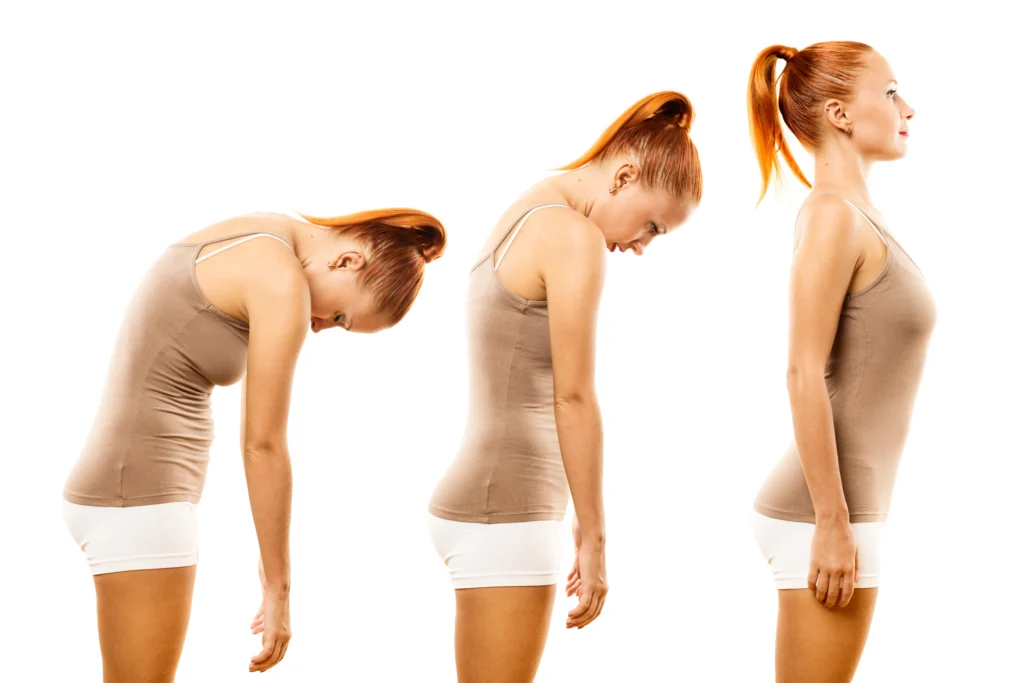
In practical terms, it shows how far forward your head sits relative to your spine.
A larger angle suggests better alignment. A smaller angle indicates forward head posture.
Read: Lhermitte’s sign- An Electic Shock Sensation Down The Neck
Normal Values and What They Mean
In most clinical settings, we interpret CVA like this:
- Above 50 degrees suggests good posture
- Between 45 to 50 degrees indicates mild forward head posture
- Below 45 degrees reflects more significant deviation
These values are not absolute. What matters more is how the angle relates to your symptoms and how it changes over time.
Read: How to Fix Sagging,Ozempic Neck After Rapid Weight Loss
Why Physiotherapists Pay Close Attention to CVA
In practice, CVA helps us do something very important. It allows us to track posture objectively.
Instead of saying “your posture looks better,” we can measure improvement.
But more importantly, CVA gives insight into how your muscles are functioning.
Research has shown that individuals with forward head posture demonstrate altered activation of deep cervical flexors and superficial neck muscles. (Falla et al. 2004)
This imbalance is one of the key drivers of persistent neck discomfort.
Learn how posture affects neck pain and correction exercises in our article on Simple Posture Correction Exercises for Forward Head Posture
CVA Is Not Just About the Neck
One of the biggest misconceptions is that this is only a neck issue.
In reality, changes in cervicovertebral angle influence the entire body.
Recent research has shown that forward head posture affects balance and walking mechanics by shifting the center of gravity forward. (Kim et al. 2025)
In clinic, this explains why some patients report:
- Early fatigue while walking
- A sense of instability
- Discomfort in areas far from the neck
The body compensates silently, often without obvious warning signs.
Read : How to Treat Neck Pain in Ankylosing Spondylitis
What Causes a Reduced Cervicovertebral Angle
It is rarely just one factor. It is usually a combination of habits and muscle behavior.
Prolonged Screen Use
Phones and laptops encourage a forward head position for long durations. Over time, this becomes your default posture.
Read in detail: Neck Pain from Phone Use? Here’s How to Treat Text Neck Syndrome
Weak Deep Cervical Flexors
These muscles are small but essential for maintaining alignment.
When they are not functioning well, larger muscles take over, often inefficiently. (Jull et al. 2008)
Tight Upper Trapezius and Levator Scapulae
These muscles become overactive and maintain the head in a forward position.
Thoracic Kyphosis
A rounded upper back pushes the head forward as a compensatory mechanism.
Read about: What Is Military Neck Or Cervical Kyphosis And How To Treat It
Sedentary Lifestyle
Lack of movement reduces postural awareness and muscle activation.
Lesser Known Factor: Helmet Load and Commuting
An interesting recent observation comes from studies on bike riders.
Long durations of riding, combined with helmet weight, can influence head positioning and reduce CVA. Reddy et al. 2024)
This is particularly relevant in daily commuters.
Also Read : Neck Cracking: Benefits, Risks, and the Truth About Stroke
Symptoms Linked With Poor CVA
Most people do not recognize posture as the root cause.
They usually report:
- Persistent neck stiffness
- Headaches, especially by evening
- Shoulder tightness
- Upper back discomfort
- Fatigue during desk work
Forward head posture has been consistently associated with increased neck pain intensity. (Lau et al. 2010)
Read more: Cervical Myelopathy: The Hidden Neck Condition Affecting Your Walking
What I Notice in Real Patients With Low CVA
In practice, patients rarely come in saying they have forward head posture. They usually talk about discomfort, not alignment.
Over time, certain patterns become very predictable.
Here are a few things I commonly observe:
- People tend to rub the base of their neck or upper shoulders without realizing it
- There is often a habit of leaning forward while listening or working, even when sitting on a chair with support
- Many patients say their neck feels fine in the morning, but heaviness builds up as the day progresses
- When asked to sit straight, they can correct posture briefly, but cannot sustain it for more than a few seconds
- Some individuals report a vague feeling of fatigue or mental tiredness, which improves slightly after posture correction
One subtle sign that stands out is this:
When someone tries to sit upright, instead of gently aligning their head, they often overcorrect by lifting the chin, which actually increases strain.
This tells us that the issue is not just strength, but awareness and control.
Read about : What is Cervical Facet Joint Pain, how it causes cervicogenic headaches and how to correct it naturally
The Link Between CVA and Headaches
There is a strong connection between posture and headaches.
Forward head posture keeps neck muscles in a constant state of low-grade contraction.
Over time, this contributes to tension-type and cervicogenic headaches. (Watson and Trott 1993)
Read: Pain in the Back Side of the Neck: Causes and Treatment
CVA and Your Body’s Internal Balance System
This is something many people are not aware of.
Your neck plays a role in proprioception, which is your body’s ability to sense position and movement.
When the head stays forward for prolonged periods, this system becomes less efficient.
Recent findings suggest that reduced CVA is associated with altered proprioception and even mild dizziness in some individuals. (El-Gohary et al. 2025)
Patients often describe this as feeling slightly off rather than clearly dizzy.
Read about: What is Turkey Neck And How To Fix It Naturally
How CVA Is Measured
In clinical practice, measurement is usually done through:
- Side-view photographic analysis
- Digital posture assessment tools
- Occasionally, manual methods
CVA is considered a reliable measure when done correctly. (Rathod et al. 2017)
However, we focus more on trends rather than a single reading.
Read more: Is Cervical Traction For Neck Pain Really Effective
A Simple but Powerful Insight: Your Head Feels Heavier
When the head moves forward, the load on the neck increases significantly.
At neutral posture, the head weighs around 4.5 to 5 kg.
With forward positioning, the effective load increases several times. (Hansraj 2014)
This explains why even mild posture changes can cause fatigue.
Read : Chiropractic for Neck Pain: Does It Really Work?
Muscle Imbalance Behind a Reduced CVA
From a clinical perspective, this pattern is quite consistent.
Tight muscles:
- Upper trapezius
- Levator scapulae
- Sternocleidomastoid
- Pectorals
Weak muscles:
- Deep cervical flexors
- Lower trapezius
- Rhomboids
This pattern is commonly referred to as upper crossed syndrome.
Read in detail about: How to Fix Upper Crossed Syndrome Naturally
Improving Cervicovertebral Angle: What Actually Works
One important thing to understand is that posture correction is not just about strengthening muscles.
It is about retraining movement patterns.
Recent research has shown that combining exercise with motor control training leads to better improvements in CVA. (Lee et al. 2024)
Read about: Effective Neck Pain Exercises At Home: A Complete Guide to Relief and Improved Mobility
Key Exercises That Help
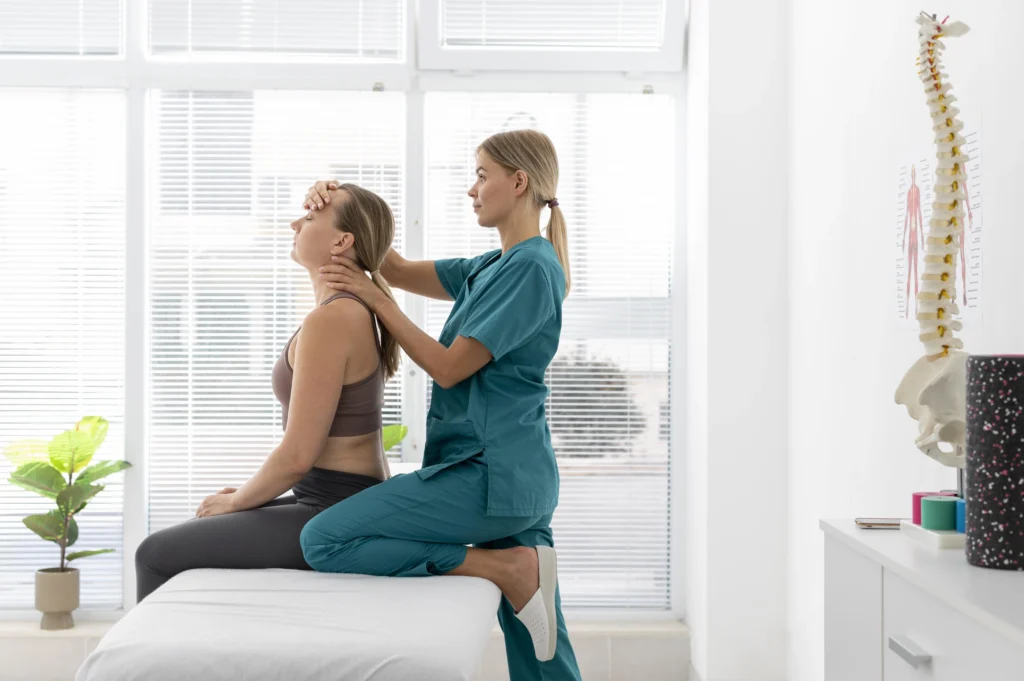
Chin Tucks
Activates deep cervical flexors and restores alignment.
Learn: How to do Chin Tucks for Neck Pain Relief and Posture Correction
Thoracic Extension
Improves upper back mobility, allowing the head to come back naturally.
Scapular Retraction
Stabilizes the shoulder girdle and reduces forward pull.
Pectoral Stretch
Releases tight anterior structures.
Read about: Which Is The Best Sitting Posture To Avoid Neck Pain And How To Achieve It
Why Exercises Alone Are Not Enough
This is something I often explain to patients.
You can do exercises for 20 minutes a day, but if your posture is poor for the remaining 10 hours, progress will be limited.
Posture is a habit.
Correction requires:
- Frequent awareness
- Small adjustments
- Consistency over time
Learn About: The Ultimate Neck Stretch Routine for Desk Workers in 2026
Daily Habits That Make the Biggest Difference
- Keep screens at eye level
- Bring your phone up instead of bending your neck
- Sit with proper back support
- Take regular movement breaks
- Avoid long static positions
These small changes often produce better results than intensive exercise programs alone.
Read in detail: Best Desk Setup to Reduce Neck and Back Pain
How Long Does It Take to Improve CVA
In most cases:
- Initial changes can be seen in 4 to 6 weeks
- More noticeable improvement occurs in 8 to 12 weeks
Consistency is the key factor.
Read About: Best Sleeping Position for Neck Pain: A Physiotherapist’s Complete Guide
When You Should Seek Help
Consider consulting a physiotherapist if:
- Pain persists despite self-care
- Headaches are frequent
- Neck movement is restricted
- Symptoms are progressively worsening
Read About: How to Choose the Right and Best Pillow for Neck Pain
Final Thoughts
The cervicovertebral angle gives us a window into how your body is adapting to your lifestyle.
It is not just about posture. It reflects muscle balance, movement efficiency, and even how your nervous system is functioning.
In practice, the biggest improvements come from simple, consistent changes rather than complex interventions.
Your posture is not fixed. It is something your body learns.
And anything that is learned can be relearned.
Also Read: Ultimate 6 Weeks Neck Rehabilitation Exercises For Pain Relief
Frequently Asked Questions
1. What does cervicovertebral angle measure?
The cervicovertebral angle measures forward head posture and shows how your head is positioned relative to your cervical spine.
2. What is a normal cervicovertebral angle?
A normal cervicovertebral angle is typically above 50 degrees, indicating proper head and neck alignment.
3. What is considered a low cervicovertebral angle?
An angle below 45 degrees is considered low and is commonly associated with forward head posture.
4. Can cervicovertebral angle be improved?
Yes, it can be improved with physiotherapy exercises, posture correction, and consistent daily habits.
5. Is cervicovertebral angle related to neck pain?
Yes, a reduced cervicovertebral angle increases strain on neck muscles and is often linked with neck pain and stiffness.
6. How is cervicovertebral angle measured?
It is measured using a side-view assessment by identifying the C7 vertebra and the tragus of the ear to calculate the angle.
7. Can forward head posture affect balance?
Yes, forward head posture can disrupt body alignment and affect balance, coordination, and movement efficiency.
8. Do I need physiotherapy for poor posture?
If symptoms like pain, stiffness, or headaches persist, consulting a physiotherapist is recommended for proper assessment and treatment.
Stay tuned with us for more health related topics.
Follow us on LinkedIn and Instagram for more.
More Read


Medical Disclaimer!
This article has been reviewed and written under the guidance of our Head Physiotherapist, Dr. Kruti Raj (PT, MUHS,CPT,CMPT). The information shared is intended for educational purposes only and should not be considered a substitute for personalized medical advice, diagnosis, or treatment.
Please consult us or any other qualified healthcare professional before beginning any exercise program, especially if you are experiencing pain, recovering from injury, or managing a medical condition.


