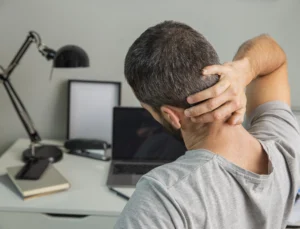
Atlantoaxial osteoarthritis refers to degeneration of the joint between the first cervical vertebra (atlas) and the second cervical vertebra (axis).
This joint is responsible for a large part of head rotation, especially when you turn your head side to side.
In clinical practice, this condition is often overlooked.
Many patients are told they have general cervical spondylosis or muscle strain, but the pain is actually coming from the uppermost segment of the neck.
What makes this joint unique is not just its location but its function. Nearly half of cervical rotation happens here.
When this joint starts degenerating, even simple activities like reversing a car or checking traffic can become uncomfortable.
Read about our Complete Neck Pain Guide : Causes, Symptoms, Exercises and Treatment
Quick Answer
Atlantoaxial osteoarthritis affects the upper cervical joint (C1-C2) and often causes pain at the base of the skull, headaches, and difficulty turning the head. Targeted physiotherapy focusing on posture, stability, and controlled movement is the most effective way to manage symptoms.
Read about: Early Signs of Cervical Spine Damage You Should Never Ignore
Key Takeaways
- Atlantoaxial joint contributes significantly to neck rotation
- Common symptoms include base of skull pain and headaches
- Muscle health and control play a key role in this condition
- Generic neck exercises may not be effective
- Posture and daily habits strongly influence recovery
Read about : 15 Common Causes of Neck Pain You Should Know
Why This Joint Deserves More Attention
The atlantoaxial joint is built for mobility, not load bearing.
Its horizontal orientation allows smooth rotation, but it also makes it vulnerable when posture is poor.
With prolonged forward head posture, the load shifts upward. Over time, the upper cervical joints take more stress than they are designed to handle.
This leads to gradual cartilage wear, joint irritation, and eventually osteoarthritis.
Many patients I see are surprised when their upper neck is the source of their headache or stiffness.
They usually expect the problem to be lower down.
Read in detail about: Cervical Disc Degeneration: The Hidden Cause of your Neck Pain

What Recent Research Says
Recent studies have added depth to our understanding of this condition.
Prevalence increases with age and may range from about 5 percent in the sixties to nearly 18 percent in older populations.
A 2025 study reported an overall prevalence of around 11.6 percent, suggesting that the condition is more common than previously thought. (Zhang et al., 2025)
What is interesting is that not all cases are symptomatic.
Many people have degenerative changes but do not report pain, while others have significant symptoms with minimal imaging findings.
Another important finding is the role of muscle quality. Fatty infiltration of the obliquus capitis inferior muscle has been associated with atlantoaxial osteoarthritis.
This indicates that the condition is not just about joint wear but also about muscle health and control. (Zhang et al., 2025)
There is also evidence suggesting that ossification of upper cervical ligaments can contribute to increased mechanical stress at the C1 to C2 level.
Read about: Cervical Ligament Injury or Neck Ligament Tear
A Lesser Known Mechanism
One aspect that often goes unnoticed is how pain is referred.
The upper cervical region shares neural connections with the head through the greater occipital nerve.
Because of this, irritation at the atlantoaxial joint can present as headaches rather than localized neck pain.(Bogduk, 2003)
This is why many patients describe pain at the base of the skull that spreads upward. It is not just a muscle problem. It is a joint and nerve interaction.
Read in detail about: What is Cervical Spondylosis? The Truth Behind Chronic Neck Pain
Symptoms
Atlantoaxial osteoarthritis rarely presents in a textbook way.
Patients often describe:
- Pain at the base of the skull rather than the lower neck
- Stiffness more on one side
- Discomfort while turning the head, especially in one direction
- A blocked or restricted feeling instead of sharp pain
- Headaches triggered by posture rather than stress
Some also report mild dizziness or eye strain, which can be linked to altered proprioception in the upper cervical spine. (Falla et al., 2018)
Read: Lhermitte’s sign- An Electic Shock Sensation Down The Neck
Conditions That Can Feel Similar
Not every pain at the base of the skull is atlantoaxial osteoarthritis. In clinic, a few conditions often overlap and can confuse both patients and practitioners.
It is important to recognise when the pattern does not fully match.
Some commonly overlapping conditions include:
Occipital neuralgia
Pain tends to be sharper, electric, and more sensitive to touch along the scalp
Upper cervical disc issues
Less common, but may present with deeper, more constant pain and occasional neurological symptoms
Read more: Cervical Disc Bulge: Causes, symptoms and treatment
Cervicogenic headache
Often posture-related, but may not always involve the C1–C2 joint specifically
Read about : What is Cervical Facet Joint Pain, how it causes cervicogenic headaches and how to correct it naturally
Inflammatory conditions like rheumatoid arthritis
Usually associated with morning stiffness, multiple joint involvement, and systemic symptoms
Read more: Rheumatoid Arthritis Neck: Causes, Symptoms and Treatments
Vertebrobasilar insufficiency (rare but important)
Symptoms like dizziness, visual disturbance, or nausea with neck movement should never be ignored
Read more: Cervical Vertigo Explained: Why Neck Pain Make You Feel Dizzy
When to Seek Immediate Attention
While most cases are mechanical, certain signs need urgent evaluation:
- Sudden severe dizziness with neck movement
- Double vision or difficulty speaking
- Unexplained weakness or numbness
- Loss of balance
These are not typical of osteoarthritis and should be assessed promptly.
Read more: Cervical Myelopathy: The Hidden Neck Condition Affecting Your Walking
How It Is Diagnosed
Diagnosis requires more than just imaging.
While CT scans can show degenerative changes at the atlantoaxial joint, clinical assessment remains the most important part.
This includes:
- Assessing rotation range and quality
- Palpating the upper cervical region
- Identifying muscle tightness and trigger points
- Observing movement patterns during functional tasks
It is important to correlate imaging findings with symptoms.
Many people show degeneration without pain, and treating the scan instead of the patient can lead to poor outcomes. (Bogduk, 2003)
Read about: What Is Cervical Myofascial Pain Syndrome And How To Relieve Trigger Points
Why Standard Neck Treatments Often Fall Short
A common frustration among patients is that they have already tried exercises but still have symptoms.
This usually happens because the exercises are too general.
Atlantoaxial osteoarthritis is not just about stiffness. It involves:
- Poor segmental control
- Muscle imbalance
- Reduced proprioception
- Subtle instability in earlier stages
General stretching or strengthening does not address these specific issues.
Read: Spasm In Neck: What Causes It & How to Fix It Fast
A Simple Self-Check You Can Try at Home
This is not a diagnosis, but it can give you a useful indication.
Sit comfortably and try the following:
Step 1: Gentle Head Rotation
Slowly turn your head to one side.
- Does the restriction feel very high up in the neck
- Is one side clearly more limited than the other
Step 2: Support Your Head
Now place your hand lightly under your chin or head and repeat the movement.
- Does it feel slightly easier or less painful
This may suggest reduced muscular support in the upper cervical region.
Step 3: Check for Headache Reproduction
Gently press at the base of your skull.
- Does this reproduce your typical headache
If yes, the upper cervical joints may be involved.
Read: Pain in the Back Side of the Neck: Causes and Treatment
What This Means
If your symptoms match these patterns, there is a higher chance that your pain is coming from the atlantoaxial region rather than the lower neck.
But keep in mind, this is only a screening guide. A proper clinical assessment is always more accurate.
Read: Neck Pain When Looking Up: What It Really Means and How to Fix It
Physiotherapy That Actually Helps
A more targeted approach tends to work better.
Deep Cervical Flexor Training
These muscles help stabilize the upper cervical spine.
Gentle activation, often through controlled chin tuck exercises, improves support without overloading the joint. (Jull et al., 2008)
Suboccipital Muscle Management
Tight suboccipital muscles are almost always present.
Manual therapy and gentle release techniques can reduce tension, but long term improvement comes from reducing overuse.
Read more on : Manual Therapy for Neck Pain: A Physiotherapist’s Evidence Based Guide
Controlled Mobility
Instead of forcing range, the focus is on improving movement quality. Small, controlled rotations are more effective than aggressive stretching.
Sensorimotor Training
This is often overlooked. Exercises that improve head and eye coordination help restore proprioception and reduce symptoms like dizziness.
Postural Correction
Posture is one of the biggest contributors.
The goal is not to sit stiffly but to reduce excessive upper cervical extension and bring the head back into alignment.
Read about: Which Is The Best Sitting Posture To Avoid Neck Pain And How To Achieve It
Daily Habits That Make a Real Difference
In many cases, what patients do outside therapy matters more than what they do in sessions.
Simple changes include:
- Holding the phone at eye level
- Adjusting screen height
- Avoiding prolonged static positions
- Turning the body instead of only the neck when possible
These small adjustments reduce repetitive stress on the atlantoaxial joint.
Read in detail: Best Desk Setup to Reduce Neck and Back Pain
Factors That Can Worsen the Condition
Certain patterns tend to accelerate progression:
- Increasing age
- Female gender
- Coexisting lower cervical degeneration
- Poor posture over long periods
- Reduced muscle quality
Read about: Yoga for Neck Pain: Poses That Actually Work
Can It Be Reversed
The structural degeneration itself cannot be reversed. However, symptoms can be managed very effectively.
Research shows that a majority of patients improve with conservative treatment, especially when physiotherapy is combined with lifestyle changes.
The focus is not on reversing damage but on restoring function and reducing pain.
Read about: Effective Neck Pain Exercises At Home: A Complete Guide to Relief and Improved Mobility
When to Seek Further Evaluation
Most cases respond well to physiotherapy, but certain symptoms require medical attention:
- Progressive neurological signs
- Severe unrelenting pain
- Loss of coordination
- Persistent dizziness
These may indicate additional issues that need further investigation.
Read: How to Fix Neck Hump Naturally
Clinical Insight
Over time, one pattern becomes clear.
Patients who improve are not the ones doing the most exercises.
They are the ones who make consistent, small changes in how they move and sit throughout the day.
Consistency matters more than intensity.
Read : Chiropractic for Neck Pain: Does It Really Work?
Conclusion
Atlantoaxial osteoarthritis is a subtle but important cause of upper neck pain and headaches.
It often goes unnoticed because its symptoms do not always match typical neck conditions.
A focused physiotherapy approach that addresses movement control, posture, and daily habits can make a significant difference.
Understanding the condition is the first step. Managing it correctly is what brings lasting relief.
Also Read : Neck Cracking: Benefits, Risks, and the Truth About Stroke
Frequently Asked Questions
1. What is atlantoaxial osteoarthritis?
It is degeneration of the joint between the first and second cervical vertebrae, leading to upper neck pain and restricted movement.
2. Can it cause headaches?
Yes, it often causes pain at the base of the skull that can spread upward as a headache.
3. Is physiotherapy helpful?
Yes, targeted physiotherapy can significantly reduce symptoms and improve function.
4. What makes symptoms worse?
Poor posture, prolonged screen use, and repetitive neck movements can worsen symptoms.
5. Is imaging necessary?
Not always. Clinical assessment plays a major role in diagnosis.
6. Can it be cured?
The degeneration cannot be reversed, but symptoms can be effectively managed.
7. When is surgery needed?
Surgery is rare and considered only in severe cases.
Stay tuned with us for more health related topics.
Follow us on LinkedIn and Instagram for more.
More Read


Medical Disclaimer!
This article has been reviewed and written under the guidance of our Head Physiotherapist, Dr. Kruti Raj (PT, MUHS,CPT,CMPT). The information shared is intended for educational purposes only and should not be considered a substitute for personalized medical advice, diagnosis, or treatment.
Please consult us or any other qualified healthcare professional before beginning any exercise program, especially if you are experiencing pain, recovering from injury, or managing a medical condition.