


Meniscus root tear treatment is different from treating a typical meniscus tear because a damaged root can disrupt the meniscus’s ability to distribute pressure across the knee.
A knee can look surprisingly normal on the outside while a small but important structure inside it is quietly failing.
A meniscus root tear is one of those injuries that can be overlooked, mistaken for an ordinary meniscus tear, or even missed on an MRI.
The reason this matters is simple: the meniscus is not merely a piece of cushioning tissue.
Its roots anchor it firmly to the tibia and allow the meniscus to convert body weight and movement into hoop stresses, spreading load across the knee.
When a root is torn, the meniscus can lose much of this function and may extrude outward, exposing the cartilage to substantially greater stress.
Quick Answer
A meniscus root tear is a tear or avulsion near the point where the meniscus attaches to the tibia. Because this attachment helps the meniscus distribute pressure across the knee, a complete root tear can cause meniscal extrusion and increase stress on the cartilage. Symptoms may include joint-line pain, deep-flexion pain, swelling or a popping sensation, although classic locking is not always present. MRI is helpful but can miss some root tears. Meniscus root tear treatment depends on the tear, cartilage health, alignment and symptoms, with selected patients benefiting from surgical root repair followed by structured rehabilitation.
Recent reviews describe meniscal root tears as accounting for roughly 10% to 21% of meniscal tears and emphasize their association with cartilage damage and osteoarthritis.
As a physiotherapist, I want you to know something particularly important: a root tear does not always produce dramatic locking, swelling, or an obvious sports injury.
Some people simply notice knee pain when squatting, rising from a chair, climbing stairs, or bending the knee deeply.
Others describe a pop that seemed insignificant at the time.
That subtle presentation is exactly why this injury deserves more attention. (Sage Journals)
Key Takeaways
- A root tear can seriously affect how the meniscus distributes load.
- Deep-flexion pain is an important but often overlooked clue.
- Locking is not necessary for a root tear to be present.
- MRI can occasionally miss posterior root injuries.
- Meniscal extrusion can provide an important imaging clue.
- Complete root tears cannot be anatomically repaired through exercise alone.
- Appropriately selected patients may benefit from root repair.
- Rehabilitation after repair requires gradual, protected progression.
What Exactly Is a Meniscus Root Tear?
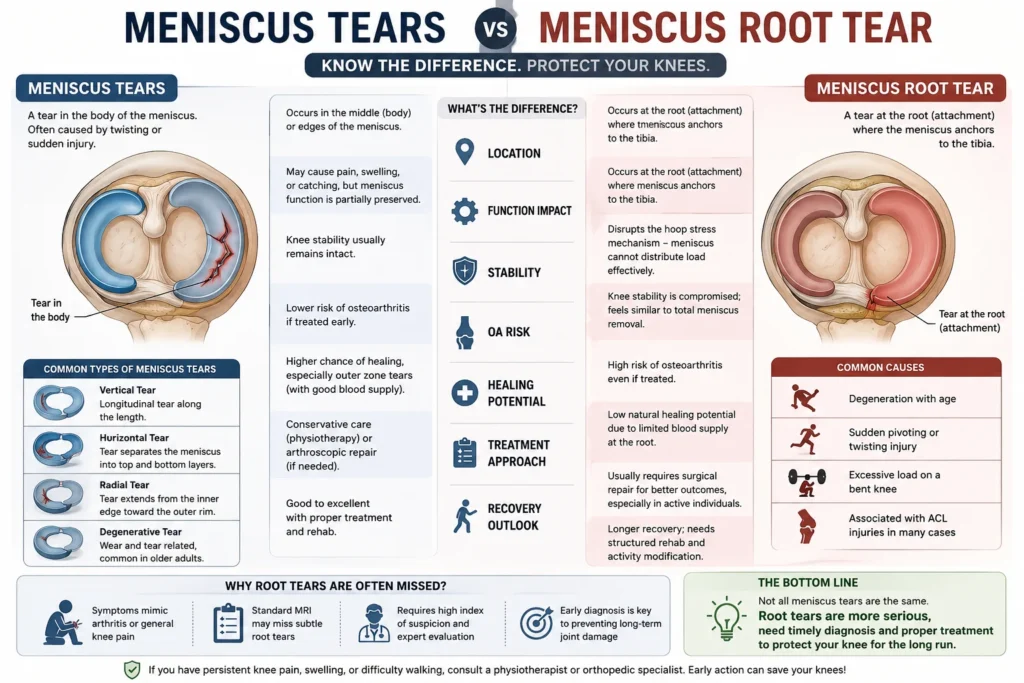
Your knee contains two crescent-shaped menisci: the medial meniscus on the inner side and the lateral meniscus on the outer side.
Each meniscus has attachments near its front and back.
These attachments are called meniscal roots.
A meniscus root tear occurs when the attachment itself is torn or when a radial tear occurs very close to the root.
One commonly used definition describes a root tear as a radial tear within approximately 1 cm of the meniscal attachment or an avulsion of the root itself.
The posterior root of the medial meniscus is particularly important clinically.
Here is the lesser-known part: a complete root tear can behave biomechanically somewhat like losing a large portion of the meniscus altogether.
Why?
Normally, when you put weight through your knee, the meniscus attempts to spread the load outward around the joint.
This is called the hoop-stress mechanism.
The root acts like an anchor.
If that anchor fails, the meniscus can no longer resist being pushed outward effectively.
The tissue may move away from the joint surface, a phenomenon known as meniscal extrusion.
This is why a “small” tear on an MRI should not automatically be considered a small problem. (Archives of Bone and Joint Surgery)
Why Can a Root Tear Be So Difficult to Recognize?
A classic meniscus tear is often associated with catching, locking, twisting pain or swelling.
Root tears can behave differently.
A 2024 scoping review found that patients with medial meniscus posterior root tears experienced locking and giving-way sensations relatively infrequently, at about 14.3% and 9.5%, respectively.
More common findings were pain during full knee flexion and joint-line tenderness.
A McMurray test was positive in only about 57% of patients. (Acta Orthopaedica)
That means you can have a significant root injury without the textbook “my knee is locking” story.
This is one reason I would not advise judging the severity of a knee injury solely by whether you can walk.
A root tear may begin with an ordinary-looking movement
One of the unusual features of medial posterior root tears is that they do not necessarily require a dramatic sporting collision.
A person may report hearing or feeling a pop while:
- Getting up from a low chair
- Squatting
- Kneeling
- Stepping awkwardly
- Turning while the foot is planted
- Performing a deep knee bend
- Walking downstairs
In some cases, there is no memorable injury at all.
That can make people think, “I probably just strained my knee.”
Unfortunately, persistent symptoms deserve a more careful assessment.
The Hidden Biomechanical Problem Behind the Pain
Think of the meniscus as a pressure-distributing ring.
When the root is intact, compression pushes the meniscus outward, but the root attachment helps restrain that movement and allows the tissue to develop circumferential tension.
When the root is completely disrupted, this mechanism is compromised.
The result can be increased contact stress within the affected compartment of the knee.
This is not simply theoretical.
Research consistently associates meniscal root tears with increased joint degeneration and cartilage damage.
A recent systematic review reported that medial posterior root tears were associated with substantial cartilage lesions, including lesions of at least ICRS grade 2 in 80% of the medial femoral condyles examined across the included studies. (PubMed)
That does not mean every person with a root tear will inevitably develop severe arthritis.
It means the injury deserves early identification and appropriate management rather than being dismissed as an ordinary knee ache.
Symptoms of a Meniscus Root Tear You Should Not Ignore
The symptoms can overlap with other knee conditions, so this is not a self-diagnosis checklist.
However, certain patterns should raise suspicion.
Pain at the inner or outer joint line
Medial root tears commonly produce pain around the inner joint line.
Lateral root tears may cause pain on the outside.
However, pain location alone cannot identify the exact structure involved.
Pain when bending the knee deeply
This is one of the more useful clues.
You may notice pain when:
- Squatting
- Sitting cross-legged
- Kneeling
- Getting up from the floor
- Using Indian-style toilets
- Performing deep gym squats
A 2024 review identified pain with full flexion as one of the most frequent clinical findings in medial posterior root tears. (Orthopaedic Journal of Sports Medicine)
Pain when rising from a chair
This can be surprisingly important.
Some patients remember a small pop or sudden discomfort when standing from a chair rather than a dramatic sports injury.
Earlier clinical literature has specifically described popping during relatively light activities such as rising from a chair or squatting.
Swelling after activity
Some people develop intermittent swelling, particularly after increased walking, stairs or exercise.
But the absence of swelling does not rule out a root tear.
Joint-line tenderness
A physiotherapist or orthopaedic clinician may find tenderness directly over the joint line during examination.
A feeling of something being “off”
Patients sometimes describe their knee as uncomfortable, weak, heavy or unreliable rather than clearly locked.
This vague symptom is easy to underestimate.
Can a Meniscus Root Tear Be Missed on MRI?
Yes.
MRI is extremely useful, but it is not an infallible answer machine.
A diagnostic study of 3-T MRI found moderate sensitivity for posterior meniscal root pathology, with sensitivity of about 82% for medial root tears and 60% for lateral root tears in that cohort.
The authors concluded that some root tears may not be identified until arthroscopy. (Wiley)
The issue can be even more striking with lateral root tears.
One study found that only 15 of 45 lateral meniscus posterior root tears, or 33%, were initially identified on preoperative MRI.
On retrospective review, some missed tears were clearly visible, while others were subtle or occult. (NCBI)
So if your MRI report says “no significant meniscal tear” but your symptoms and clinical examination strongly suggest a root injury, the conversation should not necessarily end there.
Ask a better question about your MRI
Instead of only asking:
“Does my MRI show a meniscus tear?”
ask:
“Were the meniscal roots specifically evaluated, and is there evidence of meniscal extrusion?”
That distinction can be clinically useful.
Modern research is also identifying specific MRI signs that can improve recognition.
A 2025 systematic review and meta-analysis found that the cleft sign and ghost sign performed particularly well for detecting posterior root tears. (BMC)
Meniscal Extrusion: The Lesser-Known Clue
This is one of the most important concepts I want patients to understand.
Meniscal extrusion means the meniscus has moved outward beyond its normal position.
It is not synonymous with a root tear, but significant extrusion can be an important imaging clue.
A root injury can disrupt the meniscus’s ability to resist outward displacement.
Once the meniscus is no longer positioned properly between the bones, its load-sharing function can become compromised.
This is why an MRI report mentioning “meniscal extrusion” deserves attention rather than being treated as an incidental sentence.
Research has also suggested that residual or increasing extrusion can influence outcomes following root repair.
Long-term observational research has identified varus alignment and postoperative meniscal extrusion as important predictors of clinical failure after medial root repair. (PMC)
Who Is More Likely to Develop a Meniscus Root Tear?
Root tears can happen to athletes, but they are not exclusively sports injuries.
Middle-aged adults
Degenerative medial posterior root tears are frequently seen in middle-aged and older adults.
The tissue may gradually become less resilient, meaning an apparently ordinary movement can become the final event that produces a tear.
People with knee degeneration
Existing cartilage changes can coexist with root pathology.
This creates an important clinical challenge: sometimes the pain is attributed entirely to “arthritis” when a root tear is also present.
Varus knee alignment
Varus alignment, sometimes described as bow-legged alignment, can increase loading through the medial compartment.
Research suggests that substantial varus alignment can negatively influence long-term outcomes after medial root repair.
Previous ACL injury
Lateral posterior root tears are particularly relevant in people with ACL injuries.
A review of the literature reports a strong association between lateral root injuries and ACL injury, which is why the lateral meniscus root should be carefully evaluated when an ACL injury occurs. (Case Reports in Orthopaedics)
The Physiotherapy Assessment: What I Would Look For
A good assessment should go beyond simply asking, “Where does it hurt?”
I would want to understand:
- How the pain started
- Whether there was a pop
- Whether the knee twisted
- Whether the foot was planted
- Whether deep flexion aggravates symptoms
- Whether stairs are painful
- Whether rising from a chair hurts
- Whether swelling occurs after activity
- Whether there is joint-line tenderness
- Whether there are mechanical symptoms
- Whether there is an alignment issue
- Whether strength has changed
- Whether your gait has altered
Clinical tests can provide useful clues, but none should be treated as a standalone confirmation.
The 2024 scoping review emphasizes that clinical diagnosis is challenging because root tears do not always produce the classic signs of conventional meniscal injuries.
This is where physiotherapy has an important role:
identifying the movement pattern, loading strategy and functional limitations while recognizing when the presentation warrants further medical investigation.
What Happens If You Ignore a Root Tear?
This is where I become more cautious as a physiotherapist.
If a root tear is clinically significant and remains untreated, altered meniscal mechanics may contribute to progressive cartilage degeneration.
A 2025 systematic review found that meniscal root tears were associated with more severe cartilage damage than other meniscal tear patterns in the included studies. (Science Direct)
But there is an important nuance:
Not every root tear automatically requires surgery.
Meniscus root tear treatment depends on factors such as:
- Tear type
- Acute versus degenerative onset
- Degree of extrusion
- Existing osteoarthritis
- Limb alignment
- Cartilage condition
- Age and activity requirements
- Stability of the tear
- Overall health
- Patient goals
That is why meniscus root tear treatment should be individualized rather than based on the MRI phrase alone.
Meniscus Root Tear Treatment: Does It Always Need Surgery?
No.
But a suspected complete root tear should not be treated casually.
Meniscus root tear treatment options may include activity modification, physiotherapy, medication prescribed when appropriate, injections in selected cases, or surgical intervention.
The correct choice depends heavily on the condition of the knee.
When physiotherapy may be part of management
Physiotherapy can be useful for:
- Reducing unnecessary joint loading
- Restoring knee range of motion
- Maintaining quadriceps strength
- Improving hip and trunk control
- Improving walking mechanics
- Managing swelling
- Gradually rebuilding functional capacity
- Addressing contributing movement patterns
However, physiotherapy cannot physically reattach a completely detached meniscal root.
That distinction is important.
Exercise can improve how the knee functions around an injury, but it cannot recreate an anatomical attachment that has completely failed.
What About Meniscus Root Repair?
When a patient is considered an appropriate surgical candidate, one common approach is arthroscopic root repair, frequently using a transtibial pullout technique.
The objective is to restore the root toward its anatomical attachment and recover as much meniscal function as possible.
Evidence increasingly favors repair over simply removing the damaged tissue in appropriately selected patients.
A systematic review of 19 studies involving 1,086 patients found that conversion to total knee arthroplasty ranged from 0% to 1% after repair, compared with 11% to 54% after partial meniscectomy and 31% to 35% after nonoperative treatment in the included studies. (NLM)
The authors cautioned that much of the evidence was observational and that higher-quality trials are still needed.
More recently, a 2025 systematic review of 56 studies involving 3,191 patients similarly found that root repair generally produced better structural and patient-reported outcomes than meniscectomy or nonoperative treatment, although the evidence remained heterogeneous. (Joint Disease and Related Surgery)
An even newer meta-analysis with more than five years of follow-up reported lower clinical failure and knee arthroplasty conversion rates after medial meniscus root repair compared with partial meniscectomy.
These findings are encouraging, but they should not be interpreted as “every root tear must be repaired.”
Why Partial Meniscectomy Is Not Automatically the Easy Solution
This is a particularly important conversation to have.
For many traditional meniscus tears, partial meniscectomy has historically been common.
But with a root tear, simply trimming away damaged tissue does not restore the lost root attachment.
A systematic review comparing medial root repair with partial meniscectomy found better clinical outcomes and lower rates of severe osteoarthritis and reoperation with repair.
This does not make meniscectomy universally wrong.
Some patients have advanced degenerative disease or other characteristics that change the treatment equation of meniscus root tear.
The point is that root tears require a different biomechanical discussion from ordinary meniscus trimming.
What Does Rehabilitation After Root Repair Look Like?
This is another area where patients sometimes make a costly mistake.
A repaired root generally needs protection while biological healing occurs.
Your surgeon’s protocol takes priority, but rehabilitation commonly progresses through stages rather than jumping immediately into strengthening and deep squatting.
Early rehabilitation may emphasize:
- Protecting the repair
- Controlling swelling
- Maintaining safe range of motion
- Appropriate quadriceps activation
- Safe mobility
- Gradual weight-bearing progression
Later phases can progressively introduce:
- Strength training
- Balance work
- Functional exercises
- Controlled closed-chain loading
- Cardiovascular conditioning
- Return-to-activity drills
The 2024 scoping review found broad agreement in the literature regarding the importance of early repair and postoperative rehabilitation, although specific surgical and rehabilitation protocols continue to vary. (BJS Open)
One mistake I strongly discourage
Do not decide that your knee “feels good enough” and immediately return to deep squats, running or heavy leg training.
Pain reduction and biological tissue healing are not the same thing.
Your rehabilitation progression should be based on the repair, symptoms, strength, movement quality and your surgeon’s restrictions.
What You Should Avoid If a Root Tear Is Suspected
Until you have been properly assessed, I would be cautious with activities that repeatedly reproduce significant pain.
These may include:
- Deep loaded squats
- Heavy leg presses through deep flexion
- Repeated pivoting
- High-impact twisting sports
- Deep kneeling if painful
- Sudden increases in walking volume
- “Testing” the knee repeatedly to see whether it still hurts
You do not need to completely immobilize yourself either.
The goal is smart load management, not fear of movement.
A Lesser-Known Tip: Don’t Chase Pain Alone
One of the biggest mistakes I see in musculoskeletal rehabilitation is assuming that the most painful structure must be the most important structure.
Knee pain is influenced by cartilage, synovium, bone, meniscus, muscles and the nervous system.
A root tear can also coexist with osteoarthritis or other meniscal pathology.
Therefore, successful management requires answering two questions:
What is causing the symptoms?
and
What is happening mechanically inside the joint?
Those are not always identical questions.
When Should You Seek an Orthopaedic Opinion?
Consider further evaluation if you have persistent joint-line pain, particularly when combined with:
- A sudden pop during squatting or rising
- Pain with deep knee flexion
- Recurrent swelling
- Persistent symptoms despite sensible rehabilitation
- MRI evidence of meniscal extrusion
- A reported posterior horn tear
- A suspected root tear
- Persistent symptoms despite a “normal” MRI
- A history of ACL injury with lateral knee symptoms
A normal-looking MRI report should not automatically override a strongly suspicious clinical picture.
MRI is valuable, but interpretation matters, and some root tears are genuinely difficult to identify.
Can You Prevent a Meniscus Root Tear?
Not every root tear can be prevented.
Age-related tissue changes, alignment and anatomy are not completely under your control.
But you can reduce avoidable loading errors.
Build strength before chasing intensity
Strong quadriceps, hamstrings, gluteal muscles and calf muscles help you tolerate daily and sporting loads more efficiently.
Increase exercise volume gradually
Going from occasional exercise to five intense training sessions a week is a much bigger mechanical jump than many people realize.
Respect repeated pain
Pain that consistently appears with deep flexion, twisting or loading should be investigated rather than repeatedly provoked.
Do not confuse flexibility with knee health
Being able to sit extremely deeply or force your knee into end-range positions does not necessarily mean the joint is healthier.
For someone with suspected meniscal pathology, repeatedly forcing painful end-range flexion is not a useful “test.”
The Most Important Takeaway for Patients
A meniscus root tear is not simply “another meniscus tear.”
The location of the tear matters because the root is responsible for anchoring the meniscus and helping it perform its load-distributing function.
The symptoms may be surprisingly subtle.
The MRI may occasionally miss it.
The absence of locking does not exclude it.
And meniscus root tear treatment should consider much more than the tear itself.
Recent evidence increasingly supports anatomical root repair for appropriately selected patients, particularly when the knee has reasonable cartilage status and the root is repairable.
At the same time, researchers continue to acknowledge important uncertainties surrounding patient selection, alignment, extrusion, surgical technique and long-term outcomes.
As a physiotherapist, my advice is straightforward:
If your knee hurts repeatedly during deep flexion, squatting, stairs or rising from a chair, especially after a pop or seemingly minor twisting event, don’t automatically assume it is “just a meniscus tear.”
Ask whether the meniscal root has been assessed.
That one question can change the direction of the entire evaluation.
Final Word
The most dangerous thing about a meniscus root tear is not necessarily the pain.
It is underestimating what the injury means mechanically.
A knee that can still walk, climb stairs or perform light exercise may still have an important structural problem.
If your symptoms do not fit the usual “meniscus tear” story, particularly if deep flexion causes pain or your MRI mentions extrusion or posterior horn pathology, it is worth asking a more specific question:
“Could this involve the meniscal root?”
That question can lead to a more targeted assessment, better treatment decisions and, in appropriate cases, earlier intervention before avoidable joint degeneration progresses.
This article is educational and does not replace an in-person assessment by a physiotherapist, sports-medicine physician or orthopaedic specialist. Persistent swelling, inability to bear weight, a locked knee, significant trauma or rapidly worsening symptoms warrant prompt medical assessment.
Frequently Asked Questions
Can you walk with a meniscus root tear?
Yes. Walking ability does not rule out a meniscus root tear. Symptoms may mainly appear with deep knee bending, squatting, stairs or prolonged activity.
Can an MRI miss a meniscus root tear?
Yes. MRI is useful but some posterior root tears can be missed, particularly lateral root injuries. Clinical assessment remains important.
Does every meniscus root tear need surgery?
No. Treatment depends on the tear pattern, cartilage health, alignment, extrusion, symptoms, activity requirements and overall knee condition.
Can physiotherapy heal a meniscus root tear?
Physiotherapy can improve strength, movement and function, but exercise cannot anatomically reattach a completely detached meniscal root.
What does a meniscus root tear feel like?
Symptoms can include joint-line pain, pain during deep knee flexion, swelling and sometimes a popping sensation. Locking is not always present.
Can a meniscus root tear cause arthritis?
A root tear can increase abnormal joint loading and is associated with progression of cartilage degeneration, although individual outcomes vary.
How long does meniscus root repair recovery take?
Recovery generally takes several months and depends on the repair technique, healing, strength, symptoms and the surgeon’s rehabilitation restrictions.
Can you exercise with a meniscus root tear?
Some exercise may be appropriate, but painful deep flexion, pivoting and high-impact loading may need modification until the injury has been assessed.
What is meniscal extrusion?
Meniscal extrusion means the meniscus has moved outward beyond its normal position. It can occur with root pathology and may indicate impaired meniscal function.
When should I see a doctor for suspected meniscus root tear?
Seek assessment for persistent joint-line pain, recurrent swelling, a pop followed by pain, painful deep flexion, suspected extrusion or symptoms that persist despite appropriate rehabilitation.
Stay tuned with us for more health related topics.
Follow us on LinkedIn and Instagram for more.
More Read


Medical Disclaimer!
This article has been reviewed and written under the guidance of our Head Physiotherapist, Dr. Kruti Raj (PT, MUHS,CPT,CMPT). The information shared is intended for educational purposes only and should not be considered a substitute for personalized medical advice, diagnosis, or treatment.
Please consult us or any other qualified healthcare professional before beginning any exercise program, especially if you are experiencing pain, recovering from injury, or managing a medical condition.


