


An MRI report that says “partial ACL tear” can immediately make you wonder: Do I really need surgery? Will my ACL heal? Can physiotherapy make my knee stable again?
The reassuring answer is that surgery is not automatically required for every partial ACL tear.
Quick Answer
Can a Partial ACL Tear Heal Without Surgery?
Yes, in selected people. A partial ACL tear does not automatically mean ACL reconstruction. If the knee is stable, swelling settles, strength and movement control recover, and there are no major associated injuries, structured physiotherapy may allow you to return to normal activities without surgery. However, repeated giving-way episodes, significant meniscal injury, persistent instability, or high-demand pivoting sports may make surgery more appropriate.
In carefully selected people, structured physiotherapy and activity modification can restore excellent knee function without ACL reconstruction.
However, “partial tear” does not automatically mean “minor injury.”
The real question is not simply how much of the ligament is torn on MRI.
It is whether your knee is functionally stable, whether you experience giving-way episodes, what other structures are injured, and what you expect your knee to do in the future.
A 2024 systematic review and meta-analysis found that there is not strong evidence that reconstruction is universally superior to well-designed non-operative treatment for isolated ACL injuries. (Sage Journals)
The authors specifically concluded that non-operative treatment with structured rehabilitation can be considered as a primary option, although the certainty of evidence was limited.
As a physiotherapist, this is how I would explain it to a patient sitting in front of me:
Your MRI tells me what the ligament looks like.
Your examination tells me what your knee can actually do.
And those are not always the same thing.
Key Takeaways
- Partial ACL tear does not automatically require surgery.
- MRI findings should be interpreted alongside knee stability and functional testing.
- Repeated knee giving-way is more concerning than the tear percentage alone.
- Meniscal injury, bone bruising and anterior tibial translation can influence prognosis.
- Physiotherapy should restore mobility, strength, proprioception and movement control.
- Return to sport should be based on function, not simply time since injury.
- High-demand pivoting athletes may have different treatment needs from recreational exercisers.
- Surgery improves stability in appropriate patients but does not guarantee prevention of arthritis.
- A rehabilitation-first approach does not mean that surgery can never be considered later.
- The real goal is a stable, strong and trustworthy knee, not simply avoiding surgery.
What exactly is a partial ACL tear?
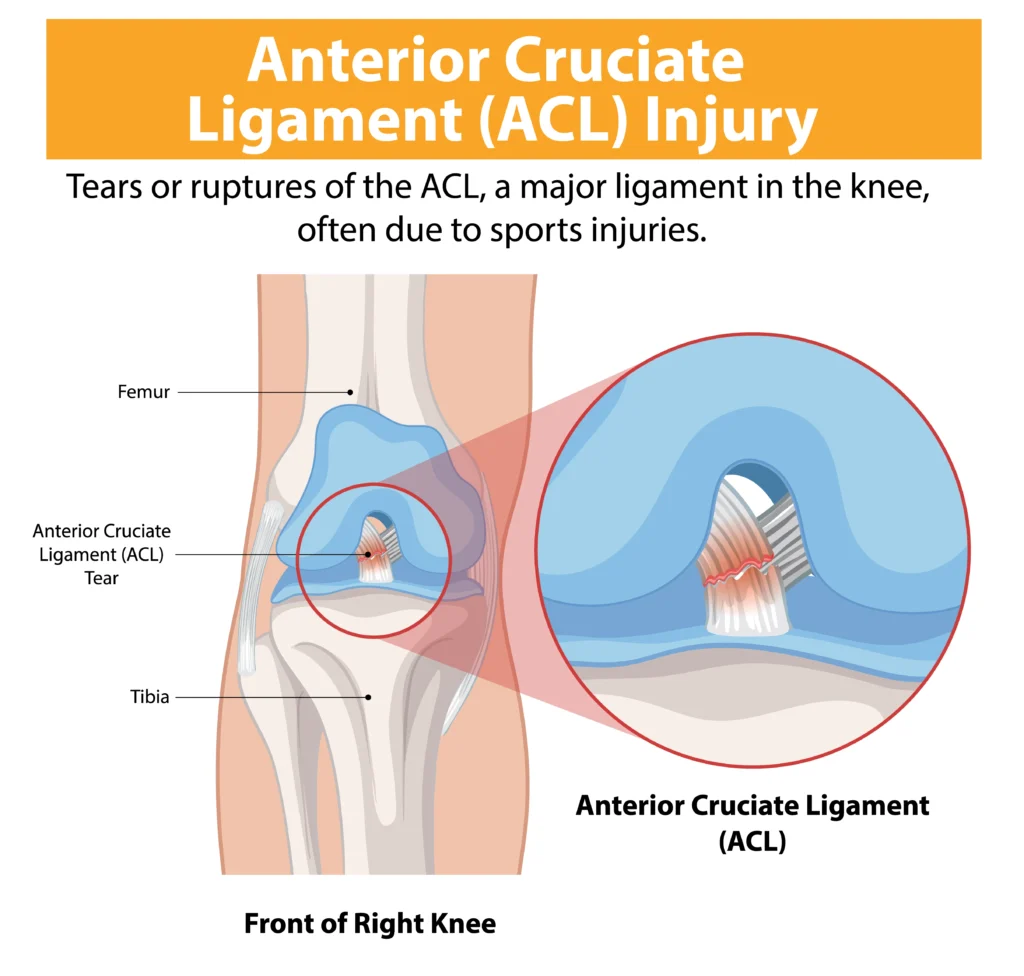
The anterior cruciate ligament, or ACL, is one of the major stabilising ligaments inside the knee.
It helps control forward movement of the tibia relative to the femur and contributes importantly to rotational stability.
A partial ACL tear means that some ACL fibres remain intact while others are damaged or disrupted.
This is different from a complete rupture, where functional continuity of the ligament may be lost.
But there is an important catch: MRI appearance alone does not tell us whether the remaining ACL fibres are functionally sufficient.
Two people can have MRI reports describing partial ACL tears and have completely different knees.
One person may:
- Walk normally
- Have little or no swelling
- Have a relatively stable Lachman examination
- Have no episodes of giving way
- Regain strength progressively
- Return to cycling, gym training or recreational activity
Another may have:
- Repeated knee buckling
- Difficulty changing direction
- Persistent swelling
- Significant quadriceps weakness
- Meniscal injury
- Rotational instability
- Fear during single-leg activities
Those two patients should not necessarily receive the same treatment.
A study investigating partial ACL injuries found that selected patients treated non-operatively could achieve successful short-term outcomes. (SpringerLink)
Interestingly, anterior tibial translation and the extent of bone bruising on imaging were among the radiographic factors associated with failure of non-operative treatment.
That is one reason I do not recommend making a surgical decision from the phrase “partial ACL tear” alone.
So, can a partial ACL tear heal without surgery?
Sometimes, yes.
But “healing” needs to be defined carefully.
The ACL has historically been considered relatively poor at spontaneous healing compared with ligaments outside the knee.
Nevertheless, modern research has challenged the idea that every ACL injury remains permanently disconnected.
A secondary analysis of the KANON trial found MRI evidence of ACL healing in some people treated initially with rehabilitation, and those with evidence of healing tended to have better patient-reported outcomes. (BMJ)
This does not mean that every ACL tear will reconnect itself or become anatomically normal.
It means that the biological response after ACL injury is more complicated than the old “torn ligament equals permanent damage” model.
For partial tears, the remaining intact fibres may continue contributing to mechanical stability while the surrounding neuromuscular system adapts.
That is why rehabilitation can be so important even when the ligament itself does not become completely normal on MRI.
The most important question is not “How much is torn?”
One of the biggest mistakes I see is treating the MRI percentage as the deciding factor.
You might hear:
“Only 30% is torn, so you definitely won’t need surgery.”
Or:
“Half the ACL is torn, so you definitely need reconstruction.”
Neither statement is clinically reliable on its own.
The percentage of fibres described on MRI or during arthroscopy does not perfectly predict how the knee will behave.
Older research on partial ACL tears also found that the estimated percentage of ACL tearing did not correlate strongly with later clinical scores. (Elsevier)
Your physiotherapist and orthopaedic specialist should therefore look beyond the scan.
What I would assess as a physiotherapist
I would want to know:
Does your knee give way?
This is one of the most important questions.
A painless knee that repeatedly buckles during turning or stepping down stairs may be more concerning than a painful knee that is mechanically stable.
Can you fully straighten the knee?
Loss of extension is important. A persistently stiff knee should not simply be pushed aggressively through exercise.
How much swelling is present?
Recurrent effusion can indicate that the knee is not tolerating your current activity.
How strong is your quadriceps?
Quadriceps inhibition can occur after knee injury and swelling.
It can dramatically change how you walk, squat, climb stairs and land.
Can you control the knee on one leg?
Single-leg squat quality, step-down control and landing mechanics can reveal deficits that are invisible when you simply walk across the room.
What happens during rotational tasks?
Cutting, pivoting and sudden deceleration place different demands on the ACL than cycling or straight-line walking.
Are the meniscus, cartilage or other ligaments injured?
This can significantly change the treatment decision.
Who is more likely to avoid ACL surgery?
There is no single checklist that guarantees success, but several factors can make conservative treatment more reasonable.
You may be a stronger candidate for non-operative management when:
- The knee is clinically stable or only mildly lax.
- You do not experience recurrent giving way.
- There is no major associated meniscal or ligament injury requiring surgery.
- Swelling settles with rehabilitation.
- You regain near-normal range of motion.
- Quadriceps and hamstring strength progressively improve.
- You are willing to temporarily modify high-risk activities.
- Your desired activities do not require frequent cutting and pivoting.
- You can demonstrate good single-leg control.
- Your knee becomes functionally reliable with rehabilitation.
Research on ACL-deficient knees has identified the concept of “copers”, meaning people who can function successfully despite ACL deficiency. (PMC)
Importantly, passive ligament laxity alone did not reliably distinguish people who functioned well from those who struggled.
Functional testing and neuromuscular behaviour were more informative.
That finding has a very practical physiotherapy message:
A loose-looking knee is not automatically a useless knee.
But who should think more seriously about surgery?
Conservative treatment becomes less attractive when the knee repeatedly fails you.
Warning signs include:
Recurrent giving way
If the knee repeatedly buckles, especially during ordinary activities, I would take that seriously.
Every instability episode can potentially expose the meniscus and cartilage to abnormal loading.
High-demand pivoting sports
Football, basketball, handball, kabaddi, tennis, badminton and similar sports involve rapid deceleration, cutting and rotation.
A person who wants to return to competitive pivoting sport has different requirements from someone whose goal is pain-free walking and gym exercise.
Associated meniscal injury
A partial ACL tear combined with an unstable meniscal injury is a very different clinical situation from an isolated partial ACL injury.
Persistent instability despite good rehabilitation
If you have genuinely completed a progressive rehabilitation programme and your knee continues to buckle, surgery may become a more reasonable option.
Significant functional asymmetry
If the injured leg remains substantially weaker and demonstrates poor movement control despite appropriate rehabilitation, simply returning to sport because “the MRI isn’t that bad” is not sensible.
A retrospective study of ACL injuries found that younger age and higher activity levels were associated with greater failure rates of non-operative treatment. (Orthopaedic Journal of Sports Medicine)
Those who failed non-operative management also had more new meniscal injuries identified at surgery.
This does not mean every young athlete needs immediate reconstruction.
It means activity demands matter enormously when making the decision.
The surprising role of your activity level
Here is a lesser-known point:
The same ACL injury can be manageable for one person and completely unacceptable for another.
Imagine two patients with similar MRI findings.
Patient A enjoys walking, swimming, cycling and resistance training.
Patient B plays competitive football three times a week.
Patient A may potentially function extremely well without reconstruction.
Patient B repeatedly needs the knee to tolerate rapid rotation and sudden changes in direction.
The ligament does not know your job title.
It responds to mechanical demand.
Research examining people who successfully cope with ACL deficiency found that older age, lower activity level and absence of meniscal injury were associated with better ability to cope without reconstruction. (NCBI)
So treatment should be based partly on what you want your knee to do, not merely what the MRI says.
What does physiotherapy actually do for a partial ACL tear?
Physiotherapy cannot simply “stitch” a torn ACL back together.
Its goal is more sophisticated.
We are trying to:
- Control swelling and pain.
- Restore full knee motion.
- Reactivate the quadriceps.
- Restore lower-limb strength.
- Improve balance and proprioception.
- Retrain movement strategies.
- Improve single-leg control.
- Gradually expose the knee to increasing loads.
- Determine whether the knee can tolerate your desired activities.
- Identify instability before returning to high-risk sport.
A 2022 systematic review specifically examining physiotherapy-led treatment for partial ACL tears found evidence that interventions such as:
Pilates and Tai Chi could improve selected outcomes including pain, proprioception and muscle strength, although the authors emphasised that larger, higher-quality trials are needed. (BMC)
More broadly, a 2025 systematic review and meta-analysis of exercise-based ACL rehabilitation found that exercise was a central component of recovery, while differences between specific exercise approaches were often smaller than expected. (Science Direct)
Compared with exercise, surgery showed no meaningful advantage for pain and only a small functional advantage in the pooled evidence.
Your rehabilitation should not be “just strengthening”
This is where many ACL rehabilitation programmes go wrong.
A patient may spend weeks doing:
- Straight-leg raises
- Leg extensions
- Bridges
- Mini squats
and then suddenly attempt running.
That is not adequate preparation for sport.
A functional ACL rehabilitation programme progresses through several layers.
Phase 1: Calm the knee
Initially, the goals are:
- Reduce swelling
- Restore extension
- Restore comfortable flexion
- Establish normal walking
- Prevent unnecessary deconditioning
Do not interpret swelling as something you should simply “push through.”
A swollen knee often does not tolerate loading as efficiently as a quiet knee.
Phase 2: Rebuild the quadriceps
Quadriceps weakness is common after ACL injury.
Appropriate strengthening may include progressively loaded:
- Squats
- Leg press
- Step-ups
- Split squats
- Controlled knee extension exercises
- Isometric strengthening
The exact exercises should be selected according to the person’s symptoms, examination and rehabilitation stage.
Interestingly, contemporary evidence does not support the idea that one category of exercise is universally superior.
A 2024 systematic review found that both open- and closed-kinetic-chain exercise can have useful roles in ACL rehabilitation when appropriately prescribed. (Journal of Sports Medicine)
Phase 3: Retrain balance and proprioception
Your ACL contributes to sensory information about knee position.
After injury, the nervous system also has to adapt.
This is why rehabilitation eventually includes:
- Single-leg balance
- Perturbation exercises
- Controlled reaching
- Unstable-surface tasks where appropriate
- Dynamic balance
- Reactive drills
The goal is not to make you wobble on a Bosu ball forever.
The goal is to teach your nervous system to respond rapidly when the knee is challenged.
Phase 4: Build strength at higher loads
This is where rehabilitation becomes more athletic.
Exercises may progress toward:
- Heavy squats
- Split squats
- Deadlifts
- Step-downs
- Single-leg strengthening
- Calf strengthening
- Hamstring strengthening
The load should increase progressively rather than being selected randomly.
Phase 5: Running, landing and changing direction
If you want to return to sport, rehabilitation must eventually resemble the demands of that sport.
Running is different from walking.
Landing is different from running.
Cutting is different from landing.
And reacting to an opponent is different from performing a pre-planned cutting drill.
That is why time alone should never be the only return-to-sport criterion.
When can you return to running?
There is no universal “partial ACL tear running day.”
Before running, I would generally want to see:
- Minimal or no swelling
- Full or near-full range of motion
- Good walking mechanics
- Adequate quadriceps strength
- Good single-leg control
- Ability to tolerate progressive loading
- No significant giving-way episodes
Then running should be introduced gradually.
A common mistake is:
“It doesn’t hurt, therefore I can run normally.”
Pain is only one variable.
You can have relatively little pain while still lacking strength, control or confidence.
When can you return to sports?
This should be based on function rather than a calendar date.
International ACL surgeons surveyed about isolated partial ACL injuries reported that most favoured non-operative management when the clinical examination suggested a stable ligament. (PMC)
Functional testing, strength, swelling and a painless Lachman examination were among the factors commonly considered when deciding return to sport.
Your physiotherapist may therefore assess:
- Quadriceps strength
- Hamstring strength
- Single-leg squat
- Hop performance
- Landing mechanics
- Change-of-direction control
- Balance
- Confidence
- Swelling response after training
- Sport-specific drills
The key question becomes:
Can the knee repeatedly tolerate the demands of your sport without instability?
One lesser-known MRI finding that matters: bone bruising
Bone bruising is commonly associated with ACL injuries.
It can tell clinicians something about the forces that occurred during the original injury.
More importantly for partial ACL tears, research has suggested that the extent of bone bruising and anterior tibial translation may help identify people more likely to fail non-operative management. (Researchgate)
This is why I encourage patients not to read their MRI report in isolation.
A radiologist may mention:
ACL partial-thickness tear + bone marrow oedema + tibial translation + meniscal injury
That combination deserves a different discussion from:
Isolated partial ACL signal change with a clinically stable knee.
The words surrounding the ACL matter.
Can a knee brace prevent surgery?
A brace can sometimes be useful during the early stages or for selected activities, but it is not a substitute for rehabilitation.
Interestingly, a 2025 international survey found that among surgeons who favoured non-operative management of partial ACL injuries, many did not routinely recommend a knee brace. (PubMed)
That should not be interpreted as “braces are useless.”
It means bracing should be individualised.
A brace may help some people feel more secure, but feeling supported is not the same as restoring neuromuscular control.
What should you avoid with a partial ACL tear?
Avoid testing your knee repeatedly
Do not repeatedly perform twisting movements just to see whether the knee gives way.
Avoid rushing back because pain has disappeared
Pain resolution is not equivalent to readiness.
Avoid aggressive pivoting early
Rapid changes of direction can expose an unstable knee to significant rotational loads.
Avoid complete inactivity for weeks
Too much rest can produce substantial strength loss and deconditioning.
Avoid copying someone else’s ACL rehabilitation
Your MRI, strength, stability and goals may be completely different.
Avoid relying only on MRI follow-up
A better-looking MRI does not automatically mean that you are ready for sport.
Avoid treating swelling as irrelevant
If your knee repeatedly becomes swollen after exercise, your current load may be exceeding its capacity.
A surprisingly important goal: make the knee boring
In rehabilitation, “boring” is often a compliment.
I want the knee to become predictable.
You should be able to:
- Walk without thinking about it.
- Climb stairs confidently.
- Stand on one leg.
- Squat without fear.
- Exercise without repeated swelling.
- Perform progressively harder movements without buckling.
The best outcome is not necessarily an impressive MRI.
It is a knee you can trust.
Does avoiding surgery increase the risk of arthritis?
This question deserves a nuanced answer.
ACL injury itself is associated with an increased long-term risk of knee osteoarthritis.
But it is too simplistic to say:
“Surgery prevents arthritis.”
A 2024 systematic review and meta-analysis found no certain evidence that ACL reconstruction was superior to non-operative treatment for preventing premature radiological osteoarthritis in isolated ACL injuries. (OJSM)
The evidence quality was low, and reconstructed knees did demonstrate better stability.
This distinction is extremely important.
Surgery can improve mechanical stability.
But surgery does not erase the original injury or guarantee that osteoarthritis will never develop.
That is why protecting the meniscus, managing recurrent instability, restoring strength and maintaining a healthy activity level remain important regardless of whether reconstruction is performed.
What if physiotherapy doesn’t work?
Non-operative management should not mean:
“Never have surgery.”
It means:
“Give the knee an appropriate opportunity to demonstrate whether it can function without reconstruction.”
If you continue to experience:
- Recurrent giving way
- Persistent instability
- Repeated swelling
- Inability to return to necessary activities
- Significant associated meniscal pathology
- Failure to progress despite genuinely appropriate rehabilitation
then reassessment by an orthopaedic knee specialist is appropriate.
Surgery can remain an option.
In fact, one advantage of a structured rehabilitation-first approach in selected patients is that it gives you objective information about how your knee behaves.
You are not making the decision blindly.
A practical physiotherapy decision tree
Think of the process this way:
Partial ACL tear → detailed examination → assess stability + swelling + range + strength + associated injuries → begin structured rehabilitation when appropriate → reassess function → progress loading → test sport-specific capacity →
If stable and functioning well → continue non-operative management.
If persistent instability or unacceptable functional limitation → discuss surgical options.
This is much more useful than:
MRI says partial tear → surgery or no surgery?
My physiotherapy prescription for the first few weeks
If your orthopaedic clinician has cleared you for conservative management, rehabilitation commonly focuses on:
Early priorities
- Restore knee extension.
- Gradually restore flexion.
- Reduce swelling.
- Normalise walking.
- Begin quadriceps activation.
- Maintain general fitness through appropriate low-impact exercise.
Progressive priorities
- Strengthen quadriceps.
- Strengthen hamstrings and gluteal muscles.
- Improve calf capacity.
- Develop single-leg control.
- Introduce balance and proprioceptive work.
- Progress resistance gradually.
Later priorities
- Running progression.
- Hopping.
- Landing.
- Deceleration.
- Cutting.
- Reactive drills.
- Sport-specific conditioning.
The exact sequence should be individualised.
Rehabilitation should be progressed according to symptoms, examination findings and functional performance rather than an arbitrary number of days.
The biggest mistake: treating the ACL instead of treating the person
This is perhaps the most important point I would leave you with.
Your ACL is one structure.
Your knee is an entire system.
It includes:
- Bone
- Menisci
- Cartilage
- Muscles
- Tendons
- Other ligaments
- Joint capsule
- Nervous system
- Proprioceptive mechanisms
- Movement patterns
- Psychological confidence
A partial ACL tear may therefore be managed successfully without surgery in one person but require reconstruction in another.
The decision should be based on clinical stability, functional performance, associated injuries, activity demands and response to rehabilitation.
Quick answer: Can you avoid surgery with a partial ACL tear?
Yes, some people can successfully avoid ACL reconstruction.
Non-operative treatment is particularly reasonable when the knee is clinically stable, there are no major associated injuries, swelling settles, strength and movement control recover, and the person’s desired activities can be performed safely.
However, a partial ACL tear combined with recurrent instability, significant meniscal injury or high-demand pivoting requirements may make reconstruction more appropriate.
The most important thing is not whether your MRI says “partial.”
It is whether your knee can reliably perform the activities you need it to perform.
Final word from a physiotherapist
If you have just received a partial ACL tear diagnosis, please do not panic and do not assume that surgery is inevitable.
At the same time, don’t make the opposite mistake of assuming that “partial” means harmless.
Give your knee a proper assessment.
Restore movement.
Control swelling.
Rebuild strength.
Train balance and neuromuscular control.
Progress loading intelligently.
Then test the knee against the demands of your real life.
If it becomes stable, strong and trustworthy, you may be one of the people who can successfully manage a partial ACL tear without reconstruction.
And if it does not, recognising that early is not a failure of physiotherapy.
It is useful clinical information that helps you choose the next treatment more intelligently.
The goal is not simply to avoid surgery.
The goal is to build the safest, strongest and most functional knee possible, with or without surgery.
Frequently Asked Questions
Can a partial ACL tear heal without surgery?
Yes. Some people with partial ACL injuries can achieve good knee function with structured rehabilitation, particularly when the knee is stable and there are no major associated injuries.
How long does a partial ACL tear take to heal?
Recovery varies considerably. Functional recovery may take several weeks to months, depending on the extent of injury, swelling, strength deficits, associated injuries and activity goals.
Is physiotherapy enough for a partial ACL tear?
It can be enough for selected patients. Physiotherapy focuses on restoring range of motion, strength, balance, neuromuscular control and progressively higher levels of function.
Can I walk with a partial ACL tear?
Many people can walk after a partial ACL tear, although pain, swelling or instability may initially make walking difficult. Your ability to walk does not by itself determine whether the knee is ready for sport.
Can a partial ACL tear become a complete tear?
It can, particularly if the knee remains unstable and is repeatedly exposed to high-risk pivoting or cutting activities. The risk varies according to individual factors and activity demands.
Does a partial ACL tear always need a knee brace?
No. Bracing is individualised. Some people may benefit from temporary support, while others can progress successfully without a brace.
Can I exercise with a partial ACL tear?
Usually, appropriate exercise is an important part of recovery. However, exercise should be progressed according to swelling, stability, strength and functional response rather than copied from a generic ACL workout.
When should I consider ACL surgery?
Surgery may be considered when there is persistent instability, recurrent giving way, associated injuries, failure of appropriate rehabilitation, or a need to return to activities that place very high rotational demands on the knee.
Can I return to football after a partial ACL tear without surgery?
Some people can, but football places substantial demands on the ACL through cutting, pivoting and sudden deceleration. Return should follow objective functional and sport-specific testing.
Does a partial ACL tear cause arthritis?
ACL injury is associated with an increased long-term risk of knee osteoarthritis, but surgery does not guarantee prevention. Maintaining knee strength, controlling instability and managing associated injuries are important components of long-term joint health.
Stay tuned with us for more health related topics.
Follow us on LinkedIn and Instagram for more.
More Read


Medical Disclaimer!
This article has been reviewed and written under the guidance of our Head Physiotherapist, Dr. Kruti Raj (PT, MUHS,CPT,CMPT). The information shared is intended for educational purposes only and should not be considered a substitute for personalized medical advice, diagnosis, or treatment.
Please consult us or any other qualified healthcare professional before beginning any exercise program, especially if you are experiencing pain, recovering from injury, or managing a medical condition.


