


ACL tear recovery is rarely just about waiting for the ligament to heal.
It is a carefully staged process of reducing swelling, restoring movement, rebuilding strength, retraining balance and gradually preparing the knee for everyday activity or sport.
An anterior cruciate ligament, or ACL tear is one of those knee injuries that can change how you walk, exercise, work, and play almost overnight.
Sometimes the injury is dramatic.
You pivot during football, badminton, basketball, skiing, or running, hear a loud “pop,” and your knee swells within hours.
Other times, it is surprisingly subtle.
You may not hear a pop at all.
You may simply notice that your knee feels unstable when turning, stepping down stairs, or changing direction.
That difference matters.
Quick Answer
An ACL tear commonly causes sudden knee instability, rapid swelling, a popping sensation, difficulty fully straightening the knee, and trouble with pivoting or changing direction. However, not everyone experiences a pop or severe pain.
Diagnosis usually combines the injury history, physical examination and, when appropriate, MRI. Recovery depends on whether the ACL is treated with rehabilitation alone or reconstruction, whether the meniscus or cartilage is also injured, and how well strength and movement control return.
Important: ACL recovery should not be based on time alone. Return to running and sport should depend on objective strength, movement, stability, functional and psychological criteria.
An ACL tear is not diagnosed by pain alone, and recovery is not determined by a calendar alone.
From a physiotherapy perspective, I am much more interested in how stable the knee is, how much swelling remains, whether you have regained full movement, how strong the quadriceps and hamstrings are, and how confidently you can control the leg.
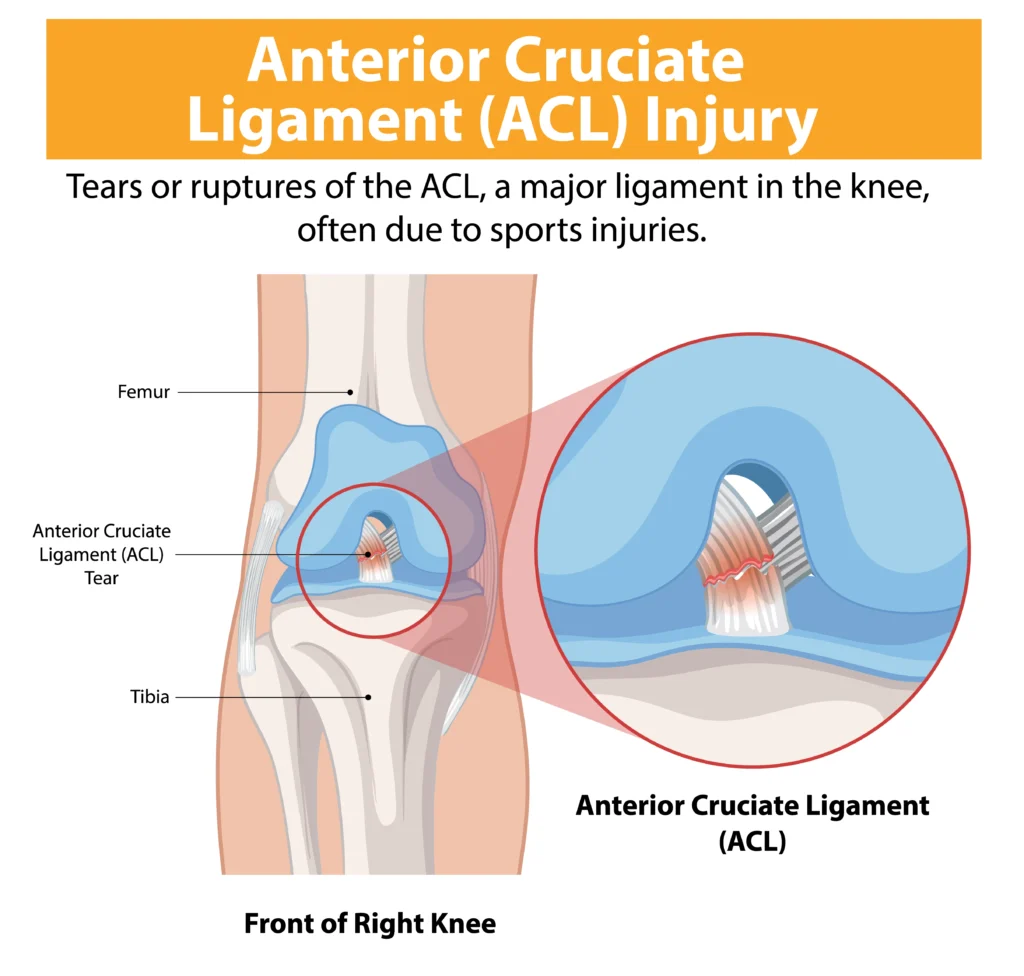
The ACL is one of the major stabilising ligaments inside the knee.
It helps control forward movement of the tibia relative to the femur and contributes significantly to rotational stability.
When it is torn, the knee may become particularly vulnerable during cutting, pivoting, landing, and sudden deceleration.
And here is one of the most important things I tell patients:
A diagnosis of an ACL tear does not automatically mean you need surgery.
But it does mean you need a properly planned assessment and rehabilitation strategy.
Current evidence supports individualised treatment based on injury pattern, associated meniscal or cartilage damage, knee instability, activity demands, age, occupation, sport, and personal goals rather than applying one treatment to everyone. (PubMed)
The American Academy of Orthopaedic Surgeons also emphasises patient-specific factors and future activity demands when making treatment decisions. (Arthroplasty Today)
Key Takeaways
- A popping sensation can occur with an ACL tear, but its absence does not rule out the injury.
- Rapid swelling after a twisting knee injury is an important reason to seek assessment.
- The Lachman and pivot-shift tests are important components of clinical ACL assessment.
- MRI can identify ACL damage and associated meniscus, cartilage and bone injuries.
- Not every ACL tear automatically requires reconstruction.
- Early rehabilitation focuses on swelling, knee extension, movement and quadriceps activation.
- Later rehabilitation must progressively restore strength, power, landing and change-of-direction control.
- The ACL graft continues undergoing biological maturation after symptoms improve.
- Nine months is not an automatic return-to-sport clearance date.
- Return to sport should be criteria-based and consider physical performance, psychological readiness and sport-specific demands.
What exactly happens when you tear your ACL?
The ACL runs diagonally through the centre of the knee and connects the femur to the tibia.
Its job is not simply to “stop the knee from moving forward.”
It also contributes to rotational control.
That is why an ACL-deficient knee may feel relatively normal during straight-line walking but suddenly feel unreliable when you twist or change direction.
A typical ACL injury occurs when the foot is planted while the body rapidly changes direction.
It can also happen during awkward landing, sudden deceleration, contact sports, or a hyperextension injury.
Interestingly, contact is not required.
Non-contact ACL injuries are common in sports involving rapid cutting and landing.
Poor landing mechanics, trunk position, fatigue, neuromuscular control, and sport-specific movement demands can all influence injury risk.
An ACL tear may be:
- Partial, where some ligament fibres remain intact
- Complete, where the ligament is functionally disrupted
- Isolated, where no major associated injury is present
- Combined with meniscus, cartilage, bone, MCL, or other ligament injuries
That last point is important because your recovery timeline may be determined as much by the associated injuries as by the ACL tear itself.
ACL tear symptoms: what does an ACL injury actually feel like?
The classic ACL injury has a recognisable pattern, but not everyone experiences every symptom.
1. A popping sensation
Some people describe hearing or feeling a “pop” at the moment of injury.
It can be loud enough that the person immediately knows something serious happened.
However, absence of a popping sound does not rule out an ACL injury.
This is one of the first misconceptions I try to correct in clinic.
2. Rapid knee swelling
A knee that becomes significantly swollen soon after a twisting injury deserves assessment.
Rapid swelling can occur because bleeding into the joint, called haemarthrosis, develops after injury to structures inside the knee.
Do not assume that every swollen knee is an ACL tear.
Meniscal, osteochondral and other intra-articular injuries can also produce swelling.
3. Knee instability or “giving way”
This is often more clinically meaningful than pain.
Patients may say:
“My knee feels like it is going to give out.”
You may notice it while:
- Turning quickly
- Going downstairs
- Walking on uneven ground
- Getting out of a car
- Playing sport
- Squatting
- Pivoting
- Attempting a single-leg movement
A knee that repeatedly gives way should not simply be “tested” repeatedly at home.
Repeated instability episodes can potentially expose the meniscus and cartilage to additional stress.
4. Difficulty fully straightening the knee
Loss of extension is particularly important during the early rehabilitation period.
A swollen knee often becomes difficult to straighten completely because of joint effusion, pain, protective muscle inhibition, or mechanical problems.
This is why I do not like the idea of aggressively strengthening a knee that cannot yet achieve comfortable extension.
Restore the basics first.
5. Reduced confidence in the leg
This symptom is often overlooked.
You may have surprisingly little pain but still feel unable to trust the knee.
That is not “just psychological.”
Fear and reduced confidence can alter movement patterns, muscle activation, landing strategy and willingness to load the injured leg.
Modern ACL rehabilitation therefore considers psychological readiness alongside physical recovery rather than treating it as an unrelated issue.
The lesser-known ACL symptom: your knee may not hurt very much
One of the most misleading features of an ACL injury is that pain severity does not necessarily tell you how serious the ligament injury is.
A person can have a substantial ACL injury and relatively modest pain after the initial event.
Conversely, a badly swollen knee can be extremely painful without the ACL being completely torn.
This is why “I can walk, so my ACL must be fine” is not a safe conclusion.
If your knee suddenly swelled after a twisting injury and subsequently feels unstable, get it assessed even if your pain has already improved.
How is an ACL tear diagnosed?
A good ACL diagnosis usually combines history + physical examination + imaging when appropriate.
An MRI should not replace a clinical examination.
Step 1: Understanding how the injury happened
I would want to know:
- Did your foot stay planted?
- Did you twist?
- Did you land awkwardly?
- Did the knee buckle?
- Did you hear or feel a pop?
- How quickly did swelling develop?
- Could you continue playing?
- Has the knee given way since?
- Was there direct contact?
- Do you have locking or catching?
The mechanism provides important clues about which structures may have been injured.
Step 2: Checking swelling and movement
The clinician examines:
- Joint swelling
- Knee flexion
- Knee extension
- Walking pattern
- Tenderness
- Muscle inhibition
- Ability to contract the quadriceps
- Overall knee function
A large effusion can make examination more difficult, which is one reason assessment may sometimes need to be repeated once the acute swelling settles.
Step 3: Lachman test
The Lachman test assesses anterior translation of the tibia relative to the femur.
It is one of the most widely used clinical tests for ACL insufficiency.
A systematic review and meta-analysis found good diagnostic performance for the Lachman test, although accuracy varies according to injury characteristics and clinical circumstances.
Step 4: Anterior drawer test
The anterior drawer test also assesses excessive forward movement of the tibia.
It can contribute useful information, but it should not be interpreted in isolation.
Step 5: Pivot-shift test
The pivot-shift test assesses functional rotational instability.
It is technically more demanding and may be uncomfortable during an acute injury.
Interestingly, research has found the pivot-shift test to have particularly high specificity, meaning a positive result can provide strong evidence of ACL-related instability when appropriately performed.
This is a useful reminder that ACL assessment is more sophisticated than simply asking, “Does it hurt?”
Do you always need an MRI for an ACL tear?
MRI is extremely useful, particularly when the diagnosis is uncertain or when associated injuries need to be identified.
An MRI can help assess:
- ACL integrity
- Meniscus tears
- Bone bruising
- Cartilage injury
- Other ligament damage
- Osteochondral injury
However, the MRI report should be interpreted alongside the clinical picture.
A radiology report saying “ACL tear” does not automatically tell you how your knee functions.
Likewise, an apparently intact or partially visualised ligament on imaging does not necessarily mean your knee has normal functional stability.
The combination of clinical examination and appropriate imaging is much more informative than either one alone.
What happens immediately after an ACL injury?
The first few days are not the time to prove how strong you are.
The early priorities are to control symptoms and protect the knee while maintaining appropriate movement.
Depending on your injury, your clinician may recommend:
- Relative activity modification
- Compression
- Elevation
- Pain-relieving strategies
- Gentle range-of-motion exercises
- Quadriceps activation
- Appropriate walking support
- Temporary crutches if necessary
The goal is not to keep the knee completely still.
Instead, the goal is to avoid unnecessary irritation while gradually restoring normal movement and muscle function.
One of the most important early milestones is regaining comfortable full knee extension.
ACL tear recovery timeline: how long does it take?
There is no single recovery timeline that applies to every ACL tear.
A person treated non-operatively may have a very different pathway from someone undergoing ACL reconstruction with a meniscus repair.
Even among surgical patients, graft type, associated injuries, age, sport, strength, swelling, movement quality and rehabilitation progress can alter the timeline.
For general orientation, the following framework is more useful than promising an exact return date.
Weeks 0-2: Calm the knee and restore basic function
The early objectives are usually:
- Reduce swelling
- Regain knee extension
- Gradually restore flexion
- Re-establish quadriceps activation
- Walk with improving mechanics
- Reduce pain
- Protect associated injuries
Depending on the injury, exercises may include carefully selected range-of-motion work, quadriceps contractions, straight-leg raises when appropriate, hip strengthening and progressive weight-bearing.
The exact programme should be individualised.
A swollen knee that refuses to straighten is not ready for an aggressive jumping programme.
Weeks 2-6: Rebuild movement and strength
As symptoms improve, rehabilitation generally becomes more active.
The physiotherapist may progress:
- Squats
- Step exercises
- Hip strengthening
- Hamstring strengthening
- Calf strengthening
- Single-leg control
- Balance exercises
- Progressive resistance training
This is where many people make a mistake.
They focus on the injured knee but forget the rest of the kinetic chain.
The hip and trunk influence how the knee behaves during landing and cutting.
Good ACL rehabilitation therefore develops the entire lower-limb movement system.
Around 6-12 weeks: Build capacity rather than simply “feel better”
This is often when patients start feeling much better.
That can be dangerous if “feeling better” is interpreted as “fully recovered.”
Pain may have disappeared while strength, power, coordination and rotational control remain inadequate.
This phase should increasingly challenge the leg under controlled loading.
Progression may involve:
- Heavier resistance training
- Single-leg strengthening
- Dynamic balance
- Controlled landing drills
- Cardiovascular conditioning
- Movement retraining
The objective is not simply to make the knee pain-free.
It is to make the knee capable.
Months 3-6: Strength, power and movement quality become central
For patients after ACL reconstruction, this phase can involve substantial strengthening and progressive athletic preparation.
The quadriceps deserves particular attention.
Quadriceps weakness after ACL reconstruction is common and can persist long after patients feel functionally recovered.
This is why I often tell patients:
Your knee may feel normal before your muscles are normal.
Progressive resistance exercise is therefore one of the foundations of rehabilitation.
The Aspetar clinical practice guideline recommends combining strength training with motor-control work rather than expecting one to replace the other.
Months 5-9+: Running, jumping and sport-specific progression
Return to running should not simply occur because “six months have passed.”
Current rehabilitation guidance proposes objective considerations such as near-full range of motion, minimal or no effusion, adequate quadriceps strength, appropriate jumping ability and pain-free preparatory activities before running progression. (PMC)
Later rehabilitation may introduce:
- Running
- Acceleration
- Deceleration
- Hopping
- Jumping
- Landing
- Cutting
- Change of direction
- Reactive drills
- Sport-specific practice
These skills should be introduced progressively.
A football player and a recreational cyclist should not have identical return-to-sport criteria.
Is nine months enough to return to sport after ACL reconstruction?
This is one of the biggest ACL myths.
Nine months is a milestone, not a magic clearance date.
Older rehabilitation approaches often focused heavily on time since surgery.
Modern consensus increasingly favours criteria-based progression.
The Panther Symposium ACL Return-to-Sport Consensus Group specifically stated that purely time-based return-to-sport decision-making should be abandoned. (Elsevier)
Physical examination, functional testing, psychological readiness, biological healing and associated injuries should all contribute to the decision.
The latest APKASS consensus published in 2026 similarly emphasises clinical assessment, functional testing, psychological readiness, rehabilitation progress and sport-specific demands rather than using time alone. (Science Direct)
So instead of asking:
“Has it been nine months?”
ask:
“Can my knee demonstrate the capacity my sport requires?”
That is a much better question.
What should you be able to do before returning to sport?
A proper return-to-sport assessment may consider:
- Full knee range of motion
- No significant swelling
- Knee stability
- Quadriceps strength
- Hamstring strength
- Single-leg strength
- Hop performance
- Jumping mechanics
- Landing control
- Running mechanics
- Change-of-direction ability
- Sport-specific skills
- Psychological readiness
The Aspetar guideline proposes demanding objective benchmarks for high-level return to pivoting sports, including strong limb symmetry and normalised jumping and running mechanics.
Importantly, limb symmetry is not the whole story.
If both legs are weak, a simple comparison between them may make the result look better than it really is.
That is why absolute strength, sport demands and movement quality also matter.
The ACL graft is not simply “healed” when you feel better
Here is a lesser-known fact worth remembering.
After ACL reconstruction, the tendon graft undergoes biological remodeling often described as ligamentization.
This process is not finished simply because your pain has disappeared or because you can jog.
Research investigating graft maturation shows that biological changes continue for considerably longer than the early rehabilitation period. (Journal of Open Medical Publishing)
This does not mean everyone must wait years before returning to activity.
It means that symptoms and biological maturation do not move at exactly the same speed.
That is another reason rehabilitation should be progressive rather than rushed.
Can an ACL tear heal without surgery?
Sometimes, yes, but the answer requires nuance.
Not every ACL-injured person requires reconstruction.
Some individuals can achieve a functionally stable knee with structured rehabilitation and modification of high-risk activities.
The Panther consensus recognises that some people can return to activity without reconstruction, particularly when their functional demands and knee stability make that strategy appropriate. (BMJ)
However, non-operative treatment is not the same as “doing nothing.”
A successful conservative pathway can involve months of:
- Strength training
- Neuromuscular retraining
- Balance work
- Movement retraining
- Progressive cardiovascular conditioning
- Functional testing
- Activity modification
If your knee repeatedly buckles, especially during normal activities or sport, reassessment is important.
Does ACL surgery need to happen immediately?
This is another area where oversimplification can be harmful.
“Operate immediately” is not appropriate for every patient.
Evidence comparing early and delayed ACL reconstruction has produced mixed findings, and systematic reviews have not demonstrated a universal functional advantage for immediate reconstruction in isolated ACL injuries. (Sage Journals)
However, the timing discussion becomes more complicated when meniscal injuries are involved.
A 2020 meta-analysis found that ACL reconstruction performed more than three months after injury was associated with higher rates of medial meniscal tears, although the authors noted limitations in the evidence and the possibility of confounding. (Wiley)
More recently, a 2026 systematic review reported lower long-term rates of secondary meniscus surgery following early ACL reconstruction, particularly at follow-up beyond five years. (NCBI)
However, the authors also noted differences between shorter- and longer-term findings.
The practical message is simple:
Do not choose surgery timing from an internet countdown.
Your orthopaedic surgeon should consider knee stability, meniscus and cartilage injuries, range of motion, swelling, activity demands and your rehabilitation progress.
What mistakes can slow ACL recovery?
Returning because the knee “feels fine”
Feeling better is excellent.
It is not the same as passing a functional assessment.
Ignoring swelling
Persistent or recurrent effusion is useful information.
Your knee is telling you that the current workload may exceed its present capacity.
Training only the injured leg
ACL rehabilitation requires the entire movement chain.
Hip, trunk, calf and contralateral limb function all matter.
Avoiding strength training because you are afraid of the graft
Appropriately prescribed progressive strengthening is a central part of ACL rehabilitation.
Fear-driven avoidance can leave you weaker and less prepared for return to sport.
Chasing symmetry alone
A 95% limb symmetry score sounds excellent.
But if both legs are significantly weaker than expected for your body size, age and sport, symmetry can create false reassurance.
Testing your knee repeatedly
Repeatedly trying to make the knee “give way” is not a useful home diagnostic strategy.
A qualified clinician can assess stability much more safely.
Can you prevent another ACL tear?
You cannot eliminate ACL injury risk.
But prevention programmes can reduce risk, particularly programmes that address landing, deceleration, strength, balance and neuromuscular control.
Good prevention training may include:
- Progressive strength training
- Hamstring and quadriceps strengthening
- Hip strengthening
- Single-leg control
- Landing technique
- Deceleration drills
- Balance and proprioception
- Cutting mechanics
- Sport-specific fatigue training
The key is consistency.
A five-minute warm-up once a month is not an ACL prevention programme.
A physiotherapist’s lesser-known tip: train deceleration, not just jumping
Many recreational athletes spend time practising how to jump but much less time practising how to stop.
Yet sport repeatedly exposes the knee to braking forces.
Learning to control:
accelerate → decelerate → stabilise → change direction
is extremely relevant to ACL rehabilitation.
That is why late-stage rehabilitation should eventually resemble the demands of the person’s actual sport rather than remaining a collection of gym exercises.
When should you seek urgent medical assessment?
Seek prompt medical evaluation after a significant knee injury if you experience:
- Rapid major swelling
- Inability to bear weight
- Severe knee pain
- A locked knee
- Obvious deformity
- Repeated giving way
- Numbness or significant weakness
- A cold or unusually pale foot
- Significant instability after trauma
A locked knee deserves particular attention because a displaced meniscal injury or another mechanical problem may be present.
The bottom line on ACL tear recovery
An ACL tear is not simply a ligament problem.
It is a movement, strength, stability, confidence and load-management problem.
The first stage is accurate diagnosis.
The next stage is restoring movement and controlling swelling.
Then comes progressive strength.
After that, the knee needs to demonstrate control under increasingly demanding tasks.
Finally, return to sport should involve running, jumping, landing, cutting, reaction and sport-specific exposure rather than simply receiving a clearance because a certain number of months have passed.
For someone who has undergone ACL reconstruction, modern rehabilitation guidelines emphasise progressive exercise, strength, motor control, running preparation and objective return-to-sport criteria.
And perhaps the most important message I would give you as a physiotherapist is this:
Do not measure ACL recovery only by how your knee feels. Measure it by what your knee can safely do.
Pain can disappear before strength returns.
Confidence can return before movement quality returns.
Strength can return before sport-specific capacity returns.
And the calendar can move forward while your rehabilitation still needs more time.
A successful ACL recovery is therefore not a race to the finish line.
It is a gradual process of rebuilding the capacity your knee needs for the life and activities you want to return to.
Frequently Asked Questions
What are the first symptoms of an ACL tear?
Common symptoms include a popping sensation, rapid knee swelling, instability, difficulty fully straightening the knee, reduced range of motion and difficulty trusting the leg during turning or pivoting.
Can you walk with a torn ACL?
Yes. Some people can walk after an ACL tear, particularly once the initial swelling and pain decrease. Being able to walk does not rule out an ACL injury.
How is an ACL tear diagnosed?
Diagnosis usually involves the injury history, knee examination and clinical stability tests such as the Lachman and pivot-shift tests. MRI may be used to confirm the injury and identify associated meniscus, cartilage or other ligament damage.
Does every ACL tear require surgery?
No. Some people can achieve a functionally stable knee through structured rehabilitation and activity modification. Surgery may be considered when instability persists, when high-demand pivoting sport is a goal, or when associated injuries and individual circumstances make reconstruction appropriate.
How long does it take to recover from an ACL tear?
Recovery varies considerably. After ACL reconstruction, rehabilitation commonly takes many months, with return to high-demand sport often requiring around 9 to 12 months or longer. The actual timeline should depend on rehabilitation milestones rather than time alone.
Can an ACL tear heal naturally without surgery?
Some ACL-injured individuals can regain good functional stability without reconstruction. However, this requires structured rehabilitation and careful assessment of knee stability, activity demands and associated injuries.
When can I start running after ACL reconstruction?
Running should begin only after appropriate clinical and functional milestones have been achieved. These can include near-full range of motion, minimal swelling, adequate quadriceps strength and the ability to perform preparatory hopping and running activities without pain.
Is nine months enough to return to sports after ACL surgery?
Not necessarily. Nine months is a commonly discussed milestone, but return to sport should also depend on strength, jumping and landing ability, knee stability, movement quality, sport-specific capacity and psychological readiness.
Can an ACL tear cause future meniscus problems?
An unstable ACL-deficient knee can place additional stress on other structures of the knee. Research has investigated an association between ACL reconstruction timing and secondary meniscal injury, although the evidence is complex and treatment timing should be individualised.
What is the most important part of ACL rehabilitation?
There is no single exercise that fixes an ACL injury. Successful rehabilitation progressively restores knee movement, strength, balance, motor control, running ability, jumping, landing, deceleration and sport-specific capacity.
Stay tuned with us for more health related topics.
Follow us on LinkedIn and Instagram for more.
More Read


Medical Disclaimer!
This article has been reviewed and written under the guidance of our Head Physiotherapist, Dr. Kruti Raj (PT, MUHS,CPT,CMPT). The information shared is intended for educational purposes only and should not be considered a substitute for personalized medical advice, diagnosis, or treatment.
Please consult us or any other qualified healthcare professional before beginning any exercise program, especially if you are experiencing pain, recovering from injury, or managing a medical condition.


