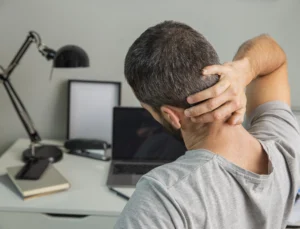
In simple terms, cervical stenosis means that the space inside your neck where the spinal cord passes has become narrower.
But patients rarely come saying that.
They usually say things like:
“My neck feels tight all the time”
“I get tingling in my fingers sometimes”
“My grip feels weaker than before”
So instead of thinking only in terms of anatomy, it helps to understand what is actually happening inside the body.
There is a natural canal in your cervical spine. With time or stress, this space can reduce. When that reduction starts affecting nerves or the spinal cord, symptoms begin to appear.
What is important to understand is this.
This process is usually slow. It develops over years, not days.
Read about our Complete Neck Pain Guide : Causes, Symptoms, Exercises and Treatment
Quick Answer
Cervical stenosis is a condition where the spinal canal in the neck becomes narrow, which may compress nerves or the spinal cord. It can lead to neck stiffness, arm pain, tingling, weakness, or balance issues. In many cases, symptoms can be effectively managed with physiotherapy, posture correction, and consistent lifestyle changes without needing surgery.
Read about: Early Signs of Cervical Spine Damage You Should Never Ignore
Key Takeaways
- Not all cervical stenosis cases cause symptoms
- Pain is influenced by movement and muscle control, not just MRI findings
- Physiotherapy focuses on restoring function and stability
- Posture and daily habits play a major role in recovery
- Surgery is only needed in specific progressive cases
- Early management helps prevent worsening symptoms
Read about : 15 Common Causes of Neck Pain You Should Know
Why cervical stenosis happens
There is rarely a single cause. It is usually a combination of changes that build up gradually.
Age related changes
- Discs lose water content
- Joints become less flexible
- Bone spurs start forming
These changes are part of natural aging, but in some people they become excessive. (Matsumoto et al. 2010)
Read in detail about: Cervical Disc Degeneration: The Hidden Cause of your Neck Pain
Disc bulge or herniation
When a disc pushes backward, it can occupy space inside the canal.
If the canal is already narrow, even a small bulge can create symptoms.
Read more: Cervical Disc Bulge: Causes, symptoms and treatment
Ligament thickening
One of the least discussed contributors is ligament thickening.
The ligament inside the spine can gradually become thicker and reduce available space.
Many patients are unaware of this because it is rarely explained clearly.
Read about: Cervical Ligament Injury or Neck Ligament Tear
Posture and daily habits
This is something I see very frequently now.
- Long hours on laptops
- Looking down at phones
- Slouched sitting
These habits do not cause stenosis overnight. But over time, they change how load is distributed across the spine.
Eventually, this contributes to narrowing and symptoms.
Read in detail: Neck Pain from Phone Use? Here’s How to Treat Text Neck Syndrome
Metabolic and systemic factors
Recent research has shown that conditions like diabetes and chronic inflammation may influence how the spine degenerates.
So it is not just about age. (Sarathi et al. 2024)
Read about: How to Relieve Morning Neck Stiffness Naturally

Symptoms
Cervical stenosis does not always start dramatically.
Early signs
- Mild stiffness in the neck
- Discomfort after long sitting
- Occasional headaches from the base of the skull
These are often ignored.
Read about : What is Cervical Facet Joint Pain, how it causes cervicogenic headaches and how to correct it naturally
Progression
As the narrowing increases, symptoms may change.
- Pain moving into the shoulder or arm
- Tingling or numbness in fingers
- Weakness in grip
- Difficulty with fine hand movements
Read in detail about: Cervical Radiculopathy: Why Neck Nerve Pain Travels to the Arm
When the spinal cord is involved
This is where things become more serious.
- Loss of balance
- Unsteady walking
- Frequent dropping of objects
- Changes in bladder control
This stage is referred to as cervical myelopathy. (Fehlings et al. 2017)
Read more: Cervical Myelopathy: The Hidden Neck Condition Affecting Your Walking
Important truth
Not every case of cervical stenosis causes symptoms.
Some people have clear narrowing on MRI but feel completely normal.
Others have mild changes but significant discomfort.
Why does this happen
Because symptoms are influenced by function, not just structure.
This is where physiotherapy becomes important.
Read about: Effective Neck Pain Exercises At Home: A Complete Guide to Relief and Improved Mobility
Physiotherapy perspective: what actually drives recovery
This is where the approach shifts.
In physiotherapy, we do not treat the scan alone.
We look at how your body is working.
We assess:
- Movement patterns
- Muscle activation
- Postural habits
- Joint mobility
- Breathing patterns
Because in many cases, the issue is not just narrowing.
It is how your body is adapting to that narrowing.
Read: Neck Pain from Poor Breathing Pattern? Correct Now!
The functional difference between patients
Two people can have similar MRI findings.
One continues daily life without much difficulty.
The other struggles with pain and limitation.
The difference is often:
- Muscle control
- Movement efficiency
- Load distribution
This is why treatment has to be individualized.
Read about: Yoga for Neck Pain: Poses That Actually Work
Role of physiotherapy in cervical stenosis
Recovery is not about complete rest.
It is about controlled and guided movement.
Phase 1: calming the system
When symptoms are high:
- Reduce aggravating movements
- Use supported postures
- Introduce gentle breathing exercises
Breathing is often ignored. Shallow breathing increases tension in neck muscles.
Phase 2: restoring movement
Once pain reduces:
- Gentle neck mobility
- Upper back mobility exercises
- Shoulder movement correction
In many cases, the stiffness is more in the upper back than the neck itself.
Phase 3: building stability
This is the most important phase.
Focus areas include:
- Deep neck flexor activation
- Scapular muscle strength
- Postural endurance (Jull et al. 2008)
Phase 4: returning to daily life
This is where long term success is decided.
We work on:
- Workstation setup
- Sitting habits
- Movement during daily tasks
Without this step, symptoms often return.
Read about: The Most Effective McKenzie Exercises For Neck Pain
What recent research tells us about treatment decisions
There is a common fear that cervical stenosis always leads to surgery.
That is not true.
Many mild to moderate cases are managed conservatively. (Brannigan et al. (2024)
When surgery is considered
Surgery may be required if:
- There is significant spinal cord compression
- Neurological symptoms are worsening
- Balance and coordination are affected
Even then, surgery creates space. It does not automatically restore function.
Rehabilitation remains essential. Ergan et al. (2025)
Also Read: Ultimate 6 Weeks Neck Rehabilitation Exercises For Pain Relief
Exercises that help when done correctly
Exercises do help, but here is something I often tell patients during sessions.
It is not about how many exercises you do.
It is about how well your body understands them.
I have seen people doing neck exercises for months with no change.
Then we correct one small thing in their technique, and suddenly symptoms start improving.
That is how sensitive the neck can be.
Chin tuck
This looks simple on paper, but it is one of the most misunderstood exercises.
Most people do it too forcefully. They push the chin back hard or tilt the head down. That is not what we want.
The correct way feels subtle.
Imagine someone gently pulling the back of your head upward, making your neck feel slightly longer. Your chin moves back just a little, without strain.
If done correctly, you may feel a mild activation deep in the front of your neck. Not pain. Not tension. Just a quiet engagement.
In the beginning, it might feel like nothing is happening. That is normal.
These deep muscles are not used to working in most people, especially if posture has been poor for years.
Doing fewer repetitions with proper control is far more useful than doing many repetitions incorrectly.
Thoracic extension
Many patients focus only on the neck, but the upper back is often the real contributor.
If your upper back is stiff, your neck has to compensate for that lack of movement. Over time, this increases stress on cervical structures.
Thoracic extension exercises help restore that missing movement.
A simple example is sitting upright and gently opening your chest while lifting your sternum slightly upward.
You may notice a stretch across the chest and a sense of relief in the neck.
Some people feel immediate ease after working on the upper back. That is usually a sign that the neck was overworking for a stiff thoracic spine.
This is one of those areas where small improvements can make a noticeable difference.
Scapular strengthening
Your shoulder blades play a bigger role in neck health than most people realize.
If the muscles around your shoulder blades are weak or inactive, your neck muscles end up doing extra work to stabilize your upper body.
This leads to fatigue and discomfort.
Scapular strengthening is not about pulling your shoulders back aggressively. That usually creates tension.
Instead, it is about controlled movement.
Think of gently drawing your shoulder blades slightly down and back, as if you are trying to hold a light object between them without squeezing hard.
You should feel the effort more in the mid back, not in the neck.
Over time, better scapular control reduces unnecessary strain on the cervical spine.
Deep neck flexor training
This is one of the most important and also one of the most overlooked areas.
These muscles sit deep in the front of your neck. They act like stabilizers rather than movers.
When they are weak or inactive, larger surface muscles take over. Those muscles are not designed for constant stabilization, so they become tight and overworked.
Training these deep muscles is not about visible movement.
It is about control.
Often, we start with very low intensity exercises, sometimes even lying down, focusing on gentle activation without recruiting the larger muscles.
Patients are often surprised by how challenging this feels despite minimal movement.
That is usually a sign that these muscles have not been working properly for a long time.
Consistent, correct activation gradually improves neck stability and reduces symptoms. (Jull et al. 2008)
Read: Simple Posture Correction Exercises for Forward Head Posture
Lifestyle factors that influence recovery
This is the part many people underestimate.
You can do the best exercises in the world, but if your daily habits keep stressing your neck, progress will be slow.
Recovery is shaped more by what you do throughout the day than by a 15 minute exercise session.
Read in detail: Best Desk Setup to Reduce Neck and Back Pain
Screen height
This is one of the first things I check when someone comes in with neck pain.
If your screen is too low, your head naturally moves forward and down. This increases load on the cervical spine.
Over hours and days, that load adds up.
Ideally, your screen should be at eye level so your head stays in a more neutral position.
It may feel slightly unusual at first if you are used to looking down, but most people adjust within a few days.
A small change here can reduce a significant amount of strain.
Read about: Which Is The Best Sitting Posture To Avoid Neck Pain And How To Achieve It
Sitting posture
People often think posture means sitting perfectly straight all the time.
That is not realistic.
The goal is a relaxed upright position.
Your back is supported, your shoulders are not slouched forward, and your head is not jutting out.
If you try to hold a rigid posture, you will fatigue quickly. Then you end up collapsing into a worse position.
Instead, think of gentle alignment.
And more importantly, change positions regularly.
Even a good posture becomes stressful if held for too long.
Read About: Best Sleeping Position for Neck Pain: A Physiotherapist’s Complete Guide
Sleep position
Sleep is when your body should recover, but poor positioning can keep your neck irritated.
The most important factor is pillow height.
If the pillow is too high, your neck stays flexed. If it is too low, your neck falls backward.
Both can increase discomfort.
A neutral position, where your neck feels supported without being pushed, is ideal.
Side sleeping or lying on your back usually works better than sleeping on your stomach.
Stomach sleeping often forces the neck into rotation for long periods, which can aggravate symptoms.
Read About: How to Choose the Right and Best Pillow for Neck Pain
Movement breaks
This sounds simple, but it is one of the most effective strategies.
Staying in one position for too long increases stiffness and reduces circulation.
Taking a short break every 30 to 40 minutes helps reset your system.
You do not need a full exercise routine.
Just stand up, stretch a little, roll your shoulders, or walk for a minute.
These small resets prevent the gradual build up of tension that leads to pain later in the day.
Many patients notice that their symptoms reduce significantly just by adding regular movement breaks.
Learn About: The Ultimate Neck Stretch Routine for Desk Workers in 2026
Lesser known facts about cervical stenosis
Severe MRI findings do not always mean severe symptoms
Pain can originate from movement dysfunction, not just narrowing
Stress can increase muscle tension and worsen symptoms
Breathing patterns influence neck muscle activity
Recovery depends more on function than structure
Read: 10 Proven Home Remedies for Neck Pain from Anxiety
When to seek medical help immediately
Do not ignore these symptoms:
- Progressive weakness
- Loss of coordination
- Difficulty walking
- Numbness in both hands
- Changes in bladder or bowel control
These require urgent evaluation.
Also Read : Neck Cracking: Benefits, Risks, and the Truth About Stroke
The recovery outlook
Cervical stenosis is not a condition that simply disappears.
But symptoms can be managed effectively.
With the right approach, many people return to:
- Normal daily activities
- Work without significant discomfort
- Active lifestyles
Recovery takes time.
But it is possible.
Read more: Is Cervical Traction For Neck Pain Really Effective
Frequently Asked Question
Q1. Can cervical stenosis go away on its own?
The structural narrowing does not reverse, but symptoms can improve significantly with physiotherapy and lifestyle changes.
Q2. Is it safe to exercise with cervical stenosis?
Yes, but exercises should be guided and controlled. Incorrect technique can worsen symptoms.
Q3. How do I know if my cervical stenosis is serious?
Symptoms like balance issues, weakness, or bladder changes require immediate medical attention.
Q4. Can posture really make a difference?
Yes, poor posture over time increases stress on the neck and can worsen symptoms.
Q5. Do I need surgery for cervical stenosis?
Most cases do not require surgery. It is usually recommended only when neurological symptoms are progressing.
Q6. What is the best sleeping position?
Sleeping on your back or side with proper neck support is generally more comfortable and safer.
Q7. How long does recovery take?
Recovery varies, but consistent physiotherapy and habit changes usually show improvement over weeks to months.
Q8. Can I continue working on a laptop?
Yes, but screen height, posture, and regular movement breaks are essential.
Stay tuned with us for more health related topics.
Follow us on LinkedIn and Instagram for more.
More Read


Medical Disclaimer!
This article has been reviewed and written under the guidance of our Head Physiotherapist, Dr. Kruti Raj (PT, MUHS,CPT,CMPT). The information shared is intended for educational purposes only and should not be considered a substitute for personalized medical advice, diagnosis, or treatment.
Please consult us or any other qualified healthcare professional before beginning any exercise program, especially if you are experiencing pain, recovering from injury, or managing a medical condition.