


When can you hear baby’s heartbeat?
It is one of the most awaited early pregnancy moments, showing an important sign of your baby’s development.
For many parents, one of the biggest milestones in early pregnancy to hear their baby’s heartbeat for the first time.
It is often the moment when pregnancy starts to feel real.
Quick Answer
A baby’s cardiac activity can often be seen on a high-resolution transvaginal ultrasound around 5 to 6 weeks of pregnancy, but actually hearing the heartbeat with a handheld Doppler usually happens later, often between 10 and 12 weeks. The exact timing varies from one pregnancy to another.
Some women look forward to this experience with excitement, while others feel anxious and wonder whether they will hear the heartbeat during their very first appointment.
As a physiotherapist,
I often meet women who worry because a friend heard the heartbeat at six weeks, while someone else had to wait much longer.
This comparison can create unnecessary stress because every pregnancy develops at its own pace.
One of the biggest misconceptions is that seeing a heartbeat and hearing a heartbeat are the same thing.
They are not.
Understanding the difference can help reduce anxiety and set realistic expectations for early pregnancy.
Key Takeaways
- The baby’s heart starts developing very early in pregnancy.
- Cardiac activity is often seen before it can be heard.
- High-resolution transvaginal ultrasound may detect cardiac activity around 5 to 6 weeks.
- Handheld Doppler devices usually detect heart tones later, often around 10 to 12 weeks.
- Not hearing a heartbeat early does not automatically mean something is wrong.
- Pregnancy dating and scan type influence what can be detected.
- Repeat scans are common and often completely routine.
- Understanding the process can help reduce unnecessary anxiety.
When Does Your Baby’s Heart Start Developing?
The human heart is one of the earliest organs to develop during pregnancy.
Although many people imagine heartbeat suddenly appearing one day, the process actually begins gradually as the tiny embryonic heart tube forms and starts to function.
(Männer et al. 2022) describe the early stages of human embryonic heart activity and explain that the embryonic heart begins functioning very early in development.
A Lesser-Known Fact
The early embryonic heartbeat does not sound like the strong heartbeat heard later in pregnancy.
In the earliest weeks, healthcare providers are usually identifying cardiac activity rather than listening to a fully developed heartbeat.
When Can Cardiac Activity First Be Seen?
This is where many people become confused.
The first sign of the baby’s heartbeat is often seen before it is heard.
With a high-resolution transvaginal ultrasound, cardiac activity may be visible during the early weeks of pregnancy.
Guidelines for first trimester ultrasound report that fetal heart movements can often be visualized from around 5 to 6 weeks of gestation using a high-resolution vaginal transducer. (Mizia et al. 2021)
What You May See at Different Stages
Around 5 Weeks
The ultrasound may show:
- A gestational sac
- A yolk sac
At this stage, it may still be too early to identify the embryo clearly.
Around 6 Weeks
Many pregnancies will show:
- An embryo
- Early cardiac activity
(Murugan et al. 2019) discuss first trimester ultrasound evaluation and note that cardiac activity may be seen as early as the sixth week of gestation.
Around 7 to 8 Weeks
The embryo becomes easier to identify, and cardiac activity is often more obvious during the ultrasound examination.
Seeing the Heartbeat Is Not the Same as Hearing It
This is one of the most important things parents should understand.
During a very early ultrasound, the healthcare provider may simply observe movement within the embryo that represents cardiac activity.
You may not actually hear a heartbeat sound during the appointment.
In many cases, what parents hear later through ultrasound equipment is a processed representation created by the machine rather than the actual sound of the tiny heart itself.
Understanding this difference can prevent unnecessary disappointment if the sonographer shows the heartbeat but does not play an audible sound.
When Can You Hear the Baby’s Heartbeat With a Doppler?
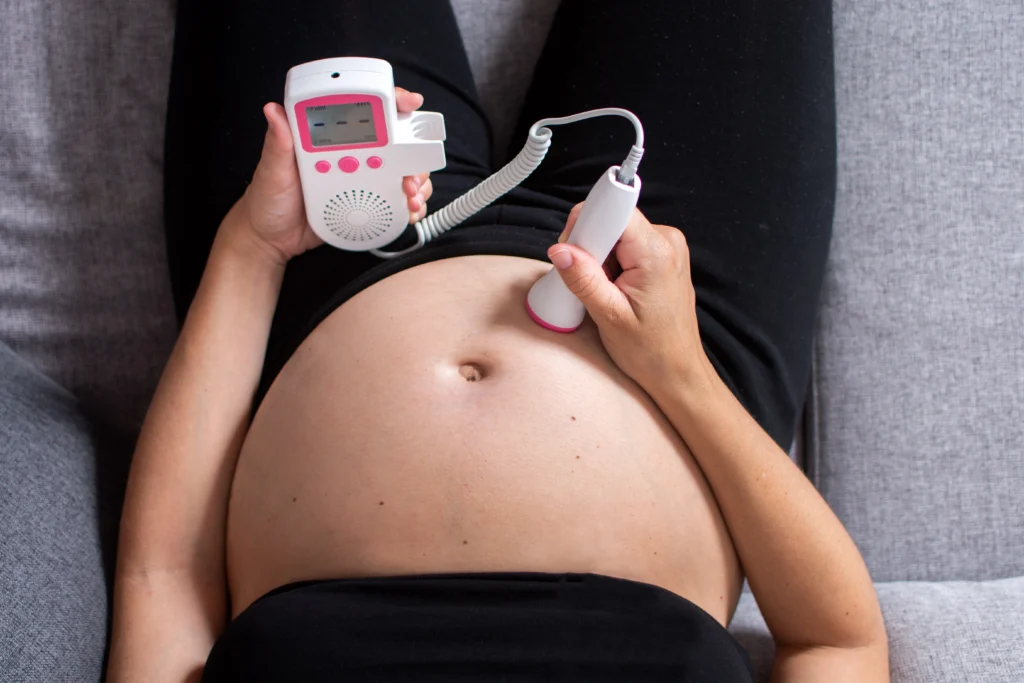
A handheld fetal Doppler works differently from an ultrasound scan.
Rather than creating a picture, it detects movement associated with blood flow and converts it into an audible signal.
Most healthcare providers can usually detect fetal heart tones with a Doppler later in the first trimester, often around 10 to 12 weeks of pregnancy.
The exact timing can vary depending on several factors, including:
- The position of the uterus
- Maternal body type
- The quality of the equipment
- The exact stage of pregnancy
(Mitra et al. 1996) examined transvaginal and transabdominal Doppler auscultation and demonstrated that detection rates vary according to gestational age and examination method.
Why Might You Not Hear Your Baby’s Heartbeat Early?
Not hearing a heartbeat during an early appointment can feel frightening.
However, it does not automatically mean that something is wrong.
There are several common reasons.
Pregnancy Dates May Be Different
Many women do not ovulate exactly in the middle of their menstrual cycle.
If ovulation happened later than expected, the pregnancy may simply be earlier than originally estimated.
The Pregnancy May Be Too Early
Cardiac activity develops over time.
An ultrasound performed only a few days later may provide completely different information.
The Examination Method Matters
A transvaginal ultrasound often provides clearer images during very early pregnancy than a scan performed over the abdomen.
The Baby’s Position Can Affect Imaging
Even in early pregnancy, positioning can influence what the healthcare provider can see or detect.
Does Not Hearing the Heartbeat Mean You Are Miscarrying?
This is one of the most common fears among expectant parents.
The answer is:
Not necessarily.
If a heartbeat cannot be identified during a very early scan, the healthcare provider may recommend repeating the ultrasound after a short interval.
Sometimes the explanation is simply that the pregnancy is earlier than expected.
Waiting for another scan can be emotionally difficult, but one appointment does not always tell the complete story.
Myths vs Facts About Your Baby’s Heartbeat
| Myth | Fact |
|---|---|
| Seeing the heartbeat and hearing it are the same thing. | Cardiac activity is often seen before heart tones can be heard. |
| Not hearing the heartbeat at six weeks means miscarriage. | Pregnancy dates and scan type can affect detection. |
| Every woman hears the heartbeat at the same time. | The timing varies from one pregnancy to another. |
| Home Dopplers are always reassuring. | They can sometimes create unnecessary anxiety if the heartbeat cannot be located. |
Physiotherapist’s Perspective
As a physiotherapist, I often see how much emotional stress early pregnancy can create.
Many women spend days comparing their experiences with friends, online forums, or social media stories.
It is important to remember that pregnancy timelines are not identical.
One woman may see cardiac activity at six weeks.
Another may need a repeat scan a week later.
Neither experience automatically predicts the outcome of the pregnancy.
During this waiting period, focus on the things you can control:
- Stay gently active.
- Get enough rest.
- Eat well.
- Keep your prenatal appointments.
- Talk openly with your healthcare provider if you have concerns.
Sometimes understanding the science behind the process helps reduce unnecessary fear and allows you to enjoy this remarkable stage of pregnancy with greater confidence.
What Happens If the Heartbeat Cannot Be Detected?
Few moments during early pregnancy can feel as worrying as hearing that the baby’s heartbeat cannot yet be found.
For many parents, their minds immediately jump to the worst possible conclusion.
Fortunately, there are many situations where not detecting a heartbeat during an early appointment does not automatically mean there is a problem.
The Pregnancy May Be Earlier Than Expected
One of the most common reasons is that the pregnancy dates are different from what was originally calculated.
Many women do not ovulate exactly halfway through their menstrual cycle.
A later ovulation or later implantation can mean that the embryo is simply younger than expected.
In these situations, repeating the ultrasound after a short interval often provides more information.
The Type of Scan Matters
A transvaginal ultrasound generally provides clearer images during the earliest weeks of pregnancy than a transabdominal scan.
If cardiac activity cannot be seen through the abdomen, your healthcare provider may recommend a transvaginal examination.
This recommendation is usually about improving image quality rather than suggesting that something is wrong.
Every Pregnancy Develops at Its Own Pace
It is easy to compare your pregnancy with stories from friends or online communities.
However, small differences in timing are common.
Some women see cardiac activity earlier.
Others may need an additional scan a few days later.
The important thing is to allow healthcare providers to evaluate the pregnancy using appropriate medical guidelines rather than comparing experiences with others.
Is It Safe to Hear the Baby’s Heartbeat?
Many parents ask whether repeated ultrasound examinations or Doppler devices are safe.
Current medical guidance supports the appropriate use of diagnostic ultrasound during pregnancy when there is a medical reason for the examination.
The American Institute of Ultrasound in Medicine supports the prudent use of diagnostic ultrasound during pregnancy and recommends that it should be performed when medically indicated. (American Institute of Ultrasound in Medicine)
What About Home Doppler Devices?
Home fetal Doppler devices have become increasingly popular.
Many parents purchase them hoping to hear their baby’s heartbeat whenever they want.
While they can seem reassuring, they may also create unnecessary anxiety.
A parent may be unable to locate the heartbeat because of:
- Early pregnancy
- Baby’s position
- Limited experience using the device
- Maternal body type
Not finding the heartbeat at home does not necessarily indicate a problem.
For this reason, many healthcare professionals encourage women to rely on scheduled prenatal visits rather than frequent home monitoring.
Why Does the Baby’s Heartbeat Sound So Fast?
The first time many parents hear the heartbeat, they are surprised by how rapid it sounds.
An adult heart typically beats between 60 and 100 times per minute.
A developing baby’s heart beats much faster.
During early pregnancy, the fetal heart rate increases rapidly as development progresses.
The exact rate changes throughout the first trimester, which is why healthcare providers interpret the heartbeat according to gestational age.
A Lesser-Known Fact
The “galloping horse” sound that many parents hear through a Doppler is not exactly the same as placing a stethoscope over an adult chest.
The Doppler device processes reflected sound waves and converts movement associated with blood flow into an audible signal.
Understanding this helps explain why seeing cardiac activity and hearing heart tones are two different experiences.
Can Stress Affect Your Baby’s Heartbeat?
Many pregnant women quietly worry that being stressed or anxious before an appointment could somehow affect the baby’s heartbeat.
Normal day-to-day stress does not suddenly stop a healthy embryonic heart from beating.
However, prolonged high levels of stress can affect a mother’s overall well-being, sleep quality, physical activity, and emotional health.
As a physiotherapist, I encourage women to focus on practical ways to manage stress during early pregnancy, including:
- Gentle walking
- Deep breathing exercises
- Prenatal stretching
- Adequate sleep
- Limiting information overload from the internet
- Talking openly with healthcare providers
Sometimes the waiting between appointments is more stressful than the appointment itself.
Questions You May Want to Ask Your Healthcare Provider
Many women leave the ultrasound room and later realize they forgot to ask something important.
Consider writing down a few questions before your appointment.
You may want to ask:
- Can cardiac activity be seen?
- Does the pregnancy size match the dates?
- Is a follow-up scan recommended?
- Which type of ultrasound was performed?
- When is the next prenatal appointment?
- Is everything progressing as expected for this stage?
There are no foolish questions during pregnancy.
The more you understand, the less overwhelming the process often becomes.
Physiotherapist’s Perspective
Final Thoughts
Hearing your baby’s heartbeat for the first time is one of the most emotional milestones of pregnancy, but it is important to remember that every pregnancy follows its own timeline.
Many parents are surprised to learn that cardiac activity can often be seen before it can be heard and that the timing depends on factors such as pregnancy dating, the type of ultrasound, and the equipment being used.
As a physiotherapist, I often encourage women to focus less on comparing their journey with others and more on understanding how early pregnancy naturally develops. Knowledge can replace unnecessary fear and make the waiting period much easier to manage.
Remember that not hearing the heartbeat during an early appointment does not automatically mean something is wrong. Sometimes a few extra days and a follow-up scan provide a completely different picture.
A Gentle Reminder:
Every pregnancy is unique. Trust your healthcare team, attend your prenatal appointments, and remember that your baby’s development follows its own remarkable schedule.
One thing I have learned from working with pregnant women is that uncertainty can sometimes be more difficult than physical discomfort.
The days leading up to an ultrasound appointment can feel very long.
Many women repeatedly search the internet, compare themselves with others, and worry that they are behind because someone else heard the heartbeat earlier.
Pregnancy rarely follows an identical timeline for everyone.
As a physiotherapist, I encourage women to trust the process and remember that the body develops according to its own biological schedule.
Gentle movement, healthy routines, and good emotional support can help you navigate this waiting period with greater confidence.
Frequently Asked Questions
When can you first hear your baby’s heartbeat?
Cardiac activity may be seen around 5 to 6 weeks, but a handheld Doppler usually detects heart tones later, often between 10 and 12 weeks.
Can you hear the heartbeat at 6 weeks?
Some pregnancies may show cardiac activity at six weeks, but hearing the heartbeat with a Doppler is often not possible this early.
Why couldn’t my doctor hear the heartbeat?
Pregnancy dates, baby position, and the type of examination can all affect heartbeat detection.
Is it normal to need a repeat scan?
Yes. Repeat ultrasounds are common when a pregnancy appears earlier than expected.
Can stress stop my baby’s heartbeat?
Normal day-to-day stress does not suddenly stop a healthy embryonic heart from beating.
Are home Doppler devices reliable?
Home Dopplers may not always locate the heartbeat, especially during early pregnancy.
Is ultrasound safe during pregnancy?
Diagnostic ultrasound is widely used during pregnancy when medically indicated.
Does not hearing the heartbeat mean miscarriage?
No. Many factors can influence early heartbeat detection, and a follow-up scan is often recommended.
Stay tuned with us for more health related topics.
Follow us on LinkedIn and Instagram for more.
More Read


Medical Disclaimer!
This article has been reviewed and written under the guidance of our Head Physiotherapist, Dr. Kruti Raj (PT, MUHS,CPT,CMPT). The information shared is intended for educational purposes only and should not be considered a substitute for personalized medical advice, diagnosis, or treatment.
Please consult us or any other qualified healthcare professional before beginning any exercise program, especially if you are experiencing pain, recovering from injury, or managing a medical condition.


