


A cervical sprain refers to an injury of the ligaments in the neck. These ligaments connect the vertebrae and provide stability to the cervical spine.
In simple terms, it happens when these ligaments are stretched beyond their normal capacity or develop small tears.
This can occur suddenly, such as during a jerking movement, or gradually due to repeated stress.
In clinical practice, many patients do not recall a single injury. Instead, they describe waking up with stiffness or developing pain after long hours of desk work.
This is because cervical sprains are often not dramatic injuries. They build up quietly over time.
Read about our Complete Neck Pain Guide : Causes, Symptoms, Exercises and Treatment
Quick Answer
A cervical sprain is a ligament injury in the neck caused by sudden movement or repeated strain. It commonly presents as stiffness, pain, and reduced mobility, and improves with early movement, physiotherapy, and posture correction.
Read about: Early Signs of Cervical Spine Damage You Should Never Ignore
Key Takeaways
- Cervical sprain involves ligament injury, not just muscle tightness
- Early symptoms often start as stiffness rather than sharp pain
- Movement control and coordination are crucial for recovery
- Stopping exercises early is a common reason for prolonged symptoms
- Lifestyle habits like posture and screen use play a major role
Read about: Cervical Ligament Injury or Neck Ligament Tear
Why This Injury Feels More Serious Than It Looks
One of the most confusing aspects for patients is that the pain feels severe even when the injury is mild.
This happens because ligaments are not just passive structures. They contain receptors that help your brain understand joint position.
When these receptors are disturbed:
- Movement feels unsafe
- Muscles tighten excessively
- The body becomes protective
This is why even small movements can feel uncomfortable. It is not just damage. It is also how the nervous system responds to that damage.
Research shows that ligament injury can alter joint mechanics and increase sensitivity in surrounding tissues. (Sterling et al., 2016)
Read about : 15 Common Causes of Neck Pain You Should Know
Common Causes in Daily Life

Cervical sprains are no longer limited to accidents. Most cases today are linked to everyday habits.
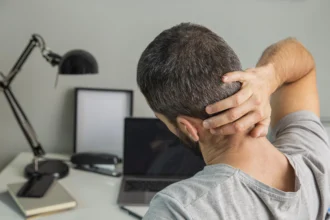
Prolonged Sitting and Desk Work
When the head stays slightly forward for long periods, the posterior ligaments remain under constant tension.
Mobile Phone Use
Looking down at a screen increases the effective load on the neck significantly.
Read in detail: Neck Pain from Phone Use? Here’s How to Treat Text Neck Syndrome
Poor Sleeping Posture
A pillow that is too high or too low changes the alignment of the cervical spine overnight.
Sudden Movements
Quick turning of the head or sudden stops can overstretch ligaments.
Repetitive Micro Stress
Small daily stresses accumulate and eventually lead to pain.
Read about: What Is Military Neck Or Cervical Kyphosis And How To Treat It
Symptoms
The presentation can vary, but commonly includes:
- Neck pain that increases with movement
- Stiffness, especially after rest
- Reduced ability to turn the head
- Muscle tightness
- Headaches at the base of the skull
In some patients:
- Pain may spread to the shoulders
- There may be a feeling of heaviness or fatigue
A typical pattern I see in clinic is that symptoms are worse in the morning or after long inactivity.
Read: Lhermitte’s sign- An Electic Shock Sensation Down The Neck
How a Cervical Sprain Presents in Real Life
In textbooks, symptoms are listed neatly. In real practice, it rarely looks that clean.
I remember a patient who came in complaining of “just stiffness” on the right side of the neck.
No injury, no fall, nothing significant. She assumed it was due to sleeping wrong.
But when we looked closer:
- She had been working long hours on a laptop
- Her head posture was consistently forward
- She avoided turning her neck fully because it felt “tight”
On examination, there was clear restriction in rotation and mild ligament tenderness.
This is a typical presentation.
Many cervical sprains do not begin with sharp pain. They start as:
- A feeling of tightness
- Slight discomfort while turning
- Fatigue in the neck by evening
Over a few days, this progresses into pain and stiffness.
The important takeaway is this:
If you wait for severe pain before taking action, you are already late in the process.
Early signs are often subtle and easy to ignore.
Read in detail: Whiplash Injury After An Accident? Here’s Treatment And Expert Rehab Guide
Grading of Cervical Sprain
Understanding severity helps guide recovery.
Grade I
Mild stretching of ligaments with minimal pain
Grade II
Partial tearing with noticeable stiffness and pain
Grade III
Severe injury with instability and significant limitation
Most patients fall into the first two categories and recover well with structured physiotherapy.
Read: How to Fix Neck Hump Naturally
What Happens Inside the Neck After Injury
Healing is not just about tissue repair.
The body adapts, and not always in a helpful way.
After a cervical sprain, we often see:
- Altered movement patterns
- Reduced proprioception
- Delayed muscle activation
- Protective stiffness
This increases the risk of recurrence if not addressed properly. (Blanpied et al., 2017)
Read more: Cervical Vertigo Explained: Why Neck Pain Make You Feel Dizzy
The Hidden Problem: Your Neck Forgets How to Move
One thing I often explain to patients is this.
Your neck does not just get injured. It becomes uncoordinated.
After injury, the body tries to protect the area by tightening surrounding muscles.
While this may reduce immediate strain, it creates inefficient movement.
Movement becomes:
- Less precise
- More effortful
- Poorly timed
Recent research shows that people with neck pain develop altered movement patterns and increased joint loading even during simple activities. (Treleaven, 2024)
So even when pain starts reducing, the movement system is still not fully normal.
This is why many patients feel stiffness long after the initial injury.
Read in detail about: How to Fix Upper Crossed Syndrome Naturally
Physiotherapy Approach to Cervical Sprain
From a physiotherapy perspective, treatment is not just about pain relief. It is about restoring how the neck functions.
Read more: Heat Or Cold Therapy for Neck Pain: What Actually Works?
Phase 1: Pain Management
- Gentle movements instead of complete rest
- Heat therapy to reduce muscle tightness
- Avoid prolonged immobilization
Complete rest often delays recovery.
Read about: Effective Neck Pain Exercises At Home: A Complete Guide to Relief and Improved Mobility
Phase 2: Restore Mobility
Controlled movements are introduced:
The goal is to bring back normal joint movement.
Read about: Which Is The Best Sitting Posture To Avoid Neck Pain And How To Achieve It
Phase 3: Stability and Strength
This phase is essential but often neglected. (Falla et al., 2018)
Focus is on:
- Deep neck flexor activation
- Scapular stability
- Postural correction
Phase 4: Functional Recovery
This includes:
- Ergonomic correction
- Movement retraining
- Return to daily activities
Read in detail: Best Desk Setup to Reduce Neck and Back Pain
Why Strength Alone Is Not Enough
A common mistake is focusing only on strengthening exercises.
If deep stabilizing muscles are not functioning properly, strengthening larger muscles can increase stress on the cervical spine. (Jull et al., 2023)
Research shows that:
- Deep cervical flexors are essential for spinal control
- Dysfunction in these muscles is linked to persistent pain
A recent review also confirms that stabilization exercises improve outcomes when combined with other therapies. (Gross et al., 2025)
Read about: Effective Neck Pain Exercises At Home: A Complete Guide to Relief and Improved Mobility
Exercises That Actually Help
From clinical experience, simple and consistent exercises work best.
Chin Tucks
Improves deep muscle activation
Scapular Retraction
Reduces load on the neck
Controlled Neck Rotation
Restores movement safely
Consistency matters more than intensity.
Also Read : Neck Cracking: Benefits, Risks, and the Truth About Stroke
Common Mistakes Patients Make
- Resting too much
- Avoiding movement out of fear
- Ignoring posture
- Stopping exercises early
- Relying only on painkillers
These often lead to prolonged symptoms.
Read: How To Use Cervical Collar for Neck Support: Benefits & Hidden Risks
When to Seek Medical Attention
Seek evaluation if you notice:
- Numbness or tingling in arms
- Weakness
- Severe trauma
- Persistent or worsening pain
Learn About: The Ultimate Neck Stretch Routine for Desk Workers in 2026
Prevention That Works
Maintain Neutral Posture
Keep ears aligned with shoulders
Take Regular Breaks
Every 30 to 40 minutes
Optimize Workstation
Screen at eye level
Use Proper Pillow
Avoid excessive elevation
Strength Training
Support neck with strong upper back muscles
Read About: How to Choose the Right and Best Pillow for Neck Pain
Why Modern Lifestyle Is Increasing Cervical Sprains
Cervical sprains today are increasingly linked to lifestyle.
Long hours on devices lead to:
- Forward head posture
- Ligament strain
- Reduced muscle endurance
Evidence shows that repetitive strain from modern habits contributes to long term cervical dysfunction. (Sharma et al., 2025)
In simple terms, the neck is not designed for sustained forward positioning.
Read: Simple Posture Correction Exercises for Forward Head Posture
Why Some Cervical Sprains Turn Into Long-Term Problems
One thing patients often ask is:
“If this is a minor injury, why is it not going away?”
The answer usually lies in what happens after the pain begins to reduce.
Many people:
- Stop exercises too early
- Return to the same habits that caused the issue
- Do not restore proper movement control
From a clinical perspective, the issue is not that the ligament has not healed.
It is that the system around the ligament has not recovered.
The neck depends on coordination between:
- Deep stabilizing muscles
- Superficial movement muscles
- Joint position awareness
If this coordination is not restored, the body continues to move inefficiently.
Over time, this leads to:
- Recurrent stiffness
- Persistent discomfort
- Fear of movement
This is why two people with the same initial injury can have very different outcomes.
One recovers in weeks.
The other develops long-term neck pain.
The difference is not the injury. It is the quality of recovery.
Also Read: Ultimate 6 Weeks Neck Rehabilitation Exercises For Pain Relief
Long Term Outlook
With proper physiotherapy:
- Most patients recover within a few weeks
- Chronic cases improve with structured rehab
- Recurrence is preventable
The key factor is completing the full rehabilitation process, not stopping when pain reduces.
Read: Neck Pain When Looking Up: What It Really Means and How to Fix It
Frequently Asked Questions
1. What is a cervical sprain?
A cervical sprain is an injury to the ligaments of the neck caused by overstretching or sudden movements.
2. How long does a cervical sprain take to heal?
Most cases recover within 2 to 6 weeks with proper physiotherapy and activity modification.
3. Should I rest completely after a neck sprain?
No, gentle movement is important for recovery. Complete rest can delay healing.
4. Can cervical sprain cause headaches?
Yes, it can lead to headaches due to muscle tension and ligament irritation.
5. Are exercises necessary for recovery?
Yes, exercises help restore movement, strength, and prevent recurrence.
6. Can poor posture cause a cervical sprain?
Yes, prolonged poor posture can gradually strain neck ligaments.
7. When should I see a doctor?
If you experience numbness, weakness, or severe pain, medical evaluation is necessary.
Stay tuned with us for more health related topics.
Follow us on LinkedIn and Instagram for more.
More Read


Medical Disclaimer!
This article has been reviewed and written under the guidance of our Head Physiotherapist, Dr. Kruti Raj (PT, MUHS,CPT,CMPT). The information shared is intended for educational purposes only and should not be considered a substitute for personalized medical advice, diagnosis, or treatment.
Please consult us or any other qualified healthcare professional before beginning any exercise program, especially if you are experiencing pain, recovering from injury, or managing a medical condition.


