


If you have ever experienced cluster headaches, you already know one thing: this is not a normal headache, and recognizing cluster headache early warning signs matters.
Patients don’t describe it as discomfort.
They describe it as something they cannot sit through.
They pace, they press their head, they feel restless.
Some even say the pain feels unbearable in a way that is hard to explain.
From a physiotherapy perspective, what stands out is not just the intensity of pain but the pattern and behavior of the body during these episodes.
Cluster headaches are complex.
They involve the brain, the nervous system, and surprisingly, even physical factors like posture, breathing, and neck function.
This article is not a textbook explanation.
It is a practical, experience-based, research-backed guide to help you understand what is happening and what you can realistically do.
Quick Answer
Cluster headaches are extremely intense, one-sided headaches that usually occur in cycles, often at the same time every day. The pain is commonly felt around one eye and may be accompanied by tearing or nasal blockage. Immediate relief often includes oxygen therapy or prescribed medication, while long-term management focuses on identifying triggers, improving sleep patterns, and supporting the nervous system.
Key Takeaways
- Cluster headaches are among the most painful headache conditions
- They usually affect one side, especially around the eye
- Attacks often follow a fixed daily timing pattern
- Oxygen therapy is one of the fastest relief options
- They occur in cycles with pain-free periods in between
- Neck stiffness and posture may influence intensity
- Breathing patterns and sleep habits play a role
What Are Cluster Headaches
Cluster headaches are a type of primary headache disorder.
This means they are not caused by another disease but originate from neurological changes in the brain.
They are known for three things:
- extreme intensity
- one-sided pain
- cyclical pattern
The pain usually appears around one eye or temple and comes in repeated attacks over weeks or months.
Research has shown that cluster headaches involve activation of the trigeminal nerve along with changes in brain regions like the hypothalamus, which controls biological rhythms (May et al., 2018)
What Makes Cluster Headaches Different

- The pain is sharper and more intense than most headaches
- It stays on one side, usually around the eye
- It comes in repeated cycles, not random episodes
- You feel restless instead of wanting to lie down
- Symptoms like tearing and nasal blockage happen on the same side
Cluster Headache vs Migraine
| Feature | Cluster Headache | Migraine |
|---|---|---|
| Pain intensity | Very severe | Moderate to severe |
| Duration | 15-180 minutes | 4-72 hours |
| Behavior | Restless | Prefers rest |
| Frequency | Multiple daily | Occasional |
Why Do Cluster Headaches Come in Cycles
One of the most confusing aspects for patients is this pattern.
You might be completely fine for months.
Then suddenly, attacks begin at the same time every day.
This is not random.
The hypothalamus, which regulates your sleep and body clock, plays a key role here.
When its rhythm is disturbed, it can trigger these predictable cycles.
Recent research also suggests that circadian genes and sleep patterns are closely linked to cluster headache activity (Goadsby et al., 2017)
The Sleep Connection Most People Miss
- Cluster headaches often occur during sleep cycles
- Irregular sleep timing can trigger episodes
- Sleeping too late or too early may affect patterns
- Consistent sleep timing helps regulate the body clock
Even small changes in sleep habits can make a difference over time.
Calculate your ideal sleep here: “Sleep Cycle Calculator“
What Does a Cluster Headache Feel Like
Most patients describe a very similar experience:
- sudden onset without warning
- sharp or burning pain behind one eye
- rapid increase in intensity within minutes
- lasts between 15 minutes to 3 hours
- may occur multiple times in a day
Along with pain, you may notice:
- watering of the eye
- nasal congestion on the same side
- drooping eyelid
- redness
Unlike migraines, people rarely lie down. They feel restless and keep moving.
Early Signs You Might Notice Before an Attack
- A slight pressure around one eye
- Feeling unusually restless without reason
- Change in sleep pattern
- Mild neck tightness on one side
- Increased sensitivity to light or smell
Not everyone notices these, but some patients start recognizing a pattern over time.
What a Typical Cluster Headache Day Looks Like
- Early night or same fixed time
- Sudden sharp pain behind one eye
- Pain builds within minutes
- Eye starts watering, nose blocks
- Restlessness increases, cannot sit still
- Pain peaks and stays intense
- Gradually fades after 30 to 90 minutes
- Body feels exhausted afterward
What Happens After the Pain Ends
- You may feel drained or tired
- Some people experience mild soreness
- There can be a sense of relief followed by fatigue
- Energy levels may take time to return to normal
What Actually Happens Inside the Body
Let me simplify this in a way patients understand.
There are three systems involved:
1. Trigeminal nerve
This carries facial pain signals. During an attack, it becomes highly activated.
2. Blood vessels
There is a change in blood vessel activity around the brain, contributing to pain.
3. Autonomic nervous system
This explains symptoms like tearing and nasal blockage.
Modern research describes this as a trigeminal autonomic reflex pathway (Robbins et al., 2021)
Common Triggers You Should Know
Some triggers are well known:
- alcohol during active phase
- smoking
- strong smells
- disrupted sleep
But in clinical practice, I often see additional contributing factors that are rarely discussed.
Lesser-known contributors
- tight neck muscles on one side
- poor posture for long hours
- irregular breathing patterns
- prolonged screen exposure
- underlying stress even without obvious symptoms
These do not directly cause cluster headaches, but they can increase sensitivity and worsen episodes.
The Neck Connection Most People Ignore
This is where physiotherapy becomes relevant.
The upper cervical spine shares neural connections with facial pain pathways.
When there is stiffness or restricted movement in this region, it can amplify how pain is processed.
In many patients, I observe:
- reduced neck mobility on one side
- tight suboccipital muscles
- trigger points referring pain to the eye region
Research in headache disorders supports the role of neck muscle dysfunction in pain modulation (Falla et al., 2018)
Quick Posture Check You Can Do Right Now
- Is your head pushed forward while using your phone or laptop
- Are your shoulders rounded or slouched
- Do you sit for long hours without breaks
If yes, correcting posture can reduce unnecessary strain on your neck.
Breathing Patterns and Their Role
This is something most people never think about.
Many patients with recurrent headaches breathe:
- shallow
- fast
- from the chest instead of the diaphragm
This keeps the body in a constant alert state.
Cluster headaches are already linked to autonomic imbalance, so poor breathing can make recovery harder.
Correcting breathing does not stop attacks instantly, but it helps regulate the nervous system over time.
A Simple Breathing Exercise You Can Try
- Sit comfortably with your back supported
- Place one hand on your chest and one on your abdomen
- Inhale slowly through your nose for 4 seconds
- Let your abdomen rise, not your chest
- Exhale slowly for 6 seconds
- Repeat for 5 to 10 minutes daily
Why Stress Is Not Always Obvious
Patients often say they were not stressed when attacks started.
That can be true.
Stress in this context is not only emotional. It includes:
- poor sleep cycles
- irregular routines
- constant stimulation
- lack of recovery time
All of this affects the nervous system and can influence headache patterns.
Diagnosis Challenges
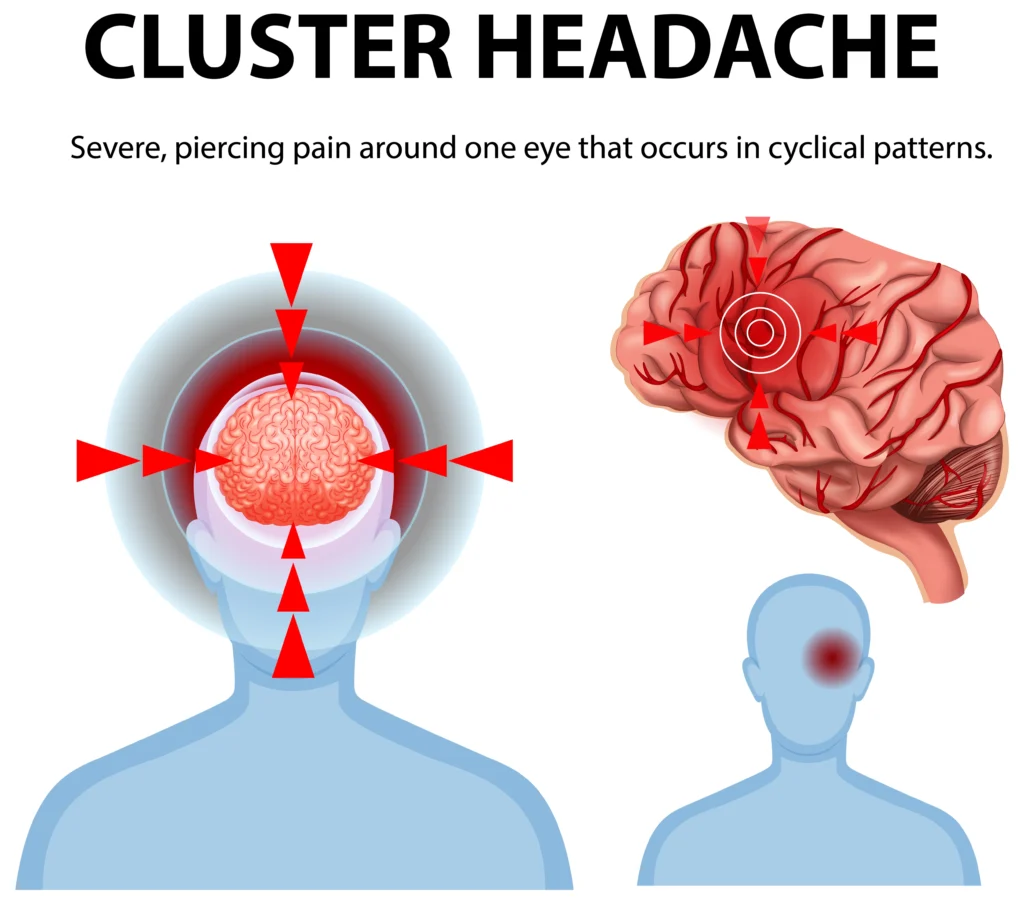
Cluster headaches are often misdiagnosed.
Common mislabels include:
- migraine
- eye strain
- sinus headache
Accurate diagnosis depends on recognizing the pattern of:
- one-sided pain
- timing
- associated symptoms
Delays in diagnosis are still common in clinical practice.
Common Mistakes People Make
- Ignoring the pattern and treating it like a normal headache
- Taking over-the-counter painkillers repeatedly
- Not tracking timing and triggers
- Delaying medical consultation
- Overlooking sleep and lifestyle factors
Medical Treatment Options
During an attack
- High-flow oxygen therapy
- Fast-acting triptans
Oxygen therapy is one of the most effective immediate treatments (Robbins et al., 2021)
Preventive treatment
- Verapamil
- Lithium
- Corticosteroids
Newer approaches are exploring CGRP-targeted therapies and neuromodulation techniques.
During an Attack vs Between Attacks
During an attack:
- Focus on fast relief like oxygen or prescribed medication
- Stay in a position that feels most comfortable
- Avoid trying random remedies
Between attacks:
- Work on sleep routine and consistency
- Address posture and neck stiffness
- Practice breathing exercises daily
- Identify and avoid triggers
Where Physiotherapy Helps
Let’s keep this realistic.
Physiotherapy does not cure cluster headaches.
But it helps in ways that matter long term.
What we focus on
- improving neck mobility
- reducing muscle tension
- correcting posture
- retraining breathing
- calming the nervous system
This combination helps reduce:
- baseline tension
- trigger sensitivity
- recovery time between episodes
What You Can Do at Home
- Maintain a consistent sleep schedule
- Avoid alcohol during active cluster periods
- Use a cold compress near the painful area
- Practice slow nasal breathing daily
- Limit long screen hours without breaks
- Track your headache timing and triggers
Track Your Triggers Like This
- Note the time of each headache
- Write down what you ate or drank
- Track your sleep timing
- Observe stress or activity levels
- Look for repeating patterns
This helps you understand your own triggers better.
Lesser Known Facts About Cluster Headaches
- They affect roughly 1 in 1000 people
- More common in men, but increasing in women
- Often linked with REM sleep phases
- Alcohol triggers attacks only during active cycles
- Some people notice seasonal patterns
When Cluster Headaches Become Chronic
- Attacks occur without long pain-free periods
- Symptoms persist for more than a year
- Management becomes more complex
This requires close medical supervision and long-term management strategies.
Myths and Facts About Cluster Headaches
- Myth: It is just a severe migraine
Fact: It is a completely different condition - Myth: Only stress causes it
Fact: It involves neurological and biological factors - Myth: Painkillers are enough
Fact: They often do not work effectively - Myth: It happens randomly
Fact: It often follows a fixed pattern
When You Should Seek Help
Do not ignore these signs:
- repeated one-sided eye pain
- attacks at the same time daily
- tearing and nasal symptoms
Early diagnosis can prevent years of confusion and ineffective treatment.
Red Flags You Should Not Ignore
- First-ever severe headache in your life
- Sudden worst headache with no history
- Headache with fever, confusion, or weakness
- Vision loss or double vision
- Headache after injury
If you notice any of these, seek medical care immediately.
The Emotional Side That Often Gets Ignored
- Fear of the next attack
- Sleep anxiety
- Frustration from repeated cycles
- Feeling misunderstood by others
These are real experiences, and they deserve attention along with physical symptoms.
Final Thoughts from a Physiotherapist
Cluster headaches are intense, unpredictable, and exhausting.
But they are not something you have to face blindly.
Medication plays a key role. But your body also plays a role.
Your posture, your breathing, your nervous system state all influence how your body responds.
The goal is not just stopping pain during an attack.
It is helping your system become less reactive over time.
And that requires a more complete approach.
A Real Patient Pattern I Often See
One of my patients came in thinking it was just eye strain.
His headaches started every night around the same time.
He had already tried multiple medications.
When we assessed him, there was clear neck stiffness on one side and very shallow breathing patterns.
Over time, with medical treatment and physiotherapy support, his episodes became less intense and easier to recover from.
This is not a cure story. But it shows how small factors can influence a big condition.
Note: This article is for educational purposes and should not replace medical diagnosis or treatment. Always consult a qualified healthcare professional for proper evaluation.
Frequently Asked Questions
1. What is the main cause of cluster headaches?
Cluster headaches are linked to changes in brain areas like the hypothalamus, along with activation of pain pathways involving the trigeminal nerve.
2. How do cluster headaches feel?
They usually feel like sharp, burning pain around one eye and can become intense within minutes.
3. What is the fastest way to stop a cluster headache?
High-flow oxygen therapy and fast-acting prescribed medications are considered the most effective options.
4. Can cluster headaches go away on their own?
They often occur in cycles and may disappear for months or years before returning.
5. Are cluster headaches dangerous?
They are not life-threatening but require proper diagnosis and management due to their severity.
6. Can lifestyle changes help?
Yes, maintaining regular sleep, avoiding triggers, and improving overall body balance can help manage symptoms.
7. Is there a difference between migraine and cluster headache?
Yes, cluster headaches are shorter but more intense and usually come with restlessness and eye-related symptoms.
8. Can physiotherapy help with cluster headaches?
It can support long-term management by addressing posture, muscle tension, and breathing patterns.
Stay tuned with us for more health related topics.
Follow us on LinkedIn and Instagram for more.
More Read


Medical Disclaimer!
This article has been reviewed and written under the guidance of our Head Physiotherapist, Dr. Kruti Raj (PT, MUHS,CPT,CMPT). The information shared is intended for educational purposes only and should not be considered a substitute for personalized medical advice, diagnosis, or treatment.
Please consult us or any other qualified healthcare professional before beginning any exercise program, especially if you are experiencing pain, recovering from injury, or managing a medical condition.


