How physiotherapists assess headaches goes beyond just symptoms.
We systematically identify the root cause to guide the right treatment from the start.
When a patient walks in with a headache, I do not jump into treatment.
I slow things down.
Because most failed treatments happen for one reason.
The headache was misunderstood from the start.
In real clinical practice, the first few minutes tell me far more than any scan or exercise plan.
Quick Answer
When assessing a headache patient, the first priority is understanding the pattern through detailed history and ruling out red flags. A physiotherapist then evaluates neck movement, posture, and muscle trigger points to identify whether the headache is mechanical, stress-related, or requires medical referral. Proper assessment ensures accurate treatment rather than temporary relief.
Key Takeaways
- Headache assessment starts with listening to the patient’s story, not rushing to treatment
- Red flags must always be ruled out before physiotherapy intervention
- The cervical spine is a major but often overlooked source of headaches
- Movement testing helps identify whether the headache is mechanical
- Trigger points in neck muscles can refer pain to the head
- Posture, sleep, and daily habits strongly influence headache patterns
- Not all headaches need physiotherapy. Some require medical referral
- Correct diagnosis leads to long-term relief, not just temporary fixes
I Start by Listening, Not Interrupting
I usually begin with one simple line.
“Tell me how your headache feels from start to finish.”
Then I let them talk.
Patients often describe patterns without realizing how useful they are.
While they speak, I quietly observe:
- Where the pain begins
- How it spreads
- What makes it worse
- What they do when it starts
Sometimes, even their body language gives clues. Guarded neck, tired eyes, or constant shifting.
Clinical evidence supports this approach.
A detailed history alone can guide diagnosis in most primary headaches. (Ashina et al. 2021)
What Patients Usually Say
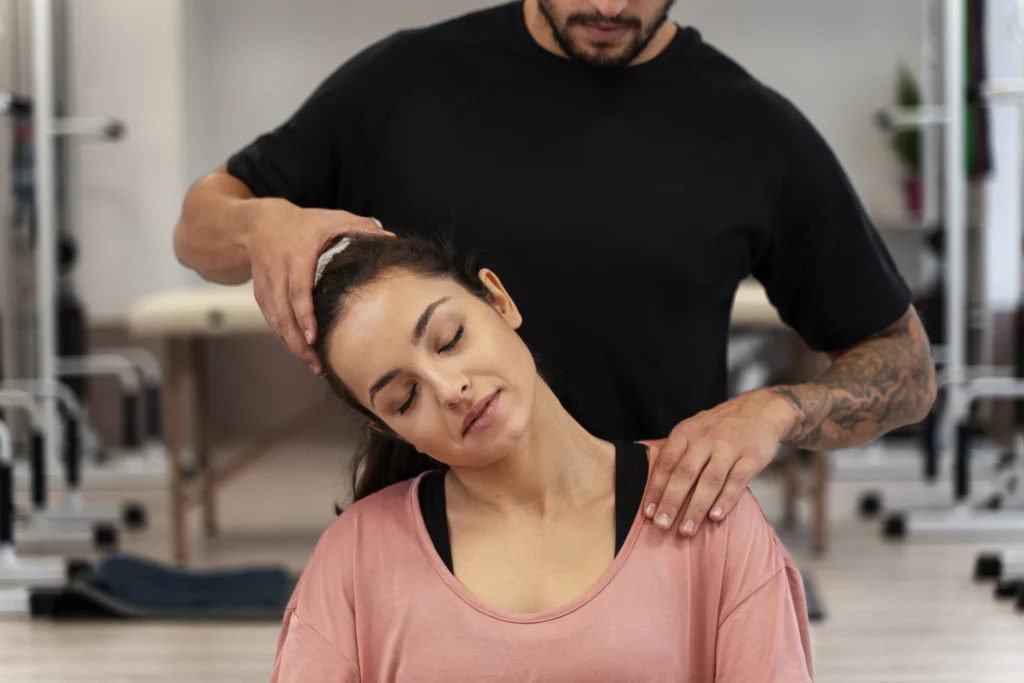
Over time, certain sentences repeat in the clinic.
And they often point directly to the cause.
You’ll hear things like:
- “It starts from here” (pointing to the base of the skull)
- “It comes after long laptop work”
- “Massage helps, but it comes back”
- “It’s worse by evening”
- “Pain goes from neck to eye”
These are not random complaints.
They are patterns.
And once you start noticing them, assessment becomes faster and clearer.
Before Anything Else, I Rule Out Red Flags
This step is non-negotiable.
Before thinking like a physiotherapist, I think about safety.
There are certain symptoms I never ignore.
What I actively screen for
- Sudden severe headache
- Fever with neck stiffness
- Visual disturbance or confusion
- Weakness or numbness
- Headache after trauma
- New onset headache in older age
If any of these are present, I stop the physio pathway and refer.
Because these can indicate serious conditions. (Dodick 2018)
There is also a simple clinical framework called SNOOP that helps identify dangerous headaches early. (American Academy of Family Physicians 2022)
Then I Shift My Attention to the Neck
This is where many patients get surprised.
A large number of headaches I see are not coming from the head itself.
They are coming from the cervical spine.
What I check
- Neck rotation
- Pain on looking up or down
- Stiffness on one side
- Reproduction of headache with pressure
If I can reproduce the headache by pressing or moving the neck, that is a strong clinical sign.
Cervicogenic headaches follow this exact pattern. (Hall et al. 2010)
I Observe Posture Without Making It Obvious
Before I even touch the patient, I observe how they sit.
Most do not notice this.
Common patterns I see daily
- Forward head posture
- Rounded shoulders
- Laptop placed too low
- Phone use with bent neck
These positions load the cervical spine continuously.
Over time, that load builds into pain. (Neupane et al. 2017)
Even a small forward shift of the head increases stress on neck muscles more than people expect.
I Test If Movement Changes the Headache
This is a simple but powerful step.
I ask the patient to move their neck.
- Turn left and right
- Look up
- Bend forward
Then I watch closely.
What I am looking for
If movement changes the headache, it is often mechanical.
If movement does not affect it at all, I start thinking beyond the neck.
This helps me avoid guessing.
A Simple Self-Check You Can Try
This is something I often tell patients during assessment.
Try this once when you have a headache.
- Sit upright
- Slowly turn your head left and right
- Then gently look up
Now ask yourself:
- Did the headache increase?
- Did it feel the same?
- Did it reduce slightly?
If your headache changes with movement, there is a good chance your neck is involved.
It is not a diagnosis.
But it is a useful clue.
I Check Muscle Trigger Points
Trigger Point is one of the most revealing parts of the assessment.
I gently press specific muscles.
Sometimes the response is immediate.
“That is exactly my headache.”
Muscles I often check
- Suboccipital muscles
- Upper trapezius
- Sternocleidomastoid
These muscles can refer pain into the head.
Many patients think the pain is in the head, but the source is elsewhere. (Fernández-de-Las-Peñas et al. 2006)
I Try to Understand the Pattern, Not Just the Pain
Instead of labeling quickly, I look for patterns.
Common patterns I see
If pain starts in the neck and travels upward, usually one side
I think cervicogenic
If it feels like tight pressure around the head
I think tension-type
If it is throbbing with light sensitivity or nausea
I think migraine
This pattern-based thinking aligns with international headache classifications. (Olesen 2018)
I Always Ask About Sleep
This is often ignored by patients.
But it matters more than expected.
I ask simple questions:
- How many hours do you sleep
- Do you wake up refreshed
- Do you wake with headache
Poor sleep increases pain sensitivity. (Rains et al. 2015)
Morning headaches, in particular, often point toward sleep posture or jaw clenching.
I Check Stress, But Differently
Instead of asking “Are you stressed”, I ask better questions.
- Do your headaches come after long work hours
- Do your shoulders feel tight most of the day
This gives more honest answers.
Stress does not just affect mood. It changes how the body processes pain.
I Look for Small Lifestyle Triggers
These are easy to miss but very real.
Lesser known triggers
- Dehydration
- Skipping meals
- Caffeine withdrawal
- Long screen exposure
- Poor breathing habits
- Even mild dehydration can trigger dehydration headaches in some individuals. (Spigt et al. 2012)
Early Signs People Usually Ignore
Before headaches become frequent, the body gives warnings.
Most people ignore them.
- Mild neck stiffness in the morning
- Tight shoulders by afternoon
- Occasional headache after screen use
- Needing frequent neck cracking
These are early signals.
If addressed early, chronic headaches can often be prevented.
I Match Findings With Symptoms
This is important.
Not every abnormal finding is relevant.
Someone can have neck stiffness but no neck-related headache.
So I always ask myself:
Does this finding explain the patient’s symptoms?
If yes, I proceed.
If not, I keep looking.
What I Avoid Doing (Common Mistakes)
There are a few things I consciously avoid.
Because they lead to wrong treatment.
- I do not assume every headache is posture-related
- I do not treat based only on pain location
- I do not ignore red flags just because the patient is young
- I do not start exercises without clear reasoning
One wrong assumption can delay recovery.
So slowing down actually saves time.
I Decide If Physiotherapy Is the Right Approach
I do not treat every headache.
I proceed with physiotherapy if
- Headache is reproducible
- Neck involvement is clear
- No red flags are present
I refer if
- Symptoms do not match mechanical patterns
- Neurological signs are present
- No response to initial treatment
This decision is critical.
How I Explain It to My Patients
Once I understand the cause, I explain it in simple terms.
Not medical language.
For example:
- “Your headache is coming from your neck joints”
- “Your muscles are overworking because of posture”
- “This is more of a sensitivity issue, not damage”
When patients understand the reason, they stop fearing the pain.
And that alone reduces the intensity sometimes.
What Most Patients Realize After Assessment
Many patients come in thinking the problem is inside the head.
But often, it is:
- Coming from the neck
- Driven by posture
- Influenced by sleep and stress
Once they understand this, treatment becomes easier and more effective.
Small Daily Habits That Help More Than You Think
Simple changes can reduce headache frequency.
- Keep screen at eye level
- Take short breaks every 30-40 minutes
- Avoid holding phone below chest level
- Stay hydrated
- Do not ignore early neck stiffness
These are small things. But they add up.
How This Changes Treatment
Because the assessment is clear, treatment becomes focused.
Not random.
For example:
- Neck-driven headache gets mobility and manual therapy
- Posture-related headache gets correction and endurance work
- Trigger point headache gets release techniques
This is why proper assessment matters more than quick fixes.
When Exercises Alone Are Not Enough
Sometimes patients say:
“I tried exercises from YouTube, but it didn’t help”
That happens because:
- The wrong muscles are being targeted
- The actual cause was not identified
- The dosage is incorrect
Exercises are useful.
But only when they match the problem.
What Recovery Usually Looks Like
Patients often expect headaches to disappear instantly.
That rarely happens.
What I usually see instead:
- First, intensity reduces
- Then frequency reduces
- Then triggers become less sensitive
Some days feel better, some don’t. That is normal.
Consistent improvement matters more than quick relief.
One Thing I Have Learned Over Time
If a headache can be reproduced, it can usually be improved.
Final Thoughts
A headache is not just pain.
It is a signal.
If you listen carefully, assess properly, and connect the patterns, the body usually tells you exactly what is wrong.
And in my experience, once the cause is understood, recovery becomes much more predictable.
Quick Summary
If you want to remember just a few things:
- Most headaches are not random
- The neck is often involved
- Movement gives important clues
- Posture and lifestyle play a big role
- Proper assessment matters more than quick fixes
Frequently Asked Questions
1. What is the first thing a physiotherapist checks in a headache patient?
A detailed history is taken to understand the pattern, triggers, and type of headache before physical examination.
2. Can neck problems really cause headaches?
Yes, cervicogenic headaches originate from the cervical spine and are commonly linked to posture and muscle dysfunction.
3. What are red flags in headaches?
Sudden severe headache, neurological symptoms, fever, or trauma-related onset require immediate medical attention.
4. How do I know if my headache is posture-related?
If your headache worsens after long sitting, screen time, or improves with movement, posture may be a contributing factor.
5. Are trigger points a real cause of headaches?
Yes, tight muscle knots in the neck and shoulders can refer pain to the head and mimic other headache types.
6. Is physiotherapy effective for headaches?
Physiotherapy is highly effective for cervicogenic and tension-type headaches when the root cause is identified correctly.
7. When should I see a physiotherapist?
If your headaches are frequent, related to neck pain, or triggered by posture, physiotherapy can help.
Stay tuned with us for more health related topics.
Follow us on LinkedIn and Instagram for more.
More Read





Medical Disclaimer!
This article has been reviewed and written under the guidance of our Head Physiotherapist, Dr. Kruti Raj (PT, MUHS,CPT,CMPT). The information shared is intended for educational purposes only and should not be considered a substitute for personalized medical advice, diagnosis, or treatment.
Please consult us or any other qualified healthcare professional before beginning any exercise program, especially if you are experiencing pain, recovering from injury, or managing a medical condition.