
Shoulder bursitis treatment at home isn’t optional, your shoulder is already warning you.
If you search online, you’ll read that shoulder bursitis is inflammation of a fluid-filled sac.
That’s true, but not the full picture.
In clinic, I rarely see bursitis as a standalone issue.
Most patients actually have a broader condition called subacromial pain syndrome.
This includes irritation of the bursa, rotator cuff tendons, and reduced space in the shoulder. (Lewis 2015)
So instead of thinking “my bursa is inflamed,” it’s more useful to think:
Something in your shoulder movement is not working well.
Quick Answer
Shoulder bursitis is usually caused by poor shoulder movement and muscle imbalance rather than just inflammation. The most effective treatment is physiotherapy focused on restoring movement, strength, and control. Rest and medication may help temporarily, but long-term relief comes from correcting how your shoulder moves.
Key Takeaways
- Shoulder bursitis is often part of a larger movement problem, not just inflammation.
- Physiotherapy and exercise-based rehab are the most effective treatments.
- Complete rest can slow recovery rather than help it.
- Posture and muscle control play a major role in both cause and recovery.
- Injections may reduce pain but do not fix the root issue.
- Consistency in rehab is more important than intensity.
Understanding the Bursa Without Overcomplicating It
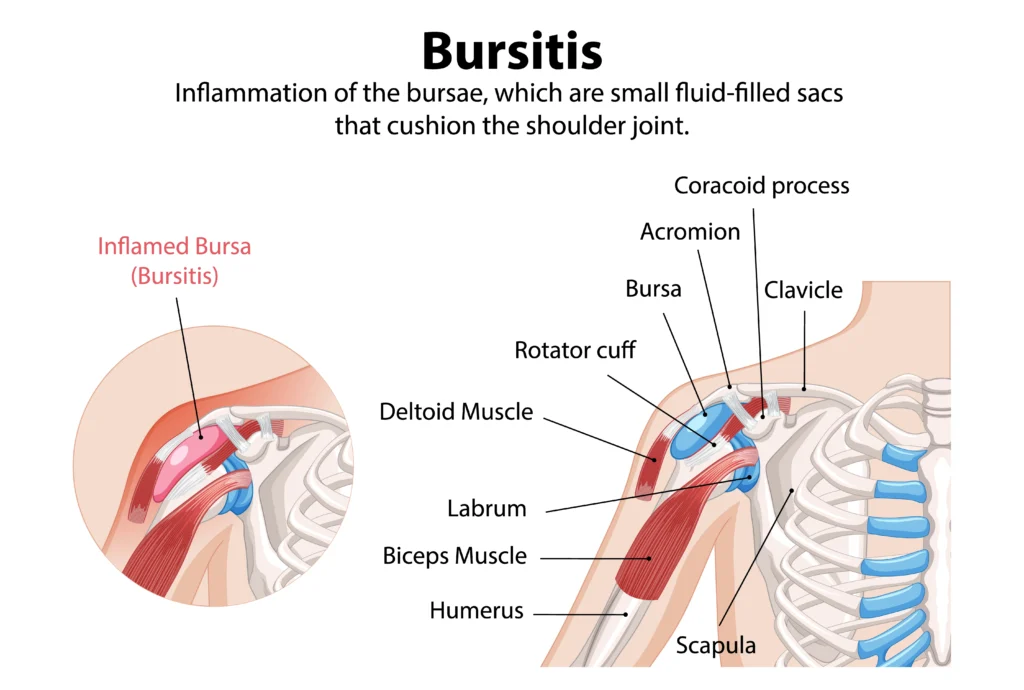
The bursa is a small fluid cushion that sits between your rotator cuff and the acromion.
Its job is simple. Reduce friction when you lift your arm.
But here’s what most people miss.
The bursa does not get irritated on its own.
It reacts to how your shoulder moves.
When movement is smooth, the space stays open and everything glides well.
When movement is off, that space becomes tight.
The bursa starts getting compressed again and again
Over time, this leads to irritation.
So it’s not just about overuse.
It’s about how your shoulder handles that movement
That’s why fixing movement matters more than just reducing pain.
What Actually Causes Shoulder Bursitis
Let’s simplify it.
It is not random.
It builds over time.
Common real-world causes
- Repetitive overhead activity
- Poor posture from desk work
- Weak rotator cuff
- Poor scapular control
- Sudden increase in gym or sports load (Hanratty et al. 2012)
In many cases, patients say:
“I did nothing unusual.”
But when we assess movement, the issue has usually been building for months.
A Pattern I See Very Often in Clinic
A patient walks in saying:
“I don’t know what happened. It just started hurting.”
But when we talk:
- Long hours at desk
- No upper back strength work
- Sudden weekend gym session
The shoulder was not injured in one moment. It was building up slowly
Daily Activities That Secretly Make Shoulder Bursitis Worse
Most people are not injured in the gym.
They are irritating their shoulder all day without realizing it.
Watch out for:
- Sleeping on the same painful shoulder
- Working on a laptop with rounded shoulders
- Reaching overhead repeatedly (kitchen shelves, cupboards)
- Holding phone between ear and shoulder
- Carrying heavy bags on one side
Fixing these small habits often reduces shoulder pain faster than any treatment
A Lesser Known but Important Insight
Recent research shows the bursa is not just passively inflamed.
It can be mechanically irritated during movement due to poor coordination of shoulder structures. (Garofalo et al. 2025)
This means:
Even normal movement can become painful if mechanics are off.
Symptoms You Should Pay Attention To
Instead of memorizing a list, notice this pattern.
- Pain when lifting arm sideways
- Pain between mid range of movement
- Night pain when lying on that side
- A dull, deep ache rather than sharp injury pain
If pain is constant and stiffness is severe, it may not be bursitis alone.
Early Warning Signs People Usually Ignore
Before pain becomes constant, the body gives signals.
Most people miss them.
- Mild discomfort when reaching overhead
- Slight stiffness in the morning
- Clicking or tight feeling in the shoulder
- Fatigue in the shoulder after simple tasks
These are early signs, not “normal”
If you act here, recovery is much faster.
How to Know If It’s Really Shoulder Bursitis
Try this simple self-check at home:
- Lift your arm sideways slowly
- Notice if pain increases in the middle range
- Lower it and see if pain reduces
Now try this:
- Keep your arm close to your body
- Rotate your forearm outward
If this feels weak or painful, your rotator cuff may also be involved
If both tests trigger discomfort, it is likely not just bursitis but a combination issue
Do not panic. This is very common and very treatable.
Why Painkillers Are Not a Real Solution
Painkillers reduce symptoms.
They do not fix the reason behind the problem. (Babatunde et al. 2021)
This is why many people feel better for a few days, then pain comes back.
The Physiotherapy Approach That Actually Works
This is where real recovery happens.
Not passive treatment.
Not rest alone.
Phase 1: Settle Pain
- Gentle pendulum movements
- Avoid painful overhead activity
Phase 2: Restore Movement
- Assisted range of motion
- Improve shoulder coordination
Phase 3: Strengthen Key Muscles
- Rotator cuff
- Scapular stabilizers (Littlewood et al. 2013)
Phase 4: Return to Function
- Controlled overhead movement
- Activity specific training
Skipping steps often leads to recurrence.
Simple Exercises For Shoulder Bursitis That Actually Help
Keep it simple. Consistency matters more than complexity.
Here are the basics that actually make a difference:
Pendulum swings
- Let your arm relax and hang
- Gently move it in small circles
- Helps reduce stiffness and settle pain
Wall slides
- Slide your arms up along a wall
- Keep movement slow and controlled
- Improves mobility and coordination
External rotation with band
- Keep elbow close to your body
- Rotate your forearm outward
- Strengthens the rotator cuff
Scapular retraction
- Gently pull your shoulder blades back
- Do not shrug
- Improves posture and shoulder control
Do these in a pain-free range.
Slow, controlled movement is more important than repetitions
These exercises don’t just reduce pain.
They help correct the reason the pain started.
A Simple 10-Minute Routine For Shoulder Bursitis Treatment At Home
You can do this daily:
- 2 minutes pendulum swings
- 2 minutes wall slides
- 2 minutes band external rotation
- 2 minutes scapular squeezes
- 2 minutes relaxed breathing and shoulder mobility
Keep it slow. No sharp pain.
Consistency matters more than intensity
How to Progress Exercises Safely
Do not rush to the next level too quickly.
Use this simple rule:
- No sharp pain during exercise
- No increase in pain the next day
- Movement feels smoother, not tighter
If all three are okay, you can progress.
Progression can be:
- Increasing resistance slightly
- Increasing repetitions
- Moving to more functional movements
If pain spikes, step back, not forward
Recovery is not linear. That’s normal.
What About Injections or Surgery
Steroid injections can reduce pain.
They calm inflammation and can make movement easier for a short time.
But the effect is often temporary. (Cook et al. 2023)
If movement is not corrected, symptoms often return.
Think of injections as a window of relief. Not a long-term fix
They are most useful when pain is too high to start rehab.
Once pain settles, exercise becomes the priority.
What About Surgery
Surgery is rarely needed.
It is usually considered only when:
- Pain persists despite proper rehab
- There is a rotator cuff tear or structural damage
- Daily function is significantly affected
Even then, physiotherapy remains essential before and after surgery.
Most people recover well without surgery when rehab is done properly
Why Shoulder Pain Feels Worse at Night
Patients often notice this.
It is not random.
- Increased pressure on the shoulder
- Reduced movement
- Increased sensitivity
A simple fix that helps many people:
Sleep on your back or the opposite side with support under the arm.
Recovery Timeline You Can Expect
Be realistic.
- Mild cases: 3 to 4 weeks
- Moderate: 6 to 10 weeks
- Chronic: 3 months or more
Progress depends on how consistent your rehab is.
Why Some People Don’t Recover Fully
It is usually not because the condition is severe.
It is because:
- Rehab is inconsistent
- Exercises are done incorrectly
- Root cause is not addressed
- Pain improves but strength is ignored
Recovery is not just pain relief. It is restoring function
Mistakes That Delay Recovery
These are very common.
- Completely resting the shoulder
- Random exercises from the internet
- Ignoring posture
- Stopping rehab once pain reduces
Pain going away does not mean the problem is solved.
Better Options for Your Shoulder
Instead of stopping movement completely, modify it:
- Replace overhead lifting with chest-level exercises
- Replace heavy weights with light resistance and slow control
- Replace push-ups with wall push-ups
- Replace sleeping on the painful side with supported back sleeping
The goal is not rest. The goal is smart movement
How to Modify Gym Workouts Without Stopping Completely
You don’t have to quit the gym.
You just need to train smarter for a few weeks.
Avoid temporarily:
- Overhead presses
- Lateral raises above shoulder height
- Heavy bench press
- Upright rows
You can still do:
- Chest press at a lower angle
- Rows (keep elbows close)
- Biceps and triceps work
- Lower body training
Keep pain below 3 out of 10. Focus on control, not weight
This way, you stay active without irritating the shoulder.
A Factor Most People Ignore
Pain is not only physical.
Stress, poor sleep, and fear of movement can increase pain perception. (Cook et al. 2023)
Addressing these improves recovery.
Posture Reset You Can Do Anywhere
Shoulder bursitis treatment at home starts now.
Try this simple reset:
- Sit or stand tall
- Gently pull shoulders back and down
- Imagine your chest opening slightly
- Hold for 10 seconds
- Repeat 5 times
Do this every 2 to 3 hours if you sit a lot
This alone reduces pressure in the shoulder space
When You Should Seek Help
- Pain lasting more than 2 weeks
- Difficulty lifting your arm
- Night pain not improving
- Repeated episodes
Early rehab is easier than late recovery.
When It’s NOT Just Bursitis
Sometimes symptoms look similar but the cause is different:
- Frozen shoulder
- Severe stiffness in all directions
- Rotator cuff tear
- Weakness more than pain
- Neck-related pain
- Pain radiates down the arm
If symptoms don’t match typical patterns, proper assessment is important
Quick Do’s and Don’ts
Do:
- Keep shoulder moving gently
- Follow structured exercises
- Improve posture
- Be consistent
Don’t:
- Stop movement completely
- Push through sharp pain
- Rely only on painkillers
- Jump back into heavy workouts
Final Thoughts
Shoulder bursitis can feel frustrating, especially when simple movements like lifting your arm or sleeping become uncomfortable.
But here’s the reassuring part.
In most cases, it is very manageable and highly recoverable.
The key is to shift your focus:
- Not just reducing pain
- But improving how your shoulder moves
You don’t need complicated routines or aggressive treatment.
You need:
- Consistent, simple exercises
- Better movement control
- Awareness of daily habits
Small changes done regularly create the biggest results.
Also remember, pain improving does not mean the job is done.
Strength, control, and movement quality are what keep the pain from coming back.
If something doesn’t feel right, don’t ignore it.
The right shoulder bursitis treatment at home can calm the inflammation and restore movement.
But ignoring it now may turn a simple problem into chronic shoulder pain.
Early correction is always easier than long recovery.
Take it step by step. Stay consistent.
Your shoulder will thank you for it.
Frequently Asked Questions
1. Can shoulder bursitis go away on its own?
Mild cases may improve with rest, but most need proper physiotherapy to prevent recurrence and fully recover.
2. Should I stop exercising completely?
No. You should modify exercises, not stop completely. Gentle movement helps recovery.
3. How long does shoulder bursitis take to heal?
Most cases improve within 4 to 12 weeks depending on severity and consistency of rehab.
4. Why does shoulder pain get worse at night?
Increased pressure, reduced movement, and sensitivity make pain more noticeable at night.
5. Are steroid injections necessary?
Only in severe cases. They provide short-term relief but do not fix the underlying cause.
6. Can poor posture cause shoulder bursitis?
Yes. Poor posture reduces shoulder space and increases irritation over time.
7. Can I go to the gym with shoulder bursitis?
Yes, but with modified exercises and proper guidance to avoid aggravating the shoulder.
8. Will shoulder bursitis come back?
It can, if the underlying movement and strength issues are not corrected.
Stay tuned with us for more health related topics.
Follow us on LinkedIn and Instagram for more.
More Read






Medical Disclaimer!
This article has been reviewed and written under the guidance of our Head Physiotherapist, Dr. Kruti Raj (PT, MUHS,CPT,CMPT). The information shared is intended for educational purposes only and should not be considered a substitute for personalized medical advice, diagnosis, or treatment.
Please consult us or any other qualified healthcare professional before beginning any exercise program, especially if you are experiencing pain, recovering from injury, or managing a medical condition.