Physiotherapy for back pain in pregnancy can help reduce muscle strain and support safer movement throughout pregnancy.
Pregnancy changes the body in ways most women are never fully prepared for.
One week you feel normal, and the next you notice your lower back aching while folding clothes, standing in the kitchen, or simply turning in bed at night.
For some women, the discomfort stays mild.
For others, it slowly becomes part of everyday life.
As a physiotherapist, I often hear pregnant women say things like:
“I thought back pain was supposed to happen only in the last trimester.”
Or:
“I stopped exercising because I was scared I’d make it worse.”
The truth is, pregnancy-related back pain is extremely common, but suffering through it quietly is not something you have to accept.
Quick Answer
Pregnancy back pain is extremely common and is often caused by posture changes, pelvic instability, muscle fatigue, and pressure on the spine as the baby grows. Gentle physiotherapy-based exercises such as pelvic tilts, cat-camel stretches, walking, glute strengthening, and breathing exercises can help reduce stiffness, improve posture, and support the lower back safely during pregnancy.
Many women notice their pain improves when they move regularly instead of resting all day. However, severe pain, numbness, bleeding, or contractions should always be evaluated by a healthcare professional.
The right exercises can genuinely help. Not aggressive workouts.
Not complicated gym routines.
Just simple movement strategies that improve support around the spine, reduce pressure on the pelvis, and help your body adapt better to pregnancy.
Research shows that nearly 50 to 70% of pregnant women experience low back pain or pelvic girdle pain during pregnancy. (PMC)
But what many women do not realize is that pain during pregnancy is not always caused by “weight gain.”
Sometimes the issue is poor muscle coordination, tight hips, shallow breathing, reduced movement, or fatigue from standing too long.
And interestingly, some women actually feel better once they start moving more consistently.
Key Takeaways
- Pregnancy back pain often develops because muscles and joints work harder to support the growing baby.
- Pelvic tilts, walking, cat-camel stretches, and glute strengthening are among the safest physiotherapy-recommended exercises.
- Standing too long in one position may worsen discomfort more than gentle walking.
- Weak hips and poor breathing mechanics are commonly overlooked contributors to back pain during pregnancy.
- Supportive sleeping positions with pillows between the knees can reduce pelvic strain at night.
- Complete bed rest may increase stiffness and muscular weakness in many pregnancies.
- Pregnancy support belts may provide temporary relief but should not replace strengthening exercises.
- Seek medical attention immediately if back pain is associated with bleeding, contractions, fever, numbness, or severe weakness.
Why Pregnancy Back Pain Happens in the First Place
Pregnancy changes posture gradually.
As the abdomen grows, the body naturally shifts forward.
To avoid falling, many women lean backward slightly without realizing it.
That extra arch in the lower spine increases pressure on muscles and joints around the lumbar area.
At the same time, hormones such as relaxin loosen ligaments around the pelvis and spine to prepare the body for childbirth.
That sounds helpful in theory, but looser joints also mean the surrounding muscles have to work harder to stabilize the body.
This is one reason many women feel pain while:
- climbing stairs
- getting out of the car
- standing on one leg
- walking for long periods
- turning in bed
A lot of pregnant women are surprised that their pain feels worse after resting too long.
That actually makes sense.
Stiff muscles and joints often become more sensitive when movement decreases.
Types Of Pregnancy Back pain
Pregnancy back pain generally falls into two major categories:
Pregnancy-Related Low Back Pain (PLBP)
Usually felt around:
- lumbar spine
- lower back muscles
- waistline
Often worsens with:
- prolonged standing
- bending
- lifting
- prolonged sitting
Pelvic Girdle Pain (PGP)
Usually felt around:
- sacroiliac joints
- buttocks
- pubic bone
- hips
- groin
Often worsens with:
- walking
- stairs
- turning in bed
- standing on one leg
- getting in/out of car
Physiotherapists differentiate between these carefully because treatment strategies can differ significantly. (Physiopedia)
One Thing I Notice Frequently in Pregnant Patients
Many women stretch their lower back constantly because it feels tight.
But sometimes the lower back is not truly “tight.” It is overworking.
The real issue is often:
- weak glute muscles
- reduced deep core support
- stiff hips
- poor rib mobility
When the hips and pelvis stop sharing movement properly, the lower back compensates.
That is why random stretching alone usually does not solve pregnancy back pain.
What Kind of Exercise Helps Most?
The best exercises during pregnancy are usually the ones that:
- improve pelvic stability
- strengthen glutes
- reduce stiffness
- improve posture
- support breathing mechanics
- keep the body moving without exhausting it
You do not need intense workouts.
In fact, many women feel better with short movement sessions spread throughout the day.
The American College of Obstetricians and Gynecologists still recommends regular moderate physical activity during uncomplicated pregnancies. (ACOG Committee Opinion 2020)
Pregnancy Back Pain Relief Exercises That Actually Help
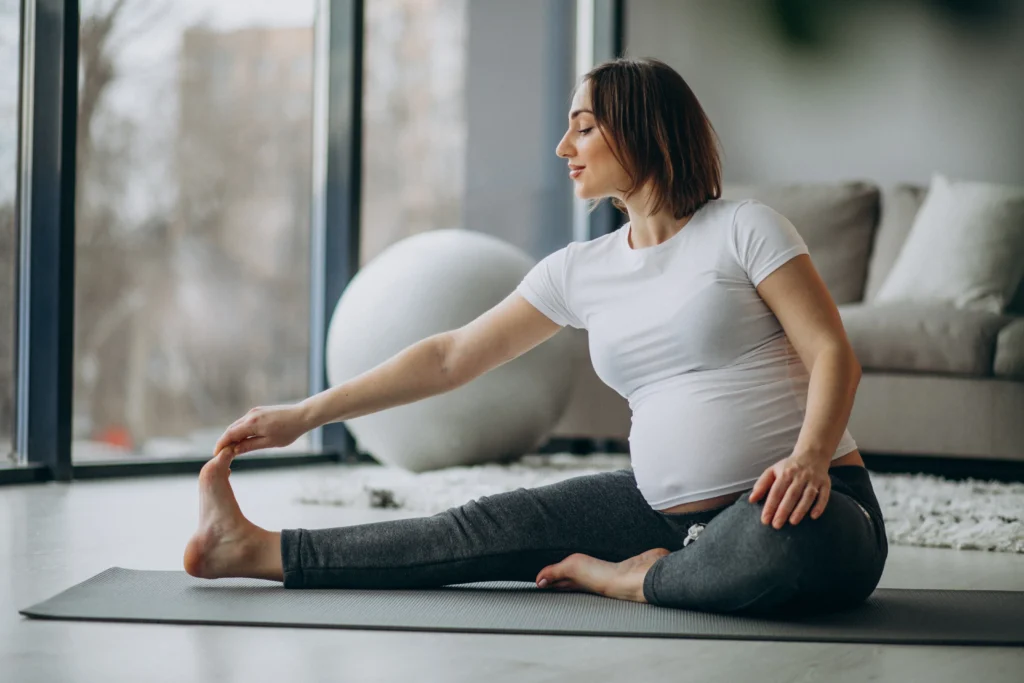
Pelvic Tilts
This is one of the safest and most effective exercises for many pregnant women.
It gently activates the deep abdominal muscles while reducing stiffness in the lower spine.
How to do it
- Stand with your back against a wall
- Keep knees slightly bent
- Gently flatten the lower back toward the wall
- Hold for 3 to 5 seconds
- Relax slowly
Do not force the movement.
A small controlled motion works best.
Some women feel immediate relief after a few repetitions because the exercise decreases pressure around the lumbar joints.
Cat-Camel Stretch
This movement improves spinal mobility without aggressive stretching.
Steps
- Come onto hands and knees
- Slowly round the back upward
- Then return to a neutral position
- Move slowly with breathing
Avoid dropping the belly too far downward.
The goal is mobility, not flexibility.
This exercise is especially helpful for women who feel stiff after prolonged sitting.
Glute Bridge Modification
A lot of pregnancy-related back discomfort comes from weak glutes.
When the glutes stop supporting the pelvis properly, the lower back takes over.
Modified Version
- Lie with upper back supported
- Keep feet hip-width apart
- Lift hips slightly
- Pause briefly
- Lower slowly
If lying flat feels uncomfortable, this exercise can be modified further with pillows or an elevated surface.
Advanced Physiotherapy Treatments for Back Pain During Pregnancy
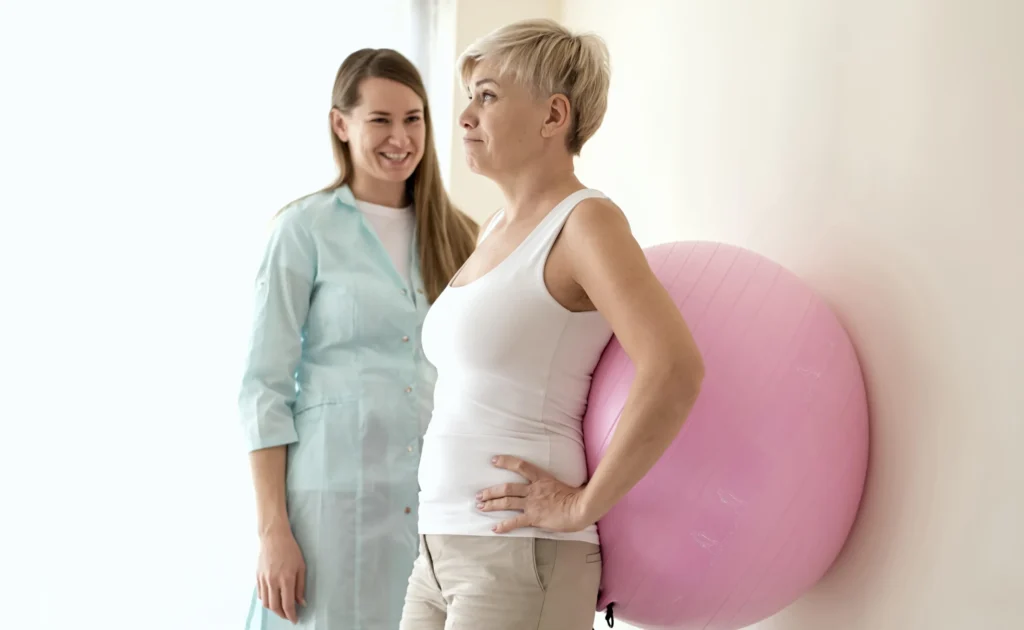
Pregnancy-related back pain is one of the most common musculoskeletal complaints treated by physiotherapists globally.
Studies estimate that more than 50-70% of pregnant women experience significant low back pain or pelvic girdle pain during pregnancy. (Nature)
What many women do not realize is that pregnancy back pain is rarely caused by a single factor.
Physiotherapists worldwide now approach pregnancy-related pain through a combination of:
- movement therapy
- pelvic stabilization
- breathing retraining
- manual therapy
- neuromuscular rehabilitation
- load management
- posture correction
- pain modulation techniques
Modern physiotherapy for back pain in pregnancy is no longer just “do some stretches and rest.”
Advanced physiotherapy treatments for back pain in pregnancy today are far more individualized, evidence-based, and function-focused.
Individualized Pelvic Stabilization Programs
This is currently one of the most widely recommended physiotherapy approaches worldwide.
Instead of aggressively stretching everything, physiotherapists focus on improving force transfer and pelvic stability.
Common Stabilization Exercises Include:
- glute bridges
- clamshells
- modified squats
- pelvic tilts
- transverse abdominis activation
- side-lying hip strengthening
- deep core coordination
Research strongly supports exercise therapy for reducing pregnancy-related lumbopelvic pain and disability. (NCBI)
One important modern physiotherapy shift:
Therapists now prioritize movement quality and load management over “perfect posture.”
Pelvic Floor Physiotherapy
Pelvic floor physiotherapy has become a cornerstone of modern pregnancy care.
Many pregnant women unknowingly over-grip pelvic muscles because of:
- pain
- stress
- instability
- fear of movement
Pelvic health physiotherapists assess:
- pelvic floor coordination
- breathing mechanics
- abdominal pressure management
- core-pelvic integration
Common Techniques Include:
- pelvic floor relaxation
- diaphragmatic breathing
- internal assessment (when appropriate)
- pressure management retraining
- core-pelvic synchronization exercises
This is especially useful for women with:
- pelvic heaviness
- pubic symphysis pain
- tailbone pain
- pelvic pressure
- urinary symptoms
Manual Therapy Techniques
Many physiotherapists worldwide use gentle manual therapy techniques safely during pregnancy.
These May Include:
- soft tissue mobilization
- myofascial release
- sacroiliac joint mobilization
- lumbar mobilization
- hip joint mobilization
- muscle energy techniques
- pregnancy-adapted massage therapy
Research reviews suggest manual therapy may improve pain and function in pregnancy-related low back and pelvic pain when appropriately applied. (NCBI)
Important Clinical Note:
Modern physiotherapy avoids aggressive spinal manipulation during pregnancy unless specifically indicated and performed by trained professionals.
Gentle, symptom-guided approaches are preferred.
Kinesiology Taping (K-Taping)
Kinesiology taping has become extremely popular in obstetric physiotherapy clinics internationally.
Common Applications:
- lumbar support
- abdominal unloading
- sacroiliac stabilization
- postural cueing
Some women experience reduced muscular fatigue and better support with taping, especially during second and third trimesters.
Benefits:
- non-invasive
- drug-free
- wearable during daily activities
- may improve proprioception
Physiotherapists commonly use:
- lumbar decompression taping
- abdominal lift taping
- SI joint stabilization taping
Pregnancy Support Belts and Pelvic Belts
Pelvic belts are widely recommended internationally for pelvic girdle pain.
These belts help reduce excessive pelvic shear forces and improve stability during walking and standing. (Nature)
Common Physiotherapy Recommendations:
- sacroiliac support belts
- pelvic compression belts
- maternity abdominal support bands
Reddit discussions among pregnant women frequently report improved function with professionally fitted support belts. (Reddit)
Lesser-Known Clinical Insight:
Improperly fitted belts can worsen symptoms.
Physiotherapists often teach:
- correct placement
- timing of use
- movement modifications alongside belt use
Belts should support rehabilitation, not replace muscle function entirely.
Aquatic Physiotherapy and Hydrotherapy
Hydrotherapy is considered one of the safest and most effective pregnancy pain treatments globally.
Why Water Therapy Works So Well:
Water:
- reduces spinal loading
- decreases joint compression
- improves circulation
- allows easier movement
- reduces fear of movement
Common Hydrotherapy Exercises:
- pool walking
- pelvic mobility drills
- gentle resistance exercises
- floating decompression exercises
- supported squats
Women with severe pelvic girdle pain often tolerate aquatic therapy better than land exercise.
Patient reports consistently describe pools as one of the most relieving environments for pregnancy pain. (Reddit)
Clinical Pilates for Pregnancy
Pregnancy-adapted clinical Pilates is now widely integrated into physiotherapy care internationally.
Unlike generic Pilates classes, physiotherapy-based clinical Pilates is highly individualized.
Focus Areas:
- deep core activation
- pelvic stability
- breathing coordination
- spinal control
- posture optimization
- hip strength
Clinical Pilates is especially helpful for:
- recurrent back pain
- hypermobility
- postural fatigue
- sedentary pregnancies
Neuromuscular Re-Education
This is one of the lesser-known but highly important physiotherapy strategies.
Pregnancy changes movement patterns dramatically.
Physiotherapists retrain:
- walking mechanics
- sit-to-stand movement
- stair climbing
- bed mobility
- lifting patterns
- pelvic coordination
Example:
Many women unknowingly worsen pelvic pain by:
- standing on one leg while dressing
- twisting while lifting
- taking large walking strides
Pregnancy physiotherapy often involves teaching safer movement strategies. (Physiopedia)
Breathing Retraining and Pressure Management
Modern physiotherapy increasingly recognizes breathing dysfunction as a major contributor to pregnancy pain.
As the uterus expands:
- rib mobility changes
- diaphragm mechanics alter
- abdominal pressure increases
This can overload:
- lumbar spine
- pelvic floor
- sacroiliac joints
Advanced Physiotherapy Approaches Include:
- diaphragmatic breathing
- 360-degree rib expansion
- exhale-on-effort training
- pressure control during lifting
This approach is now commonly integrated into pelvic health physiotherapy globally.
Myofascial Release Therapy
Myofascial restrictions can develop around:
- hips
- glutes
- thoracolumbar fascia
- abdominal wall
- pelvic muscles
Gentle myofascial release may help:
- improve tissue mobility
- reduce muscle guarding
- improve movement comfort
Many women describe relief after gluteal and hip soft tissue work. (Reddit)
Functional Movement Training
This is becoming one of the most important modern trends in prenatal physiotherapy.
Instead of isolated exercises alone, physiotherapists now train women in:
- real-life movement patterns
- load distribution
- movement efficiency
Functional Pregnancy Rehab Includes:
- safe squatting mechanics
- stair training
- lifting mechanics
- baby-carry preparation
- rolling strategies in bed
- standing endurance management
This reduces daily mechanical stress accumulation.
Modified Strength Training Programs
Contrary to old myths, properly supervised strength training during pregnancy is often beneficial.
Physiotherapists may include:
- glute strengthening
- hip abductors
- posterior chain training
- resistance bands
- bodyweight stability exercises
Many pelvic girdle pain patients report improvement when glute stability programs are introduced. (Reddit)
Important Modification:
Physiotherapists often reduce:
- unilateral loading
- deep asymmetrical lunges
- excessive twisting
- high-impact activities
because these may aggravate pelvic instability symptoms.
Prenatal Yoga Therapy
Physiotherapy-informed prenatal yoga can improve:
- mobility
- breathing
- relaxation
- pain modulation
- stress reduction
Evidence suggests yoga may reduce pregnancy-related low back pain intensity. (Physiopedia)
However, physiotherapists usually modify:
- deep backbends
- aggressive stretching
- prolonged supine positioning
- extreme hip-opening poses
TENS (Transcutaneous Electrical Nerve Stimulation)
TENS is used cautiously in some physiotherapy settings.
Potential Benefits:
- temporary pain relief
- reduced muscle spasm
- improved comfort during flare-ups
Physiopedia notes TENS may be used as a supplementary treatment with appropriate precautions during pregnancy. (Physiopedia)
Important:
Electrode placement and intensity must be pregnancy-safe and supervised professionally.
Ergonomic and Workplace Physiotherapy
This area is becoming increasingly important globally.
Physiotherapists assess:
- sitting posture
- workstation setup
- sleep positioning
- driving posture
- lifting techniques
Common Advice Includes:
- pillow between knees while sleeping
- avoiding prolonged standing
- avoiding asymmetrical loading
- shorter walking strides
- foot support during sitting (Physiopedia)
Techniques Physiotherapists Usually Avoid or Modify During Pregnancy
Experienced pregnancy physiotherapists are cautious with:
- aggressive spinal manipulation
- high-velocity thrust techniques
- strong abdominal pressure techniques
- prolonged flat supine exercises late pregnancy
- high-heat modalities over abdomen
- unsafe electrotherapy placement
Safety and trimester-specific modifications are essential.
Lesser-Known Physiotherapy Insights About Pregnancy Back Pain
Pain Is Not Always Due to Weakness
Sometimes pain comes from:
- excessive muscle guarding
- instability
- poor pressure management
- overactivity of stabilizing muscles
Walking Too Much Can Sometimes Worsen Pelvic Girdle Pain
This surprises many women.
For severe pelvic instability, excessive walking may aggravate symptoms temporarily.
Physiotherapists often carefully dose walking volume.
Glute Weakness Is a Huge Hidden Contributor
Modern pelvic rehab heavily emphasizes glute medius and hip stabilizer strengthening.
Stress Can Intensify Pregnancy Pain
Stress changes:
- breathing
- muscle tension
- posture
- nervous system sensitivity
This is why relaxation and nervous system regulation are increasingly integrated into physiotherapy.
An Interesting Clinical Observation
Women with stronger glutes often report less pelvic heaviness during late pregnancy.
That heaviness many women describe is sometimes linked more to muscular fatigue than to the baby’s weight itself.
Side-Lying Clamshells
This exercise targets hip stabilizers.
Steps
- Lie on your side
- Bend knees comfortably
- Keep feet together
- Lift the top knee slowly
- Lower gently
You do not need a large movement.
If your hips start shaking after a few repetitions, that is completely normal.
Pregnancy exercise is not about pushing hard.
Supported Child’s Pose
Traditional child’s pose may feel uncomfortable later in pregnancy, but widening the knees usually helps.
How to modify it
- Kneel comfortably
- Separate knees wider than hips
- Stretch arms forward
- Relax chest gently downward
This often relieves tension around the lower spine and ribs.
Some women also notice improved breathing afterward.
Walking
Walking remains one of the most underrated pregnancy exercises.
Not because it burns calories.
Because it keeps joints moving.
Gentle walking improves circulation, reduces stiffness, and helps maintain endurance without overloading the body.
But there is one mistake I see often.
Women continue walking even after fatigue changes their posture.
Once the body becomes tired, many start leaning backward excessively, which can worsen spinal discomfort.
Shorter walks with better posture are usually more helpful than very long walks done in exhaustion.
A Lesser-Known Reason Upper Back Pain Happens
Late pregnancy changes breathing mechanics.
As the rib cage expands, many women start breathing more from the chest and neck instead of the diaphragm.
This increases tension around:
- shoulders
- upper back
- neck muscles
That is why some women feel burning pain between the shoulder blades.
Not all pregnancy back pain comes from the lower back.
Rib Expansion Breathing
This simple breathing drill can reduce upper body tension surprisingly well.
Steps
- Sit comfortably
- Place hands around the ribs
- Inhale slowly into the sides of the rib cage
- Exhale gently without force
Many women notice they stop clenching their shoulders once breathing improves.
Pelvic Girdle Pain Feels Different
Some women do not have traditional lower back pain.
Instead, they feel:
- sharp pain near the pubic bone
- pain while turning in bed
- discomfort during single-leg activities
- clicking sensations around the pelvis
This may be pelvic girdle pain.
Research suggests pelvic girdle pain affects a significant number of pregnancies and can interfere with daily activities. (PMC)
In these cases, aggressive stretching sometimes makes symptoms worse.
Stability exercises usually work better than overstretching.
Things That Quietly Make Pregnancy Back Pain Worse
Some triggers are surprisingly common.
Standing too long
Kitchen work is a huge trigger for many pregnant women.
Standing in one place creates more fatigue than walking slowly.
Constipation
This is rarely discussed enough.
Abdominal bloating and straining can increase pressure around the spine and pelvis.
Breath-holding
Many women unknowingly hold their breath while getting out of bed or lifting objects.
That increases muscular tension immediately.
Poor sleep setup
Sleeping with knees touching each other can increase pelvic strain overnight.
A pillow between the knees often helps significantly.
Exercises That Usually Need Caution
Not every exercise is pregnancy-friendly.
Avoid:
- aggressive twisting
- heavy lifting
- deep backbends
- jerky abdominal exercises
- high-impact jumping
- lying flat on the back for long periods later in pregnancy
According to current exercise recommendations, prolonged supine positioning may reduce blood flow in some pregnancies after the first trimester. (ACOG Committee Opinion 2020)
One Mistake That Increases Pain Fast
Stopping all movement completely.
Many women become fearful once pain begins.
They rest more, move less, and gradually become stiffer and weaker.
Gentle consistent movement is usually far more helpful than total rest unless medically advised otherwise.
Research reviews continue to support exercise and physiotherapy-based interventions for reducing pregnancy-related lumbopelvic pain. (NIH)
A Physiotherapist’s Advice for Daily Activities
Small habits matter more than most people think.
While getting out of bed
Roll onto your side first instead of sitting straight upward.
While standing
Keep weight evenly distributed instead of locking one knee.
While lifting
Bring objects closer to the body before lifting.
While sitting
Use support behind the lower back.
While wearing footwear
Avoid completely flat unsupportive slippers for long hours.
Emotional Stress Can Increase Physical Pain Too
This part is often ignored.
Stress changes breathing patterns and increases muscular tension.
Women who are anxious often tighten:
- jaw muscles
- shoulders
- pelvic floor muscles
The body stays guarded.
Sometimes improving relaxation and sleep reduces pain intensity more than another stretch routine.
When You Should Speak to a Doctor Immediately
Back pain should not be ignored if it comes with:
- fever
- vaginal bleeding
- numbness
- severe weakness
- painful contractions
- sudden swelling
- loss of bladder control
- reduced fetal movement
These symptoms require medical evaluation.
Final Thoughts
Pregnancy back pain can feel exhausting, especially when it affects sleep, movement, and daily routines.
But pain does not always mean damage.
In many cases, the body simply needs better support, smarter movement, and more balanced muscle activity.
Early physiotherapy support for back pain in pregnancy can help improve comfort, mobility, and daily function while reducing back strain safely.
The goal is not perfect posture or intense fitness during pregnancy.
The goal is helping your body feel safer, stronger, and more comfortable as it adapts to carrying a growing baby.
And sometimes, even small changes like better breathing, shorter walks, hip strengthening, or learning how to turn in bed differently can make a surprisingly big difference.
Frequently Asked Questions
Is lower back pain common during pregnancy?
Yes, lower back pain is one of the most common pregnancy complaints because of posture changes, muscle fatigue, hormonal shifts, and pelvic instability.
Which exercise is safest for pregnancy back pain?
Pelvic tilts, cat-camel stretches, walking, breathing exercises, and side-lying glute strengthening exercises are generally considered safe for most pregnancies.
Can walking reduce pregnancy-related back pain?
Yes, gentle walking may improve circulation, reduce stiffness, and help maintain healthy movement patterns during pregnancy.
Should I stop exercising if my back hurts during pregnancy?
Not necessarily. In many cases, modified gentle movement helps more than complete rest. However, exercises should always be comfortable and medically safe.
Can pregnancy back pain affect sleep?
Yes, many women experience discomfort while turning in bed or sleeping on one side for long hours during pregnancy.
When should I worry about pregnancy back pain?
Seek medical attention if the pain comes with fever, bleeding, contractions, numbness, severe weakness, or reduced fetal movement.
Can physiotherapy help during pregnancy?
Yes, prenatal physiotherapy can improve posture, muscle support, mobility, pelvic stability, and overall comfort during pregnancy.
Stay tuned with us for more health related topics.
Follow us on LinkedIn and Instagram for more.
More Read


Medical Disclaimer!
This article has been reviewed and written under the guidance of our Head Physiotherapist, Dr. Kruti Raj (PT, MUHS,CPT,CMPT). The information shared is intended for educational purposes only and should not be considered a substitute for personalized medical advice, diagnosis, or treatment.
Please consult us or any other qualified healthcare professional before beginning any exercise program, especially if you are experiencing pain, recovering from injury, or managing a medical condition.