


Many women notice that exercise feels different during pregnancy.
You’ve been doing the same workout for months, maybe even years.
Then one day during pregnancy, something feels off.
Your usual walk leaves you more breathless.
Your favorite yoga poses feel unstable.
Squats that once felt effortless suddenly feel awkward.
Even a simple workout can seem strangely unfamiliar.
Many first-time moms assume this means they should stop exercising.
In reality, it often means the opposite.
Your body is adapting exactly as it should.
Quick Answer
Your favorite exercise may feel different during pregnancy because your body is adapting to changes in posture, breathing, circulation, balance, joint stability, and pelvic floor function. These changes are usually normal and do not necessarily mean you are losing fitness.
As a physiotherapist,
one of the most common concerns I hear from active pregnant women is, “Why does my normal exercise feels so different now in pregnancy?”
The answer lies in the remarkable physical changes that happen during pregnancy.
Your muscles, joints, breathing patterns, circulation, balance, and even the way your brain controls movement are constantly adjusting to support your growing baby.
Understanding these changes can help you exercise feels more confident and comfortable throughout pregnancy.
Key Takeaways
- Your favorite exercise may feel different because your body is adapting, not because you are becoming unfit.
- Changes in breathing, posture, balance, and circulation affect exercise performance.
- Recovery often becomes more important during pregnancy.
- Pelvic floor symptoms deserve attention and should not be ignored.
- Exercise modifications are normal and often beneficial.
- Staying active supports both maternal and fetal health.
The Strange Moment When Your Usual Workout Stops Feeling Usual
Many women expect their body to change visually during pregnancy.
What they don’t expect is for familiar movements to feel unfamiliar.
You might notice:
- Running feels heavier
- Yoga balance poses feel shaky
- Walking uphill feels harder
- Recovery takes longer
- Certain exercise routines suddenly feels uncomfortable in pregnancy
This doesn’t necessarily mean you’ve become less fit.
It often reflects normal physiological adaptations that affect movement, balance, breathing, and energy use.
The goal during pregnancy is not to fight these changes but to understand them.
Why Your Heart Rate Climbs Faster Than Before
One of the first things active women notice is that exercise intensity feels different during pregnancy.
You may find yourself breathing harder during activities that previously felt easy.
Pregnancy creates major cardiovascular adaptations.
Your body begins increasing blood volume early in pregnancy to support both mother and baby.
The heart works harder to circulate this increased volume, and resting heart rate gradually rises.
Researchers have reported substantial cardiovascular changes throughout pregnancy, including increased cardiac output and altered heart rate responses. (Monika et al. 2014)
This means that:
- A familiar walking pace may feel more challenging
- Heart rate may rise faster
- Recovery between exercise intervals may feels different in pregnancy
- Workouts may require more frequent rest periods
Many women mistakenly interpret this as losing fitness.
In most cases, it is simply the body adapting to pregnancy.
Did You Know?
By the end of pregnancy, blood volume can increase significantly compared to pre-pregnancy levels. This is one reason your heart may work harder during activities that once felt easy.
Why Breathing Feels Different During Exercise
One of the most surprising changes occurs before the baby bump becomes obvious.
Many women notice they become breathless more easily.
The interesting part is that pregnancy actually improves certain aspects of respiratory function.
The hormone progesterone increases respiratory drive, meaning your body naturally wants to breathe more.
As pregnancy progresses, the growing uterus also changes how the diaphragm moves.
These changes can create the sensation that you cannot quite take the same deep breath you used to.
You may notice:
- Earlier breathlessness during exercise
- Increased awareness of breathing
- Difficulty singing long phrases
- Feeling winded during conversations while walking
From a physiotherapy perspective, many women respond by breathing from the upper chest instead of using efficient diaphragmatic breathing patterns.
Simple breathing exercises can often improve exercise comfort significantly.
Physiotherapist Insight
Many pregnant women assume breathlessness means they should stop exercising. In reality, adjusting pace, improving breathing mechanics, and reducing intensity slightly often allows exercise to remain comfortable and beneficial.
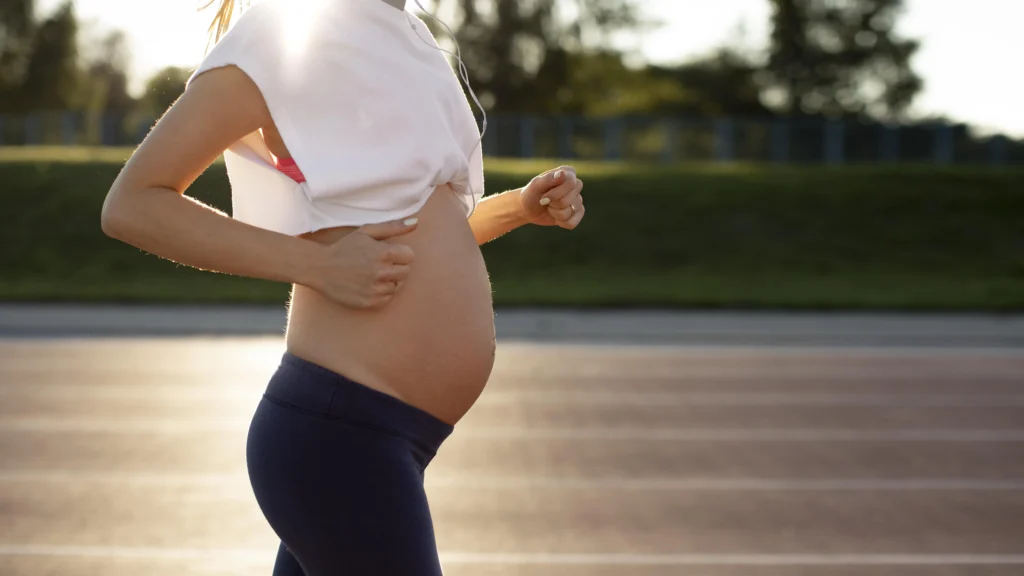
Why Running May Suddenly Feel Awkward
For women who love running, pregnancy can feel confusing.
Some continue running comfortably for months.
Others suddenly feel that their stride has changed.
Several factors contribute to this sensation.
Your Center of Gravity Changes
As the abdomen grows, the body’s center of mass gradually shifts forward.
To maintain balance, posture adjusts automatically.
These adaptations can alter:
- Running mechanics
- Stride length
- Foot placement
- Shock absorption patterns
Joint Stability Changes
The hormone relaxin contributes to ligament laxity throughout pregnancy.
While this increased flexibility helps prepare the body for childbirth, it can also create feelings of instability during high-impact activities.
Pelvic Floor Awareness Increases
Some women begin noticing:
- Pelvic heaviness
- Increased pressure
- Urinary leakage during impact
These sensations often become more noticeable during running than during lower-impact activities.
This does not automatically mean running must stop.
However, it may mean your body needs modifications, pacing adjustments, or professional guidance.
Myth vs Reality
Myth: If running feels harder during pregnancy, you are losing fitness.
Reality: Changes in posture, pelvic floor loading, breathing mechanics, and weight distribution often make running feel different even when fitness levels remain good.
Why Squats Feel Different Even If Your Technique Hasn’t Changed
Many women are surprised when a movement they’ve mastered suddenly feels awkward.
Squats are a perfect example.
Even with excellent technique, pregnancy changes the mechanics of the movement.
The Baby Changes Your Weight Distribution
As weight shifts forward, balance strategies change.
You may naturally widen your stance or alter your depth without consciously trying to.
Core Function Changes
The abdominal wall stretches during pregnancy.
This affects how the core generates pressure and stability during exercise.
As a result, movements that rely heavily on trunk control may feel less powerful or coordinated.
Hip Mobility Changes
Some women experience increased hip mobility.
Others develop stiffness due to changing posture and movement patterns.
The result is that squats can feel completely different from one trimester to the next.
Why Your Balance Changes During Yoga
Many pregnant women continue yoga because it promotes flexibility, mobility, and relaxation.
Then one day they discover that a balance pose they’ve done hundreds of times suddenly feels challenging.
This is extremely common.
Research has shown that pregnancy affects balance and postural control. (Danna-Dos-Santos et al. 2018)
Several factors contribute:
A Forward Shift in Body Weight
The growing abdomen alters body alignment.
Your brain must constantly adapt to maintain stability.
Changes in Foot Mechanics
Pregnancy often affects arch support and foot loading patterns.
These changes influence balance from the ground up.
Visual and Vestibular Adjustments
Your nervous system continuously processes information from vision, muscles, joints, and the inner ear.
As body dimensions change, these systems require constant recalibration.
This is why a tree pose that once felt effortless may suddenly require greater concentration.
Why Flexibility Can Increase While Movement Feels Less Stable
Many women notice they become more flexible during pregnancy.
At first glance, this sounds like a benefit.
However, increased flexibility does not always equal better movement.
Hormonal influences can increase ligament laxity, allowing joints to move more freely.
At the same time, muscles may need to work harder to stabilize those joints.
This creates an interesting paradox.
You may be able to move further into a stretch, yet feel less stable while doing it.
From a physiotherapy perspective, pregnancy is often a time to prioritize controlled movement rather than aggressively pursuing greater flexibility.
More range of motion is not always better.
Sometimes the body benefits more from strength and stability than additional stretching.
Ask Yourself
- Does this movement feel comfortable?
- Can I control the movement well?
- Am I holding my breath unnecessarily?
- Do I feel pelvic heaviness or pressure?
- Would a small modification improve comfort?
Why Recovery Takes Longer Than You Expect
One of the most frustrating discoveries for active women is realizing that recovery changes during pregnancy.
You may complete a workout that once felt routine and then feel unusually tired later in the day.
Many factors contribute to this.
Your body is simultaneously:
- Growing a baby
- Supporting the placenta
- Increasing blood volume
- Producing pregnancy hormones
- Building new tissue
That is a tremendous amount of work happening behind the scenes.
Even if your exercise routine has not changed dramatically, your body’s total workload has increased.
This is why recovery deserves more attention during pregnancy.
As a physiotherapist, I often encourage women to stop judging workouts based solely on calories burned or workout duration.
Pregnancy requires a broader definition of fitness that includes recovery, energy management, and overall well-being.
Why Strength Training May Feel Different
Many women expect strength to decline during pregnancy.
What surprises them is that strength often feels inconsistent.
One week a workout feels great.
The next week the exact same workout feels challenging.
Several factors influence this experience.
Core Mechanics Change
The abdominal wall gradually stretches to accommodate the growing baby.
This affects how pressure is generated during lifting movements.
Exercises that once felt stable may now require more concentration and control.
Joint Stability Changes
Hormonal influences can affect ligament support around the joints.
This may alter how force is transferred through the body during exercises such as:
- Deadlifts
- Lunges
- Squats
- Overhead presses
Fatigue Fluctuates
Pregnancy fatigue is not always predictable.
Some days energy levels feel excellent.
Other days even a moderate workout can feel difficult.
Listening to these fluctuations is often more beneficial than forcing the body through a predetermined plan.
Why Your Pelvic Floor Suddenly Gets Your Attention
Many women never think about their pelvic floor until pregnancy.
Then suddenly it becomes impossible to ignore.
You may notice:
- A feeling of heaviness
- Increased pressure during exercise
- Difficulty controlling urine when sneezing
- Sensations you have never experienced before
The pelvic floor supports the bladder, uterus, and bowel.
As pregnancy progresses, the demands placed on these muscles increase significantly. (Mørkved S et al. 2003)
Research supports pelvic floor muscle training during pregnancy to help reduce urinary incontinence and improve pelvic floor function.
Woodley et al. (2020)
As a physiotherapist, I encourage women to pay attention to pelvic floor symptoms rather than dismiss them.
These sensations provide valuable information about how the body is adapting.
Pelvic Floor Reminder
Urinary leakage, pelvic heaviness, or pressure during exercise should not be considered something you simply have to accept. These symptoms often respond well to individualized pelvic floor physiotherapy.
Why Some Exercises Suddenly Stop Feeling Good
One of the most confusing pregnancy experiences is discovering that an exercise you previously loved no longer feels enjoyable.
This can happen even when the exercise is considered safe.
A runner may suddenly prefer walking.
A cyclist may prefer strength training.
A yoga enthusiast may enjoy mobility work more than long stretching sessions.
This shift is normal.
Your body constantly provides feedback.
Pregnancy is often a time to become more responsive to that feedback rather than trying to override it.
The goal is not to prove what you can tolerate.
The goal is to support a healthy pregnancy while staying active.
Sometimes that means adapting.
Sometimes it means changing activities temporarily.
And sometimes it means discovering a new form of movement that feels better during this season of life.
Why Comparing Yourself to Other Pregnant Women Doesn’t Work
One woman may comfortably jog into her third trimester.
Another may find walking more comfortable during the second trimester.
Both experiences can be completely normal.
Pregnancy adaptations vary because of differences in:
- Fitness levels
- Previous injuries
- Baby position
- Pelvic floor function
- Joint mobility
- Pregnancy symptoms
- Recovery capacity
This is why comparing your experience with someone else’s often creates unnecessary stress.
Your body’s response is unique to you.
Simple Exercise Adjustments That Often Help
Many women do not need to stop exercising.
They simply need to modify how they exercise.
Helpful adjustments may include:
Reduce Intensity Slightly
You do not need every workout to feel challenging.
Moderate intensity is often enough to maintain fitness during pregnancy.
Increase Recovery Time
Adding additional recovery between sessions may improve overall performance and comfort.
Prioritize Movement Quality
Focus on how an exercise feels during pregnancy rather than how much weight you are lifting.
Stay Hydrated
Dehydration can increase fatigue, dizziness, and exercise discomfort.
Choose Supportive Footwear
As foot mechanics change, proper footwear becomes increasingly important.
Monitor Symptoms
Pain, heaviness, dizziness, or unusual discomfort should never be ignored.
Pregnancy Fitness Fact
Maintaining exercise consistency is often more beneficial during pregnancy than chasing personal records. Small, regular movement sessions can provide meaningful physical and mental health benefits.
When Exercise Symptoms Need Medical Attention
Exercise should generally leave you feeling energized, not unwell.
Stop exercising and seek medical advice if you experience:
Vaginal Bleeding
Any unexplained bleeding should be assessed promptly.
Persistent Dizziness
Especially if accompanied by fainting or visual disturbances.
Chest Pain
Chest discomfort during exercise requires immediate evaluation.
Severe Shortness of Breath
Breathlessness that does not improve with rest should not be ignored.
Painful Contractions
Regular painful contractions during exercise require medical assessment.
Reduced Baby Movements
If fetal movements noticeably decrease after they have been established, contact your healthcare provider.
The American College of Obstetricians and Gynecologists advises pregnant women to discuss warning signs and exercise participation with their healthcare team. (American College of Obstetricians and Gynecologists 2020)
Stop Exercising and Seek Medical Advice If You Experience:
- Vaginal bleeding
- Chest pain
- Persistent dizziness
- Painful contractions
- Severe shortness of breath
- Reduced baby movements
Physiotherapist’s Advice
One of the biggest mindset shifts during pregnancy is understanding that exercise success is no longer measured only by performance.
Success may look like:
- Completing a comfortable walk
- Maintaining strength safely
- Improving posture
- Supporting pelvic floor health
- Reducing aches and pains
- Sleeping better
- Feeling more energized
Your body is performing one of the most complex physiological tasks it will ever undertake.
It is perfectly normal for familiar exercises to feel unfamiliar.
Instead of asking:
“Why can’t I exercise the way I used to?”
Try asking:
“What does my body need from exercise today?”
That small change in perspective often makes pregnancy exercise feel far more enjoyable.
Expert Tip
The most successful pregnancy exercise programs are flexible. Instead of forcing your body to perform exactly as it did before pregnancy, learn to adjust intensity, recovery, and movement choices based on how you feel each day.
Final Thoughts
Many women enter pregnancy expecting physical changes.
Few expect their favorite exercises to feel completely different.
Yet this is one of the most common experiences among active moms-to-be.
The good news is that these changes usually reflect normal adaptations rather than problems.
Your body is adjusting to support a growing baby while simultaneously helping you stay active.
As a physiotherapist, I encourage women to approach pregnancy exercise with curiosity instead of frustration.
When you understand why movements feel different, it becomes much easier to adapt, stay confident, and continue enjoying physical activity throughout pregnancy.
Your goal is not to exercise exactly as you did before pregnancy.
Your goal is to keep moving in a way that supports both you and your baby.
Frequently Asked Questions
Why does exercise feel harder during pregnancy even when I am still fit?
Pregnancy increases cardiovascular demands, changes breathing patterns, shifts your center of gravity, and affects muscle function. These changes can make familiar workouts feel more challenging despite maintaining good fitness levels.
Is it normal to become breathless more quickly during pregnancy workouts?
Yes. Hormonal changes and increased oxygen demands often make pregnant women feel breathless sooner during physical activity, even during exercises that previously felt easy.
Why do my squats feel different during pregnancy?
Changes in posture, abdominal muscle function, balance, and weight distribution can alter squat mechanics and make the movement feel unfamiliar.
Can pregnancy affect my balance during yoga?
Yes. As your center of gravity shifts and body dimensions change, balance-based yoga poses may become more challenging and require modifications.
Why do I recover more slowly after exercise during pregnancy?
Your body is simultaneously supporting fetal growth, increasing blood volume, producing hormones, and adapting physically, which can increase recovery demands.
Should I stop exercising if I notice pelvic floor pressure?
Not necessarily. However, symptoms such as pelvic heaviness, pressure, or urinary leakage should be discussed with a pelvic health physiotherapist or healthcare provider.
Can I continue strength training while pregnant?
Most women with uncomplicated pregnancies can continue strength training with appropriate modifications and guidance from their healthcare provider.
When should I stop exercising and contact my doctor?
Seek medical advice if you experience vaginal bleeding, chest pain, severe shortness of breath, painful contractions, persistent dizziness, or reduced baby movements.
Stay tuned with us for more health related topics.
Follow us on LinkedIn and Instagram for more.
More Read


Medical Disclaimer!
This article has been reviewed and written under the guidance of our Head Physiotherapist, Dr. Kruti Raj (PT, MUHS,CPT,CMPT). The information shared is intended for educational purposes only and should not be considered a substitute for personalized medical advice, diagnosis, or treatment.
Please consult us or any other qualified healthcare professional before beginning any exercise program, especially if you are experiencing pain, recovering from injury, or managing a medical condition.


