High risk pregnancy tests help doctors closely monitor the health of both mother and baby and detect possible concerns early.
You answer the phone.
Your healthcare provider’s office is calling.
The person on the other end says something you were not expecting:
“Your screening result came back high risk.”
Quick Answer
A high-risk pregnancy screening result does not mean your baby has a chromosomal abnormality. It means the screening test found a higher-than-average likelihood of a specific condition being present. Screening tests estimate risk, while diagnostic tests such as CVS and amniocentesis provide definitive answers.
Suddenly, your mind starts racing.
Questions appear almost instantly.
- Does this mean something is wrong with my baby?
- Does my baby have Down syndrome?
- Did I do something wrong?
- What happens next?
For many parents, hearing the words “high risk” can be one of the most stressful moments of pregnancy.
But before panic takes over, there is something extremely important you need to know:
A High-Risk Screening Result Is Not A Diagnosis
In fact, understanding this single concept can completely change how you interpret your results.
Let’s take a closer look at what these results actually mean.
Key Takeaways
- A high-risk screening result is not the same as a diagnosis.
- Screening tests estimate probability rather than provide certainty.
- False-positive results can occur.
- Additional testing may be recommended after a high-risk result.
- NIPT, CVS, and amniocentesis are common follow-up options.
- Many pregnancies with high-risk screening results result in healthy babies.
- Maternal age is only one factor used in risk calculations.
- Genetic counseling may help families understand their options.
- Diagnostic testing provides more definitive answers than screening.
- The purpose of screening is to guide care, not predict outcomes with certainty.
Why The Phrase “High Risk” Sounds Scarier Than It Is
The word “risk” is emotionally powerful.
Most people hear it and immediately think:
Something bad has happened.
But that is not what prenatal screening reports are saying.
When a screening result is labeled high risk, the report is not confirming that a condition exists.
Instead, it is estimating the likelihood that a condition may be present.
Think about weather forecasts.
If a weather report says there is an 80% chance of rain tomorrow, it does not mean it is raining right now.
It means rain is more likely.
Prenatal screening works in a similar way.
A high-risk result means the screening process identified a higher probability of a specific condition compared with the general population.
It does not provide certainty.
What Is Pregnancy Screening Actually Designed To Do?
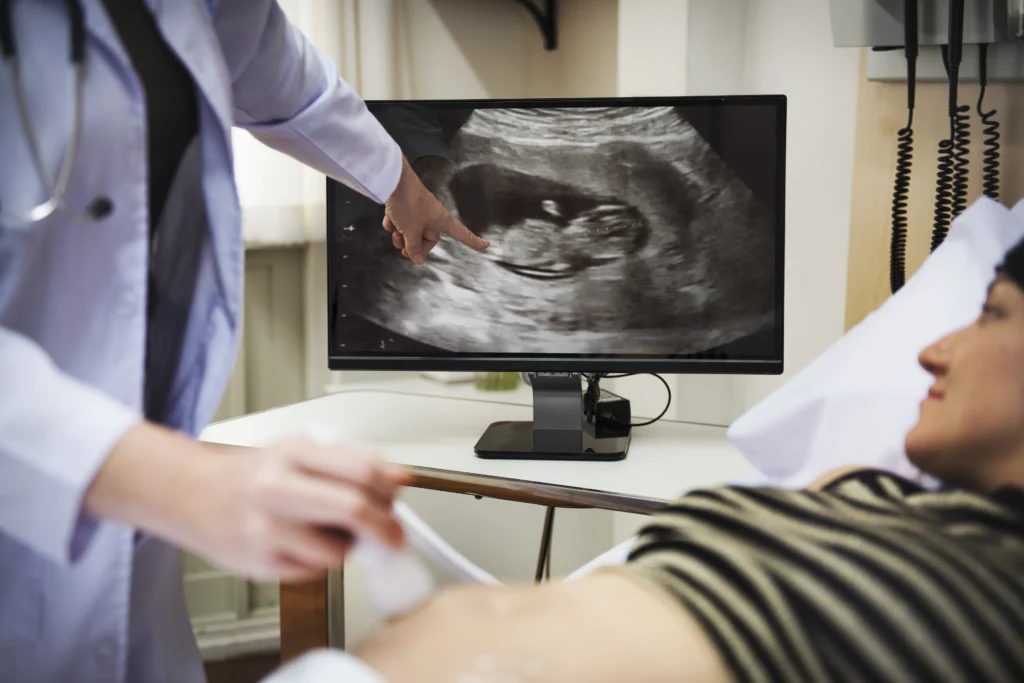
Many parents assume prenatal screening tests are designed to diagnose conditions.
They are not.
The purpose of screening is to identify pregnancies that may benefit from additional evaluation.
Healthcare providers use screening tests because they are:
- Safe
- Non-invasive
- Widely available
- Effective at identifying increased risk
Screening helps determine who may need further testing.
Researchers and professional organizations consistently emphasize that screening tests estimate risk rather than establish a diagnosis. (NCBI)
This distinction is so important that it deserves repeating:
Screening Identifies Risk.
Diagnostic Testing Confirms Answers.
The two are not the same.
What Conditions Can Trigger A High-Risk Result?
The answer depends on which screening test was performed.
Some prenatal screening tests evaluate the likelihood of chromosomal abnormalities such as:
Down Syndrome (Trisomy 21)
The most common chromosomal condition screened during pregnancy is Down Syndrome.
Edwards Syndrome (Trisomy 18)
A rare but serious chromosomal abnormality.
Patau Syndrome (Trisomy 13)
Another uncommon chromosomal condition associated with significant medical challenges.
Other screening programs may evaluate additional conditions depending on the technology used and local healthcare guidelines.
A high-risk result simply means that the screening process detected findings associated with a higher probability of one of these conditions.
It does not mean the condition is definitely present.
Understanding Risk Through A Simple Example
Imagine 10,000 pregnant women undergo screening.
Among those women, some may receive a high-risk result.
However, not every high-risk result will represent an affected pregnancy.
This happens because all screening tests have limitations.
Even excellent screening tests can produce:
False Positives
The test suggests increased risk, but the baby is unaffected.
False Negatives
The test suggests low risk, but a condition is present.
These possibilities are one reason diagnostic testing remains important when screening identifies increased risk.
Research has shown that understanding positive predictive value and false-positive rates is essential when interpreting prenatal screening results. (Liu etal., 2022)
This is one reason healthcare providers avoid making conclusions based solely on screening results.
Why False Positives Happen
Many parents find false positives confusing.
After all, if a test says high risk, shouldn’t it always be right?
Not necessarily.
Screening tests are intentionally designed to be sensitive.
In other words, they are designed to identify as many potentially affected pregnancies as possible.
As a result, some pregnancies without abnormalities may still receive high-risk results.
This trade-off helps ensure that fewer affected pregnancies are missed.
It is not a flaw.
It is part of how screening works.
Why Your Age Can Influence Results
Another source of confusion involves maternal age.
Many screening programs incorporate maternal age into risk calculations.
Why?
Because the likelihood of certain chromosomal abnormalities changes with age.
This does not mean younger women cannot receive high-risk results.
Nor does it mean older women will automatically receive them.
Age is simply one factor among many used to calculate risk.
Other factors may include:
- Ultrasound findings
- Blood marker levels
- Cell-free DNA analysis
- Medical history
- Gestational age
The final result reflects a combination of these factors rather than any single finding.
What Does “1 In 100 Risk” Mean?
Many screening reports include numbers that can seem confusing.
For example:
Risk: 1 in 100
Some parents immediately interpret this as:
My baby has the condition.
That is not what the result means.
A risk of 1 in 100 means:
- One pregnancy out of 100 with similar screening findings may be affected.
- Ninety-nine pregnancies out of 100 may not be affected.
This example highlights why understanding probability matters.
Screening reports estimate likelihood.
They do not provide certainty.
Why Modern Screening Is Still Valuable
After learning about false positives, some parents wonder:
If screening isn’t definitive, what’s the point?
The answer is simple.
Screening provides valuable information early in pregnancy.
It helps healthcare providers identify pregnancies that may benefit from:
- Additional testing
- Specialist consultation
- More detailed imaging
- Genetic counseling
Modern prenatal screening programs have significantly improved the ability to identify pregnancies at increased risk while reducing unnecessary invasive procedures.
In other words, screening is not designed to create anxiety.
It is designed to guide decision-making.
A Small Reassurance If You’ve Recently Received A High-Risk Result
If you’re reading this article because you recently received a high-risk screening result, take a moment to remember something important.
You do not have all the answers yet.
And that is okay.
A high-risk result is often the beginning of a conversation, not the end of one.
The next steps may include additional testing, more detailed evaluation, or discussions with healthcare professionals who can help interpret your results accurately.
Right now, the most important thing to understand is this:
High risk means increased probability.
It does not mean certainty.
And that distinction can make a tremendous difference in how you approach the next stage of your pregnancy journey.
What Happens After A High-Risk Pregnancy Screening Result?
For many parents, receiving a high-risk screening result feels like standing at a crossroads.
One path leads to more information.
The other leads to uncertainty.
Naturally, most people want answers as quickly as possible.
The good news is that a high-risk screening result is usually not the end of the journey.
It is often the beginning of a more detailed evaluation process.
Healthcare providers typically review:
- The specific screening result
- Your gestational age
- Ultrasound findings
- Medical and family history
- Available follow-up testing options
The next step depends on the type of screening that was performed and the condition being evaluated.
Why Doctors Do Not Make Decisions Based On Screening Alone
One of the biggest misconceptions in prenatal care is that screening results automatically determine what happens next.
They do not.
Because screening tests estimate risk rather than establish a diagnosis, healthcare providers generally recommend confirmatory testing before making significant medical decisions.
Modern prenatal screening guidelines emphasize that positive screening results should be followed by appropriate counseling and diagnostic evaluation,
rather than being interpreted as definitive diagnoses. (Carlson et al., 2017)
This is why healthcare providers focus on gathering additional information rather than drawing immediate conclusions.
Could NIPT Be Recommended Next?
In some situations, yes.
If a traditional first-trimester screening test indicates increased risk, healthcare providers may discuss the option of Non-Invasive Prenatal Testing (NIPT).
NIPT analyzes cell-free DNA circulating in the mother’s bloodstream and provides a more accurate assessment of the likelihood of certain chromosomal abnormalities.
Compared with traditional screening approaches, NIPT generally produces fewer false-positive results while maintaining high detection rates.
However, even NIPT remains a screening test rather than a diagnostic test.
That distinction remains important regardless of how advanced the technology becomes.
When Are Diagnostic Tests Recommended?
Sometimes parents want more certainty than screening can provide.
This is where diagnostic testing enters the picture.
Unlike screening tests, diagnostic procedures can directly examine fetal genetic material.
The two most commonly discussed options are:
Chorionic Villus Sampling (CVS)
CVS is usually performed during the first trimester.
A small sample of placental tissue is collected and analyzed for chromosomal abnormalities.
Amniocentesis
Amniocentesis is typically performed later in pregnancy.
The procedure involves collecting a small sample of amniotic fluid for laboratory analysis.
Unlike screening tests, these procedures can provide definitive chromosomal information.
For this reason, they are often considered when screening results suggest increased risk.
Why Some High-Risk Results Turn Out To Be False Alarms
This is perhaps the most reassuring section of the article.
Many parents assume a high-risk result means the outcome is already determined.
In reality, some pregnancies with high-risk screening results are ultimately found to be unaffected.
Why?
Because screening tests are designed to identify as many potentially affected pregnancies as possible.
As a result, some unaffected pregnancies may also be flagged for additional evaluation.
This is one reason healthcare providers place so much emphasis on confirmatory testing.
Research reviews continue to demonstrate that screening performance, while excellent, is not perfect and must always be interpreted within the broader clinical context. (Taylor-Phillips et al., 2016)
A high-risk result increases probability.
It does not guarantee an outcome.
Common Myths About High-Risk Screening Results
Myth 1: High Risk Means My Baby Has A Chromosomal Condition
False.
A high-risk result means the likelihood is higher than average.
It does not provide a diagnosis.
Myth 2: The Screening Test Was Wrong If My Baby Is Healthy
Not necessarily.
Screening tests are designed to identify pregnancies that may require additional evaluation.
A false-positive result does not mean the test failed.
It means the screening process appropriately identified a pregnancy that needed closer assessment.
Myth 3: There Is No Point In Further Testing
False.
Additional testing often provides the information needed to confirm or rule out a condition.
Myth 4: High-Risk Results Only Happen To Older Mothers
False.
Although age can influence risk calculations, high-risk screening results can occur at any maternal age.
What My Patients Often Ask
“Should I Panic?”
No.
Worry is understandable.
Panic is not helpful.
A high-risk screening result is simply one piece of information.
There are usually several additional steps before any conclusions can be made.
“Did I Cause This?”
No.
Screening results are not caused by something you ate, a stressful day at work, exercise, travel, or a mistake you made during pregnancy.
“How Long Will It Take To Get Answers?”
The timeline varies depending on the follow-up testing selected.
Some results may be available within days.
Others may take longer.
Your healthcare provider can explain the expected timeline for your specific situation.
“Can My Baby Still Be Healthy?”
Yes.
Many pregnancies with high-risk screening results ultimately result in healthy babies.
This is one reason healthcare providers avoid making assumptions based solely on screening findings.
A Note From A Physiotherapist
One thing I have learned while supporting families through healthcare journeys is that uncertainty is often harder than information.
The waiting.
The internet searches.
The endless “what if” questions.
These experiences can be emotionally exhausting.
But remember:
A high-risk screening result is not an answer.
It is a signal that additional information may be helpful.
The goal of modern prenatal screening is not to predict the future with certainty.
It is to provide enough information to support informed decisions.
What A High-Risk Result Does Not Mean
A high-risk screening result does not automatically mean:
- Your baby has a chromosomal abnormality
- Your pregnancy is unhealthy
- You did something wrong
- A diagnosis has been made
- Your pregnancy journey will have a negative outcome
Understanding what the result does not mean is often just as important as understanding what it does mean.
One Less Thing To Worry About
Many parents receive a high-risk screening result and immediately imagine the worst.
Yet screening and diagnosis are very different things.
The purpose of screening is to identify pregnancies that may benefit from closer evaluation.
It is not designed to provide final answers.
And in many cases, additional testing brings reassurance rather than bad news.
If Nobody Has Told You This Today…
It is okay to feel scared.
It is okay to feel confused.
It is okay to have questions.
But try not to confuse a screening result with a diagnosis.
You deserve accurate information, thoughtful guidance, and time to understand your options.
And that is exactly why follow-up testing exists.
Final Thoughts
Receiving a high-risk pregnancy screening result can feel overwhelming, but understanding what the result actually means can help reduce unnecessary fear.
A high-risk result indicates an increased likelihood of a condition, not confirmation that a condition exists.
Modern prenatal care uses screening tests to identify pregnancies that may benefit from additional evaluation, while diagnostic tests provide definitive answers when needed.
Professional guidelines continue to emphasize the importance of follow-up counseling, confirmatory testing, and individualized decision-making after positive screening results (Mitchell et al., 2019).
Most importantly, remember this:
High risk does not mean certainty.
It means more information is needed.
And in prenatal care, information is often the first step toward clarity, reassurance, and informed decision-making.
Frequently Asked Questions About High-Risk Pregnancy Screening Results
Does a high-risk screening result mean my baby has Down syndrome?
No. A high-risk result means the likelihood is increased, but it does not confirm that the baby has Down syndrome or another condition.
Can a high-risk screening result be wrong?
Yes. False-positive results can occur with all screening tests.
What happens after a high-risk screening result?
Your healthcare provider may recommend NIPT, CVS, amniocentesis, genetic counseling, or additional ultrasound assessments.
What is the difference between screening and diagnostic testing?
Screening estimates risk, while diagnostic tests can confirm whether a condition is present.
Should I panic if my screening result is high risk?
No. While the result deserves attention, it is not a diagnosis and further evaluation is often needed.
Can young mothers receive high-risk screening results?
Yes. High-risk screening results can occur at any maternal age.
What does a 1 in 100 risk mean?
It means that among 100 pregnancies with similar screening results, approximately one may be affected while many others may not be.
Can a healthy baby have a high-risk screening result?
Yes. Some pregnancies with high-risk screening results are later found to be unaffected after diagnostic testing.
Stay tuned with us for more health related topics.
Follow us on LinkedIn and Instagram for more.
More Read


Medical Disclaimer!
This article has been reviewed and written under the guidance of our Head Physiotherapist, Dr. Kruti Raj (PT, MUHS,CPT,CMPT). The information shared is intended for educational purposes only and should not be considered a substitute for personalized medical advice, diagnosis, or treatment.
Please consult us or any other qualified healthcare professional before beginning any exercise program, especially if you are experiencing pain, recovering from injury, or managing a medical condition.