


Can your pillow cause back pain?
While many people blame their mattress, the wrong pillow can also disrupt spinal alignment during sleep, contributing to neck strain, upper back tension, and even lower back discomfort.
So if you have been blaming your mattress every morning for your aching lower back, your pillow may actually be the missing piece of the puzzle.
As a physiotherapist, one of the most common misconceptions I hear is, “How can something under my head affect my lower back?”
Surprisingly, the answer lies in the way your entire spine functions as one continuous chain.
When your neck is forced into an unnatural position for seven to nine hours every night, subtle changes occur throughout the rest of your spine.
Over time, these changes can increase muscle tension, alter spinal alignment, and contribute to persistent morning lower back pain.
Quick Answer
Yes. An unsuitable pillow can contribute to lower back pain by disrupting your spinal alignment during sleep. When your neck is not properly supported, your upper back, pelvis and lumbar spine compensate, leading to muscle tension and morning stiffness. Choosing the correct pillow height, sleeping position and maintaining good spinal posture can significantly reduce discomfort.
While a pillow is rarely the only cause of back pain, it can certainly become a contributing factor, especially when combined with prolonged sitting, weak core muscles, poor sleep posture, or an ageing mattress.
Research increasingly suggests that the right pillow can improve spinal alignment, reduce waking pain, and decrease disability in people with musculoskeletal disorders. (PubMed)
This article explains how your pillow may be affecting your lower back, the science behind it, and what physiotherapists recommend to wake up feeling refreshed instead of stiff.
Key Takeaways
- Your pillow can indirectly contribute to lower back pain.
- Proper cervical support helps maintain full spinal alignment.
- Pillow height is more important than expensive materials.
- Side sleepers require different pillow support than back sleepers.
- Morning stiffness often indicates poor overnight posture.
- Replace flattened pillows every 1–2 years.
- Combine proper pillow selection with strengthening exercises.
- Persistent pain or neurological symptoms require medical evaluation.
The Quick Answer
Yes, your pillow can contribute to lower back pain, but usually indirectly rather than directly.
An unsuitable pillow changes the alignment of your neck and upper spine.
Since your cervical, thoracic, lumbar spine and pelvis function as one kinetic chain, poor support at the top can trigger compensatory changes lower down.
These changes may increase muscle tension, alter sleeping posture, and place unnecessary stress on the lumbar spine throughout the night. (PubMed)
Think of your spine like a stack of building blocks.
If the top block tilts, every block underneath must adjust to keep the structure balanced.
That is exactly what happens while you sleep.
Understanding the Spine as One Connected System
Many people imagine the neck and lower back as two completely separate body parts.
From a physiotherapy perspective, they are deeply interconnected.
Your spine consists of:
- Cervical spine (neck)
- Thoracic spine (upper back)
- Lumbar spine (lower back)
- Sacrum and pelvis
Each section constantly adapts to the position of the others.
If your pillow lifts your head too high, your neck bends forward.
To compensate, your upper back rounds, your rib cage shifts, your pelvis tilts slightly, and your lumbar spine loses its natural curve.
Even though these adjustments may seem tiny, they are maintained for nearly one-third of your day.
Night after night, this prolonged stress can leave muscles fatigued and joints irritated by morning.
This concept is known in physiotherapy as regional interdependence, where dysfunction in one body region influences pain or movement elsewhere. (PubMed)
Why Does Lower Back Pain Feel Worse in the Morning?
Many patients tell me:
“I feel okay before bed, but every morning my back feels locked.”
This usually happens because the spine remains relatively still for several hours.
During sleep:
- Spinal discs absorb fluid.
- Ligaments remain under prolonged tension.
- Muscles become less active.
- Small joints stiffen.
- Circulation slows slightly.
If your sleeping posture is poor because of an unsuitable pillow, these normal overnight changes become amplified.
Instead of waking with a relaxed spine, you wake with muscles that have been working all night to protect unstable joints.
That is why many people notice improvement after walking for 15–20 minutes in the morning.
Movement restores circulation, lubricates joints, and reduces muscle guarding.
How Can a Pillow Affect Your Lower Back?
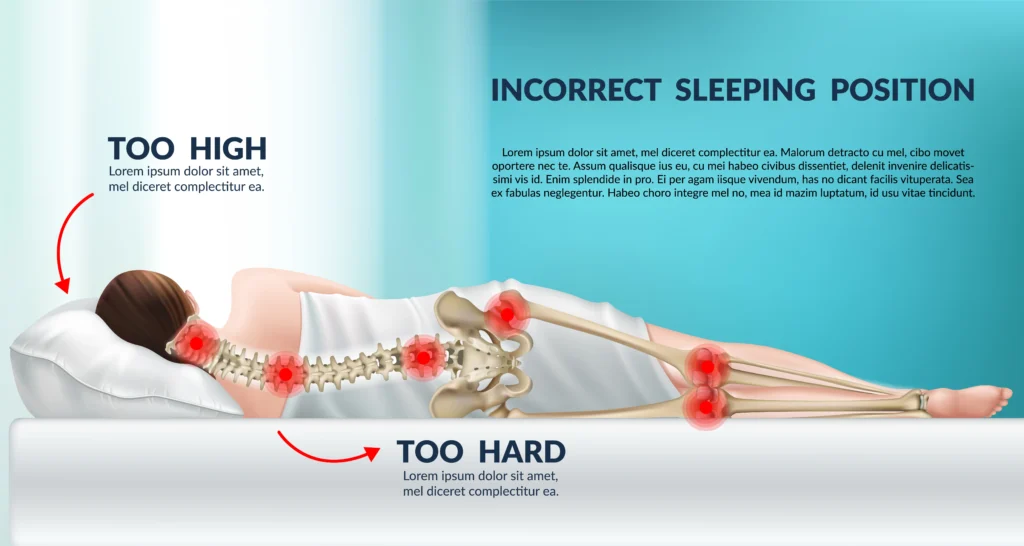
Poor Neck Alignment Creates a Chain Reaction
Imagine sleeping with your head tilted sideways for eight hours.
Your neck muscles remain under continuous tension.
Your shoulders rotate.
Your upper spine twists.
Eventually, your pelvis also rotates slightly.
This rotational force may increase stress across one side of the lumbar spine.
Over weeks or months, the repeated strain may contribute to:
- Morning stiffness
- Muscle tightness
- Sacroiliac joint irritation
- Mechanical lower back pain
Although the movement is subtle, the duration makes it significant.
Research indicates that pillow height and shape influence cervical alignment more than many people realise. (NCBI)
Your Pillow Changes Sleeping Position Without You Knowing
A pillow that is too high often encourages:
- Neck flexion
- Rounded shoulders
- Increased spinal flexion
A pillow that is too flat allows:
- Head dropping
- Neck side bending
- Uneven shoulder loading
Both situations can alter the natural curves of the spine.
This is especially important for side sleepers.
If the shoulder is not adequately supported, the upper body gradually collapses toward the mattress, forcing the lumbar spine into an awkward position for several hours.
Muscle Guarding Never Truly Switches Off
Many people think muscles completely relax during sleep.
They don’t.
Your nervous system constantly makes tiny adjustments to maintain joint stability.
If your pillow keeps your neck unsupported, muscles throughout the back continue making small corrective contractions all night.
These contractions are usually too subtle to notice while sleeping.
However, by morning they may produce:
- Muscle fatigue
- Tightness
- Trigger points
- Reduced flexibility
- Local inflammation
This is one reason why some people wake feeling sore despite sleeping eight hours.
Lesser-Known Fact: Your Brain Cares More About Head Position Than You Think
One fascinating discovery from neuroscience is that the brain receives enormous amounts of sensory information from the neck.
Small muscles around the upper cervical spine contain one of the highest concentrations of proprioceptors; the body’s position sensors.
These receptors constantly tell the brain where your head is located in space.
When head position remains abnormal overnight because of a poor pillow, muscle activation patterns throughout the trunk may also change.
This explains why correcting cervical posture sometimes reduces pain far away from the neck, including the lower back.
Many people never realise that improving neck support can reduce lumbar discomfort without any treatment directed at the lower back itself.
Signs Your Pillow May Be Contributing to Lower Back Pain
Ask yourself these questions.
Do you:
- Wake up with lower back stiffness that improves after moving around?
- Frequently wake during the night to adjust your pillow?
- Fold your pillow to make it taller?
- Stack multiple pillows together?
- Wake with neck pain and lower back pain simultaneously?
- Notice less pain after sleeping in hotels?
- Experience pain mostly in the morning rather than evening?
If you answered “yes” to several of these, your pillow deserves closer attention.
Not Every Pillow Is Right for Every Sleeper
One of the biggest myths is that there is a universally perfect pillow.
There isn’t.
The ideal pillow depends on:
- Shoulder width
- Sleeping position
- Body size
- Mattress firmness
- Existing spinal conditions
- Personal comfort
Research has shown that pillow height often matters more than pillow material.
A supportive pillow that maintains neutral cervical alignment generally performs better than simply choosing the softest pillow available. (EaseLivingUAE)
How Different Sleeping Positions Affect the Lower Back
Side Sleepers
Side sleeping is often recommended for people with lower back pain because it can help maintain spinal alignment, provided the pillow height is correct.
A pillow that is too thin causes the head to drop downward.
A pillow that is too thick pushes the head upward.
Both create sideways bending throughout the spine.
For side sleepers, the pillow should fill the entire space between the ear and shoulder without forcing the neck to bend.
Placing a pillow between the knees can further reduce rotation through the pelvis and lower back.
Recent physiotherapy recommendations continue to support this simple modification for many people with mechanical back pain. (Verywell Health)
Back Sleepers
Back sleeping generally places less rotational stress on the spine.
However, using a very thick pillow pushes the head forward.
This flattens the natural cervical curve and may indirectly increase lumbar muscle tension.
A medium-height pillow combined with a small pillow beneath the knees often helps preserve natural spinal curves while reducing lumbar extension.
Can the Wrong Pillow Actually Change Your Sleeping Mechanics?
Yes and this is one of the most overlooked causes of recurring morning back pain.
When your pillow fails to support your head properly, your body unconsciously compensates throughout the night.
Instead of maintaining a neutral spinal position, muscles around your neck, shoulders, hips and lower back continuously make tiny adjustments to keep your body balanced.
As physiotherapists, we call this “compensatory movement.”
It may be small, but remember, you remain in that position for nearly one-third of every day.
Over months or years, this repeated stress can become enough to trigger chronic mechanical lower back pain, particularly in people who already have weak core muscles, disc degeneration or prolonged desk jobs.
Research continues to support the relationship between sleep posture, spinal alignment and musculoskeletal pain outcomes. (PLOS One)
Lesser-Known Fact: Your Pillow Can Affect Your Pelvic Position
Most people never associate a pillow with the pelvis.
However, the body functions as one connected chain.
When your head is elevated too much:
- The neck flexes.
- The thoracic spine rounds.
- The rib cage shifts.
- The pelvis gradually rotates backward.
- The lumbar curve flattens.
Conversely, if the pillow is too low:
- The head tilts backwards.
- The chest opens excessively.
- The lumbar spine may become overextended.
Neither position is ideal.
Maintaining the natural spinal curves throughout sleep helps distribute pressure evenly across discs, muscles and spinal joints.
Can a Pillow Cause a Herniated Disc?
Not directly.
A pillow alone does not cause a disc to herniate.
Disc herniation usually develops because of multiple factors including:
- Age-related degeneration
- Heavy lifting
- Smoking
- Obesity
- Repetitive bending
- Poor physical conditioning
- Genetic predisposition
However, an unsuitable pillow may worsen symptoms if you already have a bulging or herniated disc by placing additional stress on irritated spinal tissues.
Think of the pillow as a “pain amplifier” rather than the primary cause.
Research published in Spine suggests that maintaining neutral spinal posture reduces unnecessary loading on spinal structures and may help minimise symptoms in people with chronic low back disorders. (PMC)
Can Your Pillow Aggravate Sciatica?
Yes.
Although sciatica originates from irritation of the sciatic nerve, sleeping with poor spinal alignment may increase pressure on lumbar nerve roots.
People with sciatica often report:
- Increased morning leg pain
- Tingling after waking
- Hip stiffness
- Difficulty straightening after getting out of bed
If your pillow causes excessive spinal twisting, nerve irritation may temporarily increase overnight.
A proper sleeping position combined with the right pillow and appropriate physiotherapy exercises often reduces morning symptoms.
Which Pillow Features Matter Most?
Many advertisements focus on expensive materials.
From a physiotherapy perspective, support matters much more than luxury.
The most important features include:
Appropriate Height
The pillow should keep your ears aligned with your shoulders.
Neither too high nor too low.
Proper height allows your cervical spine to remain neutral throughout sleep.
Consistent Support
The pillow should maintain its shape overnight.
Old pillows often collapse after only a few hours.
When this happens, your neck gradually loses support during deeper stages of sleep.
Pressure Distribution
A good pillow spreads pressure evenly beneath the head and neck.
This reduces muscle fatigue and minimises pressure points.
Breathability
Cooler pillows often improve sleep quality because overheating causes frequent position changes.
Research has shown that fragmented sleep itself is associated with increased pain sensitivity the following day. (Journal of Clinical Sleep Medicine )
Do Expensive Pillows Work Better?
Not necessarily.
One of the biggest marketing myths is that the most expensive pillow automatically provides the best spinal support.
Current research does not consistently show that higher price equals better pain relief.
Instead, success depends upon:
- Proper height
- Sleeping position
- Body shape
- Shoulder width
- Mattress firmness
- Individual comfort
Many moderately priced pillows outperform premium luxury models simply because they fit the user’s body better.
Memory Foam vs Latex vs Feather Pillows
Memory Foam
Advantages
- Excellent contouring
- Good cervical support
- Maintains height
- Suitable for chronic neck pain
Disadvantages
- Can retain heat
- May feel firm initially
Several clinical studies have reported improved neck comfort with appropriately designed memory foam pillows compared with conventional polyester pillows. (Journal of Physical Therapy Science)
Latex Pillows
Advantages
- Highly durable
- Naturally supportive
- Better airflow
- Resistant to dust mites
Disadvantages
- Heavier
- Firmer feel
Latex pillows often suit combination sleepers who frequently change positions.
Feather Pillows
Advantages
- Soft
- Lightweight
- Easily adjustable
Disadvantages
- Lose shape quickly
- Require frequent fluffing
- Less consistent support
These pillows may be comfortable initially but often fail to maintain cervical alignment throughout the night.
Polyester Fibre Pillows
Advantages
- Affordable
- Lightweight
- Widely available
Disadvantages
- Flatten relatively quickly
- Reduced long-term support
Replacing inexpensive pillows every 18-24 months may actually provide better spinal support than keeping premium pillows for many years.
Does Pillow Age Matter?
Absolutely.
Even high-quality pillows lose their structural integrity.
Most pillows gradually lose:
- Elasticity
- Height
- Neck support
- Pressure distribution
Over time they collect:
- Dust mites
- Sweat
- Skin cells
- Allergens
- Moisture
Sleep experts generally recommend replacing pillows approximately every 1-2 years depending on the material and condition. (Sleep Foundation)
Physiotherapist’s Clinical Assessment
When someone visits my clinic complaining of morning lower back pain, I never begin by looking only at the lumbar spine.
Instead, I assess the entire sleeping system.
Questions I commonly ask include:
- What sleeping position do you prefer?
- How old is your pillow?
- Has your mattress been changed recently?
- Do you wake with neck stiffness?
- Does your pain improve after walking?
- Do you sleep with multiple pillows?
- Do you experience shoulder numbness at night?
Many patients are surprised that these questions often reveal the real source of their discomfort.
Red Flags: When Your Pillow Is NOT the Problem
Sometimes changing your pillow will make little difference because the pain originates from a more serious condition.
Seek prompt medical evaluation if your lower back pain is associated with:
- Severe leg weakness
- Loss of bladder or bowel control
- Saddle numbness
- Fever
- Unexplained weight loss
- History of cancer
- Persistent night pain that does not improve with changing position
- Significant trauma
- Progressive numbness
These symptoms require medical assessment rather than simply replacing your pillow.
Clinical guidelines from the American College of Physicians and international low back pain recommendations emphasise identifying these red flags before assuming mechanical causes. (Acp Journals)
Things You Should Do
As a physiotherapist, I recommend the following habits to improve spinal alignment during sleep:
- Replace flattened pillows before they lose support.
- Choose a pillow height based on your sleeping position rather than marketing claims.
- Keep your ears aligned with your shoulders while lying down.
- Sleep on a supportive mattress that complements your pillow.
- Stretch your hips and lower back before bedtime.
- Strengthen your core muscles regularly.
- Maintain a healthy body weight.
- Stay physically active during the day.
- Use a pillow between your knees if you sleep on your side.
- Keep your bedroom cool to improve sleep quality.
Things You Should Avoid
Avoid these common mistakes that often contribute to morning lower back pain:
- Sleeping on a pillow that is over five years old.
- Using two or three pillows unless medically advised.
- Sleeping with your head sharply bent forward.
- Sleeping on your stomach with your neck rotated.
- Ignoring persistent morning stiffness.
- Assuming an expensive pillow automatically solves back pain.
- Spending prolonged hours sitting without movement during the day.
- Using decorative cushions instead of supportive pillows.
- Continuing with a pillow that consistently causes neck pain.
Can Children Develop Lower Back Pain Because of the Wrong Pillow?
Although lower back pain is less common in children than adults, poor sleep ergonomics can still contribute to musculoskeletal discomfort, especially during periods of rapid growth.
Children often use adult-sized pillows that elevate their heads excessively.
This may place unnecessary stress on the developing cervical spine and alter overall spinal alignment during sleep.
While there is limited evidence directly linking pillows to paediatric lower back pain, maintaining age-appropriate sleep posture remains an important part of healthy musculoskeletal development.
Research on children’s sleep posture also highlights the importance of proper sleep surfaces and ergonomic support. (BMJ Open)
Can Pregnancy Make Pillow Choice More Important?
Absolutely.
During pregnancy, the body’s centre of gravity shifts forward, the hormone relaxin increases ligament laxity, and lumbar lordosis often becomes more pronounced.
If the pillow does not adequately support the neck and upper spine, these biomechanical changes may further increase lower back strain.
Physiotherapists commonly recommend:
- A supportive head pillow
- A pillow between the knees
- A pillow supporting the abdomen (during later pregnancy)
- Sleeping on the left side whenever comfortable
These simple adjustments can significantly improve comfort and reduce overnight spinal stress.
Simple Physiotherapy Exercises Before Bed
Improving your pillow is only one part of the solution.
Gentle mobility exercises before bedtime help relax muscles and prepare the spine for restful sleep.
Pelvic Tilts
Perform 10-15 slow repetitions while lying on your back with your knees bent.
Benefits include:
- Improving lumbar mobility
- Activating deep core muscles
- Reducing stiffness
Cat-Camel Stretch
Move slowly between arching and rounding your back.
Repeat 10 times.
Benefits include:
- Improving spinal flexibility
- Reducing muscle guarding
- Increasing joint lubrication
Clinical practice guidelines frequently recommend gentle movement for mechanical low back pain. (JOSPT)
Child’s Pose
Hold for 30-45 seconds.
This stretch gently lengthens:
- Lumbar muscles
- Latissimus dorsi
- Hip muscles
Avoid if it increases leg pain or numbness.
Hip Flexor Stretch
Tight hip flexors often exaggerate lumbar curvature.
Stretch each side for 30 seconds.
Repeat twice.
Diaphragmatic Breathing
Spend five minutes practising slow diaphragmatic breathing before bed.
Benefits include:
- Reduced muscle tension
- Improved relaxation
- Better sleep quality
- Reduced pain sensitivity
Poor sleep quality has been linked with increased pain intensity and delayed recovery in people with chronic musculoskeletal disorders. (JCSM)
Myths vs Reality
| Myth | Reality |
|---|---|
| Only mattresses cause lower back pain. | Pillows can also influence spinal alignment and contribute to pain. |
| A memory foam pillow works for everyone. | The best pillow depends on sleeping position, shoulder width and individual comfort. |
| Softer pillows are always better. | Excessively soft pillows may allow the head to sink too much, compromising alignment. |
| Expensive pillows always relieve pain. | Proper support is far more important than price. |
| Replacing a pillow will cure chronic back pain. | Pillow changes should complement exercise, posture correction and physiotherapy—not replace them. |
| Sleeping longer is always better for the back. | Poor posture maintained for longer can actually worsen morning stiffness. |
Physiotherapist’s Clinical Insight
In clinical practice, I rarely see a pillow acting as the sole cause of lower back pain.
More commonly, it becomes one part of a much larger picture that includes:
- Weak core muscles
- Reduced physical activity
- Poor workplace ergonomics
- Age-related spinal changes
- Stress and poor sleep quality
- Inappropriate mattress support
- Prolonged sitting
The encouraging news is that these factors are often modifiable.
Something as simple as choosing the correct pillow, improving sleep posture and following a personalised exercise programme can significantly reduce morning stiffness and improve overall spinal health.
Final Verdict
Can your pillow cause lower back pain?
Yes, but usually indirectly.
A pillow that fails to support your head and neck properly can disturb spinal alignment, increase muscle activity during sleep and contribute to morning lower back stiffness.
However, it is rarely the only reason for ongoing pain.
Before investing in an expensive pillow, assess your entire sleep environment.
Consider your mattress, sleeping position, daily activity level and spinal strength.
As physiotherapists, we focus on addressing the root cause rather than simply treating symptoms.
Combining the right pillow with regular movement, core strengthening, healthy sleep habits and professional guidance offers the best chance of long-term relief.
Remember, your spine spends nearly one-third of its life in bed.
Supporting it properly during those hours is one of the simplest investments you can make in your long-term back health.
Frequently Asked Questions
1. Can the wrong pillow really cause lower back pain?
Yes. Poor neck support can alter spinal alignment and contribute to lower back stiffness, especially in the morning.
2. Which pillow is best for lower back pain?
A pillow that keeps your neck in a neutral position based on your sleeping posture is generally the best choice.
3. Is memory foam better than feather pillows?
Memory foam often provides more consistent support, but the ideal pillow depends on your individual needs.
4. Should side sleepers use a thicker pillow?
Usually yes. The pillow should fill the gap between the shoulder and the head without tilting the neck.
5. Can an old pillow worsen back pain?
Yes. Flattened pillows lose their ability to support the neck and may contribute to poor sleep posture.
6. How often should I replace my pillow?
Most pillows should be replaced every 1–2 years, depending on the material and condition.
7. Does sleeping without a pillow help?
For most people, no. Sleeping without proper neck support may increase spinal strain.
8. Can changing my pillow completely cure back pain?
No. Pillow changes should be combined with exercise, posture correction and physiotherapy when appropriate.
9. Why is my back pain worse in the morning?
Prolonged poor sleep posture, joint stiffness and muscle guarding can all contribute to morning discomfort.
10. When should I see a physiotherapist?
If pain persists for several weeks, recurs frequently or limits your daily activities, a physiotherapy assessment is recommended.
Stay tuned with us for more health related topics.
Follow us on LinkedIn and Instagram for more.
More Read


Medical Disclaimer!
This article has been reviewed and written under the guidance of our Head Physiotherapist, Dr. Kruti Raj (PT, MUHS,CPT,CMPT). The information shared is intended for educational purposes only and should not be considered a substitute for personalized medical advice, diagnosis, or treatment.
Please consult us or any other qualified healthcare professional before beginning any exercise program, especially if you are experiencing pain, recovering from injury, or managing a medical condition.


