


A sudden shooting pain from your lower back into your buttock, thigh, or foot can be scary.
Many people who experience this burning, electric-like pain immediately ask:
“Will my sciatica go away on its own, or do I need physiotherapy?”
The answer is: yes, many cases of sciatica improve naturally, but recovery depends on the cause, severity, and how you manage your body during healing.
Sciatica is not a disease itself.
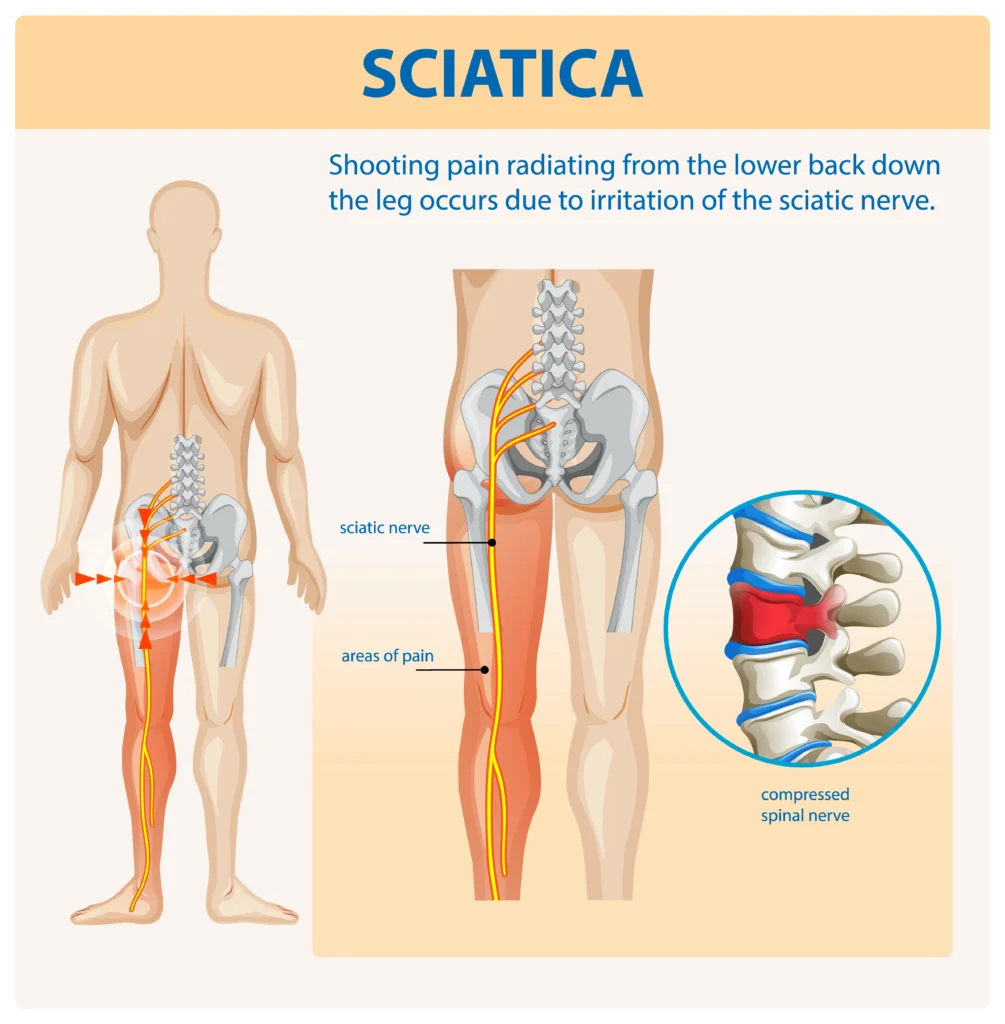
It is a collection of symptoms caused by irritation, inflammation, or compression of the sciatic nerve.
The sciatic nerve is the largest nerve in the human body.
It begins from nerve roots in the lower spine (lumbar and sacral region), passes through the buttock, and travels down the back of each leg.
When this nerve becomes irritated, you may feel:
- Sharp pain shooting down the leg
- Burning sensation
- Tingling
- Numbness
- Pins and needles
- Weakness
- Difficulty walking or sitting
Quick Answer: Can Sciatica Go Away on Its Own?
Yes, many cases of sciatica improve naturally within weeks as inflammation settles and the irritated nerve recovers. However, recovery depends on the cause, severity, daily habits, and how you manage movement.
Ignoring symptoms, prolonged bed rest, or continuing painful activities may delay healing. Physiotherapy, gradual strengthening, posture correction, and activity modification can improve recovery and reduce recurrence.
Seek medical help if you notice worsening weakness, loss of bladder/bowel control, or numbness around the inner thighs.As a physiotherapist,
I often explain to patients that pain reduction and complete nerve recovery are not always the same thing.
Sometimes pain improves because inflammation settles, but the underlying movement problem remains.
Research shows that many people with sciatica improve without surgery, but some continue experiencing symptoms for months or even longer.
A systematic review on sciatica prognosis found that recovery varies greatly depending on the individual and the cause. (NCBI)
Key Takeaways
- Many sciatica cases improve without surgery.
- A disc problem may shrink naturally over time.
- Complete bed rest is usually not recommended for most people.
- Walking and controlled exercise can support recovery.
- Nerve pain needs different management than normal muscle pain.
- Strengthening your hips and core can reduce future flare-ups.
- Worsening weakness or bladder changes require urgent evaluation.
Why does sciatica sometimes heal naturally?
The human body has powerful healing mechanisms.
In many cases, sciatica improves because:
- inflammation decreases
- nerve irritation settles
- muscles relax
- spinal tissues adapt
- the nervous system becomes less sensitive
However, “healing naturally” does not mean doing nothing.
Many people accidentally delay recovery by:
- staying in bed for too long
- avoiding all movement
- stretching aggressively
- continuing painful activities
- ignoring posture and strength problems
Modern rehabilitation approaches generally focus on gradual return to movement rather than prolonged rest.
The surprising reason some slipped discs shrink on their own
One of the most interesting facts about sciatica is that a disc problem does not always stay the same size forever.
A common cause of sciatica is a lumbar disc herniation.
Between each spinal bone are soft discs that work like shock absorbers.
Sometimes the inner gel-like material pushes outward and irritates a nearby nerve.
Many people assume:
“Once a disc is damaged, it can never improve.”
But research shows otherwise.
A systematic review and meta-analysis found that herniated lumbar discs can undergo spontaneous regression, especially larger extruded or sequestrated discs.
The researchers found higher rates of natural regression in certain types of disc herniations compared with simple bulges. (PubMed)
Another systematic review reported spontaneous regression rates after conservative treatment, showing that some herniations can shrink significantly over time. (NLM)
This happens because the body’s immune system can recognize the displaced disc material and gradually break it down.
This is one reason many people recover without surgery.
How long does sciatica take to go away?
There is no universal timeline.
Some people feel better within:
- a few days
- 2-6 weeks
Others may need:
- several months
- structured physiotherapy
- medical evaluation
Recovery depends on:
The cause of your sciatica
Sciatica from temporary inflammation may settle faster than nerve compression caused by structural changes.
How irritated the nerve is
A mildly irritated nerve usually recovers faster than a nerve that has been compressed for a long time.
Your daily habits
A person who sits 10 hours daily with poor movement habits may keep irritating the nerve even after the original problem improves.
Your nervous system sensitivity
A lesser-known fact:
Your nervous system can become “overprotective” after an injury.
This does not mean the pain is imaginary.
It means your brain and nerves may continue producing pain signals even after the original irritation reduces.
This is why rehabilitation often includes:
- movement retraining
- graded exercises
- confidence with activity
- strengthening
Can walking help sciatica heal?
For many people, yes.
Walking is one of the simplest forms of movement that can support recovery.
Walking may help by:
- improving circulation
- reducing stiffness
- maintaining spinal mobility
- improving hip and core endurance
However, walking should be comfortable and progressive.
A common mistake is:
“I will push through severe pain because exercise is good.”
That is not always helpful.
A better approach:
- walk short distances
- increase gradually
- monitor symptoms
- avoid activities that clearly worsen nerve pain
The goal is not to completely avoid movement, it is to find the right level of movement.
Should you rest or stay active with sciatica?
The old belief was:
“Back pain means bed rest.”
Modern evidence does not support prolonged inactivity for most people.
Too much rest can lead to:
- muscle weakness
- reduced mobility
- increased fear of movement
- slower return to normal activities
A physiotherapist usually recommends:
- gentle movement
- controlled exercises
- posture correction
- gradual strengthening
The right amount of activity depends on your symptoms and diagnosis.
Signs your sciatica is improving
Many people only track pain, but nerve recovery can show other signs.
Positive recovery signs include:
Pain moving upward
For example:
Pain that originally reached your foot may reduce to the calf or buttock.
This is called centralization and is often considered a positive sign in some mechanical back pain patterns.
Less numbness
Tingling may reduce gradually as nerve irritation settles.
Better movement
You may notice:
- easier walking
- improved sitting tolerance
- better sleep
- easier bending
Increased strength
Improved leg control is an important recovery marker.
When should you not wait for sciatica to disappear?
Although many cases improve naturally, some symptoms require professional assessment.
Seek medical advice if you experience:
Increasing weakness
Examples:
- foot dropping
- difficulty lifting your toes
- leg giving way
- worsening muscle weakness
Loss of bladder or bowel control
This can indicate serious nerve involvement and needs urgent evaluation.
Numbness around the inner thighs or saddle area
This is another warning sign.
Severe pain that keeps worsening
Pain that continues escalating despite rest and appropriate care should be evaluated.
What does a physiotherapist do for sciatica recovery?
Many people believe physiotherapy for sciatica means only stretching.
That is a common misconception.
A good physiotherapy plan focuses on identifying why the nerve became irritated in the first place.
During assessment, a physiotherapist may look at:
- spinal movement
- hip mobility
- muscle strength
- walking pattern
- posture habits
- nerve sensitivity
- daily activities
The goal is not simply to “remove pain.”
The goal is to restore normal movement so the nerve is less likely to become irritated again.
A review published in the journal European Spine Journal highlighted that conservative care,
including exercise-based rehabilitation, plays an important role in managing lumbar radicular pain (sciatica). (NIH)
Which exercises help sciatica?
There is no single “magic exercise” for everyone.
The best exercises depend on whether your symptoms are coming from:
- disc irritation
- spinal narrowing
- muscle imbalance
- reduced mobility
- poor movement control
However, many people benefit from exercises that improve:
- core endurance
- hip strength
- spinal control
- flexibility
Gentle nerve mobility exercises
Nerves are not like muscles.
A muscle can be stretched and held. Nerves need to glide smoothly.
A technique called neural mobilization or nerve gliding is sometimes used by physiotherapists.
The aim is to help the nerve move better without aggressively stretching it.
Research suggests neural mobilization may improve pain and disability in some people with lumbar radiculopathy, although results vary depending on the individual. (PMC)
Strengthening the hips can reduce sciatic stress
A lesser-known fact:
Your hips play a major role in lower back health.
Weak glute muscles can change how you walk, bend, and lift.
When the hips do not contribute enough movement, the lower back may compensate.
Commonly trained muscles include:
- gluteus maximus
- gluteus medius
- deep core muscles
Examples of commonly used rehabilitation exercises include:
- bridges
- side-lying hip strengthening
- controlled squats
- pelvic control exercises
The correct dosage matters. Doing too much too soon can irritate symptoms.
Things that can make sciatica worse
Staying completely inactive
Many people stop moving because they are afraid of damaging their spine.
But excessive inactivity can create:
- stiffness
- weakness
- reduced confidence with movement
The goal is controlled activity, not complete avoidance.
Aggressive stretching
This surprises many patients.
People often search:
“Best stretches for sciatica”
and immediately start pulling their leg aggressively.
But if the nerve is already irritated, intense stretching may increase symptoms.
A nerve irritation problem is not always a flexibility problem.
Sometimes the nerve needs calming before it needs stretching.
Long sitting
Modern lifestyles often create the perfect environment for recurring sciatica:
- desk work
- driving
- screen time
- poor sitting habits
Sitting itself is not “bad,” but staying in one position for hours can increase discomfort.
Helpful habits:
- stand every 30-60 minutes
- change positions regularly
- walk briefly
- avoid staying frozen in one posture
Can stress make sciatica pain worse?
Yes, stress can influence pain sensitivity.
Your brain and nervous system regulate how pain signals are processed.
When stress levels remain high, the nervous system may become more reactive.
This is why two people with similar spine scans may experience completely different symptoms.
A study published in Pain Medicine discussed the relationship between psychological factors and persistent low back pain outcomes. (IASP)
This does not mean sciatica is “just stress.”
It means recovery involves both:
- physical healing
- nervous system regulation
Helpful strategies include:
- good sleep routine
- relaxation practices
- gradual return to activity
- avoiding fear-based movement restrictions
Lesser-known tips that may help sciatica recovery
1. Sleep position matters more than most people think
Poor sleep positions may increase morning stiffness.
Many people feel worse after waking because the spine has stayed still for several hours.
Try:
- side sleeping with a pillow between knees
- back sleeping with support under knees
Choose the position that keeps symptoms calm.
2. Avoid repeated bending and twisting early in recovery
A single movement usually does not “damage” your back.
The problem is often repeated loading.
Examples:
- bending forward 50 times daily
- lifting with a rounded back repeatedly
- twisting while carrying weight
Your spine is designed for movement, but it also needs recovery.
3. Build walking tolerance slowly
Instead of:
“I walked 30 minutes and my pain increased, so walking is bad.”
Try:
“Can I walk 5 minutes comfortably today?”
Then gradually increase.
Rehabilitation works through progression.
4. Do not depend only on painkillers
Medication may help some people temporarily, but it does not correct:
- weakness
- movement patterns
- reduced endurance
- poor lifting habits
Long-term recovery usually requires addressing the reason the nerve keeps getting irritated.
5. Your core does not mean having visible abs
Another common misunderstanding:
A strong core is not about having a six-pack.
Deep stabilizing muscles help control movement and reduce unnecessary stress on the spine.
Core training in physiotherapy is usually about:
- control
- endurance
- coordination
Things to avoid if you have sciatica
Avoid ignoring worsening symptoms
Pain that changes into weakness needs attention.
Avoid “no pain, no gain” thinking
Nerve pain behaves differently from normal muscle soreness.
Avoid copying random exercises online
An exercise that helps one person may aggravate another person depending on the cause.
Avoid believing MRI findings tell the entire story
Many people have disc bulges without symptoms.
A scan is only one part of diagnosis.
Research has shown that asymptomatic people can have spinal abnormalities on imaging, meaning MRI findings should always be interpreted with symptoms and clinical examination. (PubMed)
Clinical Insight
In my experience as a physiotherapist, many people with sciatica make one of two mistakes:
They either panic and stop moving completely, or they ignore their symptoms and continue activities that keep irritating the nerve.
The best recovery usually comes from the middle path:
Respect the pain, but do not fear movement.
Your body needs gradual exposure, strength, and confidence to return to normal.
Physio Prescription
A general recovery approach may include:
- Short frequent walks
- Gentle mobility exercises
- Progressive strengthening
- Hip and core training
- Posture awareness
- Sleep improvement
- Activity modification
Your exact program should depend on your symptoms and assessment.
Myth vs Reality
Myth:
“Sciatica always means you need surgery.”
Reality:
Most people improve with conservative treatment, especially when the cause is identified early.
Myth:
“If pain disappears, the problem is completely fixed.”
Reality:
Pain relief is an important sign, but restoring strength and movement habits helps prevent recurrence.
Myth:
“Complete bed rest heals nerve pain.”
Reality:
For most people, gradual movement is part of recovery.
Final Word
So, can sciatica go away on its own?
Yes, many cases improve naturally.
But the fastest and most reliable recovery usually comes from understanding what caused it and supporting your body through the healing process.
Sciatica is not a condition you have to simply “wait out.”
With the right movement, strengthening, and professional guidance when needed,
many people return to normal activities without surgery.
Your spine is not fragile, it is adaptable.
The goal is to help it move confidently again.
Frequently Asked Questions About Sciatica
1. Can sciatica disappear without treatment?
Yes, mild cases often improve naturally. However, correct movement, strengthening, and avoiding triggers can speed recovery.
2. How long does sciatica usually last?
Many people improve within a few weeks, but some cases may take months depending on the cause and severity.
3. Can walking make sciatica worse?
Walking is helpful for many people, but it should be increased gradually. Severe symptom worsening means your activity level may need adjustment.
4. Is sciatica permanent?
Most cases are not permanent. Many people recover with conservative treatment and lifestyle changes.
5. Does sciatica always mean a slipped disc?
No. Sciatica can occur from spinal narrowing, muscle irritation, movement problems, or nerve sensitivity.
6. Should I stretch if I have sciatica?
Gentle mobility may help, but aggressive stretching can sometimes irritate an already sensitive nerve.
7. Can physiotherapy cure sciatica?
Physiotherapy can help manage symptoms, improve movement, strengthen supporting muscles, and reduce recurrence risk.
8. What makes sciatica worse?
Common triggers include prolonged sitting, poor lifting technique, inactivity, and exercises that irritate the nerve.
9. When should I worry about sciatica?
Seek medical advice if you develop increasing weakness, bowel/bladder problems, or numbness in the saddle area.
10. Can sciatica come back after healing?
Yes, recurrence can happen, especially if underlying strength, posture, and movement issues are not addressed.
Stay tuned with us for more health related topics.
Follow us on LinkedIn and Instagram for more.
More Read


Medical Disclaimer!
This article has been reviewed and written under the guidance of our Head Physiotherapist, Dr. Kruti Raj (PT, MUHS,CPT,CMPT). The information shared is intended for educational purposes only and should not be considered a substitute for personalized medical advice, diagnosis, or treatment.
Please consult us or any other qualified healthcare professional before beginning any exercise program, especially if you are experiencing pain, recovering from injury, or managing a medical condition.


