


Back pain affects nearly one in every thirteen people worldwide, making it one of the leading causes of disability.
While many people blame long working hours, poor posture, or ageing, they often overlook one of the biggest contributors hiding in plain sight; their sleeping position.
You spend nearly one-third of your life in bed.
If your spine remains twisted, unsupported, or compressed for seven to nine hours every night, it is hardly surprising that you wake up feeling stiff, sore, or in pain.
Research consistently shows that spinal posture during sleep can significantly influence pain intensity, morning stiffness, muscle recovery, and even the healing process of spinal tissues. (PLOS One)
Quick Answer
The worst sleeping position for back pain is sleeping on your stomach. It forces your lower back into excessive arching while twisting your neck for several hours, increasing stress on spinal joints, muscles, and discs. Physiotherapists generally recommend sleeping on your side with a pillow between your knees or on your back with a pillow under your knees to maintain a neutral spine and reduce morning back pain.
As a physiotherapist, one of the first questions I ask patients with persistent back pain is not about their exercise routine but about how they sleep.
Surprisingly, many people spend hours performing stretching exercises during the day only to undo all that progress by sleeping in a harmful position every night.
Even a healthy spine can become irritated if it is repeatedly placed under uneven pressure for prolonged periods.
The good news is that correcting your sleeping posture is one of the easiest and most cost-effective ways to reduce back pain naturally.
It requires no medications, injections, or surgery, just a better understanding of how your spine behaves while you sleep.
Key Takeaways
- Sleeping on your stomach is generally the worst sleeping position for back pain.
- Side sleeping with a pillow between the knees helps maintain spinal alignment.
- Back sleeping with a pillow beneath the knees reduces lumbar stress.
- A medium-firm mattress offers the best balance between comfort and support for most people.
- An incorrect pillow can worsen both neck and lower back pain.
- Changing sleeping posture alone may significantly reduce morning stiffness.
- Regular physiotherapy exercises improve long-term spinal stability.
- Replacing an old mattress may improve sleep quality and reduce pain.
- Persistent pain lasting more than 2–4 weeks should be assessed by a physiotherapist.
- Red flag symptoms such as bowel or bladder changes require urgent medical attention.
Why Does Sleeping Position Matter So Much?
Most people think their spine “rests” during sleep.
In reality, your spine continues working throughout the night.
The spinal discs absorb fluid, muscles remain partially active for postural control, ligaments experience prolonged stretching, and joints respond to sustained pressure.
Because you remain in one position for several hours, even a small amount of poor alignment becomes amplified.
Think of bending a paperclip.
One bend does not break it.
Thousands of repeated bends eventually do.
Your spine responds in a similar manner.
Research in biomechanics demonstrates that prolonged spinal loading alters disc pressure, ligament tension, muscle activity, and tissue recovery, particularly when unsupported postures are maintained during sleep. (MDPI)
How Your Spine Changes During Sleep
Throughout the day, gravity compresses your spinal discs.
At night, these discs slowly rehydrate by absorbing water.
This explains why most people are approximately 1–2 centimetres taller in the morning than in the evening.
However, disc rehydration only occurs optimally when the spine remains relatively neutral.
Sleeping with excessive twisting, arching, or bending places uneven pressure across the discs, limiting healthy recovery and increasing mechanical stress.
MRI studies have demonstrated overnight changes in intervertebral disc hydration and spinal mechanics, highlighting the importance of spinal positioning during sleep for disc health. (Science Direct)
The Worst Sleeping Position for Back Pain
Sleeping on Your Stomach
If I had to choose one sleeping position that consistently aggravates lower back pain, stomach sleeping would be at the top of the list.
Although some people find it comfortable, it creates multiple biomechanical problems simultaneously.
Instead of allowing your spine to relax, stomach sleeping forces several parts of your body into awkward positions for hours.
These include:
- Increased lumbar arch
- Neck rotation
- Shoulder compression
- Rib cage restriction
- Pelvic tilt
- Uneven muscle activation
Together, these factors increase strain throughout the spine.
It Increases the Arch in Your Lower Back
When lying on your stomach, your pelvis naturally sinks into the mattress.
Meanwhile, your chest remains relatively elevated.
This creates excessive lumbar lordosis, the inward curve of your lower back.
While a normal lumbar curve is healthy, excessive arching compresses the small facet joints at the back of the spine and increases pressure on surrounding muscles.
People with facet joint arthritis, spondylosis, spinal stenosis, or chronic mechanical low back pain often notice worsening symptoms after sleeping in this position.
Biomechanical studies have shown that excessive lumbar extension increases posterior spinal loading and facet joint compression, potentially aggravating pain-sensitive structures. (PMC)
Your Neck Remains Twisted for Hours
Breathing while lying face down is impossible unless your head turns to one side.
Unlike briefly looking sideways during the day, stomach sleepers maintain this rotation for six to eight hours.
This sustained twist increases tension in:
- Upper trapezius
- Levator scapulae
- Sternocleidomastoid
- Deep cervical muscles
- Cervical facet joints
It is therefore common for stomach sleepers to wake up with both neck pain and lower back pain.
Research has linked prolonged cervical rotation during sleep with increased neck discomfort, muscle stiffness, and altered spinal loading. (JPTS)
It Places Uneven Pressure on the Pelvis
One lesser-known reason stomach sleeping worsens back pain involves the pelvis.
Many people unconsciously bend one knee upward into a “runner’s position” while lying on their stomach.
Although this may feel comfortable initially, it rotates one side of the pelvis forward.
The lumbar spine follows this pelvic rotation, producing a mild twisting force that continues throughout the night.
Night after night, this repeated asymmetrical loading may contribute to muscle imbalance, sacroiliac joint irritation, and persistent lower back discomfort, especially in people with poor core stability.
Recent physiotherapy literature increasingly recognises asymmetrical sleep postures as a potential contributor to recurrent mechanical low back pain. (TandFonline)
It Increases Pressure Inside the Spine
Scientists have long studied how different positions affect spinal loading.
Although standing creates considerable spinal compression, prolonged unsupported positions during sleep may increase local stress on muscles, ligaments, and joints if spinal alignment is poor.
For individuals with degenerative disc disease, chronic low back pain, or inflammatory spinal conditions, this prolonged loading can delay overnight recovery and contribute to morning stiffness.
Clinical guidelines for low back pain increasingly emphasise minimising prolonged positions that provoke symptoms and maintaining neutral spinal alignment whenever possible. (JOSPT)
A Lesser-Known Fact Most People Never Hear
One fascinating discovery in sleep science is that healthy people naturally change sleeping positions between 20 and 40 times every night.
These small movements redistribute pressure, improve blood flow, reduce muscle fatigue, and protect joints from prolonged compression.
People suffering from chronic back pain often change positions less frequently because pain discourages movement.
Ironically, remaining still for too long further increases tissue stiffness, creating a vicious cycle of pain and reduced mobility.
Sleep laboratory research suggests that reduced nocturnal movement is associated with musculoskeletal discomfort and poorer sleep quality, reinforcing the importance of comfortable spinal support. (Dovepress)
Can Stomach Sleeping Ever Be Safe?
There are a few exceptions.
Some individuals with certain spinal conditions, such as specific lumbar disc-related symptoms, may temporarily feel relief while lying prone because it can reduce pain caused by disc flexion intolerance.
This principle is used selectively in physiotherapy techniques such as extension-based exercises.
However, therapeutic prone positioning for a few minutes during rehabilitation is very different from sleeping on your stomach for eight hours.
If you absolutely cannot avoid stomach sleeping,
you can reduce some of its harmful effects by placing a thin pillow beneath your pelvis to decrease excessive lumbar arching and by using a very thin pillow or no pillow at all, under your head to minimise neck rotation.
Even then, most physiotherapists recommend gradually transitioning to side sleeping or back sleeping, as these positions generally provide better spinal alignment for the majority of people with persistent back pain.
Research on mechanical diagnosis and therapy supports individualised positioning based on symptom response rather than a one-size-fits-all approach.(TJMMT)
Is Sleeping on Your Back Always Better?
Many people assume that sleeping on your back is automatically the healthiest position for the spine.
While back sleeping generally promotes better spinal alignment than stomach sleeping, it is not a perfect solution for everyone.
As a physiotherapist, I often remind patients that the “best” sleeping position depends on their specific diagnosis, body type, mattress support, flexibility, and pain pattern.
Someone with lumbar spinal stenosis may feel worse lying flat on their back because this position slightly increases lumbar extension.
On the other hand, a person with a lumbar disc herniation may find back sleeping far more comfortable than stomach sleeping.
Individual assessment is therefore essential.
Recent clinical practice guidelines for low back pain emphasise personalised management rather than recommending one sleeping position for everyone. (NCBI)
Common Mistakes People Make While Sleeping on Their Back
Back sleeping can still cause pain if it is done incorrectly.
Some of the most common mistakes include:
- Using an overly thick pillow that pushes the head forward.
- Sleeping without adequate support beneath the knees.
- Using an old mattress that sags around the hips.
- Sleeping with one leg rotated outward for several hours.
- Sleeping with the arms overhead, increasing shoulder and upper back tension.
Each of these seemingly minor habits can gradually place unnecessary stress on the spine and surrounding muscles.
Small adjustments often lead to surprisingly significant improvements in morning comfort.
Research in ergonomics supports maintaining a neutral head, neck, and spinal position during prolonged rest. (MDPI)
Is Side Sleeping Better for Back Pain?
For many people with chronic lower back pain, side sleeping is often the most comfortable and physiotherapist-recommended position.
However, there is an important condition.
Your spine should remain straight rather than twisting.
When lying on your side, imagine a straight line running from your ears through your shoulders, hips, knees, and ankles.
If this line remains relatively straight, your spine experiences less rotational stress.
Side sleeping also distributes body weight more evenly across larger joints instead of concentrating pressure in the lower back.
Sleep medicine research has shown that side sleeping often improves comfort in individuals with musculoskeletal pain while promoting better spinal alignment than prone sleeping. (NCBI)
The Pillow Between the Knees Trick
One of the simplest physiotherapy recommendations is placing a pillow between your knees.
Although this sounds almost too simple to work, its biomechanical effects are impressive.
A pillow between the knees helps:
- Reduce pelvic rotation.
- Improve hip alignment.
- Decrease twisting forces on the lumbar spine.
- Reduce strain on the sacroiliac joints.
- Maintain a neutral spinal posture.
- Improve comfort throughout the night.
Many patients notice reduced morning stiffness within one to two weeks after adopting this habit consistently.
The Mattress Matters More Than Most People Think
Changing your sleeping position without considering your mattress is like correcting your posture while standing on uneven ground.
The mattress forms the foundation of spinal support.
An excessively soft mattress allows the pelvis to sink too deeply, increasing spinal curvature.
An extremely firm mattress may create pressure points around the shoulders and hips, encouraging awkward sleeping positions.
Current evidence suggests that medium-firm mattresses generally provide the best balance between spinal support and pressure relief for most individuals with chronic low back pain.
A well-known randomised controlled trial demonstrated that people sleeping on medium-firm mattresses reported less pain and disability compared with those using very firm mattresses. (PubMed)
A Lesser-Known Fact About Mattresses
Most people replace their mobile phones every few years but continue sleeping on the same mattress for more than a decade.
Over time, mattresses lose their ability to distribute pressure evenly.
Even if a mattress appears visually normal, the internal foam or springs may have deteriorated significantly.
Research indicates that replacing an ageing mattress can improve sleep quality, reduce musculoskeletal discomfort, and decrease morning stiffness, particularly in individuals with chronic back pain. (Journal of Orthopaedics and Traumatology)
Your Pillow Could Be Contributing Too
Although this article focuses on sleeping positions, pillows deserve attention because the neck and lower back function as part of one continuous kinetic chain.
If your pillow is too high:
- Your neck bends excessively forward.
- Upper back muscles tighten.
- Shoulder muscles remain under tension.
- Spinal alignment changes throughout the thoracic and lumbar regions.
If your pillow is too low:
- Your head tilts backward.
- Neck muscles work harder overnight.
- Cervical joints become compressed.
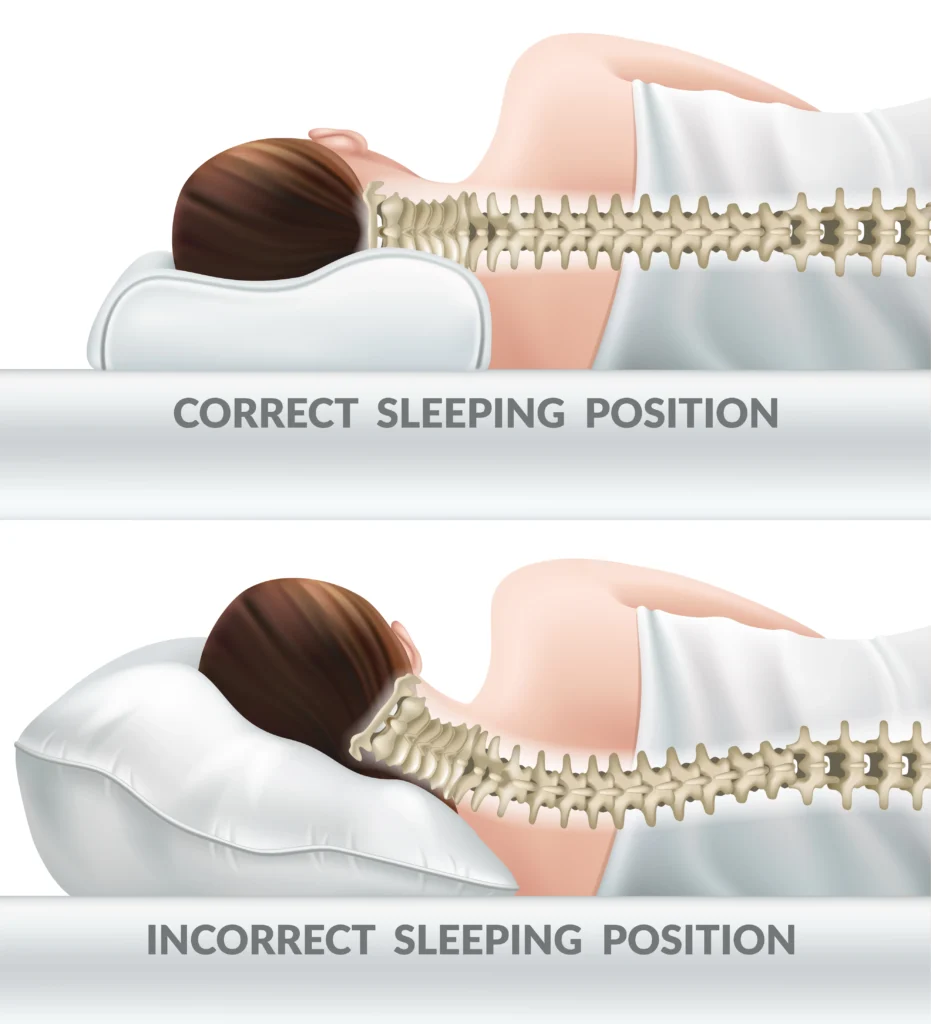
A supportive pillow should fill the space between your head and mattress without forcing the neck into excessive flexion or extension.
Clinical studies have shown that appropriately designed pillows may reduce neck pain and improve sleep quality, indirectly benefiting overall spinal posture. (PMC)
Why Morning Back Pain Is Often Worse Than Evening Pain
Many patients tell me,
“My back feels terrible when I wake up, but improves after I start moving.”
This pattern is surprisingly common.
Several physiological changes occur overnight:
- Spinal discs absorb fluid.
- Connective tissues become temporarily stiffer.
- Muscles remain relatively inactive.
- Joint lubrication decreases during prolonged immobility.
When you first stand in the morning, these tissues need time to adapt to body weight again.
If your sleeping posture has also placed unnecessary stress on your spine, morning discomfort becomes even more noticeable.
Research on spinal biomechanics demonstrates that intervertebral discs exhibit increased hydration and altered mechanical behaviour after overnight rest, explaining why gradual morning movement often eases symptoms. (NLM)
Physiotherapy Tips for Sleeping Comfortably With Back Pain
The most effective strategy is not simply changing your sleeping position, it is creating an environment that allows your spine to remain as neutral as possible throughout the night.
Here are evidence-informed recommendations I routinely share with my patients:
Maintain Neutral Spinal Alignment
Whether sleeping on your back or side, avoid excessive twisting, arching, or curling.
Imagine your spine remaining in a relaxed, straight position from head to pelvis.
Change Positions Naturally
Avoid forcing yourself to remain perfectly still.
Healthy sleepers naturally change positions several times during the night.
These movements reduce prolonged pressure on muscles, joints, and nerves.
Keep Your Hips Supported
If sleeping on your side, place a pillow between your knees.
If sleeping on your back, place a pillow beneath your knees.
These simple changes reduce lumbar strain significantly.
Stretch Before Bed
Gentle mobility exercises performed before sleeping can reduce muscle tension accumulated during the day.
Examples include:
- Pelvic tilts
- Cat-camel movements
- Child’s pose
- Hip flexor stretches
- Gentle hamstring stretching
Avoid aggressive stretching immediately before bed, as this may temporarily irritate sensitive tissues.
Research supports regular exercise and movement as key components in managing chronic low back pain. (The Oschsner Journal)
Strengthen Rather Than Only Stretch
One of the biggest misconceptions is that back pain results solely from “tight muscles.”
In reality, weak stabilising muscles often contribute more than inflexibility.
A physiotherapy programme focusing on:
- Core stability
- Gluteal strengthening
- Hip control
- Trunk endurance
- Functional movement
provides longer-lasting benefits than stretching alone.
High-quality systematic reviews consistently support exercise therapy as one of the most effective non-surgical treatments for persistent low back pain. (European Spine Journal)
Things to Do
- Sleep on your side or back with proper spinal support.
- Replace an old or sagging mattress if necessary.
- Choose a pillow that maintains neutral neck alignment.
- Stay physically active during the day.
- Perform regular physiotherapy exercises.
- Maintain a healthy body weight to reduce spinal loading.
- Get out of bed using the “log roll” technique rather than twisting abruptly.
- Walk for five to ten minutes after waking to reduce morning stiffness.
- Stay hydrated, as intervertebral discs rely on adequate hydration for optimal function.
- Seek professional assessment if pain persists beyond a few weeks.
Things to Avoid
- Sleeping on your stomach for prolonged periods.
- Using multiple thick pillows under your head.
- Sleeping on a worn-out mattress.
- Remaining in one position all night if it increases pain.
- Ignoring persistent morning stiffness.
- Lifting heavy objects immediately after waking.
- Spending long hours sitting without movement during the day.
- Self-prescribing painkillers without addressing the underlying cause.
- Assuming all back pain is caused by ageing.
- Delaying physiotherapy until symptoms become severe.
Can the Wrong Sleeping Position Cause Sciatica?
Absolutely, it can make sciatica symptoms significantly worse, although it is not usually the primary cause.
Sciatica occurs when the sciatic nerve becomes irritated or compressed, commonly due to a lumbar disc herniation, spinal stenosis, or degenerative changes.
Sleeping in a position that twists the pelvis, excessively arches the lower back, or places prolonged pressure on the lumbar spine may increase irritation around the affected nerve root.
Many patients with sciatica report that their symptoms are worst immediately after waking because the spine has remained in one position for several hours.
Clinical guidelines recommend posture modification alongside exercise therapy as part of conservative management for lumbar radiculopathy. (Cureus)
People with sciatica often find the greatest comfort by sleeping on their side with a pillow between their knees or on their back with a pillow beneath their knees.
These positions help reduce tension on the lumbar spine and surrounding soft tissues.
When Should You See a Physiotherapist?
Occasional morning stiffness is common and often improves with movement.
However, persistent or worsening symptoms should not be ignored.
Consult a physiotherapist if you experience:
- Back pain lasting longer than two to four weeks.
- Pain that wakes you repeatedly at night.
- Pain radiating into one or both legs.
- Tingling, numbness, or weakness.
- Difficulty walking because of pain.
- Morning stiffness lasting more than one hour.
- Pain that continues despite changing your sleeping position.
Early physiotherapy assessment can identify movement impairments, muscular weaknesses, and biomechanical contributors before symptoms become chronic.
Evidence consistently supports early conservative care for non-specific low back pain to improve function and reduce disability. (Pain and Therapy)
Red Flags: When Back Pain Needs Immediate Medical Attention
Although most back pain is mechanical and improves with conservative treatment, certain symptoms require urgent medical evaluation.
Seek immediate medical care if back pain is associated with:
- Loss of bladder or bowel control.
- Numbness around the groin or saddle region.
- Progressive weakness in one or both legs.
- Severe pain following a major fall or accident.
- Unexplained fever with back pain.
- Unexplained weight loss.
- History of cancer with new-onset back pain.
- Constant night pain that does not improve with position changes.
These symptoms may indicate serious underlying conditions such as cauda equina syndrome, spinal infection, fracture, or malignancy and should never be ignored.
International low back pain guidelines recommend prompt medical evaluation when red flag symptoms are present.
Lesser-Known Facts About Sleeping Position and Back Pain
Many people know that posture affects the spine, but research has uncovered several fascinating findings that are rarely discussed.
Your Brain Continues Monitoring Pressure While You Sleep
Even during deep sleep, your nervous system constantly monitors pressure on your joints and muscles.
When one area experiences excessive compression, the brain triggers small movements to redistribute body weight.
This is why healthy sleepers naturally change positions dozens of times each night.
Pain Can Reduce Night-Time Movement
Ironically, people with chronic back pain often move less during sleep because painful movements subconsciously discourage repositioning.
Remaining in one position for prolonged periods increases tissue stiffness, creating a cycle of discomfort and poor-quality sleep.
Sleep research has linked reduced nocturnal movement with increased musculoskeletal pain and impaired recovery. (Dovepress)
Sleep Quality Influences Pain Sensitivity
Poor sleep does more than make you feel tired, it actually changes how your brain processes pain.
Studies show that sleep deprivation increases inflammatory mediators and lowers pain thresholds, making existing back pain feel more intense the following day.
Improving sleep quality can therefore reduce pain even before structural healing occurs.
Recent research demonstrates a bidirectional relationship between chronic pain and sleep disturbances.
Stress Can Make Your Sleeping Position Worse
People experiencing stress or anxiety often sleep with increased muscle tension, clenched shoulders, or a tightly curled posture.
This sustained muscular contraction may contribute to neck and back discomfort by morning.
Incorporating relaxation techniques such as diaphragmatic breathing, mindfulness, or gentle stretching before bed may help reduce overnight muscle tension.
Final Thoughts from a Physiotherapist
As physiotherapists, we often focus on exercise, strengthening, and movement correction, but your recovery does not stop when you go to bed.
Sleep is when your body repairs muscles, restores spinal discs, and prepares for another day of movement.
If your spine remains poorly aligned for seven to nine hours every night, even the best rehabilitation programme can struggle to overcome those repeated mechanical stresses.
The worst sleeping position for back pain is generally sleeping on your stomach because it places the lumbar spine, pelvis, and neck in unfavourable positions for prolonged periods.
However, the ideal sleeping posture ultimately depends on your diagnosis, body shape, and individual symptoms.
Simple changes such as switching to side sleeping, placing a pillow between your knees, using a supportive mattress, and maintaining a neutral spinal position can significantly reduce morning pain for many people.
Remember, sleeping position alone is rarely the sole cause of back pain.
Recovery usually requires a combination of healthy movement, regular strengthening exercises, ergonomic habits, quality sleep, and professional physiotherapy guidance when needed.
If your pain persists despite making these changes, do not simply tolerate it.
An early assessment can identify the true source of your symptoms and help you return to comfortable, pain-free sleep.
Frequently Asked Questions
1. What is the worst sleeping position for back pain?
Sleeping on your stomach is generally considered the worst because it increases spinal stress and twists the neck for prolonged periods.
2. Is side sleeping better than back sleeping?
Both can be beneficial, but side sleeping with a pillow between the knees often provides excellent spinal alignment.
3. Can sleeping position cause lower back pain?
Yes. Poor sleeping posture maintained for several hours may contribute to muscle strain, joint irritation, and morning stiffness.
4. Which mattress is best for back pain?
A medium-firm mattress is supported by research for improving pain and sleep quality in many people with chronic low back pain.
5. Should I sleep without a pillow?
Most people benefit from using an appropriately sized pillow that maintains neutral neck alignment.
6. Can stomach sleeping cause sciatica?
It may aggravate existing sciatica by increasing lumbar extension and nerve irritation.
7. Why is my back stiff every morning?
Morning stiffness may result from prolonged immobility, poor sleeping posture, ageing, or underlying spinal conditions.
8. Does changing sleeping position really help?
Many people experience noticeable improvements within a few weeks after correcting their sleeping posture.
9. When should I see a physiotherapist?
If your pain lasts longer than 2–4 weeks, radiates into the legs, or interferes with daily activities, seek professional assessment.
10. Can exercise help more than changing sleeping position?
Yes. Combining good sleeping posture with strengthening exercises provides the best long-term outcomes for back pain.
Stay tuned with us for more health related topics.
Follow us on LinkedIn and Instagram for more.
More Read


Medical Disclaimer!
This article has been reviewed and written under the guidance of our Head Physiotherapist, Dr. Kruti Raj (PT, MUHS,CPT,CMPT). The information shared is intended for educational purposes only and should not be considered a substitute for personalized medical advice, diagnosis, or treatment.
Please consult us or any other qualified healthcare professional before beginning any exercise program, especially if you are experiencing pain, recovering from injury, or managing a medical condition.


