


Lumbar spondylosis treatment is not just about relieving back pain.
Lumbar spondylosis is one of those diagnoses that can sound far more frightening than it actually is.
You may see phrases such as “disc space narrowing,” “osteophytes,” “facet arthropathy” or “degenerative changes” on an X-ray or MRI and immediately assume that your lower back is permanently damaged.
But here is something I want you to understand as a physiotherapist: a degenerative-looking spine is not necessarily a painful spine, and a painful spine is not necessarily a severely damaged spine.
Lumbar spondylosis describes age- and load-related changes affecting structures of the lower spine.
These may include the intervertebral discs, facet joints, vertebral endplates and surrounding tissues.
The important question is not simply “How bad does my scan look?” but rather, “How are these changes affecting my movement, strength, function and nervous system?”
Quick Answer
Lumbar spondylosis refers to degenerative changes in the lower spine involving structures such as the discs, facet joints and vertebral endplates.
It does not always cause pain, and an abnormal MRI does not automatically mean severe symptoms. The most effective long-term approach usually focuses on exercise, strength, mobility, physical activity, healthy load management and self-management.
Seek urgent medical assessment if back pain is accompanied by new bladder or bowel problems, saddle-area numbness or significant new weakness.
Research has repeatedly demonstrated that degenerative spinal findings can occur in people who have no symptoms.
A systematic review of imaging in asymptomatic adults found that disc degeneration, bulging and other degenerative findings become increasingly common with age. (PubMed)
So, if you have been told that you have lumbar spondylosis, don’t panic and don’t stop moving.
The goal of treatment is usually to improve your capacity, reduce symptoms and keep your back functioning well.
Key Takeaways
- Lumbar spondylosis is common and does not always cause pain.
- MRI findings should always be interpreted alongside symptoms and clinical examination.
- Exercise and progressive strengthening are central to physiotherapy management.
- Walking can be an effective and accessible form of rehabilitation.
- There is no universal list of exercises that everyone with lumbar spondylosis must avoid.
- Prolonged inactivity can reduce physical capacity and confidence.
- Sleep quality can influence pain and recovery.
- The goal is improved function and capacity, not a “perfect” MRI.
- Sudden neurological changes, bladder/bowel problems or saddle numbness require urgent medical assessment.
What exactly is lumbar spondylosis?
Lumbar spondylosis is a broad term used for degenerative changes in the lumbar spine.
Your lower back contains five lumbar vertebrae, separated by intervertebral discs.
Behind these discs are small joints called facet joints, while nerves travel through openings around the spinal column.
With ageing and repeated loading, several changes may occur:
- The discs may lose some water content and height.
- Vertebral endplates may change.
- Bone spurs, or osteophytes, may develop.
- Facet joints may become arthritic.
- Ligaments may become thicker.
- The spaces available for spinal nerves may become narrower.
These changes do not necessarily happen at the same speed or to the same degree in every person.
In fact, population research illustrates how common radiographic lumbar spondylosis can be.
In the ROAD population study of adults aged 60 and above,
radiographic spondylosis was present in approximately three-quarters of participants at a specified severity threshold, while substantially fewer reported low back pain. (PubMed)
That is an important clinical lesson: the X-ray finding and the person’s symptoms are related, but they are not interchangeable.
What causes lumbar spondylosis?
There is rarely one single cause.
Age is an important factor, but lumbar spondylosis should not be thought of simply as something that happens because you are “old.”
Your spine responds to years of mechanical loading.
That loading comes from walking, sitting, lifting, bending, sport, work, body weight and countless small movements performed every day.
Genetics, previous injuries, physical workload, muscle capacity, smoking, sleep, physical activity and general health can also influence how symptoms develop.
One lesser-known point is that the amount of degeneration visible on imaging does not tell us exactly how much pain you will experience.
Pain is influenced by more than tissue structure.
Sensitivity of the nervous system, sleep, stress, physical conditioning, fear of movement and previous pain experiences can all influence how symptoms behave.
This is why two people with similar MRI findings may have completely different experiences.
What are the symptoms of lumbar spondylosis?
Some people have no symptoms whatsoever.
When symptoms occur, they may include:
- Lower back pain
- Difficulty standing for long periods
- Pain during certain bending or lifting activities
- Pain after prolonged sitting
- Reduced spinal mobility
- Buttock discomfort
- Muscle tightness
- Reduced exercise tolerance
- Morning stiffness
If degenerative changes affect the structures around a nerve, symptoms may extend into the buttock or leg.
You may experience:
- Tingling
- Numbness
- Burning or electric-like pain
- Weakness
- Shooting pain into the leg
However, leg symptoms should not automatically be labelled as “lumbar spondylosis.”
Disc-related nerve irritation, spinal stenosis and other conditions can produce similar symptoms.
That is why a proper clinical assessment matters.
Why your MRI can look terrible while you feel reasonably well
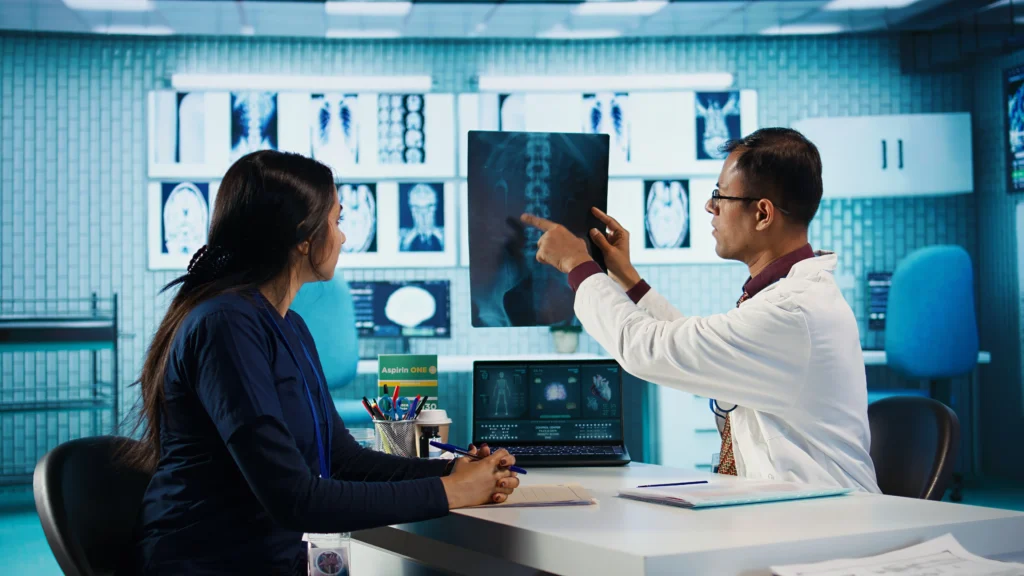
This is one of the most important things I explain to patients.
Imagine your MRI report says:
“Multilevel degenerative changes.”
It is very easy to interpret that sentence as:
“My spine is damaged at several levels.”
But degeneration is common even among people without significant pain.
The landmark systematic review by Brinjikji and colleagues showed that imaging features associated with spinal degeneration become increasingly prevalent with age even among asymptomatic individuals. (PMC)
Another meta-analysis found that several degenerative MRI findings were more common in people with low back pain than asymptomatic controls, but they were still present in people without symptoms. (NCBI)
Therefore, an MRI should be interpreted alongside your symptoms and physical examination rather than treated as a standalone diagnosis.
This is also why guidelines do not recommend routine imaging for uncomplicated low back pain when the result is unlikely to change management. (Nice)
Lumbar spondylosis versus lumbar spinal stenosis
These conditions can overlap, but they are not identical.
Lumbar spondylosis refers broadly to degenerative changes in the lumbar spine.
Lumbar spinal stenosis occurs when the spaces available for nerves become narrowed.
A person with advanced degenerative changes may therefore develop stenosis, but having lumbar spondylosis does not automatically mean that you have spinal stenosis.
Stenosis can produce a characteristic pattern in which standing or walking aggravates leg symptoms while sitting or bending forward provides relief.
This distinction matters because exercise selection and rehabilitation strategies may need to be adjusted according to the person’s symptom pattern.
A systematic review of exercise treatments for lumbar spinal stenosis found that:
exercise programmes commonly combine components such as strengthening, flexibility, aerobic activity and functional training, rather than relying on one “magic” exercise. (Sage Journals)
How is lumbar spondylosis diagnosed?
Diagnosis starts with your history and physical examination.
A physiotherapist may assess:
- Your pain pattern
- Spinal movement
- Hip mobility
- Lower-limb strength
- Core and trunk control
- Walking ability
- Balance
- Neurological signs
- Functional limitations
- Repeated movement responses
- Work and exercise demands
Imaging may be considered when the clinical picture suggests that it could alter management.
This is important because treating an MRI rather than treating the person can lead to unnecessary fear and unnecessary interventions.
NICE specifically recommends against routine imaging for uncomplicated low back pain in non-specialist settings. (Nice)
What is the best treatment for lumbar spondylosis?
There is no single best treatment for every patient.
For most people, conservative management is the starting point.
The physiotherapy approach usually focuses on four things:
- Reducing excessive sensitivity and pain
- Restoring movement
- Building strength and endurance
- Gradually returning to normal activities
Exercise is particularly important.
A systematic review and network meta-analysis involving 75 randomized controlled trials and more than 5,000 participants found beneficial effects from several forms of exercise for chronic low back pain,
including approaches such as Pilates, yoga, tai chi and other structured exercise programmes. (Frontiers)
This does not mean that Pilates or yoga is automatically superior for every person with lumbar spondylosis.
It means that movement-based rehabilitation has multiple effective routes.
The best programme is the one you can perform safely, progressively and consistently.
Which exercises can help lumbar spondylosis?
Your programme should be individualized, but common physiotherapy components may include:
Walking
Walking is often underestimated.
It provides repeated low-to-moderate loading while improving cardiovascular fitness and functional endurance.
A 2026 systematic review and dose-response meta-analysis of randomized trials found that walking programmes reduced pain and disability in people with chronic low back pain, although certainty of evidence varied. (Wiley)
This is particularly useful for people who have gradually become afraid of movement.
Start with a tolerable duration rather than chasing an arbitrary step count.
Core and trunk strengthening
Your spine does not need to be kept rigid all day.
Instead, the goal is to improve your ability to control and tolerate movement.
Depending on your assessment, exercises may include:
- Modified bridges
- Dead-bug variations
- Bird-dog exercises
- Trunk endurance exercises
- Hip strengthening
- Sit-to-stand training
Progression matters more than finding the “perfect” exercise.
Hip strengthening
This is another commonly overlooked component.
Your lower back does not work independently.
Weakness or poor endurance around the hips can alter how you perform lifting, walking, climbing stairs and other daily movements.
For some patients, improving gluteal strength and hip control can make functional tasks considerably easier.
Mobility exercises
Gentle lumbar, hip and thoracic mobility exercises can be useful when stiffness is limiting activity.
But more stretching is not always better.
If a movement repeatedly increases radiating leg pain, numbness or neurological symptoms, it should not simply be pushed harder.
What exercises should you avoid?
There is no universal list of “forbidden exercises” for lumbar spondylosis.
That is another myth worth challenging.
An exercise may be inappropriate for you at a particular stage, but become completely manageable after you develop sufficient strength and tolerance.
For example, bending, squatting or lifting are not inherently harmful to everyone with lumbar degeneration.
The better question is:
Can your current capacity handle the load?
Instead of permanently avoiding bending, the long-term goal may be to progressively restore your ability to bend safely.
Avoid exercises that consistently cause escalating pain, new neurological symptoms or prolonged worsening.
And do not suddenly begin heavy spinal loading because you had one good day.
Think progression, not punishment.
The physiotherapist’s “load budget” approach
One of my favourite ways to explain lumbar spondylosis is to think of your daily spinal load as a budget.
Imagine you have a certain amount of physical capacity available each day.
You spend that capacity on:
- Eight hours of sitting
- Commuting
- Household work
- Bending
- Lifting
- Walking
- Exercise
- Poor sleep
- Stressful days
If your capacity is low and your daily demands are high, symptoms can flare.
The solution isn’t necessarily to eliminate every activity.
Instead, we can increase capacity while temporarily modifying excessive loads.
This is why graded exposure and progressive strengthening can be more useful than living in fear of your spine.
Does posture cause lumbar spondylosis?
Poor posture is often blamed for almost every back problem.
The reality is more nuanced.
There is no single perfect posture that you must maintain all day.
Your body is designed to move between positions.
The problem is often prolonged exposure to one position, especially when you lack the physical capacity to tolerate it comfortably.
Instead of obsessing over sitting perfectly straight, try changing positions regularly.
Stand.
Walk.
Sit differently.
Move your hips.
Take short movement breaks.
Your spine generally prefers variety over prolonged stillness.
NICE also encourages people with low back pain to continue normal activities as much as possible rather than unnecessarily withdrawing from daily life.
Can weight affect lumbar spondylosis?
Body weight is only one part of the picture, but excess body weight can increase the physical demands placed on the musculoskeletal system.
However, I would never reduce someone’s back problem to a number on a weighing scale.
Improving muscle strength, walking capacity, cardiovascular fitness and general activity can be valuable regardless of weight.
The objective is better physical capacity, not simply a smaller number.
Don’t ignore sleep
Sleep is an underrated component of back rehabilitation.
Poor sleep can make pain harder to manage, while persistent pain can disrupt sleep, creating a frustrating cycle.
A systematic review involving more than 19,000 participants found associations between sleep and subsequent pain intensity, disability and recovery in people with low back pain,
although the authors noted substantial risk of bias in much of the available evidence. (Oxford Academic)
Another meta-analysis found that non-pharmacological interventions for chronic low back pain produced a small improvement in sleep and a moderate reduction in pain intensity, although evidence quality varied. (Elsevier)
So if your rehabilitation plan discusses exercises but completely ignores your sleep, it may be missing an important piece of the puzzle.
Calculate your ideal sleep timings here: “Sleep Calculator“
Small daily habits that can make a difference
Instead of looking for one miracle treatment, build a spine-friendly routine.
Try to:
- Break up prolonged sitting.
- Walk regularly.
- Strengthen your hips and trunk.
- Increase exercise gradually.
- Avoid sudden increases in lifting volume.
- Sleep consistently.
- Keep performing normal activities within tolerance.
- Learn proper lifting mechanics without becoming afraid of lifting.
- Avoid prolonged bed rest.
- Work on cardiovascular fitness.
- Treat flare-ups as signals to modify load rather than evidence that your spine is “breaking.”
One particularly useful principle is avoid the boom-and-bust cycle.
That means doing too much on a good day, experiencing a flare-up, resting excessively, recovering slightly, then repeating the cycle.
A better approach is to find a sustainable baseline and gradually increase it.
What treatments are not necessarily worth chasing?
People with chronic back pain are often offered passive treatments that promise to “realign,” “decompress” or “repair” the spine.
Be cautious about claims that a machine, belt or treatment can permanently reverse degeneration.
Current NICE guidance emphasizes exercise and self-management and recommends manual therapy only as part of a treatment package that includes exercise.
It does not recommend traction, acupuncture or several electrotherapy approaches for routine low back pain.
That does not mean every passive treatment is useless in every circumstance.
It means that passive treatment should not replace active rehabilitation.
Your long-term goal should be greater independence, not dependence on repeated treatments.
Can lumbar spondylosis be reversed?
This requires an honest answer.
You cannot reliably “erase” every degenerative change visible on an X-ray or MRI through exercise.
But that does not mean nothing can improve.
Pain can improve.
Strength can improve.
Mobility can improve.
Walking tolerance can improve.
Sleep can improve.
Confidence can improve.
Function can improve.
And these improvements can be much more meaningful than whether an imaging report still contains the word “degeneration.”
This is one of the most important mindset changes I encourage patients to make.
The goal is not to create a perfect-looking spine. The goal is to create a stronger, more capable person.
When should you see a doctor urgently?
Most mechanical low back pain is not an emergency, but certain symptoms require prompt assessment.
Seek urgent medical attention if severe low back pain is accompanied by new bladder or bowel dysfunction, new numbness around the perineal/saddle region, or significant new neurological weakness.
NICE identifies these features as concerning for possible cauda equina syndrome.
You should also seek medical assessment for concerning features such as unexplained weight loss, history of cancer, significant trauma, fever or severe progressive/unremitting pain.
The purpose of red-flag screening is not to frighten you.
It is to make sure that a routine musculoskeletal problem is not being mistaken for something requiring different medical management.
NICE specifically recommends considering alternative diagnoses when symptoms are new or changing.
My physiotherapy takeaway
If you have been diagnosed with lumbar spondylosis, please don’t interpret the diagnosis as a sentence telling you to protect your spine forever.
Your lumbar spine is a living, adaptable part of your body.
Some structural changes are part of normal ageing.
Others may be associated with symptoms. But the relationship between imaging and pain is far more complicated than “more degeneration equals more pain.”
Your rehabilitation should therefore focus on what your body can do, not simply what your scan shows.
Start with tolerable movement.
Build strength.
Increase walking.
Improve hip and trunk capacity.
Break up prolonged sitting.
Respect flare-ups without becoming afraid of them.
Sleep well.
Progress gradually.
And most importantly, have your exercise programme matched to your actual symptoms rather than copying a random “lumbar spondylosis exercise” video from the internet.
A degenerative spine does not automatically require a fragile lifestyle.
In many people, the most powerful treatment is gradually teaching the body that movement is safe, useful and achievable again.
Frequently Asked Questions About Lumbar Spondylosis
What is lumbar spondylosis?
Lumbar spondylosis describes degenerative changes affecting structures of the lower spine, including discs, facet joints and vertebral endplates. These changes may occur with ageing and mechanical loading and do not always cause symptoms.
Can lumbar spondylosis be cured?
Structural degenerative changes cannot always be reversed, but pain, mobility, strength, walking tolerance and daily function can often improve significantly with appropriate rehabilitation and lifestyle management.
What are the best exercises for lumbar spondylosis?
Depending on your symptoms, physiotherapy may include walking, trunk strengthening, hip strengthening, mobility exercises and progressive functional training. The best programme should be individualized.
Should I avoid bending if I have lumbar spondylosis?
Not necessarily. Bending is not automatically harmful. The goal is usually to gradually restore tolerance to everyday movements while modifying activities that currently aggravate symptoms.
Is lumbar spondylosis the same as spinal stenosis?
No. Lumbar spondylosis describes degenerative changes, whereas spinal stenosis refers to narrowing of spaces around the spinal nerves. They can occur together but are not identical conditions.
Can walking help lumbar spondylosis?
Walking can be useful for improving physical activity, endurance and function in people with chronic low back pain. The appropriate amount depends on symptoms and individual capacity.
When is lumbar spondylosis serious?
Urgent assessment is required when severe back pain occurs with new bladder or bowel dysfunction, saddle-area numbness or significant new neurological weakness.
Does lumbar spondylosis always cause back pain?
No. Degenerative findings are common in people who have little or no back pain. Imaging should therefore be interpreted together with symptoms and clinical examination.
Can physiotherapy help lumbar spondylosis?
Yes. Physiotherapy can help address pain, stiffness, strength, mobility, physical conditioning, movement confidence and functional limitations through an individualized rehabilitation programme.
Should I get an MRI for lumbar spondylosis?
An MRI is not automatically required for uncomplicated low back pain. Imaging is generally considered when clinical findings suggest that the result is likely to change management or when concerning symptoms require further investigation.
Stay tuned with us for more health related topics.
Follow us on LinkedIn and Instagram for more.
More Read


Medical Disclaimer!
This article has been reviewed and written under the guidance of our Head Physiotherapist, Dr. Kruti Raj (PT, MUHS,CPT,CMPT). The information shared is intended for educational purposes only and should not be considered a substitute for personalized medical advice, diagnosis, or treatment.
Please consult us or any other qualified healthcare professional before beginning any exercise program, especially if you are experiencing pain, recovering from injury, or managing a medical condition.


