


Early signs of knee osteoarthritis can be surprisingly subtle.
Knee osteoarthritis is often imagined as a disease that begins when an older person develops severe knee pain, swelling and difficulty walking.
In clinical practice, that is rarely how the story starts.
The first clues can be surprisingly subtle.
You may notice that stairs have become slightly harder.
You may push yourself up from a chair using your hands.
Your knee may make a new grinding sound, feel “rusty” after sitting, or become uncomfortable after a long shopping trip.
You may even notice that one leg feels weaker despite having no obvious muscle wasting.
These changes are easy to dismiss because they do not necessarily feel like a disease.
Quick Answer
Early knee osteoarthritis may begin with subtle changes rather than severe pain. Common overlooked signs of knee osteoarthritis include stiffness after sitting, difficulty climbing or descending stairs, using your hands to rise from a chair, frequent knee crepitus, activity-related pain, reduced knee movement, weakness, altered walking, poor balance, difficulty squatting, occasional swelling, sleep disturbance and reduced confidence in the knee.
One symptom alone does not diagnose osteoarthritis. A physiotherapy or medical assessment should consider pain, movement, strength, function, previous injuries and other possible causes of knee symptoms.
As a physiotherapist, this is one of the things I want people to understand: early knee osteoarthritis signs does not always announce itself with severe knee pain.
Functional changes can appear before a person considers the knee to be a problem.
Research also shows that knee symptoms and structural changes seen on X-rays do not always match.
A person can have significant radiographic osteoarthritis with relatively little pain, while another person can have substantial symptoms despite relatively modest imaging changes. (Wolters Kluwer)
That is why I prefer looking at the whole picture: pain, movement, strength, walking, balance, stiffness, daily activities and how your knee responds to load.
Key Takeaways
- Early knee osteoarthritis does not always cause severe pain.
- Difficulty with stairs and getting out of a chair can reveal declining knee function.
- Frequent crepitus becomes more meaningful when combined with pain or functional changes.
- Quadriceps weakness may occur even before obvious muscle wasting.
- Balance and proprioception can also be affected.
- Previous ACL or meniscal injuries can substantially increase later OA risk.
- X-ray severity does not reliably predict how much pain an individual will experience.
- Regular, appropriately progressed exercise is a cornerstone of management.
- Weight management can improve pain and function when overweight or obesity is present.
- Hot, markedly swollen, rapidly worsening or atypical knee symptoms require medical assessment.
Here are 17 early signs of knee osteoarthritis that deserve more attention than they usually receive.
1. Your knee feels stiff after sitting for a while
One of the earliest clues can be a feeling of stiffness when you stand after sitting at a desk, watching television, travelling or riding in a car.
You may think, “My knee just needed to loosen up.”
That may be true occasionally.
But if the same pattern repeatedly occurs, especially when stiffness is accompanied by activity-related discomfort, it deserves attention.
For typical osteoarthritis, morning stiffness is generally absent or lasts no more than about 30 minutes.
NICE recommends that people aged 45 and over with activity-related joint pain and no morning stiffness, or stiffness lasting no more than 30 minutes, can often be diagnosed clinically without routine imaging. ((NICE Guideline))
The important point is not to diagnose yourself from one episode of stiffness.
Look for a repeated pattern.
2. Stairs suddenly feel more difficult
This is one of the functional clues I pay close attention to.
Perhaps climbing stairs now requires more effort.
Maybe you unconsciously pull yourself upward using the railing.
Going downstairs may feel particularly uncomfortable or uncertain.
Stairs demand substantial knee extensor strength and control.
When quadriceps function declines, everyday tasks can expose the problem before ordinary walking does.
Clinical research has demonstrated that functional tests such as the five-times-sit-to-stand test, walking speed and walking capacity can help identify functional limitations in people with knee osteoarthritis. ((PMC))
Physiotherapy tip: Instead of asking only “Does your knee hurt?”, notice whether your movement strategy has changed.
3. You use your hands to get out of a chair
This is an easily overlooked sign.
If you previously stood from a chair without thinking and now regularly push off the armrests, place your hands on your thighs or rock your body forward several times before standing, your lower-limb strength or confidence may have changed.
It does not automatically mean osteoarthritis.
However, repeated difficulty with sit-to-stand movement can be an early functional warning that the knee and surrounding muscles are no longer handling load as efficiently.
Quadriceps weakness signs has been associated with knee osteoarthritis, and research has even found weakness in people with radiographic osteoarthritis who did not report knee pain. ((PubMed))
This is one reason I do not wait for severe pain before assessing strength.
4. Your knee makes grinding, crackling or popping sounds
The medical term for joint noise is crepitus.
A popping or cracking sound by itself does not mean that your cartilage is “wearing away.”
Knees can make noises for many harmless reasons.
However, frequent crepitus becomes more interesting when it occurs together with pain, stiffness or functional changes.
A longitudinal Osteoarthritis Initiative study investigated subjective crepitus and the development of symptomatic knee osteoarthritis, finding an association between frequent crepitus and later symptomatic disease. (Wiley)
So don’t panic when your knee clicks.
Instead, ask: What else is happening with the knee?
5. Your knee hurts after activity, but settles with rest
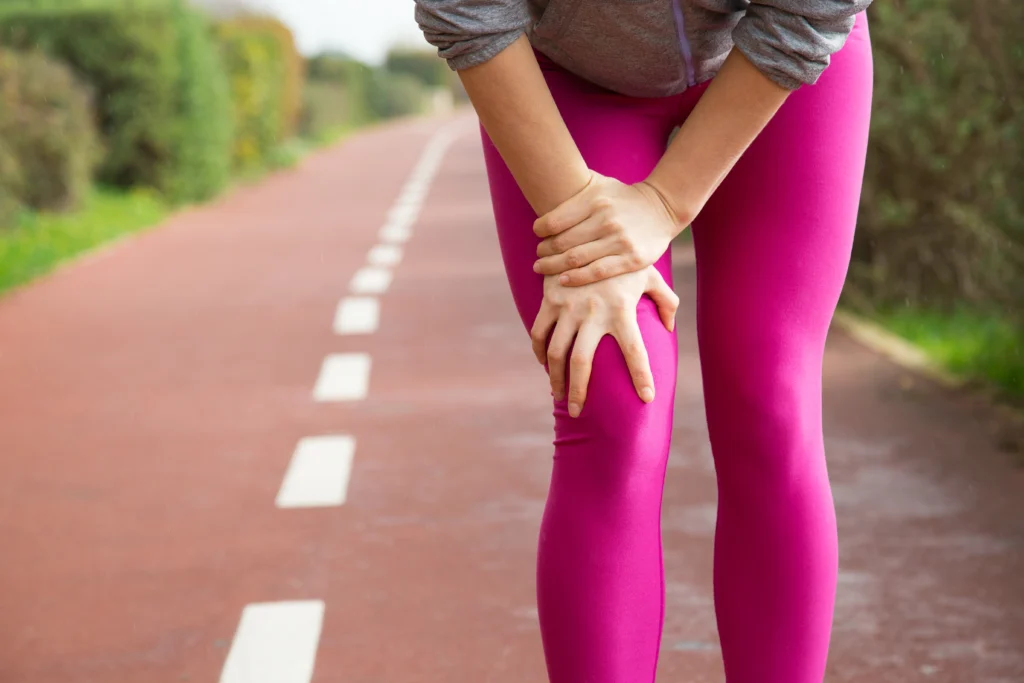
This pattern is much more meaningful than a random ache.
Perhaps your knee feels fine when you wake up but becomes uncomfortable after walking for 30 minutes.
Maybe shopping, standing in a queue or exercising produces pain that settles after you reduce the load.
Activity-related joint pain is a classic feature considered when clinically diagnosing osteoarthritis.
The mistake is to assume that because the pain disappears with rest, nothing needs to be done.
Early load-related symptoms are often the perfect time to examine your movement patterns, strength and activity dose rather than waiting until walking becomes significantly restricted.
6. Your knee feels “heavy” even when it isn’t very painful
Patients sometimes describe the early knee problem as heaviness, tiredness, pressure or a feeling that one leg is “not as free” as the other.
This can be difficult to quantify, but it can reveal a subtle reduction in movement efficiency.
A knee does not work independently.
The hip, ankle, quadriceps, hamstrings, calf and trunk all influence how forces travel through the lower limb.
This is why a physiotherapy assessment often looks beyond the painful area.
7. You have started avoiding squats without realizing it
You may not consciously say, “My knee hurts when I squat.”
Instead, you stop squatting.
You sit on higher chairs.
You avoid floor sitting.
You bend less deeply when picking something up.
You ask someone else to retrieve objects from a low shelf.
This is called activity modification, and it can be an important early clue.
The danger is that avoiding a movement indefinitely can create a vicious cycle: less movement → reduced strength and confidence → greater difficulty with the movement → more avoidance.
Current guidelines strongly support individualized therapeutic exercise for knee osteoarthritis.
8. You feel less steady on one leg
Balance is not usually the first thing people associate with knee osteoarthritis.
It should be.
The knee contributes sensory information that helps the nervous system understand where the leg is in space. This ability is called proprioception.
Research has found impaired lower-extremity proprioception in people with early-stage knee osteoarthritis compared with individuals without osteoarthritis. ((Science Direct))
You might notice this as difficulty standing on one leg while putting on trousers, stepping onto an uneven surface or turning quickly.
It does not mean that poor balance proves you have osteoarthritis.
But when balance changes occur alongside knee symptoms, they deserve assessment.
9. Your walking pattern has subtly changed
Look at an old photograph or video of yourself walking if you can.
Do you now take shorter steps?
Do you spend less time on one leg?
Do you walk more cautiously?
Do you turn your whole body instead of pivoting naturally?
Many people do not notice these changes because they develop gradually.
The body is extremely good at compensation.
Unfortunately, compensation can hide a developing movement problem for months.
A physiotherapist can examine walking speed, step length, weight transfer, knee control and hip strength to determine whether the knee is being overloaded or protected.
10. You have less knee movement than before
You may still be able to walk normally but notice that you cannot comfortably bend your knee as far.
Perhaps sitting cross-legged has become difficult.
Maybe kneeling feels different.
Or perhaps fully straightening the knee takes longer after prolonged sitting.
Reduced range of motion can occur for many reasons, including pain, swelling, joint changes or muscle tightness.
It is not specific enough to diagnose osteoarthritis on its own.
But a gradual loss of comfortable movement should not simply be labelled “age.”
Age may increase risk, but losing function is not something you automatically have to accept.
11. One thigh seems weaker or smaller
Many people wait for visible muscle wasting before thinking about muscle weakness.
That is too late.
Strength can decline before obvious changes in muscle size become apparent.
More importantly, quadriceps weakness can occur even when a person does not report significant pain.
A classic study found that quadriceps weakness was associated with knee osteoarthritis and could occur without obvious lower-limb muscle atrophy. (Research Gate)
This is clinically important because strengthening is not simply about making the thigh look stronger.
The quadriceps helps control the knee during standing, walking, stairs and other loaded movements.
12. Your knee becomes uncomfortable after a long day, not necessarily during exercise
A person may tolerate a 20-minute walk but develop discomfort after an entire day of standing, commuting, shopping and household work.
This tells us something about cumulative load.
The knee may not object to one specific activity. It may object to the total amount of loading accumulated throughout the day.
This is why I often advise patients to examine their entire 24-hour movement pattern rather than identifying one “bad exercise.”
Interestingly, prospective research has found that greater amounts of light-intensity physical activity signs were associated with lower risk of disability onset and progression among adults with knee osteoarthritis or risk factors for it. ((NCBI))
So the answer is usually not “stop moving.”
The better question is: How can we distribute movement more intelligently?
13. Your knee hurts more after a sudden increase in exercise
You may decide to get fit and immediately start running, climbing stairs, doing hundreds of squats or following an intense workout plan.
Then your knee starts complaining.
This does not necessarily mean that exercise damaged your knee.
A sudden increase in training load can exceed your current capacity.
The solution may be modifying intensity, volume, recovery and exercise selection rather than abandoning exercise altogether.
A 2024 systematic review and meta-analysis found that resistance exercise programs lasting several months can improve pain and physical function in knee and hip osteoarthritis, without evidence that a rigid exercise dose is necessary for benefit. ((ACR Journals))
The practical lesson is simple: progress gradually.
14. You feel pain when descending stairs before climbing them
Many people notice this pattern specifically.
Going downstairs requires controlled knee flexion while the quadriceps works eccentrically.
That can expose deficits in strength, control or load tolerance.
Pain going downstairs can also occur with patellofemoral disorders and other knee conditions, so it is not an osteoarthritis diagnosis.
But if this is a new, persistent symptom accompanied by stiffness, crepitus or reduced function, it is worth investigating rather than repeatedly compensating with the railing.
15. Your knee occasionally swells after a busy day
Mild intermittent swelling can occur with knee irritation, including osteoarthritis, but swelling is not specific to OA.
What matters is the pattern.
Does swelling appear repeatedly after higher-load activities?
Does your knee feel fuller or tighter afterward?
Does your range of motion temporarily decrease?
These details are more useful than simply saying, “My knee swells.”
A hot, markedly swollen joint, rapidly worsening symptoms, significant trauma or unusual systemic symptoms require medical assessment because they can indicate another condition rather than routine osteoarthritis.
NICE specifically identifies hot swollen joints, rapid worsening, recent trauma and prolonged stiffness as atypical features requiring consideration of alternative or additional diagnoses.
16. Your knee pain is beginning to affect your sleep
Sleep problems are often treated as a consequence of chronic knee pain, but they are clinically important in their own right.
You may find yourself changing sleeping positions, waking when the knee is uncomfortable or struggling to become comfortable after a physically demanding day.
Recent evidence shows that sleep disorders are common among people with osteoarthritis and are associated with pain, fatigue and disability.
This creates a potentially frustrating cycle:
pain → poorer sleep → reduced recovery → greater fatigue → less activity → reduced strength → greater difficulty moving.
Therefore, if knee symptoms are beginning to disturb sleep, don’t wait until the pain becomes severe before addressing the problem.
17. You have stopped trusting your knee
This may be the most overlooked sign of all.
You may say:
“My knee feels unreliable.”
“I don’t like turning quickly.”
“I am scared it will give way.”
“I don’t carry heavy things anymore.”
“I avoid uneven ground.”
These statements reveal more than pain intensity.
They tell me that the knee has begun to change your behaviour.
Fear and reduced confidence can lead to avoidance, and avoidance can gradually reduce physical capacity.
This does not mean the problem is “all in your head.”
Pain, confidence, movement and nervous-system responses interact.
Research on osteoarthritis increasingly supports treating the person rather than simply treating an X-ray abnormality. ((Wiley))
Imaging findings alone have limited ability to predict an individual’s pain and symptoms.
What these 17 signs of knee osteoarthritis really mean
Having one or even several of these signs does not prove that you have knee osteoarthritis.
That distinction is important.
Knee pain can come from patellofemoral pain, meniscal pathology, tendinopathy, bursitis, inflammatory arthritis, previous injury, referred pain and other conditions.
A physiotherapy assessment should consider:
- where the pain is located
- when it appears
- how long stiffness lasts
- knee range of motion
- quadriceps and hip strength
- walking mechanics
- balance and proprioception
- functional tasks such as squatting and stairs
- previous knee injuries
- activity levels
- body-weight changes where relevant
- sleep and recovery
- the presence of red flags
NICE specifically recommends that typical osteoarthritis can often be diagnosed clinically without routine imaging and advises against routinely using imaging unless there are atypical features or another diagnosis is suspected.
That is an important shift from the common belief that “I need an X-ray first.”
One surprising fact: a bad X-ray does not automatically mean a bad knee
This is something I explain frequently in clinic.
A person can have substantial structural changes on an X-ray and relatively little pain.
Another person can have significant pain with less impressive radiographic changes.
A 2025 analysis of data from the Osteoarthritis Initiative found that commonly measured structural features on radiographs and MRI had limited ability to predict individual pain and symptom severity. ((PUbMed))
This is why I would never tell someone, “Your X-ray looks terrible, so your knee must be terrible.”
The knee is a living biological system, not a photograph.
Another lesser-known issue: previous knee injuries matter years later
If you tore your ACL, injured your meniscus or suffered a significant knee injury years ago, don’t assume that because you recovered and returned to normal activities the history is irrelevant.
A systematic review and meta-analysis found substantially increased odds of knee osteoarthritis after ACL and meniscal injuries,
with estimates around fourfold after ACL injury and around sixfold after meniscal or combined ACL-meniscal injury, although the authors noted important variation between studies.
This is why rehabilitation after injury should not end simply because pain has disappeared.
Restoring strength, movement quality, balance and confidence is part of long-term joint health.
What I would do if these early signs of knee osteoarthritis were appearing
If you are noticing early knee changes, I would not begin by trying to find the “best knee supplement.”
I would start with an assessment.
Then I would usually build a plan around four areas.
1. Restore strength
Quadriceps strengthening is important, but I rarely focus on the quadriceps alone.
Depending on the individual, rehabilitation may include:
- quadriceps strengthening
- hip abductor and extensor strengthening
- calf strengthening
- sit-to-stand training
- step exercises
- balance work
- functional strengthening
- aerobic conditioning
The exact exercises should match your symptoms and functional goals.
Evidence supports exercise as a core treatment for knee osteoarthritis.
NICE recommends tailored therapeutic exercise, including muscle strengthening and general aerobic fitness.
A 2024 systematic review of home-based exercise also found improvements in pain, physical function and quality of life in people with knee osteoarthritis. ((BMC))
2. Stop treating movement as the enemy
One of the worst messages a person with early knee OA can receive is:
“Don’t use your knee.”
Movement is part of rehabilitation.
The goal is not to expose an irritated knee to unlimited load.
The goal is to develop its capacity progressively.
A 2024 Mendelian randomization study found evidence supporting appropriate physical activity as protective while suggesting that both sedentary behaviour and excessive physical activity can be problematic. (PMC)
The sweet spot is appropriate loading.
3. Look at body weight without blaming the person
If someone is living with overweight or obesity, weight management can be a useful component of knee OA care.
This should not be framed as “your weight caused your knee problem.”
It is more accurate to say that reducing excess body weight can reduce mechanical loading and improve pain and function.
The landmark IDEA randomized trial found that intensive diet plus exercise produced improvements in several clinical and mechanistic outcomes compared with exercise alone in adults with overweight/obesity and knee OA. (JAMA)
NICE recommends weight-management support when appropriate and notes that 10% weight loss is likely to provide greater benefits than 5%, while emphasizing that any amount of weight loss can be beneficial.
4. Improve consistency rather than chasing the perfect exercise
You do not need an exotic rehabilitation programme.
You need one that you can actually perform.
A 2024 meta-analysis found that resistance exercise can improve pain and function and did not find that a rigid exercise volume was necessary for benefit. (ACR)
In my clinical view, the best programme is often the one that is appropriately challenging, progressively adjusted and consistently performed.
Things I would avoid if you are noticing early knee symptoms
Don’t completely stop activity
Extended inactivity can contribute to weakness and declining physical capacity.
Don’t suddenly increase exercise volume
Going from almost no activity to intense running, stair climbing or hundreds of squats is rarely a sensible progression.
Don’t use pain as the only measure of joint health
Pain matters, but so do strength, function, movement and confidence.
Don’t chase an X-ray grade
Imaging should answer a clinical question, not become a scorecard for how “damaged” your body is.
Don’t assume every clicking knee needs treatment
Noisy knees are common.
The combination of noise plus persistent symptoms and functional changes is more informative.
Don’t rely on passive treatments alone
Manual therapy can sometimes have a role, but NICE recommends it only alongside therapeutic exercise for knee or hip osteoarthritis rather than as a stand-alone strategy.
When knee symptoms should not be dismissed as ordinary osteoarthritis
Seek medical evaluation if your knee becomes suddenly and markedly swollen, hot or red, especially if you feel unwell.
You should also seek assessment after significant trauma, with rapidly worsening symptoms, substantial deformity, prolonged morning stiffness or symptoms that do not fit the typical osteoarthritis pattern.
These features can indicate another or additional diagnosis.
The physiotherapist’s bottom line
The biggest mistake is waiting for knee osteoarthritis to become painful enough to interfere with your life before doing something about it.
Early knee osteoarthritis can whisper.
It may appear as stiffness after sitting, difficulty with stairs, reduced confidence on one leg, frequent crepitus, subtle weakness, altered walking, reduced squatting ability or the gradual decision to avoid activities you once performed automatically.
None of these signs proves that you have knee osteoarthritis.
But together, they can tell you that your knee deserves attention.
The encouraging part is that early intervention does not mean trying to “reverse cartilage” with a miracle product.
It means improving the factors you can influence: strength, movement capacity, physical activity, body weight where appropriate, recovery, confidence and symptom management.
Current evidence continues to place therapeutic exercise and appropriate weight management at the centre of knee osteoarthritis care.
And that is the message I would want every patient to remember:
A knee that is beginning to complain is not necessarily a knee that is destined to fail.
The earlier you understand what is changing, the more opportunities you have to respond intelligently.
What is the first sign of knee osteoarthritis?
Early knee osteoarthritis may cause activity-related knee pain, stiffness after sitting, difficulty with stairs, reduced knee movement or subtle changes in strength and function. There is no single first symptom for everyone.
Can knee osteoarthritis start without severe pain?
Yes. Structural knee osteoarthritis and symptoms do not always match. Some people have substantial structural changes with relatively little pain, while others can experience significant symptoms with less obvious imaging changes.
Is knee clicking an early sign of arthritis?
Knee clicking or crepitus alone does not prove arthritis. Frequent crepitus becomes more clinically relevant when it occurs together with persistent pain, stiffness or functional changes.
Can weak thigh muscles cause knee problems?
Quadriceps weakness is associated with knee osteoarthritis and reduced physical function. Strengthening the quadriceps and other lower-limb muscles is therefore an important component of physiotherapy management.
Can physiotherapy help early knee osteoarthritis?
Yes. Physiotherapy can address strength, mobility, balance, walking mechanics, exercise progression, activity modification and functional limitations. Therapeutic exercise is a core evidence-based treatment for knee osteoarthritis.
Should I stop exercising if my knee hurts?
Not necessarily. Exercise is an important part of knee osteoarthritis management. The type, intensity and progression should be adjusted according to symptoms and individual capacity rather than stopping all movement.
Can losing weight help knee osteoarthritis?
For people living with overweight or obesity, weight loss can improve knee pain and physical function. Evidence suggests that greater weight loss can produce greater improvements in some clinical outcomes.
Can an old knee injury cause arthritis years later?
Yes. Previous ACL and meniscal injuries are associated with substantially higher odds of developing knee osteoarthritis later. Long-term rehabilitation and strength maintenance are therefore important after major knee injuries.
Do I need an X-ray to diagnose knee osteoarthritis?
Not always. Typical knee osteoarthritis can often be diagnosed clinically. Imaging may be appropriate when symptoms are atypical, rapidly worsening or when another diagnosis needs to be considered.
When should knee pain be checked by a doctor?
Seek assessment for rapidly worsening symptoms, significant trauma, a hot or markedly swollen knee, major deformity, prolonged morning stiffness or symptoms that do not fit the usual osteoarthritis pattern.
Stay tuned with us for more health related topics.
Follow us on LinkedIn and Instagram for more.
More Read


Medical Disclaimer!
This article has been reviewed and written under the guidance of our Head Physiotherapist, Dr. Kruti Raj (PT, MUHS,CPT,CMPT). The information shared is intended for educational purposes only and should not be considered a substitute for personalized medical advice, diagnosis, or treatment.
Please consult us or any other qualified healthcare professional before beginning any exercise program, especially if you are experiencing pain, recovering from injury, or managing a medical condition.


