Weight loss exercises for knee pain need a careful approach.
The goal is to burn calories while reducing stress on your joints.
Trying to lose weight can feel overwhelming when every step hurts.
Many traditional weight-loss programs focus on running, jumping, burpees, or high-intensity workouts that place significant stress on the knees.
For people living with knee pain, arthritis, old sports injuries, or excess body weight, these weight loss exercises may seem impossible.
Quick Answer
Yes, you can absolutely lose weight even if you have knee pain.
You do not need to run or perform high-impact workouts. Low-impact exercises like walking, swimming, cycling, water aerobics, chair workouts, and strength training can help burn calories while being gentler on your joints.
The best exercise is the one you can perform safely and consistently.
The good news is that you do not have to run marathons or complete intense boot camps to lose weight.
In fact, many low-impact activities can burn calories, improve fitness, strengthen muscles, and support healthy weight loss while being gentler on the knees.
The goal is not to avoid movement.
The goal is to find movement that your body can tolerate and maintain consistently.
Key Takeaways
- Knee pain does not prevent healthy weight loss.
- Running is not required to burn calories.
- Swimming and water aerobics are excellent low-impact choices.
- Walking can often be modified instead of avoided.
- Strength training helps support the muscles around the knee.
- Losing weight may reduce stress on knee joints.
- Chair exercises and resistance bands are beginner friendly.
- Consistency is more important than workout intensity.
Can You Lose Weight If You Have Knee Pain?
Yes.
Knee pain may limit certain activities, but it does not prevent weight loss.
Body weight is influenced by many factors, including nutrition, physical activity, and long-term lifestyle habits.
Even if running or jumping is uncomfortable, there are many other ways to increase energy expenditure.
In some cases, losing even a modest amount of weight may help reduce stress on the knee joints.
Research supports exercise as a key component of managing knee osteoarthritis and improving physical function. (Kolasinski et al. 2020)
Rather than avoiding exercise altogether, many people benefit from choosing activities that reduce joint impact while still keeping the body active.
Why High-Impact Exercise May Not Be the Best Choice
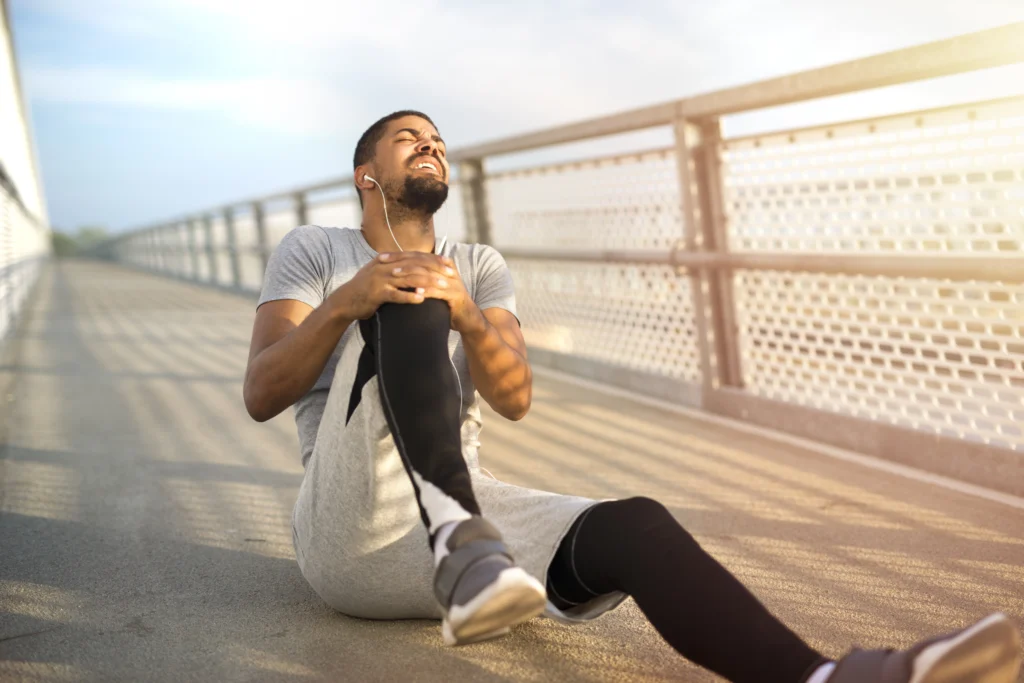
High-impact activities involve repeated force through the joints.
Examples include:
- Sprinting
- Jumping exercises
- Box jumps
- High-impact aerobics
- Some forms of competitive sports
This does not mean these exercises are bad.
However, for people with existing knee pain, they may increase discomfort and reduce the likelihood of sticking with an exercise routine.
A sustainable exercises program should challenge the body without causing unnecessary knee pain for weight loss.
Can Losing Weight Actually Reduce Knee Pain?
Excess body weight increases the load placed on the knees during daily activities.
Walking, climbing stairs, and standing all require the knees to support body weight.
Research suggests that intentional weight loss may reduce knee joint loading and improve symptoms in people with knee osteoarthritis. (Messier et al. 2013)
This creates a positive cycle.
Losing weight may reduce knee discomfort, and reduced discomfort may make it easier to stay physically active.
Good News
Even modest weight loss may reduce the load placed on your knees during everyday activities like walking and climbing stairs.
Walking Is Often a Good Place to Start
Many people assume they must stop walking if their knees hurt.
In reality, gentle walking is often one of the most practical and accessible forms of exercise.
The key is to adjust the activity to your comfort level.
Helpful strategies include:
- Walking on flat surfaces
- Choosing supportive footwear
- Starting with shorter sessions
- Taking rest breaks when needed
- Gradually increasing duration
Walking does not have to be fast to be beneficial.
Consistency is usually more important than intensity.
Swimming Is One of the Best Low-Impact Exercises
Water supports much of your body weight, reducing stress on the joints.
Swimming allows many people with knee pain to exercise comfortably while improving cardiovascular fitness.
Different swimming styles can be adjusted according to individual comfort levels.
Swimming also engages multiple muscle groups, making it an effective whole-body workout.
Best Knee-Friendly Exercises
- Swimming
- Walking
- Cycling
- Water Aerobics
- Chair Cardio
- Resistance Bands
Water Aerobics Can Burn Calories Without Excess Joint Stress
Water aerobics combines movement and resistance while minimizing impact.
The natural buoyancy of water helps support the body, making weight loss exercises easier for many people with arthritis or chronic knee pain.
Research has found that aquatic exercise can improve pain and physical function. (Bartels et al. 2016)
For beginners, water-based exercise may feel less intimidating than traditional gym workouts.
Cycling Is Gentle on the Knees
Cycling allows the legs to move through a controlled range of motion with relatively low joint impact.
Both outdoor cycling and stationary bikes can be useful options.
Resistance can be adjusted to individual ability, making it suitable for many fitness levels.
A stationary bicycle may be particularly helpful for people who prefer exercising indoors.
Elliptical Training Provides Low-Impact Cardio
Elliptical machines create a smooth movement pattern that avoids the repeated impact associated with running.
Many people find that elliptical workouts allow them to elevate their heart rate without excessive knee discomfort.
Adjusting resistance and workout duration can help tailor the weight loss exercises to individual needs.
Chair Exercises Are Better Than No Exercise
People with significant knee pain sometimes believe they cannot exercise at all.
Chair-based workouts offer another option.
Examples include:
- Seated marching
- Arm raises
- Resistance band exercises
- Seated punches
- Chair yoga
These activities can increase movement and help improve fitness while reducing stress on painful joints.
Upper-Body Cardio Can Help Burn Calories
Exercise is not limited to the legs.
Upper-body ergometers, boxing movements, resistance circuits, and seated cardio routines can all contribute to energy expenditure.
For people recovering from knee injuries, upper-body exercise may help maintain activity levels while protecting the affected joint.
Strength Training Can Help Support the Knees
Many people fear that strength training will damage painful knees.
When performed correctly, strengthening exercises can actually help support the muscles surrounding the knee joint, relieving the knee pain and promoting weight loss.
Important muscle groups include:
Quadriceps
Strong front thigh muscles help stabilize the knee.
Hamstrings
These muscles support movement and balance.
Gluteal Muscles
Strong hips help reduce unnecessary stress on the knees.
Core Muscles
A stable core contributes to better movement patterns.
Research has shown that exercise improves pain and function in people with knee osteoarthritis. (Fransen et al. 2015)
Muscles That Help Protect Your Knees
- Quadriceps
- Hamstrings
- Glutes
- Core
- Calves
Resistance Bands Are Beginner Friendly
Resistance bands provide gentle resistance and are often easier on the joints than heavy weights.
Simple movements such as leg extensions, side steps, and seated rows can help improve strength while minimizing impact.
Exercises That May Need Extra Caution
Some exercises may place greater stress on painful knees.
Depending on the individual situation, these activities may need modification:
- Deep squats
- Jump squats
- Box jumps
- High-impact HIIT workouts
- Long-distance running
- Sprint intervals
This does not mean these exercises are permanently forbidden.
The best choice depends on the person’s condition, fitness level, and medical advice.
What Should You Avoid Doing If You Have Knee Pain?
Although staying active is important, certain habits may increase discomfort or make exercise harder to maintain.
Common mistakes include:
Doing Too Much Too Soon
Trying to make up for lost time with long or intense workouts can overload the joints.
Ignoring Pain Signals
Mild muscle soreness is normal, but sharp or severe knee pain should not be ignored.
Wearing Unsupportive Footwear
Shoes that do not provide adequate support may increase stress on the knees.
Skipping Warm-Ups
Preparing the muscles and joints before exercise can improve comfort.
Focusing Only on Cardio
Strengthening the muscles around the knee is also important for long-term joint support.
Avoiding these common mistakes can help make weight loss exercises safer and more sustainable.
How to Exercise Safely With Knee Pain
Warm Up First
Gentle movement prepares the muscles and joints for activity.
Wear Supportive Shoes
Proper footwear can improve comfort and reduce impact.
Progress Gradually
Increasing exercise too quickly may increase discomfort.
Listen to Your Body
Some muscle soreness is normal.
Sharp or severe pain should not be ignored.
Allow Time for Recovery
Rest and recovery are important parts of any exercise program.
How Often Should You Exercise If You Have Knee Pain?
Many people think they need long, intense workouts to lose weight.
In reality, consistency is usually more important than intensity.
For people with knee pain, shorter and more manageable exercise sessions may be easier to maintain over the long term.
A practical approach may include:
- Walking for short periods throughout the day
- Swimming or water aerobics several times a week
- Strength training two or three times weekly
- Gentle stretching and mobility exercises
- Rest days when needed
It is not necessary to exercise at maximum effort every day.
Gradually increasing activity levels while allowing the body time to recover may reduce the risk of injury and make healthy habits easier to sustain.
Remember that even small amounts of movement are often better than complete inactivity.
Can You Lose Belly Fat Without Running?
Yes.
Many people believe running is essential for weight loss.
The truth is that overall fat loss depends on long-term energy balance, not a specific exercise.
Swimming, cycling, walking, water aerobics, and resistance training can all contribute to calorie expenditure and support fat loss.
How Many Calories Can Low-Impact Exercise Burn?
The exact number depends on:
- Body weight
- Exercise intensity
- Duration
- Fitness level
Although low-impact exercise may burn fewer calories per minute than sprinting, it is often easier to sustain consistently.
Over weeks and months, consistency can produce significant results.
Expert Tip
If a workout causes sharp knee pain, try a lower-impact alternative instead of stopping exercise altogether. Consistent movement is often better than complete inactivity.
Common Mistakes People Make
Avoiding Exercise Completely
Fear of pain often leads to inactivity.
Doing Too Much Too Soon
Rapid increases in activity may increase discomfort.
Ignoring Strength Training
Muscle support is important for knee health.
Believing Running Is Required
Many low-impact options support weight loss.
Following Crash Diets
Extreme approaches are usually difficult to maintain.
When Should You See a Doctor?
Seek medical advice if you experience:
- Severe knee pain
- Sudden swelling
- Inability to bear weight
- Joint instability
- Symptoms that continue to worsen
This article provides general information and should not replace personalized medical care.
Common Myths About Exercise and Knee Pain
Myth Alert
You do NOT have to run to lose weight. Many low-impact activities can help burn calories and improve fitness.
Myth: Knee Pain Means Complete Rest
Reality:
Appropriate exercise is often recommended.
Myth: Running Is the Only Way to Lose Weight
Reality:
Many low-impact activities support weight loss.
Myth: Swimming Does Not Burn Enough Calories
Reality:
Swimming can be an effective whole-body workout.
Myth: Strength Training Damages Bad Knees
Reality:
Properly designed strengthening programs may improve joint support.
Myth: Arthritis Patients Should Avoid Exercise
Reality:
Regular physical activity is commonly recommended for many people with arthritis.
The Centers for Disease Control and Prevention encourages physical activity for people living with arthritis. (CDC Arthritis and Physical Activity)
Final Thoughts
You do not need perfect knees to build a healthier body. The right exercise plan can help you lose weight while supporting long-term joint health.
The Bottom Line
Knee pain does not mean you have to give up on weight loss.
There are many effective exercises that can help you burn calories while reducing stress on your joints.
Walking, swimming, water aerobics, cycling, elliptical training, chair workouts, and strength training can all play a role in a healthy weight-loss plan.
The best exercise is not necessarily the one that burns the most calories in a single session.
It is the one you can perform safely, comfortably, and consistently.
By choosing knee-friendly activities and building sustainable habits,
many people can improve their fitness, reduce body weight, and support long-term joint health at the same time.
Frequently Asked Questions
Yes. Many low-impact exercises can help with weight loss without placing excessive stress on the knees.
Gentle walking is often a practical option and can usually be adjusted to individual comfort levels.
Yes. Swimming provides a full-body workout while reducing stress on the joints.
Many people find cycling to be a comfortable low-impact exercise that supports cardiovascular fitness.
Strengthening the muscles around the knee may improve support and physical function.
No. Many people lose weight successfully through low-impact exercise and healthy eating habits.
For some people, reducing body weight may decrease stress on the knee joints.
Seek medical advice if you experience severe pain, swelling, instability, or difficulty bearing weight.
Stay tuned with us for more health related topics.
Follow us on LinkedIn and Instagram for more.
More Read


Medical Disclaimer!
This article has been reviewed and written under the guidance of our Head Physiotherapist, Dr. Kruti Raj (PT, MUHS,CPT,CMPT). The information shared is intended for educational purposes only and should not be considered a substitute for personalized medical advice, diagnosis, or treatment.
Please consult us or any other qualified healthcare professional before beginning any exercise program, especially if you are experiencing pain, recovering from injury, or managing a medical condition.