


Yes, needing to urinate after sex is generally normal.
For many women, the urge to pee after intercourse is simply part of the body’s normal response to sexual activity.
Quick Answer
Yes, needing to urinate after sex is generally normal. Sexual activity can temporarily stimulate the bladder, urethral area and pelvic-floor muscles, which may create an urge to urinate. However, burning, pain, blood in the urine, fever, persistent urgency or other unusual symptoms may indicate a urinary problem and should be medically assessed. From a physiotherapy perspective, recurrent urinary urgency may sometimes be associated with pelvic-floor tension or coordination problems.
Sex can temporarily stimulate or put pressure on the bladder and surrounding pelvic tissues.
Changes in pelvic-floor muscle activity may also contribute to the sensation of needing to urinate.
In some people, urinating after intercourse may also be a useful hygiene habit, particularly because sexual activity is associated with an increased risk of urinary tract infection (UTI) in women.
Older observational research has found an association between sexual intercourse and UTI risk, while also reporting that urinating after intercourse was associated with lower UTI occurrence in some groups.
From a pelvic-health physiotherapy perspective, the important distinction is between normal post-sex urination and urinary symptoms that suggest an underlying bladder or pelvic-floor problem. (Foxman et al. 1990)
Key Takeaways
- Urinating after sex is generally normal and is not usually a cause for concern by itself.
- Sexual activity can temporarily increase awareness of the bladder and pelvic region.
- Some people may experience urinary urgency or frequency after intercourse.
- Peeing after sex may help flush bacteria from the urethral area, but it is not a guaranteed way to prevent a UTI.
- Burning, pain, blood in the urine, fever or persistent urinary symptoms require medical attention.
- A UTI should not automatically be assumed whenever urinary symptoms occur after sex.
- Pelvic-floor tension or poor muscle coordination may contribute to urinary urgency in some people.
- Kegel exercises are not automatically appropriate for everyone with urinary urgency.
- Some people may benefit from pelvic-floor relaxation, breathing or coordination work instead of strengthening.
- A pelvic-health physiotherapist can assess pelvic-floor function when symptoms are recurrent.
- Suspected urinary infections require appropriate medical assessment and treatment.
Why Do You Feel Like Urinating After Sex?
There are several possible reasons.
During intercourse, movement and pressure around the pelvis can temporarily stimulate the bladder and urethral area.
The pelvic-floor muscles are also active during sexual activity and need to coordinate between contraction and relaxation.
After sex, you may therefore notice:
- A normal urge to urinate
- Increased awareness of your bladder
- Temporary urinary urgency
- The sensation of needing to empty your bladder even when only a small amount of urine is present
This does not automatically indicate a problem.
Is Peeing After Sex Good for You?
Urinating after sex is commonly recommended as a simple measure that may help clear bacteria from the urethra, particularly for people who are prone to UTIs.
However, it is important not to present it as a guaranteed way to prevent infection.
If you regularly develop UTIs after sexual activity, talk with a healthcare professional about your individual risk factors and prevention options.
Can the Pelvic Floor Affect Urinary Urgency After Sex?
Yes.
The pelvic floor plays an important role in bladder control.
These muscles need to contract appropriately to help maintain continence, but they also need to relax and coordinate properly when you urinate.
An overly tense or poorly coordinated pelvic floor can sometimes contribute to urinary urgency, frequency or difficulty emptying comfortably.
Pelvic-floor physical therapy has been studied as a treatment for urinary urgency and frequency, with research showing potential improvements in appropriately selected women. (Adams et al. 2015)
This is one reason a physiotherapist should not automatically prescribe Kegel exercises to everyone experiencing urinary symptoms.
If the pelvic floor is already overactive, the treatment approach may need to focus on relaxation, breathing and coordination rather than simply increasing muscle strength.
When Is Urinating After Sex Not Normal?
The act of urinating after sex is not usually concerning by itself.
However, burning, pain, blood in the urine, fever, chills, strong-smelling urine or persistent urinary urgency may indicate a UTI or another urinary problem and should be medically assessed.
You should also seek professional advice if you:
- Need to urinate extremely frequently
- Have persistent bladder pressure
- Experience urinary leakage
- Have difficulty starting or stopping urine
- Feel that you cannot empty your bladder
- Repeatedly develop urinary symptoms after sex
- Experience pelvic pain alongside urinary symptoms
A pelvic-health physiotherapist can assess pelvic-floor and musculoskeletal contributors, but symptoms suggesting infection require appropriate medical evaluation.
What Can a Physiotherapist Do?
If urinary urgency or frequency continues beyond occasional post-sex urination, a pelvic-health physiotherapist can assess:
- Pelvic-floor muscle function
- Strength and endurance
- Muscle relaxation
- Coordination
- Breathing patterns
- Bladder habits
- Pelvic and abdominal muscle tension
Physiotherapy can be useful for certain urinary conditions, but treatment should be individualized.
Evidence supports pelvic-floor rehabilitation as a conservative treatment option for several pelvic-floor disorders, including some urinary symptoms. (Wallace et al. 2019)
Does Urinating After Sex Prevent a UTI?
Urinating after sex is commonly recommended as a simple hygiene measure, particularly for people who are prone to urinary tract infections.
The idea is that emptying the bladder after intercourse may help remove bacteria that have entered the urethral area.
However, peeing after sex should not be considered a guaranteed way to prevent a UTI.
If you repeatedly develop burning, urgency, pelvic discomfort or other urinary symptoms after intercourse, it is better to discuss the pattern with a healthcare professional rather than relying only on post-sex urination.
Why Do I Sometimes Need to Pee Even When My Bladder Is Not Very Full?
After sexual activity, you may become more aware of sensations around your bladder, urethra and pelvic region.
Pelvic-floor muscle activity can also temporarily influence how the area feels.
You may notice:
- A sudden urge to urinate
- Passing only a small amount of urine
- Feeling bladder pressure
- Feeling that you need to urinate again soon
- Temporary urinary frequency
An occasional episode is generally not concerning.
However, recurrent urgency or frequency deserves assessment, especially if it interferes with daily activities or occurs alongside pelvic pain.
Can a Tight Pelvic Floor Make You Feel Like You Need to Pee?
It can.
The pelvic-floor muscles work with the bladder and surrounding structures to help control urination.
They need to contract appropriately for continence but also need to relax and coordinate properly during bladder emptying.
When these muscles remain excessively active or have difficulty relaxing, some people may experience urinary urgency, frequency or difficulty emptying comfortably.
Pelvic-floor physical therapy has been studied in women with urinary urgency and frequency, with one prospective study reporting improvements in urinary symptoms following a course of pelvic-floor physical therapy. (Adams et al., 2015)
Should You Do Kegels If You Urinate Frequently After Sex?
Not necessarily.
Kegel exercises strengthen the pelvic-floor muscles, but urinary urgency does not automatically mean that the muscles are weak.
Depending on your assessment, treatment may involve:
- Pelvic-floor strengthening
- Pelvic-floor relaxation
- Bladder training
- Breathing strategies
- Coordination exercises
- Changes to bladder habits
Research on pelvic-floor muscle training for overactive-bladder symptoms suggests that it may reduce some symptoms, but the available studies have considerable differences in their exercise protocols and outcomes.
This is another reason an individualized assessment is preferable to automatically prescribing Kegels. (Bo et al., 2020)
What Is the Difference Between Normal Urination and a Possible UTI?
The urge to urinate after sex alone does not necessarily mean that you have a UTI.
You should be more alert if urinary symptoms are accompanied by:
- Burning or pain while urinating
- Persistent urinary urgency
- Unusually frequent urination
- Lower abdominal discomfort
- Blood in the urine
- Fever or chills
- Feeling generally unwell
These symptoms can occur with a UTI or other urinary conditions and warrant appropriate medical assessment.
A physiotherapist can address pelvic-floor and musculoskeletal contributors, but a suspected infection requires medical evaluation and appropriate treatment.
When Should You See a Pelvic-Health Physiotherapist?
Consider pelvic-health physiotherapy if you repeatedly experience urinary urgency or frequency after sex together with:
- Pelvic-floor tension
- Pelvic pain
- Urinary leakage
- Difficulty relaxing while urinating
- Difficulty completely emptying your bladder
- Pain during intercourse
- Persistent urinary frequency
A pelvic-health physiotherapist can assess how your pelvic-floor muscles contract, relax and coordinate with breathing and bladder function.
A systematic review found that pelvic-floor muscle training may improve some overactive-bladder symptoms in women, although the evidence remains heterogeneous. (Monteiro et al., 2018)
What Can You Do If You Need to Urinate After Sex?
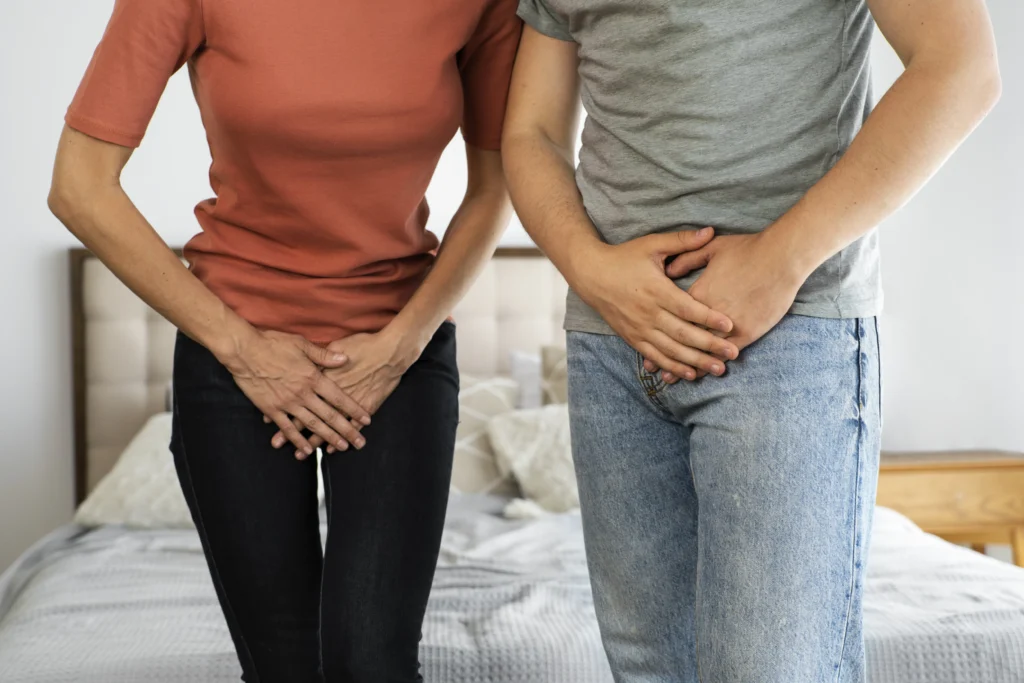
If you simply feel the need to urinate after sex and have no burning, pain, blood in the urine or other unusual symptoms, there is generally no reason to worry.
You can:
- Urinate when you naturally feel the need.
- Maintain adequate hydration throughout the day.
- Avoid deliberately holding urine for prolonged periods.
- Pay attention to whether symptoms happen occasionally or after most sexual encounters.
- Avoid excessive fluid intake simply because you are worried about urinary symptoms.
You do not need to force yourself to urinate immediately after every sexual encounter if you do not feel the urge.
When Should Urination After Sex Concern You?
The act of urinating after sex is usually not the concerning symptom.
The symptoms accompanying it are more important.
Seek medical evaluation if you experience:
- Burning or pain while urinating
- Blood in the urine
- Fever or chills
- Significant lower abdominal or pelvic pain
- Persistent urinary urgency or frequency
- Difficulty passing urine
- Repeated urinary symptoms after sex
If urinary symptoms are accompanied by fever, chills, nausea, vomiting or pain in your back or side, prompt medical assessment is particularly important because these symptoms can occur with a more significant urinary infection.
Can Sexual Activity Trigger Bladder Symptoms Without a UTI?
Yes. Not every urinary symptom following sex is caused by an infection.
Pelvic-floor muscle activity, bladder sensitivity, irritation around the urethra and pre-existing pelvic-floor dysfunction can all contribute to urinary symptoms.
A systematic review of pelvic-floor physical therapy found that pelvic-floor dysfunction can be associated with voiding problems,
pelvic pain and other pelvic-health symptoms, and that physiotherapy may be useful for appropriately selected pelvic-floor disorders. (Wallace et al., 2019)
This distinction matters because repeatedly treating urinary symptoms as a UTI without appropriate assessment may overlook other possible contributors.
Can Pelvic-Floor Relaxation Be Important?
Yes.
Pelvic-floor rehabilitation is not simply about making the muscles stronger.
The muscles need to contract, relax and coordinate appropriately with bladder function.
When excessive pelvic-floor tension is present, treatment may include relaxation and functional retraining rather than repeated strengthening.
Research on pelvic-floor hypertonicity suggests that pelvic-floor physical therapy can be beneficial for selected patients, although the quality and design of available studies vary. (van Reijn-Baggen et al., 2022)
Did You Know?
The urge to urinate after sex does not automatically mean that you have a urinary tract infection. Sexual activity can temporarily increase bladder awareness and stimulate tissues around the urethra and pelvic floor. What matters most is whether the urge is accompanied by symptoms such as burning, pain, blood in the urine, fever or persistent urinary changes.
What If Urinary Urgency Keeps Happening?
If you regularly experience urgency or frequency, a pelvic-health physiotherapist can assess:
- Pelvic-floor muscle activity
- Ability to relax the pelvic floor
- Strength and coordination
- Breathing patterns
- Bladder habits
- Pelvic and abdominal muscle tension
- Possible movement-related contributors
Physical rehabilitation approaches have been studied for overactive bladder symptoms, with a recent systematic review and meta-analysis finding that several physical and rehabilitation interventions can improve measures such as daytime urination frequency and nocturia. (Bai et al., 2023)
However, the appropriate treatment depends on the underlying cause.
More Kegels are not automatically the answer.
Urinating After Sex: Myth vs Fact
| Myth | Fact |
|---|---|
| Needing to pee after sex means something is wrong. | An occasional urge to urinate after sex is generally normal. |
| You must urinate immediately after every sexual encounter. | You do not need to force yourself to urinate immediately if you do not feel the need. |
| Peeing after sex completely prevents UTIs. | Urinating after sex may help reduce bacterial exposure, but it is not a guaranteed method of preventing UTIs. |
| Every urge to pee after sex is a UTI. | Urinary urgency can have several causes. Burning, pain and other symptoms may require assessment for infection. |
| Urinary urgency always means your pelvic floor is weak. | Pelvic-floor tension or poor coordination can also contribute to urinary urgency. |
| Everyone with urinary urgency should do Kegels. | Strengthening may help some people, while others may require relaxation or coordination-based treatment. |
| A physiotherapist can treat a UTI. | A suspected UTI requires appropriate medical evaluation and treatment. Physiotherapy may address physical or pelvic-floor contributors to urinary symptoms. |
| Urinary symptoms after sex are always caused by sexual activity. | Other bladder, urinary, pelvic-floor or medical conditions can also cause similar symptoms. |
| Drinking excessive amounts of water will prevent all urinary problems. | Adequate hydration is important, but excessive fluid intake can increase urinary frequency and is not a universal solution. |
| Persistent urinary symptoms should simply be ignored. | Recurring or painful urinary symptoms deserve appropriate assessment to identify the underlying cause. |
Lesser-Known Fact: More Pelvic-Floor Exercise Is Not Always Better
A lesser-known fact from a physiotherapy perspective is that pelvic-floor muscles need both strength and relaxation.
If the muscles are already overactive, repeatedly contracting them may not address the actual problem.
A proper assessment can determine whether the person needs strengthening, relaxation, bladder training, coordination work or another approach.
This is why pelvic-health physiotherapy should be individualized rather than based on a generic exercise program.
Final Thoughts
Needing to urinate after sex is usually a normal response and, by itself, is rarely a reason for concern. The more important question is whether you are experiencing additional symptoms such as burning, pain, blood in the urine, fever or persistent urinary urgency.
From a physiotherapy perspective, recurrent urinary symptoms may sometimes involve pelvic-floor tension, weakness or coordination problems. An individualized assessment can help determine whether pelvic-health physiotherapy is appropriate.
Listen to your body’s patterns rather than worrying about the simple act of peeing after sex. If symptoms are persistent, painful or recurrent, get the right medical or physiotherapy assessment instead of ignoring them.
Conclusion
Yes, it is generally normal to urinate after sex.
For many people, the urge simply reflects normal bladder and pelvic responses following sexual activity.
What deserves attention is persistent or painful urinary symptoms, particularly burning, blood in the urine, fever, significant pelvic pain or repeated episodes of urgency and frequency.
From a physiotherapy perspective, recurrent symptoms may sometimes involve pelvic-floor tension, weakness or coordination problems.
However, not every urinary symptom is a pelvic-floor problem and not every case requires physiotherapy.
If symptoms continue or keep returning, getting an appropriate medical or pelvic-health assessment is more useful than simply doing more Kegels or assuming that a UTI is responsible.
Frequently Asked Questions About Urinating After Sex
1. Is it normal to urinate after sex?
Yes. Needing to urinate after sex is generally normal. Sexual activity can temporarily stimulate the bladder and surrounding pelvic tissues.
2. Does peeing after sex prevent a UTI?
Urinating after sex may help flush bacteria from the urethral area, but it is not a guaranteed method of preventing urinary tract infections.
3. Why do I feel like I need to pee immediately after sex?
Sexual activity can temporarily increase bladder awareness and stimulate tissues around the urethra and pelvic floor. An occasional urge is generally not concerning.
4. Why do I only pee a small amount after sex?
You may feel an urge even when the bladder is not very full because of increased pelvic awareness or temporary irritation or stimulation around the urinary and pelvic tissues.
5. Can a tight pelvic floor cause urinary urgency?
It can. An overactive or poorly relaxing pelvic floor may contribute to urinary urgency, frequency or difficulty emptying comfortably in some people.
6. Should I do Kegels if I frequently need to pee after sex?
Not automatically. Urinary urgency can have different causes, and some people may need pelvic-floor relaxation or coordination rather than strengthening.
7. Is burning after urination following sex normal?
Burning or pain when urinating is not something to ignore, particularly if it persists or occurs with urgency, frequency, blood in the urine or other symptoms. A healthcare professional can assess for a UTI or another cause.
8. When should I see a pelvic-health physiotherapist?
Consider an assessment if urinary urgency or frequency repeatedly occurs alongside pelvic pain, pelvic-floor tension, urinary leakage, difficulty relaxing or other pelvic-floor symptoms.
9. Can physiotherapy help urinary urgency?
Pelvic-health physiotherapy may help some people by addressing pelvic-floor strength, relaxation, coordination, breathing and bladder-related habits, depending on the underlying cause.
10. When should urinary symptoms after sex be medically assessed?
Seek medical assessment for burning, blood in the urine, fever, chills, significant pelvic or lower abdominal pain, difficulty urinating or persistent/recurrent urinary symptoms.
Stay tuned with us for more health related topics.
Follow us on LinkedIn and Instagram for more.
More Read


Medical Disclaimer!
This article has been reviewed and written under the guidance of our Head Physiotherapist, Dr. Kruti Raj (PT, MUHS,CPT,CMPT). The information shared is intended for educational purposes only and should not be considered a substitute for personalized medical advice, diagnosis, or treatment.
Please consult us or any other qualified healthcare professional before beginning any exercise program, especially if you are experiencing pain, recovering from injury, or managing a medical condition.


