


Enlarged prostate vs prostate cancer is an important distinction for men, because both conditions can cause similar urinary symptoms, but they are different diseases and require different approaches to diagnosis and treatment.
A man starts waking up three or four times every night to urinate.
His urine stream is weaker than it used to be, starting takes longer, and sometimes he feels that his bladder has not completely emptied.
Naturally, one frightening question can appear: “Could this be prostate cancer?”
The answer is: possibly, but urinary symptoms alone do not mean prostate cancer.
Quick Answer
An enlarged prostate (BPH) is not prostate cancer. BPH is a benign growth of prostate tissue that commonly causes weak urine flow, difficulty starting urination, frequent urination and nighttime urination.
Prostate cancer may cause similar urinary symptoms when advanced, but early prostate cancer often causes no symptoms. PSA, examination, imaging and sometimes biopsy are used together to determine the cause.
One of the most common explanations is benign prostatic hyperplasia (BPH), also called an enlarged prostate.
BPH is a non-cancerous enlargement of the prostate that becomes increasingly common with age.
Prostate cancer, on the other hand, involves abnormal cancerous growth of prostate cells and can behave very differently.
The confusing part is that the two conditions can overlap.
Both may occur in the same man, and some urinary symptoms can occur with either condition.
Even PSA, a commonly used prostate blood test, cannot by itself tell you whether you have BPH or cancer.
That is why understanding the difference matters.
As a physiotherapist, I also want men to know something that is often overlooked: the prostate is only one part of the urinary system.
Bladder function, pelvic-floor coordination, physical activity, medications, sleep, fluid timing and bowel habits can all influence how severe urinary symptoms feel.
Here is how to separate the two conditions without jumping to conclusions.
Key Takeaways
- BPH is benign: an enlarged prostate is not the same as prostate cancer.
- Symptoms overlap: weak urine flow and frequent urination can occur with several prostate and bladder conditions.
- Early prostate cancer may be silent: urinary symptoms alone cannot rule cancer in or out.
- PSA is not a cancer verdict: BPH and prostatitis can also raise PSA.
- MRI can improve assessment: current European guidance recommends prostate MRI before biopsy in appropriate men with suspected localized cancer.
- Physiotherapy has a role: pelvic-floor rehabilitation, bladder strategies, exercise and functional rehabilitation can help selected men, particularly after prostate treatment.
- Sudden inability to urinate is urgent: seek immediate medical attention rather than trying home remedies.
Enlarged Prostate vs Prostate Cancer: The Basic Difference
The simplest distinction is this:
BPH is enlargement without cancer. Prostate cancer is malignant cell growth.
The prostate is a small gland located below the bladder.
The urethra passes through it before carrying urine out of the body.
When prostate tissue enlarges, it can narrow the urethral passage and increase resistance to urine flow.
That explains why BPH commonly causes:
- Weak urine stream
- Difficulty starting urination
- Urinary frequency
- Urgency
- Night-time urination
- Dribbling after urination
- Feeling that the bladder has not emptied completely
The National Institute of Diabetes and Digestive and Kidney Diseases notes that BPH is one of the most common prostate problems in men over 50 and can produce exactly these lower urinary tract symptoms.
(NIDDK: BPH)
Prostate cancer is different. Cancerous cells can grow within the prostate and, in some cases, spread outside it.
Importantly, early prostate cancer often causes no symptoms at all.
This is one of the biggest differences men should understand.
The National Cancer Institute explains that early-stage prostate cancer usually does not cause symptoms.
Urinary problems, blood in the urine or semen, and persistent pain in the back, hips or pelvis are more concerning when cancer has become locally advanced. (NCI)
So, ironically, severe urinary symptoms are not automatically a sign of cancer, while early prostate cancer may be completely silent.
Why an Enlarged Prostate Can Feel So Dramatic
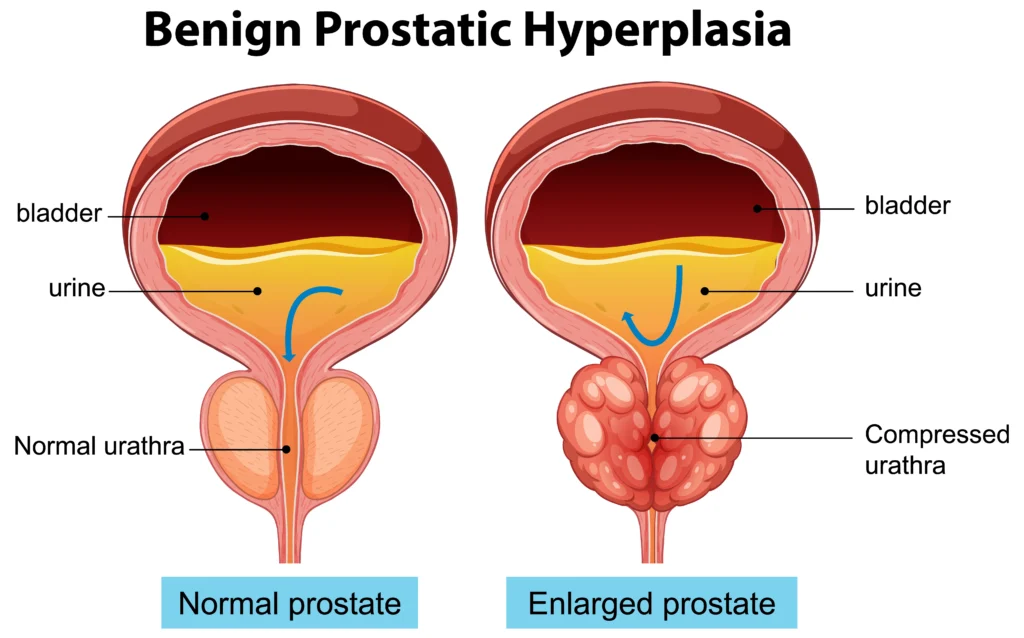
A common misconception is that the larger the prostate, the worse the urinary symptoms must be.
That isn’t necessarily true.
Two men can have similarly enlarged prostates but experience completely different levels of urinary difficulty.
Why?
Because urinary symptoms are influenced by more than prostate size.
The amount of obstruction, bladder muscle response, urethral resistance, nervous-system regulation and individual sensitivity all contribute.
Some men with relatively large prostates have surprisingly mild symptoms.
Others with more modest enlargement can experience considerable urinary bother.
This is one reason doctors use symptom questionnaires, urine-flow testing, post-void residual measurements and other assessments rather than relying only on prostate volume.
The European Association of Urology’s guidance on male lower urinary tract symptoms also emphasizes symptom severity, bladder function and residual urine rather than treating prostate size as the sole determinant of disease burden.
(EAU Guidelines)
A lesser-known point: the bladder can change too
When the bladder repeatedly works against increased resistance at the outlet, its muscle can adapt.
Over time, some men develop changes in bladder storage and emptying function.
This means that treating the prostate alone does not always explain every urinary symptom.
That is particularly relevant when someone continues to experience urgency or frequency even after prostate treatment.
Prostate Cancer Often Behaves Differently
One of the most important facts about prostate cancer is that symptoms are a poor early warning system.
A man can feel completely normal and still have prostate cancer.
This is why discussions about prostate cancer detection often involve risk assessment and PSA testing rather than simply waiting for urinary symptoms.
Risk increases with age and is also influenced by family history and genetic factors.
The European Association of Urology recommends risk-adapted early detection discussions, with earlier assessment for men with significant family history and certain genetic risks. (EAU)
A strong family history deserves particular attention.
If a close relative developed prostate cancer at a relatively young age, it is worth discussing individualized screening with a doctor rather than simply following a generic age-based rule.
Enlarged Prostate vs Prostate Cancer Symptoms
Here is where things become confusing.
Symptoms more commonly associated with BPH
BPH frequently produces:
- Hesitancy
- Weak or interrupted urine flow
- Increased urinary frequency
- Nocturia
- Urgency
- Straining to urinate
- Post-void dribbling
- Incomplete emptying
These symptoms are usually related to bladder outlet obstruction and altered lower urinary tract function.
Symptoms that deserve medical assessment for possible cancer
Prostate cancer can produce urinary symptoms, but early disease often does not.
Potential warning signs include:
- Blood in urine
- Blood in semen
- Persistent unexplained pelvic, hip or back pain
- Unexplained urinary changes
- Erectile dysfunction or sexual changes in some circumstances
- Constitutional symptoms in advanced disease
However, these symptoms do not prove cancer.
For example, blood in urine can have many causes, including urinary infection, stones, medications and other urinary tract conditions.
The correct response is investigation, not panic.
The PSA Test: Why One Number Cannot Give You the Answer
PSA stands for prostate-specific antigen.
It is a protein produced by prostate tissue, and a PSA blood test measures its concentration in the blood.
Here’s the important part:
A high PSA does not automatically mean prostate cancer.
BPH and prostatitis can also increase PSA.
Conversely, a PSA value that appears reassuring does not make cancer impossible.
The NIDDK specifically notes that PSA can be elevated by prostate cancer as well as benign prostatic hyperplasia and prostatitis, making interpretation more complicated than simply labeling a result “normal” or “abnormal.”
(NIDDK: Prostate Tests)
This is why doctors consider factors such as age, PSA trend, prostate volume, family history, symptoms and other clinical findings.
Another lesser-known fact: repeating PSA can matter
An unexpectedly elevated PSA does not necessarily mean that the next step is immediately a biopsy.
Current EAU guidance states that in asymptomatic men with PSA between 3 and 10 ng/mL, repeating PSA before further investigations can be considered.
If suspicion persists, MRI, risk calculators or additional biomarkers may help determine whether biopsy is appropriate.
That is a much more nuanced approach than “high PSA equals cancer.”
How Doctors Actually Distinguish BPH From Prostate Cancer
There is no single test that perfectly separates the two.
Doctors may use a combination of:
Medical history
Your doctor may ask about:
- Urinary symptoms
- Symptom duration
- Family history
- Previous prostate problems
- Medications
- Fluid and caffeine intake
- Previous urinary infections
- Sexual symptoms
Physical examination
A digital rectal examination may provide information about prostate texture, size and irregularities.
It cannot diagnose prostate cancer by itself, but it can contribute to the overall assessment.
Urine testing
Urinalysis may help identify infection, blood or other abnormalities that could explain urinary symptoms.
PSA testing
PSA contributes to risk assessment but must be interpreted in context.
Ultrasound and bladder assessment
Ultrasound can help assess prostate volume and the amount of urine remaining in the bladder after urination.
MRI
Multiparametric prostate MRI has become increasingly important when prostate cancer is suspected.
Current EAU guidance recommends MRI before biopsy in men with suspected organ-confined prostate cancer and uses the PI-RADS system to characterize suspicious lesions.
Biopsy
A biopsy is ultimately used to establish a tissue diagnosis when indicated.
This distinction is critical:
MRI can identify suspicious areas. PSA can indicate risk. But a biopsy examines prostate tissue for cancer.
Does Having BPH Mean You Will Develop Prostate Cancer?
This is an area where online information can become misleading.
BPH and prostate cancer frequently occur in the same age group, so they can coexist.
Some observational research has also found statistical associations between BPH and prostate cancer.
For example, a meta-analysis published in Medicine found an association between BPH and prostate cancer, although observational associations do not prove that BPH itself causes cancer.
(PubMed)
Another systematic review and meta-analysis reported associations among prostatitis, BPH and prostate cancer, but also highlighted substantial heterogeneity across studies.
(Journal of Cancer)
So I would not tell a patient, “Your enlarged prostate will turn into cancer.”
That is an oversimplification.
Instead, I would say:
BPH is not prostate cancer, but having urinary symptoms or BPH should not be used as a reason to ignore appropriate prostate-cancer risk assessment.
What Can Physiotherapy Actually Do?
This is where the conversation becomes more interesting.
Physiotherapy does not shrink a cancerous prostate, eliminate prostate cancer or replace urological treatment for BPH.
But physiotherapy can be extremely useful for the functional consequences surrounding prostate problems and their treatment.
Pelvic-floor rehabilitation
The pelvic floor helps control urinary continence and contributes to bladder and urethral function.
Men may benefit from pelvic-floor rehabilitation particularly when urinary leakage occurs after prostate surgery or other prostate treatments.
However, there is an important warning:
More pelvic-floor squeezing is not automatically better.
Some men habitually tighten their pelvic floor because they are anxious about urinary control.
If those muscles are already overactive, repeatedly performing maximal contractions may increase pelvic tension rather than improve coordination.
A pelvic-health physiotherapist can assess whether the problem is weakness, poor endurance, poor coordination, excessive tension or difficulty relaxing.
The NIDDK also recognizes the role of pelvic-floor physiotherapy in helping men with urinary leakage and improving pelvic-floor and core coordination. (NIDDK)
Bladder retraining
Some men begin urinating “just in case.”
Then they repeat this behavior every hour.
Over time, the bladder may become accustomed to frequent emptying.
Bladder diaries and carefully structured bladder-training strategies can help selected patients understand their urinary patterns and reduce unnecessary bathroom trips.
This should be individualized, particularly if significant obstruction or urinary retention is present.
Breathing and pelvic relaxation
A lesser-known physiotherapy principle is that relaxation can be just as important as strengthening.
During urination, the pelvic floor needs to relax.
If a man repeatedly strains while simultaneously contracting his pelvic floor, he may create an inefficient voiding pattern.
Slow diaphragmatic breathing and learning to relax the pelvic floor can be useful components of rehabilitation when muscle overactivity contributes to symptoms.
Exercise
Physical inactivity is another modifiable factor worth addressing.
A systematic review and meta-analysis involving more than 43,000 men found that moderate and vigorous physical activity were associated with lower odds of BPH or lower urinary tract symptoms compared with sedentary behavior. (Elsevier)
That does not mean exercise “cures” BPH.
It means that regular physical activity is part of a healthier overall strategy for urinary and cardiometabolic health.
What Men Can Do Every Day
If urinary symptoms are mild and your doctor has ruled out concerning causes, several practical changes may help.
1. Watch the timing of fluids
Do not drastically restrict water.
Instead, consider reducing large amounts of fluid shortly before bedtime or before situations where bathroom access is difficult.
EAU guidance specifically recommends adjusting fluid timing for troublesome frequency and nocturia.
2. Experiment with caffeine reduction
Coffee, energy drinks and other caffeinated beverages may aggravate urgency and frequency in some men.
You do not necessarily need to eliminate them completely.
Try reducing intake and observe whether symptoms change.
3. Limit evening alcohol
Alcohol can increase urine production and may worsen night-time bathroom trips.
4. Stay physically active
Walking, resistance training, cycling when comfortable and general aerobic activity can support cardiovascular and metabolic health.
For men undergoing prostate-cancer treatment, exercise has also been studied extensively as part of supportive care.
A recent systematic review and meta-analysis found that aerobic and resistance exercise interventions improved quality of life in men receiving prostate-cancer treatment. (NCBI)
5. Avoid prolonged sitting
For men with pelvic discomfort or lower urinary tract symptoms, breaking up long periods of sitting can be a useful practical strategy.
Stand up, walk around and change position regularly.
6. Do not repeatedly “test” your urine stream
This is surprisingly common.
A man notices a weak stream and starts monitoring every urination.
That can increase anxiety without providing useful medical information.
A proper assessment is much more valuable than repeatedly judging the stream yourself.
Things I Would Tell My Male Patients Not to Do
Do not assume every urinary problem is BPH
Urinary symptoms can come from several conditions, including infection, stones, prostatitis, bladder dysfunction, neurological disorders and prostate cancer.
Do not assume every urinary problem is cancer
This creates unnecessary fear.
BPH is extremely common and often explains lower urinary tract symptoms.
Do not self-medicate indefinitely
Some over-the-counter cold and allergy medications can worsen urinary symptoms in men with BPH.
NIDDK specifically advises discussing medicines that may aggravate BPH symptoms with a healthcare professional.
Do not ignore inability to urinate
Acute urinary retention is not something to manage at home.
If you suddenly cannot urinate despite having a strong urge, seek urgent medical attention.
Do not rely on supplements marketed as “prostate cures”
The word “natural” does not automatically mean effective or safe.
A supplement should never replace appropriate prostate evaluation.
Enlarged Prostate Treatment Vs Prostate Cancer Treatment
This distinction is essential.
For BPH, treatment may involve:
- Lifestyle modification
- Watchful waiting
- Alpha-blocker medications
- 5-alpha-reductase inhibitors
- Other medications
- Minimally invasive procedures
- Surgical procedures when appropriate
NIDDK describes lifestyle changes, medications and procedures as established approaches depending on symptom severity and individual circumstances.
Prostate cancer treatment depends on cancer grade, stage, PSA, imaging, biopsy findings, life expectancy and personal preferences.
Options can include active surveillance, surgery, radiation therapy, hormone therapy and other systemic treatments.
This is why you should never assume that a treatment used for BPH is also treating cancer.
A Physiotherapist’s Practical Perspective
When a man tells me, “My prostate is enlarged, so my urine is weak,” I look at the bigger picture.
How active is he?
How long does he sit?
Is he constipated?
Does he hold his urine for hours?
Does he drink most of his fluids at night?
Is he repeatedly tightening his pelvic floor?
Is he waking because of genuine bladder urgency, or because of poor sleep?
Has prostate treatment affected his continence?
These questions do not diagnose prostate cancer.
But they can reveal modifiable contributors to urinary dysfunction and help guide rehabilitation alongside medical care.
The goal is not simply to “strengthen the pelvic floor.”
The goal is to restore efficient bladder habits, pelvic-floor coordination, mobility, strength and confidence.
When Should You See a Doctor?
Do not wait for symptoms to become severe.
Arrange a medical assessment if you notice persistent:
- Weak or interrupted urine flow
- Difficulty starting urination
- Increasing night-time urination
- Blood in urine or semen
- Persistent pelvic, hip or back pain
- Unexplained urinary changes
- Difficulty emptying the bladder
- New urinary symptoms with a strong family history of prostate cancer
And seek urgent care if you cannot urinate at all.
Screening decisions should be individualized rather than based on a single universal age or PSA number.
The USPSTF has emphasized shared decision-making because PSA screening can provide benefits for some men but can also lead to false-positive results, biopsies, overdiagnosis and treatment-related harms. (USPSTF)
The Bottom Line
Enlarged prostate vs prostate cancer. They are not the same disease.
BPH is a benign enlargement of prostate tissue that commonly causes urinary symptoms.
Prostate cancer is malignant growth that may remain silent in its early stages.
The biggest mistake is assuming that urinary symptoms alone can tell you which condition you have.
They cannot.
A weak urine stream does not automatically mean cancer.
A normal-feeling prostate does not automatically rule cancer out.
The most sensible approach is a combination of risk assessment, appropriate medical testing, symptom evaluation and individualized management.
From a physiotherapy perspective, exercise, pelvic-floor assessment, bladder habits, breathing, mobility and rehabilitation can complement medical care, especially when urinary leakage, pelvic dysfunction, deconditioning or treatment-related side effects are present.
And perhaps the most useful message for men is this:
Do not diagnose your prostate from your bathroom habits. Get the cause investigated.
Early evaluation can prevent months of anxiety, identify treatable BPH, detect other urinary conditions and, when necessary, provide an opportunity for earlier prostate-cancer diagnosis.
Frequently Asked Questions
Can an enlarged prostate turn into prostate cancer?
No. BPH is a benign condition and is not itself prostate cancer. However, BPH and prostate cancer can occur in the same man, so persistent or concerning symptoms still deserve medical evaluation.
What is the main difference between BPH and prostate cancer?
BPH involves non-cancerous enlargement of prostate tissue, while prostate cancer involves malignant growth of prostate cells. Their symptoms can overlap, so testing may be necessary.
Can prostate cancer cause a weak urine stream?
It can, particularly when disease affects the urinary outlet, but a weak stream is much more commonly associated with BPH and other urinary conditions.
Does a high PSA always mean prostate cancer?
No. BPH, prostatitis and other prostate-related conditions can raise PSA. PSA should be interpreted together with other clinical information.
Can prostate cancer exist without urinary symptoms?
Yes. Early prostate cancer often produces no symptoms, which is why risk-based assessment and appropriate screening discussions are important.
Does exercise help men with prostate problems?
Regular physical activity can support general health and has been associated with lower risk of BPH-related urinary symptoms. Exercise is also useful as supportive rehabilitation during prostate-cancer treatment.
Can physiotherapy help after prostate cancer treatment?
Yes. Pelvic-floor rehabilitation, exercise therapy and functional rehabilitation can help selected men with urinary continence, physical fitness and treatment-related functional problems.
Is waking up twice or three times to urinate always BPH?
No. Nocturia can also be influenced by fluid intake, sleep disorders, medications, diabetes, bladder problems and other medical conditions.
When should a man see a doctor about prostate symptoms?
Persistent urinary difficulty, blood in urine or semen, unexplained pelvic or back pain, progressive symptoms or a strong family history of prostate cancer should prompt medical assessment.
What should I do if I suddenly cannot urinate?
Sudden inability to urinate can represent acute urinary retention and requires urgent medical attention.
Stay tuned with us for more health related topics.
Follow us on LinkedIn and Instagram for more.
More Read


Medical Disclaimer!
This article has been reviewed and written under the guidance of our Head Physiotherapist, Dr. Kruti Raj (PT, MUHS,CPT,CMPT). The information shared is intended for educational purposes only and should not be considered a substitute for personalized medical advice, diagnosis, or treatment.
Please consult us or any other qualified healthcare professional before beginning any exercise program, especially if you are experiencing pain, recovering from injury, or managing a medical condition.


