


Flat feet, also called pes planus, describe a foot shape in which the medial arch appears lower or flatter than usual.
A low arch does not automatically mean that something is wrong.
Many children and adults have flexible flat feet without pain or meaningful functional limitations.
Quick Answer: What Are Flat Feet?
Flat feet occur when the arch of the foot appears lower or flatter than usual when standing. Having flat feet does not automatically mean there is a problem.
Many people have flexible, painless flat feet that do not require treatment. Treatment becomes more relevant when flat feet are associated with pain, weakness, stiffness, instability, reduced activity tolerance, or progressive changes in foot shape.
Physiotherapy may help improve strength, balance, mobility, movement control and tolerance to activity when symptoms or functional limitations are present.
The situation is different when the foot becomes painful, stiff, weak, unstable, or progressively flatter.
So the more useful question is not simply, “Do I have flat feet?”
It is, “Are my flat feet causing symptoms or affecting how my foot functions?”
Key Takeaways About Flat Feet
- Flat feet are common and are not automatically a medical problem.
- Flexible, painless flat feet often do not require treatment.
- Rigid, painful or progressively changing flat feet deserve professional assessment.
- Flat feet can be associated with foot and ankle symptoms, but they are not automatically the cause of every lower-limb problem.
- Physiotherapy focuses on strength, mobility, balance, movement control and activity tolerance rather than simply trying to create a higher arch.
- Orthotics may help selected people, but they are not automatically necessary for everyone with flat feet.
- A newly developing or worsening flat foot should be assessed to identify possible tendon, joint, ligament or structural problems.
What Are Flat Feet?
A normal foot has a medial longitudinal arch that changes shape as the foot moves and accepts weight.
With flat feet, this arch appears reduced when standing.
The appearance can change depending on whether the foot is sitting unloaded, standing, walking, or performing a heel-rise movement.
This is why a clinical assessment should not rely only on looking at the foot while someone is sitting.
Flat feet are better understood by considering foot shape, flexibility, symptoms, function, and how the foot behaves under load.
Are Flat Feet Normal?
Sometimes, yes.
Flat feet are particularly common during childhood.
Flexible, painless flat feet are often considered a normal developmental finding and may change as the child grows. (Carr et al., 2016).
In adults, a stable and painless low arch can also represent an individual’s normal foot structure.
A painless flat foot that has remained unchanged for years is very different from a foot that has recently become flatter and painful.
Flexible vs Rigid Flat Feet
Flexible Flat Feet
With flexible flat feet, the arch may appear when the foot is unloaded and flatten when you stand.
The foot generally retains movement and can adapt to different positions.
Many flexible flat feet are painless and do not require treatment.
Rigid Flat Feet
A rigid flat foot remains relatively flat even when the foot is unloaded.
A painful or rigid flat foot deserves closer assessment because it can sometimes be associated with structural abnormalities or joint problems.
A foot that has suddenly become painful and rigid should not simply be assumed to have developed “normal flat feet.”
What Causes Flat Feet?
There is no single cause.
Flat feet can be influenced by:
- Normal childhood development
- Genetics and foot structure
- Ligament characteristics
- Previous injury
- Tendon problems
- Joint changes
- Repetitive loading
- Changes in activity
- Neurological or muscular conditions
- Progressive adult foot deformity
In adults, acquired flatfoot can involve multiple structures rather than one isolated muscle or tendon.
Flat Feet in Children
Flat feet are common in young children because the medial arch develops gradually.
Most children with flexible, painless flat feet do not require treatment simply because their feet look flat.
However, pain, fatigue, functional limitation, activity restriction, marked asymmetry, or a rigid foot deserves assessment.
Importantly, symptoms in children are not limited to pain.
A 2026 systematic review identified functional impairment, fatigue, altered gait, sport limitations and activity restrictions among features reported in symptomatic flexible flatfoot. (De Pellegrin et al., 2026).
A 2026 evidence-based consensus also supports structured conservative management for symptomatic pediatric flatfoot while acknowledging limitations in the quality and consistency of evidence for individual interventions. (Sharula et al., 2026).
The important distinction is simple: treat the child who has symptoms or functional problems, not simply the appearance of the foot.
Flat Feet in Adults
Flat feet in adults can be lifelong or can develop gradually.
If your feet have always looked flat and have never caused problems, the shape may simply be your normal anatomy.
A different situation occurs when an arch that was previously present gradually becomes lower, particularly when this is accompanied by:
- Inner ankle pain
- Foot fatigue
- Weakness
- Swelling
- Difficulty walking
- Reduced exercise tolerance
- Changes in foot alignment
This pattern can be associated with adult-acquired flatfoot or progressive collapsing foot deformity.
What Is Adult-Acquired Flatfoot?
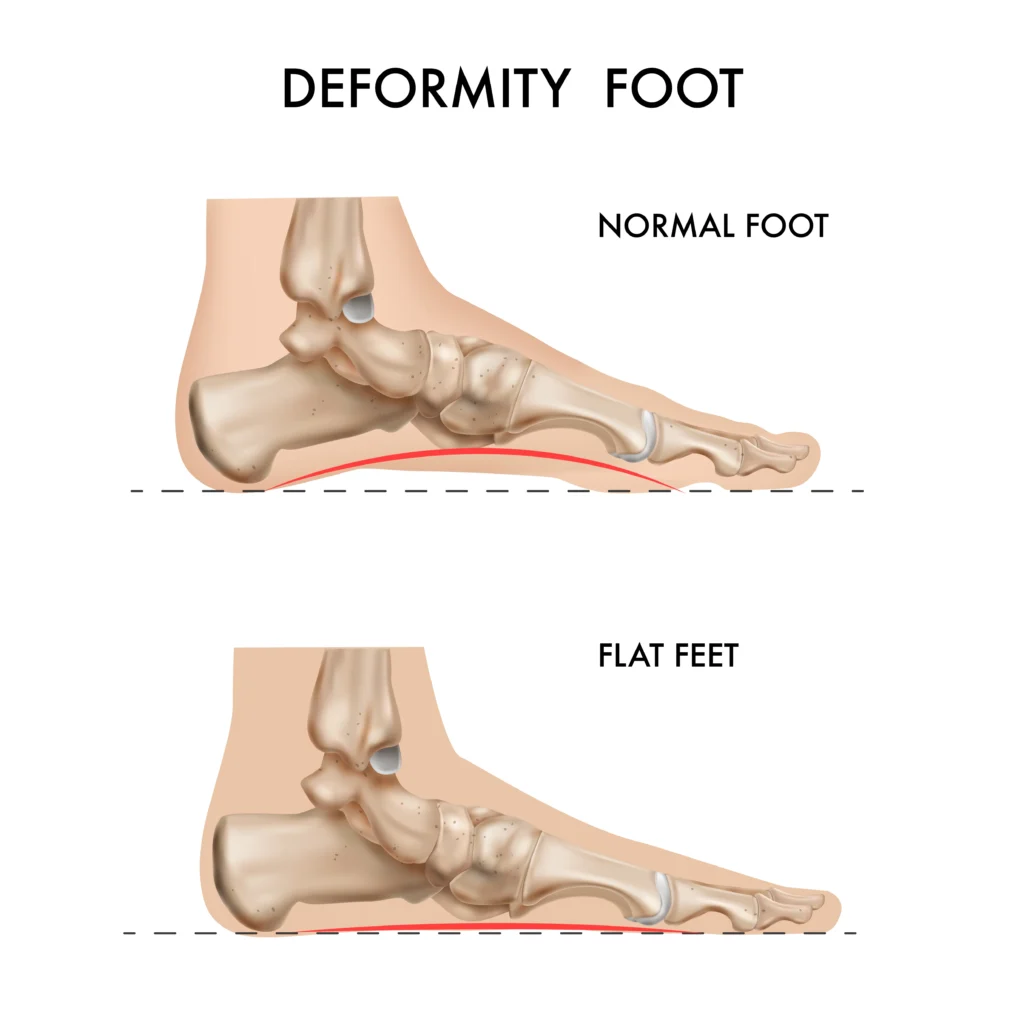
Adult-acquired flatfoot refers to a spectrum of changes in which the medial arch progressively loses height or the foot becomes increasingly misaligned.
The posterior tibial tendon can be involved, but it is not the only structure that matters.
Ligaments, bones, joints, tendons, and overall foot alignment can contribute.
Adult-acquired flatfoot can progress gradually and may eventually affect pain and daily activities, which is why assessment should be individualized according to the clinical and structural findings. (Döring et al., 2022).
What Are the Symptoms of Flat Feet?
Some people have no symptoms at all.
When symptoms occur, they may include:
- Aching in the feet
- Pain along the inside of the ankle
- Pain around the arch
- Heel discomfort
- Foot fatigue after prolonged standing
- Ankle stiffness
- Reduced walking tolerance
- Difficulty running
- Difficulty with prolonged exercise
- Changes in walking pattern
- A feeling of weakness or instability
- Swelling around the inner ankle or foot
Symptoms can vary substantially between individuals.
Can Flat Feet Cause Ankle Pain?
They can be associated with ankle or foot pain, but flat feet should not automatically be blamed for every episode of ankle pain.
A low arch changes how the foot interacts with the ground, but pain can have many other causes.
For example, someone with flat feet may also develop Achilles tendon pain, plantar heel pain, ankle arthritis, a tendon disorder, or an ankle injury.
A good assessment therefore asks:
What is painful, when does it hurt, and what changes when the foot is loaded?
Can Flat Feet Cause Knee Pain?
Flat feet can be associated with differences in lower-limb mechanics.
However, that does not mean that flat feet automatically cause knee pain.
The relationship between foot posture and symptoms is complex and varies between individuals.
Research shows that foot orthoses can alter some lower-limb joint angles and moments during walking in adults with flexible flat feet.
This demonstrates that changing foot support can influence movement mechanics, but it does not prove that correcting foot posture will automatically eliminate knee pain (Jafarnezhadgero et al., 2024).
If both the foot and knee are painful, both areas should be assessed rather than assuming one is responsible for the other.
Can Flat Feet Cause Hip Pain?
Some people with flat feet may show differences in lower-limb alignment and movement that extend above the ankle.
However, it would be inaccurate to say that flat feet directly cause hip pain in every person.
Hip symptoms can have many causes.
If someone has both flat feet and hip pain, a physiotherapist may assess the entire lower-limb movement chain rather than treating the foot in isolation.
Can Flat Feet Cause Plantar Fasciitis?
Flat feet and plantar heel pain can occur together, but one should not automatically be assumed to cause the other.
Plantar heel pain is influenced by multiple factors, including loading, activity level, tissue sensitivity, footwear, body weight, and individual foot mechanics.
If you have both flat feet and heel pain, treatment should focus on the actual symptoms and contributing factors rather than trying to “fix” the arch simply because it looks low.
Can Flat Feet Cause Bunions?
A flat or pronated foot posture can influence forefoot mechanics, but bunions have multiple possible contributors.
Genetics, foot structure, joint alignment, footwear, and mechanical loading can all be relevant.
Therefore, flat feet should not be presented as the sole cause of a bunion.
Why Do My Feet Hurt After Standing All Day?
Prolonged standing places sustained load through the feet.
If your feet are not accustomed to that amount of loading, symptoms may become more noticeable toward the end of the day.
This can happen in people with flat feet, but it is not specific to flat feet.
Work demands, footwear, standing surface, activity level, strength, previous injury, and recovery can all influence symptoms.
Why Do My Feet Hurt When Walking With Flat Feet?
Walking requires repeated loading and unloading of the foot.
Some people with flat feet tolerate this extremely well, while others experience pain or fatigue after longer distances.
The important question is not simply whether the arch is flat.
A physiotherapist may assess walking tolerance, foot strength, ankle mobility, balance, footwear, recent changes in activity, and how symptoms respond to increasing walking distance.
Why Do My Feet Hurt When Running If I Have Flat Feet?
Running increases the frequency and intensity of loading through the foot and lower limb.
Some people with flat feet can run without problems.
Others may develop foot, ankle, shin, knee, or hip symptoms.
The arch shape alone does not determine whether someone can run successfully.
Training volume, recovery, strength, previous injuries, footwear, running surface, and load tolerance may all be relevant.
Does Being Overweight Cause Flat Feet?
Body weight can influence the mechanical load placed through the feet.
However, it is too simplistic to say that body weight alone causes flat feet.
Foot structure, ligament characteristics, tendon capacity, activity, previous injury, and other factors can contribute.
For someone with symptoms, the more useful approach is to identify modifiable factors that affect foot function and load tolerance.
Can Flat Feet Get Worse With Age?
They can, but it is not inevitable.
A lifelong flexible and painless flat foot may remain stable.
On the other hand, some adults develop progressive changes in foot alignment, particularly when tendon, ligament, joint, or structural problems are present.
A foot that is becoming noticeably flatter over time, especially if it is also becoming painful or weaker, deserves assessment.
What Is Posterior Tibial Tendon Dysfunction?
The posterior tibial tendon runs behind the inner ankle and helps support and control the foot.
Problems involving this tendon can be associated with pain along the inside of the ankle, weakness during heel raises, changes in arch height, and progressive changes in foot alignment.
Posterior tibial tendon dysfunction is not the same thing as simply having flat feet.
Early-stage posterior tibial tendon problems may sometimes be managed conservatively.
Evidence suggests that exercise, particularly progressive strengthening, can be useful when combined with other appropriate conservative measures, although the overall research base remains limited. (Ross et al., 2018).
How Are Flat Feet Diagnosed?
Assessment may include:
- Observation while standing
- Foot posture
- Arch behaviour under load
- Walking pattern
- Single-leg balance
- Heel-rise testing
- Ankle mobility
- Foot and ankle strength
- Posterior tibial tendon function
- Foot and ankle alignment
- Joint movement
- Pain behaviour
- Functional limitations
If an adult has a newly developed or progressively worsening flatfoot, imaging may sometimes be appropriate.
Weight-bearing X-rays may help assess alignment and bone relationships, while ultrasound or MRI may be considered when soft-tissue structures need further evaluation.
Can Physiotherapy Help Flat Feet?
Yes, particularly when flat feet are associated with pain, weakness, balance problems, movement-control deficits, or reduced activity tolerance.
But physiotherapy should not be presented as a way to make every flat arch “normal.”
The aim is usually to improve function, strength, control, comfort, and tolerance to activity.
Depending on the assessment, rehabilitation may include:
- Foot muscle strengthening
- Calf strengthening
- Posterior tibial muscle strengthening
- Balance training
- Ankle mobility work
- Hip and lower-limb strengthening
- Gait retraining
- Running retraining
- Activity modification
- Progressive loading
Can Exercises Improve Flat Feet?
Exercise can improve aspects of foot strength and function, and some studies report changes in measures of arch posture.
A 2024 network meta-analysis of randomized trials found that different exercise approaches could improve measures of arch shape and foot function in adults with flexible flat feet.
The interventions included combinations of intrinsic foot, posterior tibial, hip, and broader lower-limb strengthening. (Jia et al., 2024).
However, this should not be interpreted as proof that exercise will permanently “build a normal arch” in every person.
Exercise is more appropriately viewed as a way to improve the foot’s capacity to control and tolerate load.
What Are the Best Exercises for Flat Feet?
There is no single best exercise for everyone.
Depending on the assessment, a physiotherapist may use:
Short-Foot Exercise
This targets the intrinsic muscles of the foot.
The aim is to gently activate the muscles that help control the arch without aggressively curling the toes.
Calf Raises
Calf raises can help develop plantarflexor strength and may be useful when calf capacity is limited.
They can be progressed from double-leg to single-leg versions when appropriate.
Balance Exercises
Single-leg balance can challenge foot and ankle control.
The exercise can be progressed by changing the surface, reaching with the opposite leg, or adding movement challenges.
Posterior Tibial Muscle Strengthening
Exercises that load the muscles supporting the medial side of the foot may be useful when weakness is identified.
The exact exercise and progression should depend on the person’s symptoms and capacity.
Do Orthotics Help Flat Feet?
Orthotics can help some people, particularly when symptoms are related to how the foot tolerates loading.
But they are not automatically necessary for everyone with flat feet.
Evidence for routine orthotic use in adults with flat feet remains limited and inconsistent.
A systematic review found that the available studies were generally small and often had methodological limitations. (Herchenröder et al., 2021).
More recent research shows that orthoses can influence lower-limb biomechanics, which may be useful for selected individuals, but a biomechanical change should not automatically be interpreted as a clinical improvement.
This is why orthoses should be considered according to symptoms, function, foot characteristics, footwear, and individual response.
Can Orthotics Change the Shape of Flat Feet?
This is an important distinction.
Orthotics can change how the foot is supported and how forces are distributed during movement.
That does not necessarily mean they permanently change the underlying structure of the foot.
Therefore, supporting an arch and permanently correcting an arch are not the same thing.
Do Flat Feet Need Arch Support?
Not necessarily.
An arch support is a treatment tool, not a requirement for having a low arch.
Someone with painless flexible flat feet may need no intervention at all.
Someone with painful symptoms may benefit from temporary or longer-term support as part of a broader management plan.
The goal should be improved comfort and function, not forcing every foot into an identical shape.
Can You Run With Flat Feet?
Yes.
Many people with flat feet can run without pain or functional limitations.
The presence of a low arch alone is not a reason to stop running.
If running causes symptoms, a physiotherapist may assess:
- Running volume
- Recent training changes
- Calf strength
- Foot and ankle control
- Balance
- Hip strength
- Footwear
- Recovery
- Running surface
- Previous injuries
The objective is to determine why the current running load is not being tolerated rather than assuming the arch itself is the problem.
Can Flat Feet Cause Poor Balance?
Flat feet do not automatically mean poor balance.
Balance depends on multiple factors, including sensory input, ankle and foot control, strength, vision, and the ability to coordinate movement.
Research on orthoses for balance in adults with flat feet has produced inconsistent findings, so arch support should not automatically be prescribed simply because someone has a balance problem. (Chinpeerasathian et al., 2024).
If balance is a concern, it should be assessed rather than assumed from foot appearance.
What Does a Physiotherapist Check?
A physiotherapist may assess:
- Foot posture
- Arch behaviour during weight-bearing
- Ankle dorsiflexion
- Other ankle movements
- Calf strength
- Foot intrinsic muscle function
- Posterior tibial muscle function
- Balance
- Single-leg control
- Walking pattern
- Running mechanics when relevant
- Squat and step-down mechanics
- Knee and hip strength
- Previous injuries
- Training load
- Footwear
- Pain behaviour
The foot should not always be assessed in isolation.
The ankle, knee, hip, and trunk all contribute to how load is transferred through the lower limb.
How Can Physiotherapy Help?
Physiotherapy management depends on what the assessment identifies.
For someone with weakness, rehabilitation may emphasize progressive strengthening.
For someone with balance or movement-control deficits, treatment may include balance and functional retraining.
For someone with limited ankle mobility, targeted mobility work may be combined with strengthening and movement practice.
For someone returning to running, the focus may be on graded exposure to running load rather than simply prescribing arch exercises.
For someone with a painful progressive flatfoot, physiotherapy may be one component of management, but medical or specialist assessment may also be necessary.
Can Physiotherapy Make Flat Feet Go Away?
Not necessarily.
This is an important expectation to set.
Physiotherapy can improve strength, balance, movement control, pain, and activity tolerance.
Exercise may also change some measures of foot posture in certain people.
But the goal is not always to create a visibly high arch.
A person can have a relatively flat foot and excellent function.
Can Children With Flat Feet Do Exercises?
Children with painless flexible flat feet generally do not need exercises simply because their arches look low.
For symptomatic children, exercise and rehabilitation may be considered as part of conservative care.
Current pediatric evidence supports individualized conservative management for symptomatic cases, but the evidence does not establish one universally superior exercise program. (Sharula et al., 2026).
The child’s symptoms, function, age, flexibility, and overall clinical findings should guide management.
When Should You See a Physiotherapist?
A physiotherapy assessment may be useful if:
- Flat feet are causing foot or ankle pain
- Your feet fatigue quickly
- You struggle with prolonged standing
- Walking or running repeatedly causes symptoms
- Your ankle feels unstable
- You have difficulty with single-leg heel raises
- Your foot posture appears to be changing
- You are struggling to return to sport
- A previous ankle injury continues to affect function
A physiotherapist can also help determine whether the problem is appropriate for rehabilitation or whether medical investigation is needed.
When Should You See a Doctor?
Medical assessment is particularly important if:
- One foot has suddenly become flatter than the other
- The arch appears to be progressively collapsing
- There is significant pain or swelling
- The foot becomes rigid
- You cannot walk normally
- There is marked weakness
- You cannot perform a heel raise because of pain or weakness
- The change followed significant trauma
- Symptoms continue to worsen
A newly acquired or progressively worsening flatfoot should not simply be treated with an off-the-shelf arch support without understanding the underlying cause.
Myth vs Fact: Flat Feet
Myth: Everyone with flat feet needs treatment.
Fact: Many people have painless flat feet with normal function and do not need treatment simply because their arches look low.
Myth: Flat feet always mean weak foot muscles.
Fact: Foot shape is influenced by bones, joints, ligaments, tendons, muscles and individual anatomy. A flat arch does not automatically indicate weakness.
Myth: Physiotherapy can permanently build an arch in everyone.
Fact: Physiotherapy can improve strength, balance, movement control, pain and activity tolerance, but the goal is not necessarily to create a visibly higher arch.
Myth: Everyone with flat feet needs arch-support insoles.
Fact: Orthotics can be useful for selected people with symptoms, but they are not automatically required for every person with flat feet.
Lesser-Known Fact: A Flat Arch Does Not Automatically Mean a Weak Foot
It is tempting to look at a flat arch and assume that the muscles are too weak to support it.
The reality is more complicated.
Foot posture is influenced by bones, joints, ligaments, tendons, muscles, anatomy, and the loads placed through the foot.
Some people with flat feet have excellent strength and function.
Others have genuine strength or movement-control deficits that may respond to rehabilitation.
That is why foot shape and foot function should be assessed separately.
Final Thoughts
Flat feet are not automatically something that needs to be corrected. A painless, flexible low arch can simply be part of your normal foot structure.
What matters more is whether your feet are painful, becoming weaker or flatter, affecting your balance, or limiting walking, running, standing or other activities.
When symptoms are present, physiotherapy can focus on the things that matter functionally, including strength, mobility, balance, movement control and gradual tolerance to activity.
Conclusion
Flat feet are common and are not automatically a medical problem.
Many people, particularly those with flexible and painless flat feet, do not need treatment simply because their arches look low.
The situation is different when flat feet are painful, progressively changing, associated with weakness or instability, or interfering with walking, running, standing, or daily activities.
Physiotherapy can help assess foot and ankle strength, mobility, balance, movement control, and load tolerance.
Exercise, activity modification, footwear changes, and orthoses may be useful for selected people, but there is no single treatment that is appropriate for every flat foot.
If one foot is becoming flatter, painful, rigid, or progressively changing, medical assessment is important to determine whether an underlying tendon, joint, ligament, or structural problem is present.
Frequently Asked Questions About Flat Feet
1. Are flat feet normal?
Yes. Flat feet can be a normal foot shape, particularly when they are flexible, painless and do not interfere with function.
2. Can flat feet cause ankle pain?
Flat feet can be associated with foot or ankle symptoms, but they are not automatically the cause of every episode of ankle pain. Other conditions should also be considered.
3. Can flat feet be corrected with exercise?
Exercise can improve foot strength, movement control and function, and may change some measures of foot posture. However, it does not guarantee that every flat foot will develop a permanently higher arch.
4. Do I need orthotics if I have flat feet?
Not necessarily. Orthotics may help selected people with pain or functional problems, but painless flat feet do not automatically require arch-support insoles.
5. Can I run with flat feet?
Yes. Many people with flat feet can run normally. If running causes pain, factors such as training load, strength, previous injury, footwear and movement control should be assessed.
6. Can physiotherapy help flat feet?
Physiotherapy can help when flat feet are associated with pain, weakness, balance problems, mobility limitations or reduced activity tolerance. Treatment is individualized according to the assessment.
7. When should I see a doctor for flat feet?
Seek medical assessment if one foot suddenly becomes flatter, the arch progressively collapses, there is significant pain or swelling, the foot becomes rigid, or you develop marked weakness or difficulty walking.
Stay tuned with us for more health related topics.
Follow us on LinkedIn and Instagram for more.
More Read


Medical Disclaimer
This article is intended for general educational purposes only and does not replace an individual assessment, diagnosis or treatment plan from a qualified healthcare professional. Flat feet can have different causes, and similar symptoms may require different approaches. Seek appropriate medical care for significant or worsening pain, swelling, sudden changes in foot shape, inability to walk normally, marked weakness, deformity, or symptoms following significant injury.


