


Ankle arthritis symptoms can develop gradually and may include pain, stiffness, swelling and reduced movement, with some people noticing discomfort mainly when walking, climbing stairs or after periods of rest.
Ankle arthritis does not always begin with severe pain.
For some people, the first warning signs are subtle: stiffness after sitting, discomfort after a long walk, mild swelling, or a gradual loss of ankle movement.
These symptoms can be easy to dismiss, particularly when they come and go.
But persistent or progressively worsening symptoms deserve attention because early ankle arthritis can affect walking, exercise, balance, and everyday movement long before the joint becomes severely painful.
Quick Answer: What Are the Early Signs of Ankle Arthritis?
Early ankle arthritis may cause morning or start-up stiffness, activity-related ankle pain, recurrent swelling, reduced ankle movement, difficulty with stairs or squatting, and gradually reduced tolerance for walking or exercise.
These symptoms do not automatically mean you have arthritis. However, persistent or progressively worsening symptoms, especially after a previous ankle injury, should be assessed by a physiotherapist or doctor to identify the underlying cause.
What Is Ankle Arthritis?
Ankle arthritis refers to inflammation or degenerative changes affecting the ankle joint.
Osteoarthritis is one important form, but ankle arthritis can also occur because of inflammatory diseases such as rheumatoid arthritis, crystal arthritis, or other rheumatic conditions.
Ankle osteoarthritis is different from the arthritis commonly seen in the knee or hip.
Previous trauma is a particularly important factor, with post-traumatic arthritis accounting for a large proportion of ankle osteoarthritis cases. (Herrera-Pérez et al., 2022)
This means an old ankle fracture, severe sprain, cartilage injury, or long-standing instability may matter even if the original injury happened years earlier.
Key Takeaways About Ankle Arthritis
- Early symptoms can be subtle: stiffness, activity-related pain, swelling and reduced ankle movement may appear before severe pain.
- Previous injury matters: ankle fractures, severe sprains and chronic instability can increase the risk of post-traumatic ankle arthritis.
- Age is not the only factor: ankle arthritis can affect younger adults, particularly after significant ankle trauma.
- Imaging is only part of the assessment: X-ray findings do not always correspond directly with pain or functional limitations.
- Physiotherapy focuses on function: mobility, strength, balance, walking mechanics and activity tolerance can all be assessed.
- Exercise is usually individualized: rehabilitation should be progressed according to symptoms, physical capacity and functional goals.
- Not every swollen or painful ankle is arthritis: persistent, hot, red or rapidly swollen joints require appropriate medical assessment.
What Are the Early Symptoms of Ankle Arthritis?
Early ankle arthritis can present differently from one person to another.
The most useful clue is often a gradual change in how the ankle feels or functions.
Morning or Start-Up Stiffness
Your ankle may feel stiff when you first get out of bed or after sitting for a long time.
You may take several steps before the joint feels more comfortable and mobile.
Occasional stiffness is not enough to diagnose arthritis.
Persistent stiffness, particularly when accompanied by pain, swelling, or reduced movement, is more important.
Pain After Walking or Standing
An early sign can be an ankle pain that appears after prolonged weight-bearing rather than pain that is present all day.
For example, you may feel fine during a short walk but develop ankle discomfort after walking for 30 or 40 minutes.
Over time, the amount of activity needed to trigger symptoms may decrease.
Pain When Walking Downhill
Walking downhill requires the ankle to move and control the body differently from walking on level ground.
Some people with ankle joint problems notice pain or restriction when walking downhill, descending stairs, or moving their body forward over the foot.
This type of activity-related limitation can be more informative than simply rating pain on a scale.
Recurrent Ankle Swelling
An ankle that repeatedly becomes swollen after activity should not automatically be attributed to a previous sprain.
Joint irritation can contribute to swelling, but swelling may also arise from other joint or soft-tissue conditions.
When recurrent swelling occurs alongside stiffness and reduced movement, an assessment can help determine what is actually causing it.
Reduced Ankle Range of Motion
You may gradually notice that the ankle does not move as freely as before.
Squatting may become more difficult. Walking downhill may feel restricted.
You may struggle to bring the knee forward over the foot.
Reduced ankle motion and strength are among the physical impairments reported in people with ankle osteoarthritis. (Al-Mahrouqi et al., 2018)
Pain During Stairs or Squatting
Activities that require greater ankle movement can expose restrictions that are not obvious during normal walking.
You may notice discomfort while climbing or descending stairs, performing a deep squat, getting up from a low chair, or exercising.
The important point is not that these activities prove arthritis is present.
Rather, a progressive change in tolerance can be a reason to investigate the ankle.
Grinding, Clicking, or a Rough Sensation
Some people describe grinding, clicking, catching, or a rough sensation inside the ankle.
Joint sounds by themselves do not diagnose arthritis.
They become more relevant when they occur together with persistent pain, swelling, stiffness, or loss of function.
A Gradual Reduction in Activity
Sometimes the earliest sign is not pain itself.
You may stop running because the ankle “doesn’t feel right.”
You may choose the lift instead of the stairs or avoid longer walks because you know the ankle will hurt afterward.
This gradual change in activity can be an important functional warning sign.
Why Can an Old Ankle Injury Lead to Arthritis?
The ankle can develop post-traumatic osteoarthritis after injuries that alter the joint surface, alignment, stability, or loading pattern.
Fractures involving the ankle joint are particularly important, but severe ligament injuries and chronic instability can also contribute.
Post-traumatic ankle arthritis can affect relatively younger and physically active adults, which is one reason persistent symptoms should not automatically be dismissed as normal ageing. (Ewalefo et al., 2018)
An old injury does not mean arthritis is inevitable. It simply makes the history clinically relevant.
Can You Have Ankle Arthritis at a Young Age?
Yes.
Ankle arthritis is not exclusively a condition of older adults.
Because trauma is such an important contributor to ankle osteoarthritis, people who previously sustained significant ankle injuries can develop symptoms during their working or physically active years.
This is different from assuming that every ankle ache in a younger person represents arthritis.
Persistent symptoms should be assessed rather than self-diagnosed.
Is Ankle Arthritis the Same as Ankle Osteoarthritis?
No.
“Ankle arthritis” is a broader term.
Ankle osteoarthritis involves degenerative changes within the joint and is commonly associated with previous trauma.
Inflammatory arthritis, such as rheumatoid arthritis or spondyloarthritis, can affect the ankle through a different disease process.
This distinction matters because the appropriate management can be very different.
New ankle swelling accompanied by prolonged morning stiffness, symptoms in multiple joints, unexplained inflammatory symptoms, or repeated episodes of a hot and swollen joint may require medical or rheumatological assessment rather than being treated simply as wear and tear. (Kiely et al., 2021)
What Makes Early Ankle Arthritis Easy to Miss?
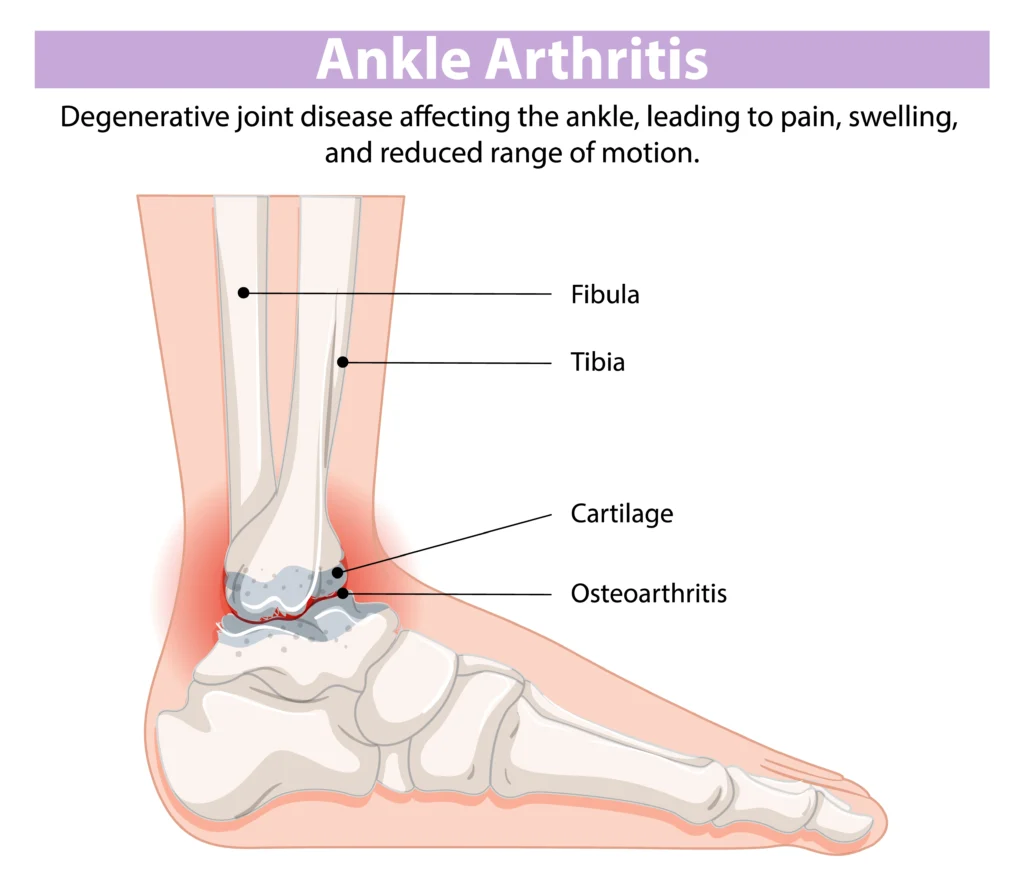
Ankle arthritis can initially resemble several other conditions.
Ankle sprain, tendon problems, impingement, synovitis, cartilage injury, inflammatory arthritis, and other causes can produce overlapping symptoms.
This is why pain alone cannot establish the diagnosis.
The pattern matters.
A physiotherapist or doctor will consider when the pain occurs, what movements provoke it, whether there is swelling, whether the ankle has been injured before, how much movement has been lost, and whether other joints are involved.
How Is Ankle Arthritis Diagnosed?
Assessment usually begins with a detailed history and physical examination.
A clinician may evaluate:
- Pain location and behaviour
- Previous ankle injuries
- Joint swelling
- Ankle range of motion
- Muscle strength
- Walking pattern
- Balance and movement control
- Functional activities
- Joint tenderness
- Activity limitations
- Symptoms in other joints
Imaging may be useful when structural changes need to be assessed or when the diagnosis is uncertain.
Weight-bearing X-rays can provide information about joint-space narrowing, alignment, bone changes, and other structural features.
MRI or other investigations may be considered when a different diagnosis or soft-tissue or cartilage problem is suspected.
Importantly, the scan should not be interpreted separately from the person.
Research has found that the severity of radiographic ankle osteoarthritis does not always correspond closely with pain and disability. (Kloprogge et al., 2023)
Does Ankle Arthritis Always Show Up on an X-Ray?
Not necessarily.
Imaging can be useful, but early symptoms and physical findings still matter.
A person can have significant symptoms without dramatic radiographic changes, while another person may have visible degenerative changes but relatively little pain.
This is why physiotherapy assessment should not be replaced by an imaging report.
The International Foot and Ankle Osteoarthritis Consortium has also highlighted the need for better approaches to diagnosis, outcome assessment, and treatment of foot and ankle osteoarthritis. (International Foot and Ankle Osteoarthritis Consortium, 2022)
What Does a Physiotherapist Check?
A physiotherapist does more than identify where the ankle hurts.
The assessment looks at how the joint functions during movement and what factors may be contributing to symptoms.
Ankle Mobility
The physiotherapist may assess how far the ankle moves in different directions and whether restrictions affect walking, stairs, squatting, or other activities.
Calf and Lower-Limb Strength
Weakness can reduce the ankle’s ability to manage everyday loading.
Strength testing may therefore include the calf, ankle muscles, and other lower-limb muscles that contribute to walking and functional control.
Balance and Proprioception
An old ankle injury can affect balance and confidence during weight-bearing.
A physiotherapist may assess single-leg balance, movement control, and the ankle’s response to changing surfaces or positions.
Walking Mechanics
Walking speed, stride pattern, ankle movement, and how the foot and lower limb accept and transfer load can all provide useful information.
Functional Capacity
The assessment should relate to the person’s actual goals.
For one person, that may mean walking comfortably to work.
For another, it may mean returning to running, recreational sport, or prolonged standing.
Can Physiotherapy Help Ankle Arthritis?
Yes, particularly when the goal is to improve function, movement, strength, and tolerance to activity.
Physiotherapy cannot restore cartilage that has already been lost or guarantee that arthritis will not progress.
Instead, treatment focuses on modifiable factors around the joint.
A rehabilitation programme may include:
- Individualized strengthening
- Mobility exercises
- Balance and movement-control training
- Activity modification
- Gait or movement retraining
- Education about load management
- Gradual return to desired activities
- Advice regarding supportive footwear or other aids when appropriate
Physical impairments involving ankle movement, strength, balance, and muscle function have been documented in people with ankle osteoarthritis, giving physiotherapy a clear functional role in assessment and rehabilitation. (Al-Mahrouqi et al., 2018)
What Exercises Can Help Ankle Arthritis?
Exercise should be selected according to the person’s symptoms and physical limitations rather than following a fixed list.
A physiotherapist may prescribe exercises such as:
Controlled Calf Strengthening
Calf strengthening can help develop the force needed for walking, stair climbing, and other weight-bearing tasks.
The exercise may begin in a supported or lower-load position and progress as tolerance improves.
Sit-to-Stand Training
Repeated sit-to-stand movements can develop functional lower-limb strength while allowing the exercise to be modified according to the person’s ability.
Step-Up Exercises
Low step-ups can gradually challenge ankle and lower-limb strength in a movement that has a direct relationship to stair climbing.
Balance Training
Balance exercises can be introduced when appropriate, particularly when previous ankle injury or instability has affected confidence during single-leg loading.
Low-Impact Aerobic Exercise
Cycling, swimming, or other well-tolerated cardiovascular activities can help maintain fitness when higher-impact activities aggravate symptoms.
The wider osteoarthritis literature supports exercise as a core component of management, although ankle-specific research remains considerably smaller than the evidence base for knee and hip osteoarthritis. (Schleimer et al., 2026)
Should You Stop Exercising If You Have Ankle Arthritis?
Usually, complete rest is not the long-term answer.
Avoiding movement because of fear of damaging the joint can lead to reduced strength and physical capacity.
A better approach is often to adjust the load.
That might mean reducing walking distance temporarily, changing running frequency, using lower-impact exercise, or breaking longer activities into manageable periods.
The right amount of exercise depends on symptoms, joint irritability, strength, fitness, and the person’s goals.
Myth vs Fact: Ankle Arthritis
Myth: Ankle arthritis only affects older adults.
Fact: Previous ankle trauma can contribute to post-traumatic arthritis, so younger adults can also develop ankle arthritis.
Myth: If an X-ray shows arthritis, the pain must be severe.
Fact: Imaging findings and symptoms do not always match closely. Clinical assessment remains important.
Myth: Exercise will damage an arthritic ankle.
Fact: Appropriately selected and progressed exercise can support strength, mobility and physical function.
Myth: Ankle arthritis means you should stop walking.
Fact: Complete inactivity is usually not the goal. Activity may instead need to be modified according to symptoms and load tolerance.
Myth: Physiotherapy can reverse ankle arthritis.
Fact: Physiotherapy cannot restore lost cartilage, but it can address modifiable impairments and improve movement and function.
Can Ankle Arthritis Get Worse?
Ankle osteoarthritis can progress, but progression varies considerably between individuals.
Symptoms can fluctuate, and a painful period does not necessarily mean that the joint has suddenly deteriorated.
The current research also emphasizes that ankle osteoarthritis differs from hip and knee osteoarthritis and remains an under-researched condition.
A 2026 multidisciplinary ankle arthritis roadmap highlighted the need for earlier prevention, better diagnosis, and more effective treatment strategies rather than waiting until disease becomes advanced. (Backus et al., 2026)
Can Early Physiotherapy Prevent Ankle Arthritis From Getting Worse?
It would be too strong to say that physiotherapy can prevent all progression.
However, rehabilitation can address modifiable problems that may contribute to poor function, including weakness, restricted movement, impaired balance, altered movement strategies, and poor tolerance to physical loading.
This is particularly relevant after an ankle injury.
The aim is not to promise that arthritis will be prevented.
The aim is to optimize the way the ankle and lower limb function and help the person remain active.
What Daily Activities May Need Modification?
Early ankle arthritis does not necessarily mean giving up activities you enjoy.
Instead, you may need to modify how you perform them.
For example:
- Take shorter walking routes initially.
- Use breaks during prolonged standing.
- Reduce repetitive high-impact activity during painful periods.
- Choose cycling or swimming when running is poorly tolerated.
- Avoid suddenly increasing exercise volume.
- Build strength before returning to demanding activities.
- Discuss footwear or bracing options with a physiotherapist when appropriate.
These changes are intended to manage load, not eliminate movement.
When Should You See a Physiotherapist?
Consider a physiotherapy assessment if ankle symptoms:
- Keep returning
- Are gradually becoming more frequent
- Limit walking or exercise
- Follow a previous ankle injury
- Cause persistent stiffness
- Reduce ankle movement
- Affect balance
- Make stairs or squatting difficult
- Change the way you walk
- Prevent you from participating in activities you previously enjoyed
A physiotherapist can also determine whether the presentation is appropriate for rehabilitation or whether further medical assessment is needed.
When Should You See a Doctor?
Some symptoms should not simply be assumed to be osteoarthritis.
Seek medical assessment if the ankle becomes suddenly very swollen, hot, or red, particularly when accompanied by severe pain or fever.
Medical evaluation is also important after significant trauma, when you cannot bear weight, when symptoms are rapidly worsening, or when unexplained recurrent swelling occurs.
A hot, acutely swollen joint can have causes such as infection or crystal arthritis that require medical investigation rather than routine exercise-based management.
What If Ankle Arthritis Is Caused by Inflammatory Arthritis?
The approach is different.
Conditions such as rheumatoid arthritis, spondyloarthritis, and other inflammatory diseases require appropriate medical management of the underlying condition.
Physiotherapy can still contribute by supporting mobility, strength, function, activity, and joint protection, but it should work alongside medical care rather than replace it.
This distinction is especially important when ankle symptoms occur together with persistent morning stiffness, swelling in several joints, or other systemic symptoms.
What Happens If Conservative Treatment Is Not Enough?
Physiotherapy is only one component of ankle arthritis management.
Depending on the cause and severity, a doctor may consider other options such as medication, injections, bracing, orthoses, or surgical consultation.
Surgery is generally considered when symptoms and functional limitations remain substantial despite appropriate non-operative management or when there is a structural problem that requires correction.
The presence of arthritis on an X-ray alone does not mean surgery is necessary.
Early Ankle Arthritis: What Should You Remember?
The earliest warning sign may not be severe pain.
A gradual loss of ankle movement, recurring swelling, stiffness after rest, reduced walking tolerance, difficulty with stairs, or a growing need to avoid activities can all justify an assessment.
Previous ankle trauma is particularly important because post-traumatic disease accounts for a substantial proportion of ankle osteoarthritis.
From a physiotherapy perspective, the focus should be on the whole movement system rather than the scan alone.
The ankle’s mobility, strength, balance, walking pattern, activity tolerance, previous injuries, and individual goals all help determine the most appropriate rehabilitation strategy.
Final Thoughts: Don’t Ignore Early Ankle Changes
Ankle arthritis does not always begin with severe pain. Stiffness after rest, recurrent swelling, reduced ankle movement, activity-related pain and declining exercise tolerance can be early signs that the ankle needs closer attention.
These symptoms can have several causes, so self-diagnosing arthritis is not recommended. A proper assessment can identify whether the problem is related to osteoarthritis, previous injury, instability, inflammatory disease or another ankle condition.
From a physiotherapy perspective, the goal is to maintain mobility, strength, balance, movement quality and activity tolerance while addressing the factors contributing to symptoms. Early assessment can help you make informed decisions about treatment and staying active.
Final Thoughts
Ankle arthritis should not be dismissed simply because symptoms are mild or because you are relatively young.
Early symptoms such as stiffness, activity-related pain, recurrent swelling, reduced ankle movement, and declining exercise tolerance can have several causes.
They do not automatically confirm arthritis, but persistent or progressive changes deserve proper assessment.
Physiotherapy can play an important role by identifying physical impairments, improving strength and movement, managing load, and helping people stay active.
The goal is not to “fix” an X-ray or promise that arthritis will disappear.
It is to understand what is contributing to the symptoms and build the best possible level of movement, function, and quality of life around the condition.
Frequently Asked Questions About Ankle Arthritis
1. What are the first signs of ankle arthritis?
Early signs can include ankle stiffness after rest, activity-related pain, recurrent swelling, reduced ankle movement and difficulty with activities such as stairs, squatting or longer walks.
2. Can an old ankle sprain cause arthritis?
A previous significant ankle injury can contribute to post-traumatic ankle arthritis, although having an old sprain does not mean arthritis is inevitable.
3. Can you get ankle arthritis when you are young?
Yes. Previous fractures, significant ankle injuries and chronic instability can contribute to ankle arthritis in younger adults.
4. Can physiotherapy help ankle arthritis?
Physiotherapy can help improve strength, mobility, balance, movement control and tolerance for everyday activities. Treatment is individualized according to the person’s symptoms and goals.
5. Should I exercise if I have ankle arthritis?
Many people can continue exercising with appropriate modifications. Exercise selection and progression should depend on symptoms, joint irritability, strength and activity goals.
6. Does ankle arthritis always show on an X-ray?
X-rays can show structural changes associated with arthritis, but imaging findings do not always correspond directly with pain or disability.
7. Is ankle arthritis the same as an ankle sprain?
No. An ankle sprain is an injury to ligaments, while arthritis involves changes within the joint. However, significant previous ankle injuries can contribute to post-traumatic arthritis.
8. When should I see a doctor for ankle pain?
Seek medical assessment if the ankle becomes suddenly very swollen, hot or red, if pain is severe, if you cannot bear weight, if symptoms rapidly worsen, or if fever or feeling unwell occurs.
Stay tuned with us for more health related topics.
Follow us on LinkedIn and Instagram for more.
More Read





Medical Disclaimer
Disclaimer: This article is intended for general educational and informational purposes only. It does not replace an individual assessment, diagnosis or treatment plan from a qualified physiotherapist, doctor or other healthcare professional. Ankle pain, swelling and stiffness can have several causes and should not be self-diagnosed solely from the information provided here. If you experience severe pain, significant swelling, redness or warmth, fever, inability to bear weight, symptoms following major trauma, or rapidly worsening symptoms, seek appropriate medical evaluation.


