


Hip cartilage damage can cause groin pain, stiffness, clicking, and discomfort during walking, exercise, or prolonged sitting.
Quick Answer: Can Hip Cartilage Heal Without Surgery?
Hip cartilage damage does not usually regenerate into completely normal cartilage on its own. Articular cartilage has a limited ability to repair itself, especially when the damage is extensive.
However, many people can improve their pain, mobility, and daily function without surgery, depending on the cause and severity of the damage.
How can physiotherapy help? A tailored program may include activity modification, progressive hip strengthening, comfortable mobility exercises, and a gradual return to exercise. Physiotherapy can improve function but cannot guarantee cartilage regrowth.
The good news is that some people can manage their symptoms without surgery, depending on the extent of the damage and its underlying cause.
However, pain relief does not necessarily mean the cartilage has healed.
Articular cartilage has a limited ability to repair itself, so treatment often focuses on reducing joint irritation, improving muscle strength, and restoring everyday function.
Physiotherapy may help, but the right approach depends on the type of cartilage injury and whether another hip condition is contributing to the symptoms.
Key Takeaways
- Hip cartilage protects the joint surfaces and helps distribute forces during movement.
- Articular cartilage has a limited ability to repair itself, particularly after significant damage.
- Physiotherapy may improve pain, strength, mobility, and daily function without surgery.
- The appropriate treatment depends on the extent of damage and conditions such as osteoarthritis, hip impingement, or labral injury.
- Strengthening, activity modification, and gradual exercise progression may help improve tolerance to everyday loading.
- Supplements and injections should not be assumed to regrow damaged cartilage.
- Persistent pain, worsening symptoms, or difficulty bearing weight warrants medical assessment.
What Is Hip Cartilage Damage?
The hip is a ball-and-socket joint formed by the head of the thigh bone, called the femoral head, and the socket of the pelvis, called the acetabulum.
Smooth articular cartilage covers both joint surfaces, allowing them to move against each other with minimal friction while distributing forces during walking, climbing stairs, and other activities.
Hip cartilage damage occurs when this protective tissue becomes softened, cracked, worn, or locally defective.
Damage may affect a small area or involve a larger portion of the joint.
It is important to distinguish articular cartilage damage from a hip labral tear.
The labrum is a ring of fibrocartilage around the socket that helps deepen the joint and support stability.
Labral injuries and articular cartilage damage can occur together, but they are different problems.
Cartilage damage may result from an injury, repeated joint loading, abnormal hip mechanics, or osteoarthritis.
The cause influences which treatments are most appropriate. (Makhni et al., 2017)
Can Hip Cartilage Heal Without Surgery?
The answer depends on what is meant by healing.
Articular cartilage has a limited capacity for self-repair because it lacks a direct blood supply and has relatively few cells capable of repairing damaged tissue.
Significant defects generally do not regenerate into completely normal cartilage on their own.
Nevertheless, symptoms and physical function can improve without surgery, even if the cartilage defect remains.
Reducing aggravating activities, strengthening the muscles around the hip, and addressing contributing movement problems may help a person return to daily activities more comfortably.
Non-surgical treatment may be reasonable when symptoms are manageable, the hip remains functional, and there is no injury or structural problem requiring an operation.
The outcome depends on several factors:
- Extent of damage: A small, localised defect may behave differently from widespread cartilage loss.
- Underlying cause: Traumatic injuries, hip impingement, and osteoarthritis require different management strategies.
- Associated conditions: Labral tears, bone abnormalities, or underlying bone injuries may affect recovery.
- Daily activity demands: Occupational requirements, sport, and training intensity influence how the hip is loaded.
- Response to rehabilitation: Persistent pain or declining function may indicate that the diagnosis or treatment plan needs reassessment.
A review of hip cartilage treatment options highlights the complexity of these injuries and the limitations of the available evidence when comparing different interventions. (Kumar et al., 2022)
What Are the Grades of Hip Cartilage Damage?
Cartilage injuries are sometimes described according to their depth and severity.
Classification systems vary, but damage may broadly range from surface changes to full-thickness defects.
Mild or Superficial Damage
The cartilage surface may become softened, roughened, or slightly irregular.
Symptoms can be mild, although pain may occur during certain activities.
Management depends on the cause and symptoms rather than the grade alone.
Physiotherapy may help improve strength, movement control, and tolerance to everyday loading.
Partial-Thickness Cartilage Damage
Damage extends into part of the cartilage without passing through its full thickness.
Symptoms vary according to the location, size, and associated joint problems.
A structured rehabilitation program may be appropriate for selected cases, but persistent symptoms require reassessment.
Full-Thickness Cartilage Defects
The cartilage is damaged through its full depth, potentially exposing the underlying bone.
These defects may require specialist assessment, particularly when pain and functional limitations persist.
Widespread Cartilage Loss
Extensive cartilage deterioration can occur with advanced osteoarthritis.
Treatment may focus on pain management, maintaining mobility, improving strength, and discussing surgical options when conservative care no longer provides sufficient relief.
The appearance of a cartilage defect on imaging does not, by itself, determine the best treatment.
Symptoms, examination findings, the condition of the underlying bone, and overall joint health also matter.
What Causes Hip Cartilage Damage?
Hip Osteoarthritis
Hip Osteoarthritis involves changes to cartilage, underlying bone, and other joint tissues.
As the condition progresses, cartilage may become thinner or deteriorate, contributing to pain and stiffness.
Physiotherapy can help maintain strength and mobility, but it cannot restore cartilage that has already been lost.
Femoroacetabular Impingement
Femoroacetabular impingement occurs when the shape of the hip bones causes abnormal contact during certain movements.
In some people, repeated contact contributes to damage involving the labrum and articular cartilage.
Physiotherapy may help improve strength, movement control, and tolerance to activity. However, exercise cannot change the underlying shape of the bones.
Sports Injuries and Trauma
Falls, collisions, twisting injuries, and other traumatic events can damage the cartilage or the bone beneath it.
Repeated high-impact loading may also aggravate symptoms in a vulnerable joint.
Sudden pain following an injury should not automatically be attributed to cartilage damage.
A fracture or another significant injury may need to be excluded.
Hip Dysplasia
Hip dysplasia occurs when the socket does not adequately cover the femoral head.
This can alter how forces are distributed across the joint and may contribute to cartilage damage over time.
When structural abnormalities contribute to symptoms, an orthopaedic assessment helps determine whether physiotherapy alone is appropriate.
What Are the Symptoms of Hip Cartilage Damage?
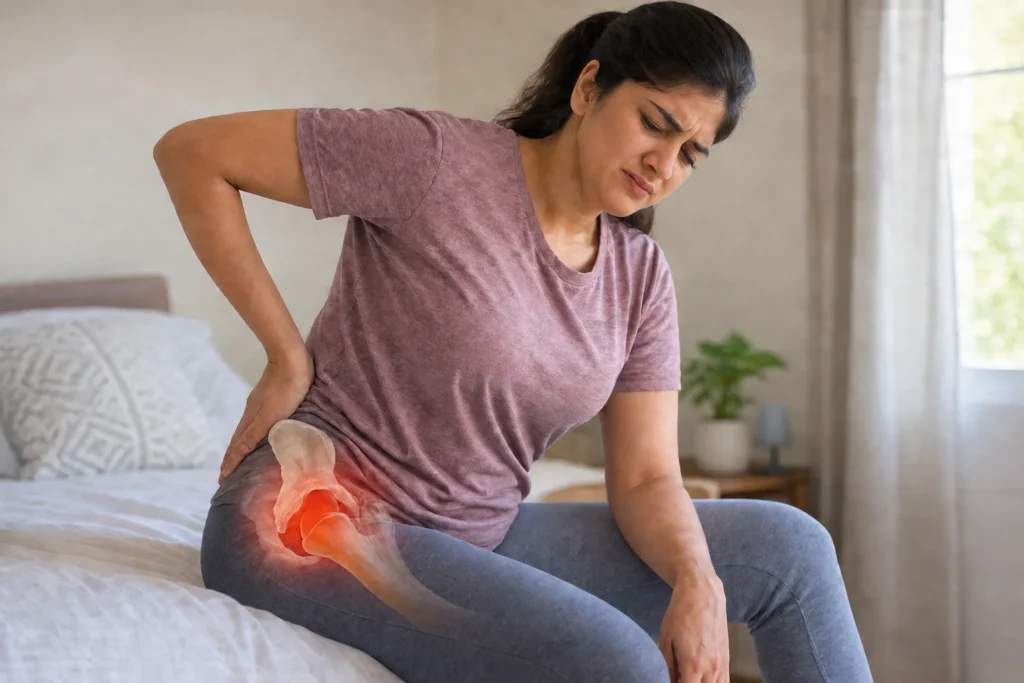
Symptoms depend on the location and severity of the damage.
Some people have imaging abnormalities without substantial symptoms, while others experience pain that interferes with daily activities.
Common symptoms include:
- Deep groin pain: Discomfort at the front of the hip, particularly during walking, squatting, or getting up from a chair.
- Stiffness: Restricted movement after sitting for long periods or when starting activity.
- Pain during exercise: Running, jumping, deep squats, and repeated hip bending may aggravate symptoms.
- Clicking or catching: These sensations may occur with associated labral or other joint problems, but clicking alone does not confirm cartilage damage.
- Reduced hip movement: Bending or rotating the hip may become uncomfortable.
- Reduced exercise tolerance: Activities that were previously manageable may cause pain during or after exercise.
These symptoms are not specific to cartilage injuries.
Hip flexor problems, tendon disorders, labral tears, osteoarthritis, and pain referred from the lower back can produce similar symptoms.
How Is Hip Cartilage Damage Diagnosed?
Diagnosis usually begins with a clinical assessment.
A healthcare professional may ask when the pain started, whether there was an injury, which movements aggravate it, and how symptoms affect walking and exercise.
The examination may include hip movement, muscle strength, walking pattern, and selected movement tests.
No single physical test can reliably confirm every cartilage lesion.
Imaging Tests
X-rays help identify osteoarthritis, changes in joint space, and some structural abnormalities.
They do not show the articular cartilage in detail.
Magnetic resonance imaging (MRI) can assess cartilage, the labrum, surrounding soft tissues, and some underlying bone abnormalities.
Its ability to identify a small cartilage defect depends on the lesion, scan quality, and imaging technique.
Additional investigations may be recommended when a fracture or another condition is suspected.
Imaging findings must be interpreted alongside symptoms and examination results.
The size of an abnormality on a scan does not always correspond directly to the amount of pain a person experiences.
How Can Physiotherapy Help Hip Cartilage Damage?
Physiotherapy aims to improve pain, movement, strength, and function.
It does not guarantee cartilage regeneration, and the program should be adapted to the type of injury and the person’s response to activity.
1. Modify Activities That Aggravate Pain
The first step is to identify activities that repeatedly provoke symptoms and adjust them temporarily.
Depending on the diagnosis, modifications may include:
- Reducing running, jumping, or other high-impact activities.
- Limiting deep squats if they reproduce groin pain.
- Breaking up long periods of sitting.
- Shortening walks temporarily if pain increases with distance.
- Avoiding sudden increases in training volume.
The aim is to maintain a tolerable level of movement rather than stopping all activity unnecessarily.
2. Strengthen the Hip and Pelvic Muscles
The gluteal muscles, hip abductors, hip extensors, and trunk muscles contribute to hip and pelvic control during daily activities.
Strengthening these muscles may improve functional capacity and tolerance to loading.
It does not directly rebuild damaged articular cartilage.
A physiotherapist may consider the following exercises when they are appropriate for the injury:
- Gluteal isometric contractions: Gently tighten the buttock muscles without moving the hip.
- Bridges: Lift the pelvis while keeping the movement comfortable.
- Standing hip abduction: Move one leg sideways while maintaining an upright posture.
- Sit-to-stand practice: Rise from a chair using a comfortable range of movement.
- Low step-ups: Practise controlled stepping when weight-bearing is well tolerated.
Start with a manageable amount of exercise and progress gradually.
The right exercises and range of movement depend on the diagnosis.
Stop an exercise that produces sharp pain, catching, or a sustained increase in symptoms, and seek advice from a physiotherapist.
3. Maintain Comfortable Hip Mobility
Gentle mobility exercises may help maintain the movement required for walking, dressing, and other daily activities.
A physiotherapist may recommend controlled hip movements within a comfortable range.
Aggressive stretching or repeatedly forcing the hip into deep flexion and rotation can aggravate symptoms in some people, especially when hip impingement is present.
Mobility exercises should therefore be selected according to the individual’s assessment rather than following a standard routine.
4. Choose Suitable Low-Impact Exercise
Low-impact activities can help maintain general fitness while reducing repeated impact on the hip.
Depending on symptoms, suitable options may include swimming, walking on level ground, or stationary cycling.
Cycling may still aggravate some hips if the position requires excessive hip bending.
Begin with a tolerable duration and monitor symptoms during activity and later that day.
If pain repeatedly increases or walking becomes more difficult, reduce the load and reassess the plan.
5. Progress Gradually Towards Normal Activity
Returning to running, gym training, or sport should depend on symptoms, strength, movement control, and the underlying diagnosis.
A physiotherapist may increase exercise duration, resistance, speed, or impact gradually rather than changing everything at once.
Evidence from research on non-operative treatment for non-arthritic hip-related pain suggests that many patients can achieve a satisfactory response, although results vary and the evidence does not apply equally to every type of cartilage defect. (Probst et al., 2023)
Hip Cartilage Damage: Myth vs Fact
MYTH: Hip cartilage always grows back naturally.
FACT: Articular cartilage has limited self-repair capacity. Significant damage generally does not regenerate into completely normal cartilage on its own.
MYTH: Cartilage damage always requires surgery.
FACT: Some people manage their symptoms with activity modification, physiotherapy, and appropriate medical care. Surgery depends on the diagnosis, severity, and response to treatment.
MYTH: Pain relief means the cartilage has healed.
FACT: Pain and function can improve even when a cartilage defect remains. Symptom improvement does not prove that the tissue has regenerated.
MYTH: More exercise always leads to faster recovery.
FACT: Exercise should be progressed according to symptoms and the underlying diagnosis. Excessive loading may aggravate some hip conditions.
Can Supplements or Injections Regrow Hip Cartilage?
Supplements and injections are sometimes marketed as treatments that can rebuild cartilage.
However, they should not be assumed to restore damaged hip cartilage.
Glucosamine, chondroitin, hyaluronic acid, platelet-rich plasma, and cell-based treatments have different evidence bases, indications, and limitations.
Research into biological and regenerative treatments for hip cartilage lesions remains evolving, and results from one joint or condition cannot automatically be applied to another.
Discuss proposed treatments with a qualified clinician, including their potential benefits, risks, costs, and evidence for your specific condition.
No supplement or injection should replace an appropriate diagnosis and rehabilitation plan.
How Long Does Hip Cartilage Damage Take to Heal?
There is no single recovery timeline because cartilage damage varies widely.
A person with mild symptoms and a manageable injury may improve over several weeks with appropriate activity modification and rehabilitation.
More significant lesions, structural problems, or osteoarthritis may require longer-term management.
Importantly, improvement in pain does not prove that the cartilage has regenerated.
Rehabilitation progress is better judged by changes in walking tolerance, movement, strength, daily activities, and the ability to exercise without repeated flare-ups.
If symptoms persist despite a well-managed rehabilitation program, the diagnosis and treatment options should be reviewed.
When Is Surgery Necessary?
Surgery is not automatically required whenever cartilage damage appears on a scan.
An orthopaedic specialist may consider it when pain and functional limitations persist despite appropriate non-surgical care, or when a specific structural problem requires intervention.
Possible procedures include arthroscopic treatment for selected focal defects and cartilage repair or restoration techniques.
These options are not suitable for everyone, and outcomes depend on factors such as defect size, location, underlying bone health, and the overall condition of the joint.
Widespread cartilage loss associated with advanced osteoarthritis may require a different discussion from a small, isolated defect in an otherwise healthy hip.
The evidence does not establish one universally best procedure for all cartilage injuries. (Hevesi et al., 2021)
When Should You Seek Medical Advice?
Arrange an assessment if hip pain persists, repeatedly returns during exercise, restricts walking, or is associated with reduced movement.
Seek urgent medical attention if you experience:
- Sudden, severe hip pain.
- Inability to bear weight after an injury.
- Rapidly worsening pain or significant swelling.
- Hip pain accompanied by fever or feeling seriously unwell.
These symptoms may indicate a serious condition that should not be managed with exercises alone.
A Lesser-Known Fact About Hip Cartilage
The amount of cartilage damage seen on a scan does not always predict how much pain a person will experience.
Symptoms can also be influenced by changes in the underlying bone, inflammation, associated labral injuries, and how the hip responds to loading.
Some people have imaging abnormalities with relatively few symptoms, while others experience substantial limitations.
This is why treatment decisions should consider the whole clinical picture rather than relying on imaging alone.
Final Thoughts: Living With Hip Cartilage Damage
Hip cartilage damage does not automatically mean that surgery is necessary. The right non-surgical approach may help reduce symptoms, improve strength, and make daily activities more manageable.
Physiotherapy can support recovery through individualised strengthening, comfortable movement, activity modification, and gradual progression towards normal activities. However, improved function should not be confused with cartilage regrowth.
If pain persists, walking becomes difficult, or symptoms repeatedly return, seek a professional assessment. Understanding the cause and extent of the damage is the best starting point for choosing appropriate treatment.
Conclusion
Hip cartilage has a limited ability to repair itself, so significant damage generally does not heal back into completely normal cartilage on its own.
However, surgery is not always necessary to improve pain and function.
Physiotherapy may help through activity modification, progressive strengthening, comfortable mobility exercises, and a gradual return to daily activities.
The best approach depends on the cause and severity of the damage.
If symptoms persist or limit your ability to walk and exercise, seek an assessment from a qualified healthcare professional.
An individualised plan can help determine whether conservative treatment is appropriate or whether specialist review is needed.
Frequently Asked Questions About Hip Cartilage Damage
1. Can hip cartilage damage heal naturally?
Articular cartilage has a limited ability to repair itself, so significant damage usually does not regenerate into completely normal cartilage. However, symptoms and function may improve with appropriate non-surgical treatment.
2. Can physiotherapy help hip cartilage damage?
Yes. Depending on the injury, physiotherapy may help improve hip strength, mobility, movement control, and tolerance to daily activities. It cannot guarantee cartilage regeneration.
3. What exercises are suitable for hip cartilage damage?
Depending on the diagnosis, a physiotherapist may recommend gentle gluteal contractions, bridges, standing hip abduction, or modified sit-to-stand exercises. The program should be adapted if movements provoke pain.
4. How long does hip cartilage damage take to heal?
Recovery varies with the type and severity of the injury. Symptoms may improve over several weeks in some cases, while other conditions require longer-term management. Pain relief does not necessarily mean the cartilage has healed.
5. Does hip cartilage damage always require surgery?
No. Some people improve with non-surgical management. Surgery may be considered when symptoms remain limiting despite appropriate treatment or when a structural problem requires intervention.
6. Can supplements regrow hip cartilage?
No supplement has been established as a reliable way to regrow damaged hip articular cartilage. Discuss supplements and proposed injections with a qualified clinician before relying on them for treatment.
Stay tuned with us for more health related topics.
Follow us on LinkedIn and Instagram for more.
More Read


Medical Disclaimer
This article is for general educational purposes only and is not a substitute for professional medical advice, diagnosis, or treatment. Hip pain may arise from cartilage damage or other conditions that require different management. Consult a qualified healthcare professional before starting or changing an exercise program. Seek urgent medical attention for sudden severe hip pain, inability to bear weight after an injury, or hip pain accompanied by fever or feeling seriously unwell.


