


A hip that catches, clicks or suddenly feels stuck can make everyday activities such as walking, squatting and climbing stairs uncomfortable.
Quick Answer: Why Does the Hip Catch or Lock?
Hip catching or locking can occur when a loose fragment of bone or cartilage interferes with normal movement inside the joint. Possible causes include previous injuries, cartilage damage and synovial chondromatosis.
Can physiotherapy help? Physiotherapy may improve strength, mobility and functional control, but it cannot remove a loose body or correct a mechanical obstruction.
When is treatment needed? Repeated locking, persistent pain or restricted movement warrants clinical assessment. Some cases require orthopaedic treatment or surgical removal.
One possible cause is a loose body, a fragment of bone or cartilage that moves inside the hip joint.
Although physiotherapy can improve strength, mobility and movement control, it cannot remove a loose fragment or correct a mechanical obstruction.
Identifying the underlying cause helps determine whether rehabilitation, orthopedic treatment or surgery is appropriate.
Key Takeaways
- What they are: Loose bodies are fragments of bone or cartilage inside the hip joint.
- Common symptoms: Catching, locking, groin pain, stiffness and restricted movement.
- Diagnosis: Clinical examination and appropriate imaging, such as X-rays, MRI or CT, help identify the cause.
- Physiotherapy: May improve strength, mobility and daily function but cannot remove a loose fragment.
- Treatment: Depends on symptoms, the underlying condition and the extent of joint damage.
- Medical assessment: Repeated locking or significant movement restriction should not be ignored.
What Are Loose Bodies in the Hip Joint?
The hip is a ball-and-socket joint formed by the head of the femur and the acetabulum, the socket in the pelvis.
Smooth articular cartilage covers these surfaces and allows the joint to move with minimal friction.
A loose body is a fragment of bone, cartilage or a combination of both that has separated from its original attachment and remains inside the joint.
The fragment may move during activity and occasionally become trapped between the joint surfaces.
This can interrupt normal movement and cause catching, pain or temporary locking.
Some loose bodies cause few symptoms, while others interfere with walking, hip rotation and daily activities.
Loose bodies may develop after trauma, cartilage damage, degenerative joint changes or a condition called synovial chondromatosis.
Why Do Loose Bodies Develop?
Understanding the underlying cause helps clinicians determine the most appropriate treatment.
Removing a fragment may relieve mechanical symptoms, but the condition that produced it may also require treatment.
Previous Hip Injury
A fracture, hip dislocation or injury involving the joint surface can detach a fragment of bone or cartilage.
These fragments may remain inside the joint and interfere with movement.
People who develop persistent groin pain, catching or restricted hip movement after an injury should undergo an appropriate clinical assessment.
Osteoarthritis and Cartilage Damage
Hip osteoarthritis gradually damages the cartilage covering the joint surfaces.
In some cases, fragments of damaged cartilage or bone may separate and become loose bodies.
These fragments can contribute to pain and mechanical symptoms alongside other features of osteoarthritis, such as stiffness and reduced mobility.
However, not everyone with hip osteoarthritis develops loose bodies, and hip locking should not automatically be attributed to arthritis.
Synovial Chondromatosis
Synovial chondromatosis is a relatively uncommon condition in which the synovial membrane, the tissue lining the joint, produces abnormal cartilage nodules. Some nodules detach and become loose bodies.
The condition may cause progressive pain, stiffness and restricted movement.
Treatment depends on symptom severity, the extent of disease and the degree of joint damage. (Iyengar et al., 2022)
Symptoms of Hip Joint Loose Bodies
Symptoms vary according to the fragment’s size, number and location, as well as the condition of the surrounding joint.
Common symptoms include:
- Catching: A sudden interruption or hesitation during hip movement.
- Locking: A temporary inability to move the hip through its usual range.
- Groin pain: Discomfort during walking, bending, turning or bringing the knee towards the chest.
- Clicking or grinding: Mechanical sensations that may occur with or without pain.
- Restricted movement: Difficulty squatting, rotating the hip or putting on shoes.
- Stiffness: Reduced mobility after sitting or periods of inactivity.
- Weight-bearing discomfort: Pain when walking, climbing stairs or standing for prolonged periods.
A loose fragment may move away from an obstructed position, allowing movement to resume.
This can make symptoms intermittent and difficult to predict.
However, painless clicking alone does not establish that a loose body is present.
Tendon movement and other hip conditions can produce similar sensations.
Why Does the Hip Catch or Lock?
The difference between catching, clicking and true locking can help guide the clinical assessment.
A loose body may become trapped between the joint surfaces and temporarily restrict movement.
The person may experience sudden pain or feel unable to complete a movement.
Other conditions can produce similar symptoms.
Hip Labral Tears
The labrum is a ring of cartilage that surrounds the hip socket and contributes to joint stability.
A tear may cause groin pain, clicking, catching or discomfort during hip rotation.
A labral tear does not necessarily mean that a loose body is present. The two conditions can also occur together.
Femoroacetabular Impingement
Femoroacetabular impingement occurs when the shape of the femoral head-neck junction or hip socket causes abnormal contact during certain movements.
People may experience groin pain, stiffness and restricted hip flexion, particularly during deep squats or repeated hip rotation.
Snapping Hip Syndrome
Snapping hip syndrome commonly occurs when a tendon moves over a bony prominence.
The resulting snap may be audible or felt during movement.
Unlike a loose body inside the joint, tendon-related snapping often occurs during a specific movement and may be painless.
These conditions require different management strategies.
A clinical examination and appropriate imaging help establish the cause rather than relying on the sound or sensation alone. (Ross et al., 2017)
How Are Hip Loose Bodies Diagnosed?
Diagnosis combines the clinical history, physical examination and appropriate imaging.
No single physical examination test reliably confirms every loose body.
Clinical and Physiotherapy Assessment
A physiotherapist may assess the person’s pain pattern, walking ability, hip range of motion, muscle strength and functional limitations.
The assessment should identify which movements provoke symptoms and whether the hip repeatedly catches or becomes mechanically blocked.
The clinician may also examine the lumbar spine, surrounding muscles and tendons because pain originating outside the hip joint can sometimes resemble an intra-articular problem.
Repeated locking, unexplained movement restriction or symptoms following significant trauma warrant medical or orthopedic assessment.
Physiotherapy should not delay investigation when a mechanical obstruction is suspected.
X-Rays
X-rays may identify calcified or ossified loose bodies, fractures and changes associated with osteoarthritis.
However, fragments made mainly of cartilage may not be visible.
A normal X-ray therefore does not always exclude a loose body.
MRI and CT Scans
Magnetic resonance imaging (MRI) can help identify cartilage fragments, labral injuries, synovial abnormalities and other soft-tissue problems.
Computed tomography (CT) provides detailed images of bone and may help locate mineralized fragments or assess complex bony injuries.
The clinician selects the imaging method according to the suspected diagnosis and the findings from the initial assessment.
Can Physiotherapy Help Hip Joint Loose Bodies?
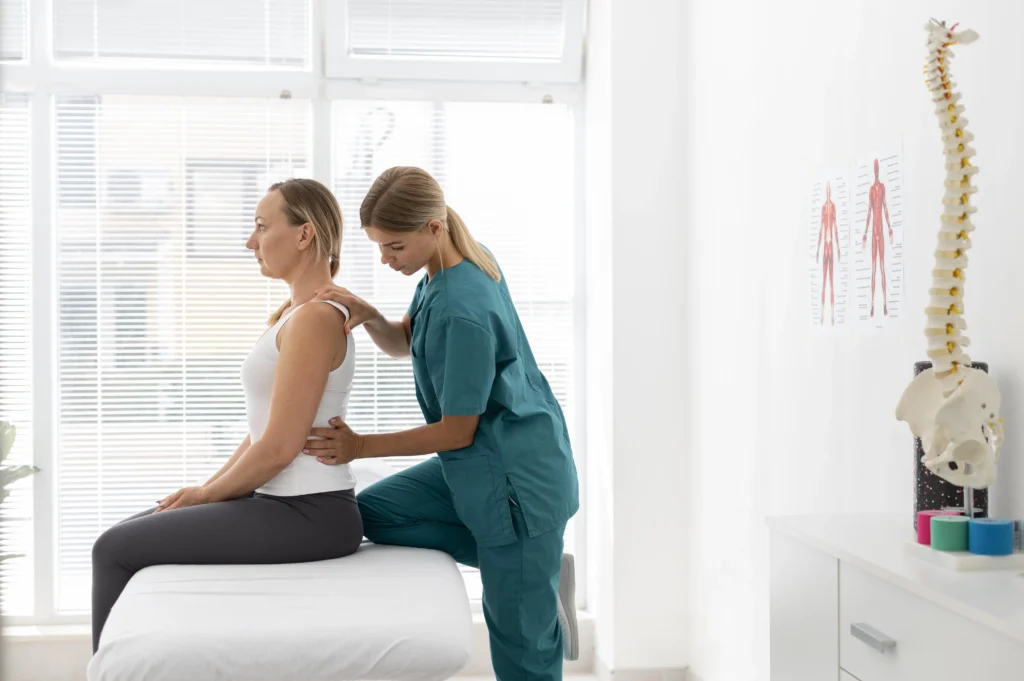
Physiotherapy can support symptom management and functional recovery when it is appropriate for the underlying condition.
It cannot dissolve, remove or reliably reposition a loose fragment.
The treatment plan depends on symptom severity, the degree of mechanical obstruction, associated joint damage and whether surgery is required.
Activity Modification
The physiotherapist may recommend reducing activities that repeatedly provoke catching or pain.
Deep squats, forceful hip rotation, sudden pivoting and movements that reproduce locking may need temporary modification.
Low-impact activities may remain suitable if they do not trigger symptoms and the treating clinician considers them appropriate.
Repeatedly forcing the hip through a blocked movement is not recommended.
Gentle Hip Mobility
When assessment confirms that conservative rehabilitation is appropriate, gentle, pain-free movement may help maintain available mobility.
The physiotherapist can select movements according to the diagnosis, symptoms and range of motion.
Exercises should not reproduce sharp pain, catching or locking.
Persistent mechanical symptoms require reassessment rather than increasingly forceful stretching.
Hip and Gluteal Strengthening
The gluteal muscles and other hip stabilizers contribute to pelvic control during walking, standing and stair climbing.
When appropriate, rehabilitation may include progressive strengthening to address weakness and improve functional movement.
Examples include supported standing exercises, gentle isometric muscle contractions and gradually progressed resistance exercises.
The selection and intensity should reflect the individual’s symptoms and clinical findings.
Strengthening can improve muscle function, but it does not remove a loose body or correct a fragment that obstructs the joint.
Gait and Functional Training
Pain can alter walking patterns and cause a person to place more weight on the opposite leg.
Physiotherapy may address walking mechanics, balance, stair use and safe movement during daily activities.
A walking aid may be appropriate when weight-bearing is painful or restricted, following clinical advice.
The objective is to improve function without aggravating the underlying joint problem.
Hip Joint Loose Bodies: Myth vs Fact
MYTH: Every clicking hip has a loose body.
FACT: Tendon movement, labral tears and femoroacetabular impingement can also cause clicking or catching.
MYTH: Exercises can dissolve loose fragments.
FACT: Physiotherapy can improve muscle function and mobility, but it cannot dissolve or remove bone and cartilage fragments.
MYTH: Every loose body requires surgery.
FACT: Treatment depends on symptoms, fragment location, joint damage and the underlying condition.
MYTH: A normal X-ray rules out loose bodies.
FACT: Some cartilage fragments may not be visible on X-rays. Further imaging may be needed when symptoms and examination findings warrant it.
Physiotherapy After Hip Arthroscopy
Hip arthroscopy may be used to remove loose bodies and treat associated joint abnormalities.
Physiotherapy can then support recovery, but the rehabilitation plan must reflect the procedure performed.
Early Recovery
The initial phase focuses on protecting healing tissues, managing symptoms and maintaining movement within the surgeon’s prescribed limits.
Depending on the procedure, the patient may require crutches, temporary weight-bearing restrictions or specific limits on hip movement.
Progressive Strengthening
As recovery progresses, the physiotherapist may introduce appropriate muscle activation, strengthening, balance work and gait training.
Exercise intensity should increase according to pain, movement quality, strength and the surgeon’s instructions.
Return to Daily Activities
Progression towards longer walks, stairs, work, recreational activities and sport depends on the procedure, joint condition and individual recovery.
There is no single timetable suitable for every hip arthroscopy patient.
Rehabilitation protocols vary, particularly when procedures involve additional cartilage, labral or bony treatment. (Grzybowski et al., 2015)
When Is Surgery Needed?
Surgery may be considered when loose bodies cause repeated locking, persistent pain, substantial movement restriction or progressive joint damage.
Hip Arthroscopy and Loose Body Removal
Hip arthroscopy allows the surgeon to examine the joint using a camera and small instruments inserted through small incisions.
The surgeon may remove loose fragments and treat associated problems where appropriate.
For synovial chondromatosis, treatment may also involve removing affected synovial tissue.
Arthroscopy is not suitable for every case.
The location and number of fragments, the accessibility of the affected area and the extent of cartilage damage influence the surgical approach.
Recovery and Recurrence
Recovery depends on the procedure performed and the condition of the joint.
Some patients need temporary restrictions on weight-bearing, while others can progress more quickly under medical guidance.
Loose-body removal may relieve mechanical symptoms, but established cartilage damage can continue to cause discomfort.
Synovial chondromatosis can recur, so follow-up may be necessary after treatment. (van der Valk et al., 2019)
When Should You Seek Medical Attention?
Arrange an assessment if hip catching or locking occurs repeatedly, pain persists, movement becomes restricted or symptoms interfere with everyday activities.
Seek urgent medical attention if:
- The hip suddenly becomes severely painful.
- The person cannot bear weight after an injury.
- The joint becomes hot or swollen, especially with fever or feeling unwell.
- Movement becomes suddenly and severely restricted.
These symptoms may indicate a serious injury, joint infection or another condition that requires prompt assessment.
Do not attempt to force a locked hip back into movement.
Early evaluation can help establish the cause and guide appropriate treatment.
Final Thoughts
A hip that catches or locks should not automatically be attributed to a loose body. Labral tears, hip impingement and tendon-related snapping can produce similar symptoms, making an accurate assessment essential.
Physiotherapy can support strength, mobility and recovery when appropriate, but persistent mechanical obstruction may require orthopaedic treatment. Early assessment helps guide the right approach and protect hip function.
Conclusion
Hip joint loose bodies are fragments of bone or cartilage that can interfere with normal movement and cause catching, locking, pain and restricted mobility.
Previous injuries, joint degeneration and synovial chondromatosis are possible causes.
Physiotherapy can improve strength, mobility and functional control when conservative management or postoperative rehabilitation is appropriate.
However, it cannot remove a loose fragment or correct a mechanical obstruction.
Accurate diagnosis is essential because loose bodies, labral tears, hip impingement and tendon-related snapping can produce similar symptoms but require different treatments.
Persistent locking or significant movement restriction warrants clinical assessment so that appropriate medical care and rehabilitation can be planned.
Frequently Asked Questions
Can loose bodies cause hip locking?
Yes. A fragment of bone or cartilage may interfere with movement inside the hip joint and cause catching or temporary locking. Other hip conditions can produce similar symptoms.
Can physiotherapy remove loose bodies?
No. Physiotherapy can improve strength, mobility and function, but it cannot remove a loose fragment. A mechanical obstruction may require orthopaedic treatment.
Will an X-ray show a loose body in the hip?
An X-ray may show fragments containing mineralized bone or cartilage. MRI or CT may be required when fragments are not visible or additional joint damage is suspected.
Does every hip loose body need surgery?
No. Treatment depends on symptoms, joint damage and the underlying condition. An orthopaedic specialist may recommend removal for persistent mechanical symptoms.
When should hip locking be assessed?
Repeated locking, persistent pain or restricted movement warrants clinical assessment. Sudden severe pain, inability to bear weight or a hot, swollen joint with fever requires urgent medical attention.
Stay tuned with us for more health related topics.
Follow us on LinkedIn and Instagram for more.
More Read


Medical Disclaimer
This article is intended for educational purposes only and does not replace professional medical advice, diagnosis or treatment. Hip catching and locking can have several causes and require appropriate clinical assessment. Consult a qualified healthcare professional for persistent symptoms. Seek urgent medical attention for sudden severe hip pain, inability to bear weight or a hot, swollen joint accompanied by fever.


