

A young athlete who regularly plays baseball, cricket or another throwing sport may gradually develop pain on the inner side of the elbow.
Initially, the discomfort may appear only after practice.
Quick Answer: What Is Little League Elbow?
Little League elbow is an overuse injury that commonly affects the developing growth plate on the inner side of a child’s elbow. It is often associated with repetitive throwing in sports such as baseball and cricket.
- Common symptom: Pain or tenderness on the inner side of the elbow during or after throwing.
- Common contributor: Repeated throwing without adequate recovery.
- Treatment: Temporary restriction of throwing, medical assessment and individualized rehabilitation.
- Physiotherapy: Helps restore elbow movement, strength, shoulder stability and whole-body coordination when rehabilitation is appropriate.
Important: Children should not continue throwing through elbow pain. Sudden severe pain, swelling or inability to move the arm needs prompt medical assessment.
Over time, it can affect throwing performance, elbow movement and participation in sport.
One possible cause is Little League elbow, an overuse injury that commonly affects the developing elbow in children and adolescents.
The condition most often involves irritation of the growth plate on the inner side of the elbow.
Repeated throwing places considerable stress on this developing area, particularly when training demands exceed the body’s ability to recover.
Recognizing the early symptoms is important. Continuing to throw through pain can worsen the injury and increase the risk of more significant damage.
With appropriate medical assessment, adequate rest and a structured rehabilitation program, many young athletes can return to their favorite sports safely.
Key Takeaways for Parents
- ✓ Little League elbow commonly affects the growth plate on the inner side of a young athlete’s elbow.
- ✓ Repetitive throwing, high training volume and inadequate recovery can contribute to the injury.
- ✓ Inner elbow pain, tenderness, stiffness and reduced throwing performance are important warning signs.
- ✓ A medical assessment helps distinguish growth-plate irritation from ligament, muscle and bone injuries.
- ✓ Treatment often involves stopping throwing temporarily and following an individualized recovery plan.
- ✓ Pediatric physiotherapy can help restore movement, strength, coordination and readiness for a gradual return to sport.
Remember: Persistent elbow pain in a young throwing athlete should never be dismissed as normal sports soreness.
What Is Little League Elbow?
Little League elbow is a throwing-related overuse injury that most commonly affects the medial epicondyle growth plate in the developing elbow of children.
The medial epicondyle is the bony prominence on the inner side of the elbow. It provides an attachment point for muscles and ligaments that help control the wrist, forearm and elbow.
In children, this area contains a growth plate made of developing cartilage. It is more vulnerable to repetitive pulling forces than mature bone and surrounding ligament structures.
Repeated throwing can irritate this growth plate, causing a condition known as medial epicondyle apophysitis.
Although this is the classic form of Little League elbow, other structures may also become affected, including the ulnar collateral ligament (UCL), flexor-pronator muscles and joint surfaces.
The condition is most commonly seen in young athletes between approximately 8 and 15 years of age, although it can occur in older adolescents while the growth plate remains open. (American Academy of Pediatrics, 2026)
Why Does Repetitive Throwing Injure a Growing Elbow?
A child’s elbow is different from an adult’s because some parts of the bone are still developing.
During an overhead throwing action, the elbow experiences considerable forces, particularly during the arm-cocking and acceleration phases.
These forces include:
- Valgus stress: A force that tends to open the inner side of the elbow.
- Traction: Pulling forces on the medial epicondyle and its attached structures.
- Compression: Pressure on the outer side of the elbow.
- Rotational forces: Forces created as the upper arm and forearm move during throwing.
Repeated exposure to these forces can irritate the medial epicondyle growth plate.
When throwing volume is excessive or recovery is inadequate, the developing tissue may struggle to tolerate the repeated loading.
This can lead to pain, growth-plate changes and, in more serious cases, partial separation or an avulsion fracture.
The injury is not simply caused by a child throwing incorrectly. Training volume, recovery, physical development and individual susceptibility can all contribute.
Which Children Are More Likely to Develop Little League Elbow?
Little League elbow is most commonly associated with baseball pitchers, but similar throwing-related injuries can affect children participating in other overhead sports.
These include:
- Baseball and softball.
- Cricket, particularly fast bowling and repeated throwing.
- Handball.
- Javelin and other throwing events.
- Other sports involving frequent, high-force overhead movements.
Several factors may increase the risk.
1. High Throwing Volume
Repeated throwing without sufficient recovery can overload the developing elbow.
Long practice sessions, frequent matches and participation in multiple teams may increase the total workload.
2. Insufficient Rest Between Sessions
The elbow needs time to recover after demanding throwing activities.
Continuing to pitch or throw when the arm is tired or painful can aggravate an existing injury.
3. Sudden Increases in Training Intensity
A sudden increase in throwing distance, speed, practice frequency or competition workload can expose the elbow to more stress than it is prepared to tolerate.
4. Year-Round Participation in the Same Sport
Playing the same throwing sport throughout the year may leave insufficient time for recovery from repetitive loading.
A planned break from competitive throwing can help reduce cumulative stress.
5. Continuing to Play Through Pain
Some young athletes hide their discomfort because they do not want to miss a match or lose their position on the team.
However, pain during throwing is a warning sign. It should not be treated as a normal part of improving performance.
Early Signs and Symptoms of Little League Elbow In Children
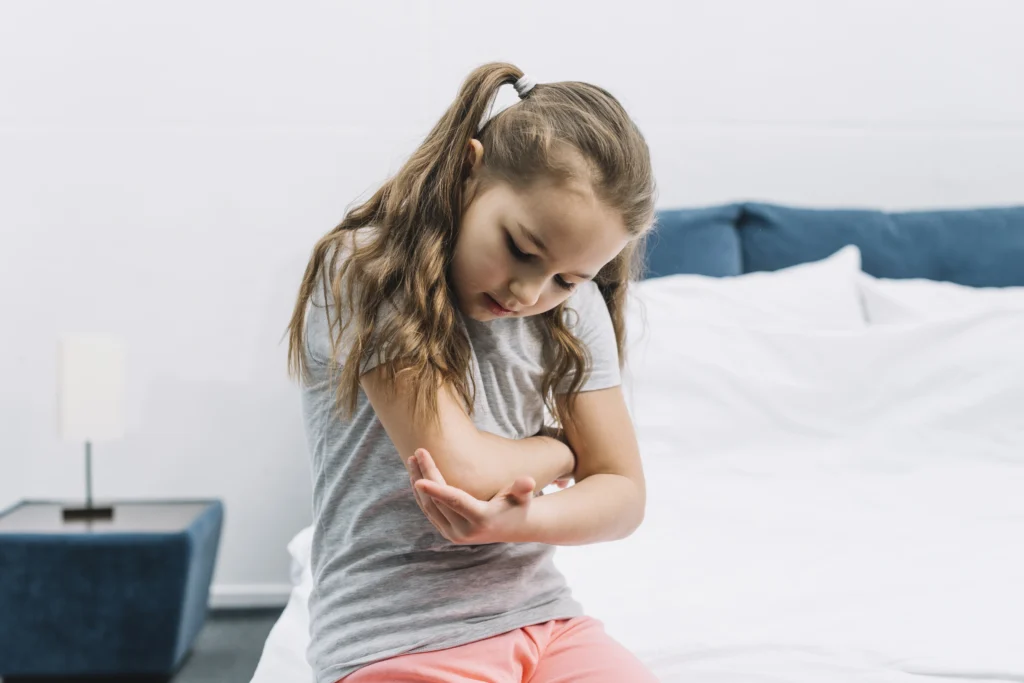
Little League elbow usually develops gradually rather than following one obvious injury.
Parents and coaches should pay attention to changes in throwing performance, complaints of pain and difficulty moving the elbow.
1. Pain on the Inner Side of the Elbow
Pain around the bony prominence on the inside of the elbow is a common symptom.
Initially, discomfort may occur only while pitching or throwing. As the injury progresses, pain may continue after practice or during everyday activities.
2. Tenderness Around the Medial Epicondyle
The inner elbow may feel sore when touched.
The child may complain when pressure is applied to the area or when the forearm muscles are used against resistance.
3. Reduced Throwing Speed or Accuracy
A young athlete may notice that they cannot throw as fast or accurately as before.
They may also struggle to complete their usual practice session because of discomfort.
4. Elbow Stiffness
Some children develop difficulty fully straightening or bending the elbow.
Reduced elbow extension is an important finding, particularly when it is new or progressively worsening.
5. Pain During Everyday Activities
As symptoms become more persistent, discomfort may occur while carrying a school bag, lifting objects, pushing up from a chair or participating in other activities that load the arm.
6. Swelling Around the Inner Elbow
Some children develop visible swelling or tenderness around the medial epicondyle.
Significant swelling, sudden severe pain or an inability to move the elbow requires prompt medical assessment.
How Is Little League Elbow Different From Other Throwing Injuries?
Not every throwing-related elbow injury affects the same structure.
Little League elbow most commonly refers to medial epicondyle growth-plate irritation, but other conditions can produce similar symptoms.
| Condition | Main structure affected | Typical problem |
|---|---|---|
| Medial epicondyle apophysitis | Growth plate on inner elbow | Gradual inner elbow pain during throwing |
| UCL injury | Ligament stabilizing inner elbow | Pain and possible instability during throwing |
| Flexor-pronator strain | Forearm muscle-tendon group | Pain with resisted wrist or forearm activity |
| Capitellar osteochondritis dissecans | Cartilage and bone on outer elbow | Outer elbow pain, stiffness or catching |
| Medial epicondyle avulsion fracture | Bone attachment at inner elbow | More acute pain, sometimes after a forceful throw |
This distinction matters because treatment and rehabilitation depend on the specific structure injured.
For example, an avulsion fracture may require immobilization or surgery, whereas uncomplicated medial epicondyle apophysitis is usually managed without surgery.
How Is Little League Elbow In Children Diagnosed?
Diagnosis involves understanding the child’s throwing history, examining the elbow and deciding whether imaging is needed.
1. Medical and Sports History
The clinician may ask about:
- Which sport the child plays.
- Whether the child pitches, bowls or performs other throwing activities.
- Number of training sessions and matches each week.
- Throwing volume across multiple teams.
- Recent increases in training intensity.
- Previous elbow or shoulder injuries.
- Whether pain occurs during throwing, after practice or at rest.
It is important to include informal throwing outside organised sport because this also contributes to the total workload.
2. Physical Examination
The clinician may assess:
- Tenderness around the medial epicondyle.
- Elbow bending and straightening.
- Forearm rotation.
- Grip and upper-limb strength.
- Elbow stability.
- Shoulder movement.
- Sensation and nerve function, particularly around the ulnar nerve.
- Throwing movement, when appropriate.
The unaffected arm may also be examined for comparison.
3. X-rays
X-rays are commonly used to examine the developing growth plate.
They may show widening, irregularity or fragmentation of the medial epicondyle growth plate. They can also help identify an avulsion fracture or another bony abnormality.
However, an early overuse injury may not produce obvious changes on an X-ray. A normal X-ray does not always exclude a clinically suspected injury.
4. MRI or Ultrasound
MRI may be recommended when symptoms persist, the diagnosis is uncertain or the clinician needs to examine the growth plate, ligament, cartilage and surrounding soft tissues in more detail.
Ultrasound may also help assess selected growth-plate and soft-tissue abnormalities.
The choice of imaging depends on the examination findings and the suspected injury. (American Academy of Physical Medicine and Rehabilitation)
What Happens If Little League Elbow Is Left Untreated?
Continuing to throw through pain can increase stress on an already irritated growth plate.
The injury may progress from discomfort during pitching to persistent pain, stiffness and reduced elbow movement.
More significant injuries may involve:
- Growth-plate widening or damage.
- Partial separation of the medial epicondyle.
- An avulsion fracture.
- Loose bone or cartilage fragments inside the joint.
- Persistent loss of elbow extension.
- Difficulty returning to throwing sports.
An avulsion fracture occurs when a strong pulling force from an attached tendon or ligament causes a fragment of bone to separate.
This is more serious than uncomplicated growth-plate irritation and requires orthopedic assessment.
Not every child with Little League elbow develops these complications. However, persistent symptoms should never be ignored.
How Is Little League Elbow In Children Treated?
Treatment depends on the type and severity of the injury, the child’s age, growth-plate status and examination findings.
The main goals are to reduce stress on the elbow, allow the injured tissues to recover and restore movement and strength before throwing resumes.
1. Stop Throwing Activities
The first step is to stop throwing with the affected arm.
This includes:
- Pitching and bowling.
- Throwing drills.
- Practice throws.
- Informal throwing outside organized sport.
Simply reducing the number of throws while continuing to experience pain may not allow the injured area to recover.
The duration of throwing rest should be determined by the treating clinician.
Many uncomplicated cases require several weeks away from throwing, often around 4-6 weeks, but more significant injuries may need longer.
2. Manage Pain and Irritation
Relative rest and ice wrapped in a towel for short periods may help relieve discomfort.
Pain-relieving medication may be considered following medical advice.
A brace or short period of immobilization may be appropriate for selected injuries, particularly when there is an associated avulsion fracture.
3. Begin Individualized Rehabilitation
Once acute symptoms have settled and the clinician considers rehabilitation appropriate, physiotherapy can help restore movement, strength and functional control.
The program should be adapted to the actual injury rather than following the same exercises for every child.
4. Surgery for Selected Injuries
Most uncomplicated cases do not require surgery.
However, a significantly displaced avulsion fracture, certain loose fragments or persistent structural problems may require orthopedic treatment.
The surgical approach depends on the specific injury and the child’s skeletal development.
Little League Elbow: Myth vs Fact
MYTH: Elbow pain is normal when children train hard.
FACT: Pain during throwing can indicate an overuse injury. It should be assessed rather than ignored.
MYTH: Little League elbow only affects baseball pitchers.
FACT: Similar throwing-related injuries can affect young athletes in other overhead sports, including cricket and handball.
MYTH: Resting for a few days is always enough.
FACT: Recovery depends on the type and severity of the injury. Some children need several weeks away from throwing and a structured rehabilitation program.
MYTH: Physiotherapy only involves elbow exercises.
FACT: Rehabilitation may also address forearm strength, shoulder stability, trunk control, balance and throwing-related movement patterns.
MYTH: A child can return to sport as soon as the pain disappears.
FACT: Return to throwing should also consider tenderness, elbow movement, strength, movement control and medical clearance.
Pediatric Physiotherapy For Little League Elbow In Children?
Physiotherapy is an important part of recovery after the initial injury has been assessed and the athlete is ready for progressive rehabilitation.
The goal is not simply to strengthen the elbow. Throwing involves coordinated movement of the shoulder, elbow, forearm, trunk and lower body.
A pediatric physiotherapist assesses these areas and develops a program based on the child’s symptoms, movement limitations and sporting demands.
1. Restoring Elbow and Forearm Movement
The physiotherapist assesses whether the child can comfortably bend and straighten the elbow and rotate the forearm.
When permitted by the treating clinician, rehabilitation may include gradual mobility exercises to restore the required movement.
The aim is to regain comfortable movement without placing excessive stress on the healing growth plate.
2. Strengthening the Forearm and Elbow
The forearm muscles help control the elbow during throwing.
Progressive strengthening may include:
- Wrist flexor and extensor exercises.
- Forearm pronation and supination.
- Grip strengthening.
- Elbow flexion and extension exercises.
Resistance and repetitions should be progressed according to symptoms and clinical findings.
3. Improving Shoulder and Scapular Strength
The shoulder blade and rotator cuff muscles help position and stabilize the arm during throwing.
Rehabilitation may include shoulder rotation exercises, scapular control activities and upper-back strengthening.
This supports the movement capacity needed for overhead sports.
4. Building Trunk and Lower-Body Control
Throwing is a whole-body movement. The legs, hips and trunk contribute to generating and transferring force.
Physiotherapy may include:
- Core stability exercises.
- Hip and leg strengthening.
- Single-leg balance activities.
- Trunk rotation and movement-control exercises.
- Sport-specific coordination drills.
These activities help address movement limitations across the body. They do not replace the need to protect the injured elbow during healing.
5. Improving Throwing Mechanics and Movement Coordination
When the child is ready for sport-specific rehabilitation, the physiotherapist may work alongside the coach to assess movement coordination and physical capacity.
This may involve examining:
- Shoulder and trunk movement.
- Balance during single-leg loading.
- Timing between the lower body and throwing arm.
- Control during acceleration and follow-through.
- The child’s tolerance for progressively demanding activities.
Technical changes should be guided by appropriate coaching and clinical assessment, rather than assuming that poor technique is the only cause of injury.
6. Planning a Gradual Return to Throwing
Once the athlete has regained the required movement and strength, a structured throwing program can be introduced with medical clearance.
The program gradually increases throwing distance, volume and intensity.
A child should not return directly to competitive pitching simply because the elbow feels better during everyday activities.
When Can a Child Return to Throwing Sports?
There is no single recovery timeline that applies to every child with Little League elbow.
Return depends on the severity of the injury, growth-plate involvement, pain, elbow movement, strength and response to rehabilitation.
Before throwing resumes, the child should generally have:
- No pain during everyday activities.
- No tenderness over the injured area.
- Full or clinically appropriate elbow movement.
- Adequate upper-limb and shoulder strength.
- Good movement control.
- Medical clearance to begin throwing.
What Does a Gradual Return-to-Throwing Program Involve?
A supervised program usually progresses through stages:
- Preparation: Confirm that the elbow has recovered sufficiently and the child is ready to begin throwing.
- Short-distance throwing: Start with controlled, low-intensity throws.
- Progressive loading: Gradually increase throwing distance and volume.
- Higher-intensity throwing: Introduce more demanding throws when earlier stages are tolerated.
- Sport-specific practice: Progress towards the demands of the child’s position and sport.
- Full participation: Return to competitive throwing after the program is completed without symptoms.
The progression should be adjusted if pain or tenderness returns.
Competitive pitching or fast bowling should not resume until the treating clinician has confirmed that the child is ready.
How Can Parents Help Prevent Little League Elbow In Their Children?
Prevention is particularly important because young athletes may not recognize early signs of overuse injury.
Parents, coaches and children should work together to manage throwing workload and allow sufficient recovery.
1. Follow Age-Appropriate Pitch Limits
Baseball players should follow the pitch-count limits and rest-day recommendations established by their league.
Parents should record pitches during both matches and practice sessions. Extra throwing outside organized training also contributes to total workload.
The Little League pitch-count rules provide age-based limits and rest requirements for baseball pitchers.
These baseball-specific limits should not automatically be applied to cricket or other throwing sports. Athletes in those sports need appropriate sport-specific workload guidance.
2. Allow Adequate Rest
Young athletes need recovery time between demanding throwing sessions.
Avoid consecutive high-intensity throwing sessions when rest is required. Do not encourage children to continue pitching or bowling when their arm feels tired or painful.
3. Avoid Year-Round Specialization
Playing the same throwing sport throughout the year can expose the elbow to repetitive loading without adequate recovery.
A planned break from competitive throwing and participation in other age-appropriate activities can help reduce cumulative stress.
4. Encourage Appropriate Throwing Technique
Coaches should teach age-appropriate throwing mechanics and avoid excessive emphasis on throwing speed.
Technique should be assessed by a qualified coach when necessary, particularly if the child repeatedly experiences discomfort.
5. Never Ignore Elbow Pain
Pain during throwing is a warning sign, not something a young athlete should be expected to tolerate.
If a child reports elbow pain, stop throwing and arrange an appropriate assessment before returning to training.
For baseball-specific workload and rest recommendations, parents and coaches can also consult MLB and USA Baseball’s Pitch Smart guidelines.
When Should Parents Seek Medical Attention?
Not every episode of elbow discomfort indicates Little League elbow. However, persistent or recurring pain in a young throwing athlete should not be ignored.
Arrange a medical assessment if your child experiences:
- Repeated pain on the inner side of the elbow.
- Pain that returns every time they throw.
- Reduced throwing speed or accuracy.
- Difficulty fully straightening the elbow.
- Swelling or tenderness around the inner elbow.
- Pain that continues after practice or affects everyday activities.
- Numbness or tingling in the ring finger or little finger.
Seek prompt medical attention if there is sudden severe pain, a painful popping sensation, significant swelling, visible deformity or an inability to move the arm after an injury.
These symptoms may indicate a more significant injury, including an avulsion fracture or another elbow condition.
Final Thoughts: Protecting Your Young Athlete’s Growing Elbow
Little League elbow is a reminder that growing athletes need the right balance between training, recovery and physical development. Persistent elbow pain should never be considered a normal part of playing sports.
Early assessment, appropriate rest and individualized pediatric physiotherapy can help children rebuild movement and strength before gradually returning to throwing activities.
A healthy return to sport is more important than a quick return. Protecting a child’s developing elbow today can help support their long-term participation in sport.
Conclusion
Little League elbow is an overuse injury that can affect the developing elbow of children who participate in repetitive throwing sports.
It most commonly involves irritation of the medial epicondyle growth plate, although other structures may also be affected.
Early recognition is important because continuing to throw through pain can worsen the injury and delay recovery.
Treatment usually involves stopping throwing activities, allowing the injured tissues to recover and following an individualised rehabilitation program.
Pediatric physiotherapy can help restore elbow movement, forearm and shoulder strength, trunk control and whole-body coordination before a gradual return to throwing.
Parents and coaches also play an important role by monitoring throwing workload, allowing adequate rest and taking elbow pain seriously.
The goal is not simply to get a young athlete back on the field quickly. It is to help them return safely while protecting their growing elbow.
Frequently Asked Questions About Little League Elbow
1. What is Little League elbow?
Little League elbow is an overuse injury that commonly affects the growth plate on the inner side of a child’s elbow. It is frequently associated with repetitive throwing in young athletes.
2. What causes Little League elbow in children?
Repeated throwing places traction and other mechanical stresses on the developing elbow. High throwing volume, insufficient rest and sudden increases in training can contribute to the injury.
3. What are the early symptoms of Little League elbow?
Early symptoms include pain or tenderness on the inner side of the elbow during or after throwing. Some children also develop stiffness, swelling or reduced throwing performance.
4. At what age does Little League elbow usually occur?
It is commonly seen in young athletes around 8–15 years of age. However, it can occur outside this range while the elbow growth plate is still developing.
5. Can cricket players develop Little League elbow?
Yes. Although the term is commonly associated with baseball, young athletes in cricket and other throwing sports can develop similar overuse injuries involving the developing elbow.
6. How is Little League elbow diagnosed?
Diagnosis involves reviewing the child’s throwing history and examining elbow movement, tenderness, strength and stability. X-rays are commonly used, while MRI or ultrasound may be recommended in selected cases.
7. Can physiotherapy help Little League elbow?
Yes. Once the injury has been assessed and rehabilitation is appropriate, physiotherapy can help restore elbow movement, forearm strength, shoulder stability, trunk control and coordination.
8. How long does Little League elbow take to heal?
Recovery varies according to the severity of the injury. Some uncomplicated cases require several weeks away from throwing, while more significant injuries may take longer. Return to sport should be based on clinical recovery rather than a fixed date.
9. Can a child continue playing sports with Little League elbow?
The child should stop throwing with the affected arm until medically assessed and cleared. Whether other activities can continue depends on the injury and the clinician’s advice. Throwing through pain is not recommended.
Stay tuned with us for more health related topics.
Follow us on LinkedIn and Instagram for more.
More Read


Medical Disclaimer
This article is intended for general educational and informational purposes only. It does not replace professional medical advice, diagnosis or treatment.
Little League elbow and other throwing-related injuries require appropriate assessment by a qualified healthcare professional. Treatment and rehabilitation should be individualized according to the child’s age, symptoms, examination findings and injury severity.
Parents should seek medical advice if a child develops persistent elbow pain, swelling, restricted movement or difficulty using the arm. Do not encourage a child to continue throwing through pain.


