


NIJMEGEN, THE NETHERLANDS: An international analysis of more than 30,000 participants identifies escitalopram, duloxetine and agomelatine as promising options for maintaining improvement in depression.
Depression symptoms can improve with treatment but may return after a period of recovery. Researchers are increasingly examining how well antidepressants help patients maintain their progress over time.
A new study published in The Lancet Psychiatry found that escitalopram showed the strongest results in the main comparison of long-term treatment outcomes. Duloxetine and agomelatine also performed better than fluoxetine, although experts say the differences between medicines were modest.
What New Research Reveals About Long-Term Depression Treatment
Researchers have found that some antidepressants may be more effective than others at helping adults maintain improvements in depression symptoms.
The findings come from a systematic review and network meta-analysis published in The Lancet Psychiatry on 10 November 2026.
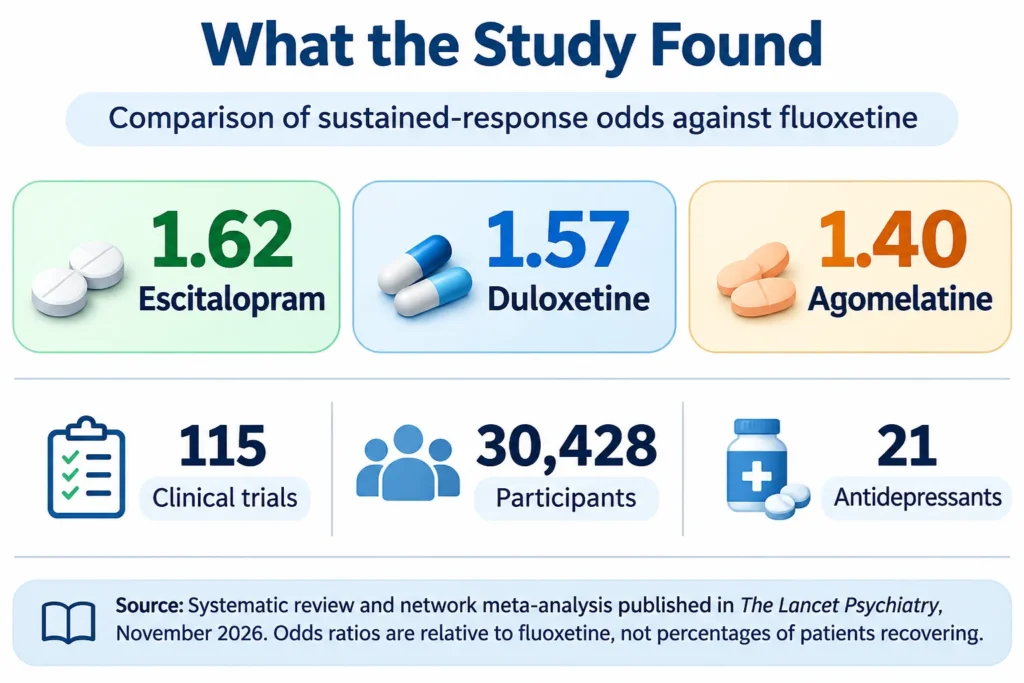
An international research team, led by scientists associated with Radboud University Medical Center in Nijmegen, the Netherlands, examined evidence from 115 randomized clinical trials involving 30,428 participants.
The researchers compared 21 antidepressants used to treat adult unipolar major depressive disorder. They examined whether patients maintained improvements during longer treatment periods and how often participants stopped taking their prescribed medication.
The main comparison of continuation and continuation-extension trials included 9,888 participants across 35 studies. These trials examined whether patients maintained their initial treatment response during continued antidepressant use.
The study found that escitalopram, duloxetine and agomelatine achieved higher sustained response rates than fluoxetine, which is commonly sold under the brand name Prozac.
According to the BBC Health report published on 11 November 2026, escitalopram performed best in the analysis, followed by agomelatine and duloxetine.
However, the researchers stressed that the results should inform treatment decisions rather than establish one antidepressant as the best choice for everyone.
What Is Sustained Response in Depression Treatment?
Sustained response refers to maintaining an improvement in depression symptoms over time after initially responding to treatment.
For example, a person may experience fewer depressive symptoms after starting an antidepressant. However, the improvement may not last if symptoms return during treatment or after medication changes.
Researchers use sustained response to understand whether treatment provides lasting benefits rather than only short-term symptom relief.
It is important to distinguish sustained response from complete remission. A sustained response does not necessarily mean that all symptoms have disappeared or that depression has been permanently cured.
The study examined whether antidepressants could help patients achieve and maintain improvement, making sustained response an important outcome in long-term depression treatment.
Escitalopram Shows the Strongest Results
Escitalopram emerged as the strongest-performing medicine among the three antidepressants that showed significantly higher odds of sustained response than fluoxetine in the primary comparison.
The study reported the following results:
| Antidepressant | Odds ratio compared with fluoxetine |
|---|---|
| Escitalopram | 1.62 |
| Duloxetine | 1.57 |
| Agomelatine | 1.40 |
These figures represent the relative odds of achieving a sustained response compared with fluoxetine.
Escitalopram had an odds ratio of 1.62, with a 95% confidence interval of 1.21 to 2.18. Duloxetine had an odds ratio of 1.57, while agomelatine had an odds ratio of 1.40.
All three medicines showed statistically higher odds of sustained response than fluoxetine in the primary analysis.
However, these figures should not be interpreted as absolute improvements in recovery rates. An odds ratio of 1.62 does not mean that 62% more patients recovered or avoided relapse.
The results also show relatively small differences between escitalopram and duloxetine. Therefore, the higher ranking of escitalopram does not automatically translate into a major clinical advantage for every patient.
Escitalopram Also Had Lower Treatment Discontinuation
The researchers examined another important outcome: treatment acceptability.
They measured this through all-cause discontinuation, which refers to participants stopping their assigned medication for any reason during the study.
Compared with fluoxetine, escitalopram had an odds ratio of 0.60 for treatment discontinuation. Duloxetine had an odds ratio of 0.64.
Both medicines therefore showed lower odds of participants discontinuing treatment than fluoxetine.
This finding adds to the evidence supporting their potential value in long-term treatment.
However, all-cause discontinuation does not measure side effects alone. People may stop taking medication for several reasons, including side effects, lack of improvement or personal preferences.
How Duloxetine and Agomelatine Compare With Escitalopram
Although escitalopram showed the strongest results, the analysis also identified duloxetine and agomelatine as promising options for maintaining improvement in depression.
Both medicines work differently from escitalopram and have their own safety considerations.
Duloxetine
Duloxetine belongs to a group of antidepressants called serotonin-norepinephrine reuptake inhibitors (SNRIs).
It affects serotonin and norepinephrine signaling in the brain. These chemical messengers play roles in regulating mood and other functions.
The study found that duloxetine had higher odds of sustained response than fluoxetine. It also showed lower odds of treatment discontinuation.
Duloxetine is prescribed for major depressive disorder and certain other conditions, including some types of persistent pain.
Its potential side effects include nausea, dizziness, dry mouth, constipation, sweating and changes in blood pressure. Its suitability depends on the patient’s medical history, other medicines and treatment needs.
Agomelatine
Agomelatine is an antidepressant with a different mechanism of action from SSRIs and SNRIs.
It acts on melatonin receptors and serotonin receptors involved in regulating mood and sleep-related rhythms.
The analysis found that agomelatine had higher odds of sustained response than fluoxetine.
However, the medicine has an important safety concern involving the liver. It can cause elevated liver enzymes and, rarely, serious liver injury.
Patients prescribed agomelatine require liver-function tests before starting treatment and at recommended intervals during treatment. Doctors must assess its benefits and risks before prescribing it.
This safety consideration is important when comparing medicines because effectiveness alone does not determine which antidepressant is most suitable.
What About Sertraline and Other Common Antidepressants?
The study also examined other commonly prescribed antidepressants, including sertraline and fluoxetine.
Sertraline belongs to the selective serotonin reuptake inhibitor (SSRI) group, which also includes escitalopram and fluoxetine.
Although these medicines are widely used to treat depression, the primary analysis did not identify sertraline among the three medicines with significantly higher sustained-response odds than fluoxetine.
This does not mean that sertraline is ineffective.
Antidepressants can work differently across individuals. A medicine that does not show a statistically significant advantage in a group-level comparison can still provide substantial benefits to particular patients.
The findings also do not establish that fluoxetine or other commonly prescribed antidepressants should no longer be used.
Instead, the study provides additional evidence that differences may exist between medicines when maintaining improvement over longer treatment periods.
Why Preventing Depression Relapse Matters
Depression is a common mental health condition that can affect mood, thinking, sleep, energy and everyday functioning.
According to Radboud University Medical Center, nearly 6% of people worldwide experience depression.
Although many people improve with medication, psychological therapy or a combination of treatments, some experience a return of symptoms after recovery.
A relapse can affect several areas of daily life, including:
- Emotional health: Persistent sadness, hopelessness and loss of interest may return.
- Sleep: People may experience insomnia, excessive sleep or disrupted sleep patterns.
- Concentration: Difficulty focusing, remembering information and making decisions can affect daily activities.
- Work and relationships: Returning symptoms may interfere with professional responsibilities and personal relationships.
- Physical health: Fatigue, appetite changes and reduced energy can make daily activities more difficult.
Preventing relapse is therefore an important part of depression treatment.
The findings also reinforce the importance of continuing appropriate treatment after initial improvement rather than assuming that symptom relief means medication can be stopped immediately.
Continuing Antidepressants May Help Maintain Improvement
An important finding highlighted by experts is the potential benefit of continuing antidepressant treatment after symptoms improve.
Dr Sameer Jauhar, Clinical Associate Professor in Affective Disorders and Psychosis at Imperial College London, discussed the results in an expert reaction published by the Science Media Centre.
He highlighted that approximately 62% of people who continued antidepressant treatment maintained their improvement, compared with 45% of those switched to placebo.
This comparison provides additional context about the value of continuing treatment. It is separate from the comparison between escitalopram, duloxetine and agomelatine.
However, continued medication is not necessarily required for every patient indefinitely. Treatment duration depends on individual relapse risk, medical history, side effects and clinical response.
Patients should discuss their treatment plans with their doctors before making changes. Science Media Centre+1
Experts Warn Against Switching Antidepressants Based on the Findings Alone
Despite the promising results, independent experts have advised against treating escitalopram as a universal first choice for every person with depression.
Professor Allan Young of the Royal College of Psychiatrists highlighted that the differences between antidepressants were modest.
Previous treatment response, side effects and patient preferences remain important factors when selecting medication.
Dr Sameer Jauhar also cautioned that the analysis cannot predict which antidepressant will work best for an individual patient.
He said the results should not be interpreted as a reason for someone who is responding well to their current antidepressant to change treatment.
This is particularly important because the study compared outcomes across groups of participants. It did not test whether switching an individual patient from another antidepressant to escitalopram would improve their condition.
The findings may help doctors and patients make more informed decisions when starting treatment or reviewing available options. However, individual clinical assessments remain essential.

Limitations of the Antidepressant Study
Although the research included more than 30,000 participants, several limitations affect how its findings should be interpreted.
More Than Half of the Main Comparison Studies Had a High Risk of Bias
The review included 115 studies involving 30,428 participants. However, the primary comparison between individual antidepressants relied on 35 continuation and continuation-extension studies involving 9,888 participants.
Of these 35 studies, 19 were assessed as having a high risk of bias.
This represents approximately 54% of the studies in the primary comparison.
A high risk of bias means that problems in study design, conduct or reporting may have affected the results. It can reduce confidence in the estimated differences between medicines.
Follow-Up Periods Were Relatively Short
The researchers examined long-term treatment studies lasting more than 12 weeks.
However, the typical follow-up period in the primary evidence was around six months, according to Dr Jauhar’s assessment.
This makes it difficult to establish whether the differences between antidepressants remain consistent over several years.
Longer clinical trials are needed to understand their effects on long-term recovery and relapse prevention.
Network Meta-Analysis Has Certain Limitations
The researchers used a network meta-analysis to compare medicines.
This approach allows scientists to assess multiple treatments by combining direct comparisons with indirect comparisons through other medicines or placebo groups.
It is useful when individual clinical trials do not compare every medicine directly.
However, the reliability of the results depends on the quality and consistency of the available studies.
The researchers conducted sensitivity analyses that supported their main findings. Nevertheless, they acknowledged that the certainty of the evidence and the risk of bias could affect the reliability of some comparisons.
They also called for more direct comparisons between antidepressants to establish their long-term effects with greater confidence.
The study received no external funding.
How Long Should Patients Continue Taking Antidepressants?
The duration of antidepressant treatment depends on the severity of depression, previous episodes, response to medication and individual risk of relapse.
The UK’s National Institute for Health and Care Excellence (NICE) recommends that people who have responded to antidepressant treatment generally continue taking medication for at least six months after their symptoms have gone into remission.
Doctors may recommend longer treatment for people who have experienced repeated depressive episodes, persistent symptoms or other factors that increase their risk of relapse.
Regular reviews are important to assess whether the medicine remains beneficial and whether side effects or other health concerns have developed.
Psychological therapies, including cognitive behavioural therapy (CBT) and mindfulness-based cognitive therapy (MBCT), may also support relapse prevention.
For some patients, continuing medication alongside psychological therapy may offer additional support.
Treatment decisions should involve the patient and their healthcare professional, taking into account the benefits, risks and available alternatives.
Why Patients Should Not Stop Antidepressants Suddenly
Patients who feel better may consider stopping their medication. However, suddenly discontinuing antidepressants can cause withdrawal symptoms.
These may include:
- Dizziness or unsteadiness.
- Nausea and headaches.
- Sleep disturbances.
- Increased anxiety or irritability.
- Unusual sensations or changes in mood.
The NHS advises patients not to stop escitalopram suddenly. Doctors may gradually reduce the dose over several weeks or months, depending on the medication, dose and individual response.
A gradual reduction can help minimize withdrawal symptoms and allow doctors to monitor whether depression symptoms return.
Patients should contact their treating healthcare professional before reducing or stopping any prescribed antidepressant.

What the Findings Mean for People Living With Depression
The new research provides useful evidence about the long-term effectiveness of antidepressants.
Escitalopram, duloxetine and agomelatine showed stronger results than fluoxetine in maintaining improvement during continued treatment. Escitalopram had the highest odds of sustained response among these three medicines.
However, the findings do not establish that one antidepressant will work best for everyone.
Doctors must consider the patient’s medical history, previous treatment response, possible side effects and personal preferences before choosing a medication.
For people already responding well to their treatment, the study does not provide a reason to switch medicines.
The research instead highlights an important consideration when selecting treatment: an antidepressant should not only help improve depression symptoms but should also support patients in maintaining that improvement over time.
Final Thoughts
The analysis published in The Lancet Psychiatry offers important evidence about how different antidepressants perform during longer treatment periods.
Escitalopram showed the strongest results in the main comparison, while duloxetine and agomelatine also performed better than fluoxetine.
However, modest differences between medicines, limitations in the available studies and variations in individual treatment responses mean that these findings should be interpreted carefully.
The most important takeaway is that long-term depression treatment requires more than initial symptom improvement. Maintaining recovery, monitoring side effects and preventing relapse are equally important.
Patients should work with their healthcare professionals to identify a treatment plan that supports their long-term mental health rather than changing medication based on a single research finding.