


If you’re searching how to do pendulum swings for frozen shoulder, doing them wrong could be the reason your stiffness isn’t improving.
Frozen shoulder can make even the simplest daily movements feel exhausting.
Reaching overhead, fastening a seatbelt, wearing clothes, or sleeping comfortably becomes difficult.
The stiffness creeps in slowly, pain increases at night, and range of motion gradually reduces.
Medically known as Adhesive capsulitis, frozen shoulder affects millions of adults globally, especially between the ages of 40 and 60.
Among all conservative treatment options available today, pendulum swings remain one of the most trusted, clinically recommended, and safest starting exercises.
Quick Answer
Pendulum swings are one of the safest and most effective early exercises for frozen shoulder. They use gravity to gently mobilize the joint, reduce stiffness, and improve circulation without straining the shoulder. Performing them 2–3 times daily for 3–5 minutes can significantly improve mobility and reduce pain over time.
Key Takeaways
- Pendulum exercises are the first-line treatment for frozen shoulder
- They improve joint lubrication and reduce stiffness safely
- Consistency is more important than intensity
- Stage-based progression is essential for recovery
- Combine exercises with heat therapy and posture correction
- Most patients recover without surgery with proper physiotherapy
What Is Frozen Shoulder
Frozen shoulder is a condition where the capsule surrounding the shoulder joint becomes inflamed, thickened, and tight.
This leads to shoulder pain and significant restriction in movement.
The condition develops gradually and typically progresses through three stages.
1. Freezing Stage
Duration: 6 weeks to 9 months
- Increasing pain
- Night discomfort
- Gradual stiffness
2. Frozen Stage
Duration: 4 to 12 months
- Reduced pain intensity
- Severe stiffness
- Limited shoulder movement
3. Thawing Stage
Duration: 6 months to 2 years
- Slow return of mobility
- Reduced stiffness
Without proper rehabilitation, frozen shoulder can last up to two years.
Early controlled movement is critical to prevent worsening capsular tightening.
Early Signs and Symptoms You Should Not Ignore
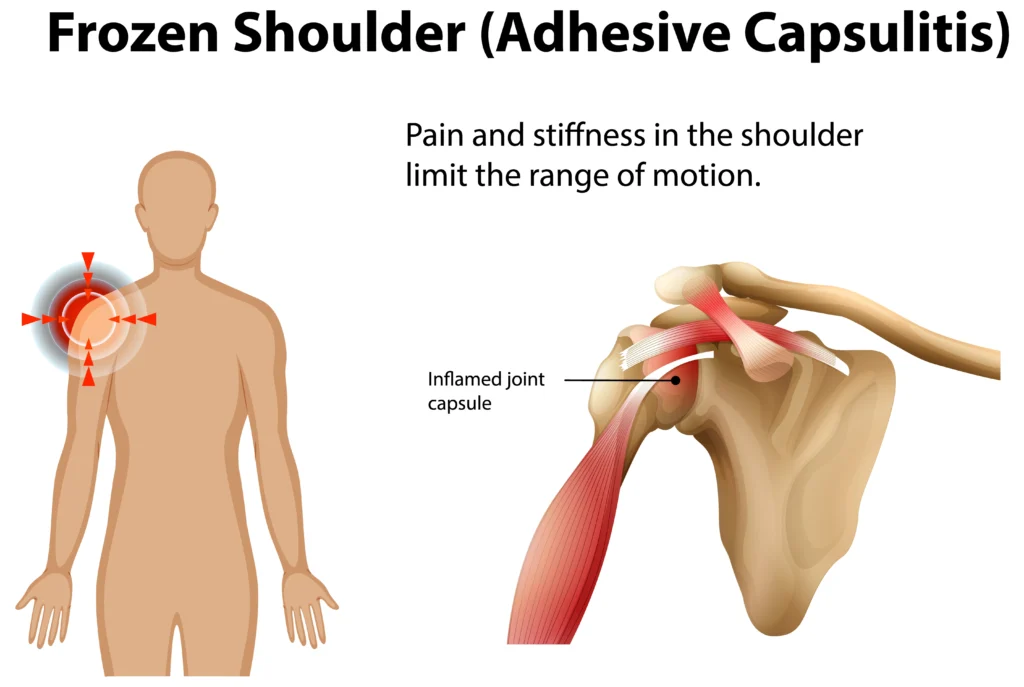
Frozen shoulder often begins subtly and is frequently misdiagnosed as simple muscle strain.
Key early signs include:
- Gradual onset of shoulder pain without injury
- Increasing difficulty reaching overhead
- Pain while sleeping on the affected side
- Stiffness during daily activities like dressing
- Reduced external rotation (early hallmark sign)
Early detection allows early intervention, which can significantly shorten recovery duration.
Research highlights that early mobilization reduces long-term stiffness progression. (NCBI)
Why Pendulum Swings Work for Frozen Shoulder
Pendulum swings are passive range of motion exercises.
This means the shoulder muscles remain relaxed while gravity gently mobilizes the joint.
They help by:
- Improving joint lubrication
- Promoting synovial fluid circulation
- Preventing capsular adhesions
- Reducing joint stiffness
- Improving blood flow
- Minimizing inflammation without strain
Unlike aggressive stretching, pendulum swings do not force the joint.
They use gravity and subtle body motion to create controlled, pain limited mobility.
Modern rehabilitation guidelines in 2026 continue to recommend early gentle motion instead of prolonged immobilization.
The Biomechanics Behind Pendulum Exercises
Understanding how pendulum swings work improves their effectiveness.
When you bend forward and allow the arm to hang:
- The shoulder muscles relax
- The humeral head gently oscillates in the glenoid cavity
- Inferior joint capsule experiences mild traction
- Synovial fluid distribution improves
Small controlled oscillations create micro traction inside the joint, supporting capsular elasticity and reducing stiffness.
Large aggressive swings are unnecessary and may irritate inflamed tissue.
How to Perform Pendulum Swings Correctly
Step 1: Starting Position
- Stand beside a table or chair.
- Place your unaffected arm on the surface for support.
- Bend forward at the hips.
- Allow the affected arm to hang completely relaxed.
- Keep knees slightly bent and spine neutral.
The key is complete relaxation of the painful shoulder.
Step 2: Forward and Backward Movement
- Gently rock your body forward and backward.
- Let the hanging arm move naturally.
- Do not actively lift the shoulder.
Perform for 30 to 60 seconds.
Step 3: Side to Side Movement
- Shift body weight left and right.
- Maintain smooth, controlled movement.
Perform for 30 to 60 seconds.
Step 4: Circular Motion
- Create small clockwise circles.
- Switch to counterclockwise after 30 seconds.
Total routine duration: 3 to 5 minutes.
Frequency: 2 to 3 times daily.
Stage Specific Pendulum Protocol
During Freezing Stage
- Keep circles small.
- Focus on pain reduction.
- Use warm compress before exercise.
During Frozen Stage
- Slightly increase range.
- Continue daily repetition.
- Add assisted stretches if tolerated.
During Thawing Stage
- Increase circle diameter gradually.
- Introduce strengthening exercises.
- Combine with resistance band training.
When To Add Weight
In later stages, therapists may recommend holding a light weight between 0.5 to 1 kilogram to increase traction.
Only add weight if:
- Pain has significantly reduced
- Approved by a professional
- Movements remain controlled
Never add weight during high pain phases.
Home Remedies That Support Pendulum Exercises
While exercises are essential, combining them with supportive strategies enhances outcomes.
Moist Heat Therapy
Applying heat before exercise improves tissue extensibility and reduces pain. (PubMed)
Cold Therapy
Ice after exercise helps control inflammation in painful phases.
Anti-Inflammatory Diet
- Omega-3 rich foods
- Turmeric (curcumin)
- Leafy greens
Diet plays a role in systemic inflammation control. (PMC)
Sleep Modifications
- Use a pillow under the arm
- Avoid sleeping on the painful side
Physiotherapy Exercises to Combine with Pendulum Swings
Pendulum swings are the starting point, but progression is essential.
1. Wall Climbing (Finger Walk)
Improves forward flexion gradually.
2. Towel Stretch
Enhances internal rotation mobility.
3. External Rotation with Stick
Targets capsular tightness.
4. Scapular Retraction
Improves shoulder mechanics.
5. Resistance Band Strengthening
Introduced in later stages for stability.
A progressive rehabilitation approach is recommended in clinical guidelines. (NCBI)
When Physiotherapy Is Not Enough
While most cases improve with conservative care, some patients may require advanced interventions.
Corticosteroid Injections
Effective for short-term pain relief and improved mobility. (PMC)
Hydrodilatation
Capsular stretching using fluid injection shows improved outcomes in selected cases.
Arthroscopic Capsular Release
Reserved for severe, resistant cases.
Early physiotherapy still remains the first-line approach before considering invasive options.
Myth vs Reality
Myth: Complete rest helps frozen shoulder heal faster
Reality: Prolonged immobilization worsens stiffness
Myth: Pain means damage
Reality: Controlled movement reduces pain over time
Myth: Surgery is always required
Reality: Most cases recover with physiotherapy
Common Mistakes to Avoid
- Actively lifting the arm
- Swinging too forcefully
- Holding your breath
- Performing inconsistently
- Stopping due to impatience
Consistency over weeks is more important than intensity.
Contraindications and Red Flags
Avoid pendulum swings if you have:
- Recent fracture
- Acute shoulder dislocation
- Severe rotator cuff tear
- Post surgical restrictions without clearance
- Infection
Seek medical evaluation if:
- Pain worsens significantly
- Swelling develops
- Numbness or tingling occurs
- Severe night pain persists
Who Is at Higher Risk for Frozen Shoulder
Frozen shoulder is more common in:
- Adults aged 40 to 60
- Individuals with diabetes
- Thyroid disorders
- Post shoulder injury patients
- Individuals with prolonged immobility
Proper medical management of underlying conditions improves outcomes.
Realistic Recovery Timeline
- Mild cases may improve within 6 to 9 months.
- Moderate cases may take 12 to 18 months.
- Severe cases can last up to 24 months.
Pendulum exercises do not instantly cure frozen shoulder but significantly reduce stiffness and shorten the painful phase.
Advanced Progressions
Once pain decreases:
- Larger pendulum circles
- Figure eight movements
- Light traction weight
- Wall walking exercises
- External rotation stretches
- Resistance band strengthening
Pendulum swings serve as the foundation before advancing to strengthening protocols.
Evidence Based Perspective 2026
Contemporary physiotherapy research continues to support early controlled motion for adhesive capsulitis.
Pendulum exercises remain first line conservative therapy because they are:
- Low risk
- Easy to perform at home
- Clinically validated
- Highly accessible
- Suitable for all stages with modifications
Even with advanced medical interventions available, basic gravity assisted mobilization remains foundational in recovery.
Final Expert Takeaway
Frozen shoulder requires patience and structured rehabilitation.
Pendulum swings are one of the safest, simplest, and most effective early exercises to reduce pain and maintain mobility.
Performed correctly and consistently, they:
- Prevent worsening stiffness
- Improve joint lubrication
- Support capsular flexibility
- Prepare the shoulder for progressive strengthening
Learning how to do pendulum swings for frozen shoulder the right way can speed up recovery.
But small mistakes can keep your shoulder stuck.
Small controlled movements performed daily create long term mobility gains.
Recovery may be gradual, but structured consistency produces measurable improvement.
Frequently Asked Questions
1. How often should I do pendulum exercises?
2–3 times daily for best results.
2. Can pendulum swings cure frozen shoulder?
They help reduce stiffness and improve mobility but must be combined with other exercises.
3. Should pendulum exercises be painful?
No. They should be gentle and pain-free.
4. When should I start pendulum exercises?
As early as possible unless contraindicated.
5. Can I add weight during pendulum swings?
Only in later stages and under guidance.
6. How long does frozen shoulder take to heal?
6 months to 2 years depending on severity.
7. Can frozen shoulder come back?
Yes, especially in high-risk individuals.
8. Is physiotherapy necessary?
Yes, it is the most effective non-surgical treatment.
9. What worsens frozen shoulder?
Immobility and aggressive stretching.
10. Is surgery always required?
No, most cases recover without surgery.
Stay tuned with us for more health related topics.
Follow us on LinkedIn and Instagram for more.
More Read


Medical Disclaimer!
This article has been reviewed and written under the guidance of our Head Physiotherapist, Dr. Kruti Raj (PT, MUHS,CPT,CMPT). The information shared is intended for educational purposes only and should not be considered a substitute for personalized medical advice, diagnosis, or treatment.
Please consult us or any other qualified healthcare professional before beginning any exercise program, especially if you are experiencing pain, recovering from injury, or managing a medical condition.


