


Lower back pain is often blamed on a “slipped disc,” poor posture, weak muscles, or sciatica.
But there is another potential pain generator that deserves far more attention: the facet joints.
Facet joint pain can produce stubborn lower back pain that becomes particularly noticeable when you stand, arch backward, twist, climb stairs, or remain in one position for too long.
It can also refer pain into the buttock or upper thigh, which sometimes makes people wonder whether they have sciatica.
Quick Answer
Yes, facet joints can cause lower back pain. They may produce local or referred pain, particularly around the lower back, buttock and upper thigh. However, an MRI showing facet arthritis does not automatically prove that the facet joint is responsible. A clinical assessment is needed to distinguish facet-mediated pain from disc, nerve, hip, sacroiliac and other causes of back pain.
As a physiotherapist, one of the most important things I want patients to understand is that back pain does not automatically mean disc damage.
Your lumbar spine contains several structures capable of producing pain, and the facet joints are among them.
Research suggests that lumbar facet joints may contribute to pain in a meaningful proportion of people with chronic low back pain, although identifying facet-mediated pain is not as straightforward as looking at an X-ray or MRI.
Controlled diagnostic studies have estimated lumbar facet pain prevalence in the range of approximately 16% to 41% in selected chronic low back pain populations. (PMC)
That distinction matters because the most effective treatment is not simply about “fixing the facet.”
It is about understanding why the joint is being irritated, restoring movement, improving load tolerance, and addressing the surrounding muscles and movement patterns.
Key Takeaways
- Facet joints can contribute to lower back and referred buttock or thigh pain.
- Facet degeneration on MRI does not automatically prove that the joint is painful.
- Facet pain can sometimes resemble sciatica but does not necessarily involve nerve-root compression.
- Progressive exercise and activity are important parts of rehabilitation.
- Hip strength, trunk endurance and movement capacity may influence recovery.
- Diagnostic blocks may be considered in selected chronic cases.
- Red-flag symptoms require prompt medical assessment.
What exactly are facet joints?
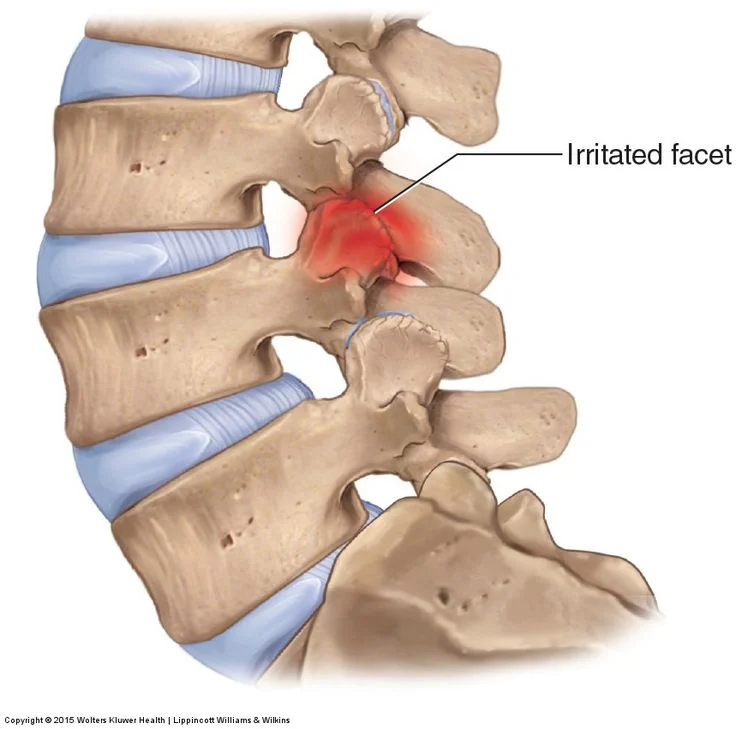
Facet joints, also called zygapophyseal joints, are small paired joints located at the back of your spine.
Each lumbar vertebra connects with the vertebra above and below it through these joints.
Think of them as small guiding joints that help control spinal movement while contributing to stability.
They are synovial joints, meaning they have a joint capsule, cartilage, synovial lining, and other structures found in many movable joints in the body.
Their orientation changes along the lumbar spine, allowing the lower back to perform movements such as flexion, extension and rotation while limiting excessive movement.
A comprehensive anatomical review describes the lumbar facet joints as complex structures with important biomechanical roles and extensive neural relationships. (Kapetanakis & Gkantsinikoudis, 2021)
One lesser-known fact is that the facet joint is not simply a passive hinge.
Its capsule and surrounding tissues contain sensory nerve endings capable of detecting mechanical and potentially painful stimuli.
The joints receive multisegmental innervation through branches of the posterior spinal nerves, which is one reason diagnosing the exact painful joint can be surprisingly complicated. (PubMed)
This is also why pain coming from a facet joint does not necessarily remain exactly over the joint itself.
Why facet joint pain can be mistaken for other back conditions
Here is where things get interesting.
Patients frequently assume that if pain is travelling into the buttock or thigh, a nerve must be involved.
That is not always true.
Facet-mediated pain can produce referred pain, meaning pain is felt away from the actual source.
In some people, this may extend into the buttock, hip region or upper thigh without representing classic nerve-root compression.
That is different from typical lumbar radiculopathy, where irritation or compression of a spinal nerve root may cause pain following a more recognizable nerve distribution,
often accompanied by neurological symptoms such as altered sensation, weakness or reflex changes.
Facet pain therefore sits in an uncomfortable diagnostic middle ground:
it can feel very real and sometimes quite severe, but the symptoms may not fit neatly into the “disc versus sciatica” categories.
A systematic review found that conventional history and physical examination findings alone are not sufficiently reliable to definitively identify facet joint pain. (Maas et al., European Journal of Pain)
That is an important clinical lesson: a good physiotherapy assessment should be a process of narrowing possibilities, not forcing every patient into one diagnosis.
What causes facet joint pain?
Facet joint pain can arise through several mechanisms rather than one single injury.
Age-related joint changes
Like other joints, facet joints can develop degenerative changes with age.
Cartilage may become thinner, joint surfaces can change, the capsule may become less flexible, and bony remodeling or osteoarthritis may develop.
But there is an important distinction here.
Degeneration does not automatically equal pain.
Imaging studies have repeatedly demonstrated that spinal degenerative findings can occur in people who have no symptoms.
A systematic review of asymptomatic individuals found that degenerative spinal findings become increasingly common with age,
meaning imaging must always be interpreted alongside symptoms and clinical findings. (Brinjikji et al., AJNR)
This is one reason I discourage patients from becoming frightened by phrases such as “facet arthropathy” on a scan.
The scan may be describing a structural change, not necessarily the source of your pain.
Repeated spinal extension
Facet joints can become more mechanically loaded during spinal extension.
This does not mean that extension is “bad” or dangerous.
Healthy spines are designed to extend.
The problem may arise when repeated or prolonged extension exceeds the person’s current tolerance.
Examples include:
- Repeatedly leaning backward at work
- Prolonged standing with an exaggerated lumbar arch
- Certain gym exercises performed with excessive lumbar extension
- Repetitive overhead activities
- Poorly controlled lifting
- Sports requiring frequent extension and rotation
A movement that is perfectly healthy for one person can be provocative for another.
Repetitive rotation
Rotation combined with extension can place substantial mechanical demand on posterior spinal structures.
This can matter in sports such as cricket, tennis, golf, gymnastics and certain throwing activities.
The answer is not to eliminate rotation permanently.
Instead, rehabilitation should gradually restore the person’s ability to rotate while improving trunk and hip control.
Altered spinal mechanics
Facet loading can change when the way you move changes.
For example, if the hips are stiff and the lumbar spine compensates with excessive movement, the lower back may repeatedly absorb loads that should be distributed across several joints.
Similarly, reduced trunk endurance can make it harder to maintain efficient movement during prolonged activities.
This is why simply treating the painful spot may not solve recurring facet-related pain.
Obesity and increased mechanical load
Body weight is not a moral issue, and I never recommend blaming patients for their back pain.
However, body composition can influence spinal loading and degenerative processes.
Interestingly, research from the Johnston County Osteoarthritis Project found obesity was a strong predictor of incident facet joint osteoarthritis, as well as several other lumbar degenerative changes and low back pain. (Wiley)
This does not mean losing weight will automatically cure facet joint pain.
It means that when appropriate, improving overall physical capacity and reducing excessive mechanical load may form part of a long-term strategy.
What does facet joint pain actually feel like?
There is no single “facet joint pain sensation.”
However, many patients describe:
- Aching pain on one or both sides of the lower back
- Local tenderness around the lower lumbar region
- Pain that increases with standing
- Discomfort during prolonged walking
- Pain with backward bending
- Pain during certain twisting movements
- Buttock pain
- Upper-thigh referred pain
- Stiffness after inactivity
- Difficulty changing positions
- Pain when getting up after sitting for a long period
Some people notice that flexing forward feels more comfortable, while others do not.
This variability is precisely why symptoms should not be used as a self-diagnosis.
A systematic review of clinical history and physical examination found substantial variability in the diagnostic accuracy of individual clinical findings for facet-mediated pain. (Maas et al., 2017)
Facet joint pain versus sciatica: what is the difference?
This is one of the most important distinctions.
Facet pain usually produces axial or referred pain. Sciatica involves nerve-root-related symptoms.
Classic sciatica may involve:
- Leg pain extending below the knee
- Tingling or pins and needles
- Numbness
- Burning or electric pain
- Muscle weakness
- Altered reflexes
- Symptoms following a nerve-root distribution
Facet pain more commonly remains in the lower back, buttock or proximal thigh, although referred pain patterns vary.
However, these are tendencies rather than absolute rules.
A patient can have more than one pain generator at the same time.
For example, someone could have degenerative facet changes, disc degeneration and nerve irritation simultaneously.
That is why an assessment should not simply ask, “Is this facet pain or sciatica?”
The better question is:
Which structures and factors appear to be contributing to this person’s symptoms, and what findings actually change management?
Why an MRI cannot automatically tell you that your facet joint is causing the pain
This is one of the biggest misconceptions I see.
You may have an MRI showing:
“Facet arthropathy.”
It is tempting to assume the diagnosis is solved.
But imaging cannot independently prove that a particular facet joint is the painful structure.
Degenerative findings are common even among people without back pain.
This principle applies broadly across spinal imaging. (Brinjikji et al.,)
Current NICE guidance also recommends against routinely imaging people with low back pain in non-specialist settings when imaging is unlikely to change management. (NICE guideline)
In physiotherapy practice, I therefore consider imaging one piece of the puzzle, not the entire puzzle.
How a physiotherapist assesses suspected facet joint pain
A good assessment goes beyond pressing around the spine.
I first look at your symptom behaviour
When does the pain appear?
What makes it better?
What makes it worse?
Does sitting aggravate it?
Does standing aggravate it?
What happens during walking?
Does bending backward reproduce your familiar pain?
What happens when you rotate?
These questions help establish a pattern.
I assess lumbar and hip movement
I may assess:
- Lumbar flexion
- Lumbar extension
- Rotation
- Side bending
- Hip mobility
- Thoracic mobility
- Pelvic movement
But I do not use one movement as a definitive diagnostic test.
That is important because research has found that clinical history and examination alone have limited reliability for definitively diagnosing facet-mediated pain.
I screen for nerve involvement
This includes assessing appropriate neurological signs such as:
- Strength
- Sensation
- Reflexes
- Neural mechanosensitivity
- Distribution of leg symptoms
This helps distinguish a primarily mechanical back problem from conditions involving nerve-root irritation.
I assess the hips and pelvis
The lumbar spine does not operate independently.
Hip mobility, hip strength, pelvic control and movement coordination can influence how forces are distributed during walking, squatting, lifting and sporting activity.
This is one of the lesser-known reasons why treating only the lumbar spine may produce temporary improvement rather than durable change.
Can facet joint pain be treated without surgery?
In many cases, yes.
The treatment depends on the individual’s presentation, duration of symptoms, functional limitations and underlying contributors.
Exercise is the foundation
For most people with persistent nonspecific or degenerative low back pain, exercise should be part of the rehabilitation strategy.
The WHO’s 2023 guideline recommends evidence-based non-surgical approaches for chronic primary low back pain, including education and physical interventions. (WHO guideline, 2023)
For a person with suspected facet-related pain, I may gradually introduce:
- Deep abdominal activation
- Trunk endurance training
- Hip strengthening
- Gluteal strengthening
- Functional squatting
- Hip-hinge training
- Controlled spinal movement
- Walking
- Aerobic conditioning
- Progressive resistance exercise
The exact exercise matters less than matching the exercise to the person’s current capacity and progressively increasing that capacity.
Don’t completely stop moving
One of the most damaging beliefs after a back-pain episode is:
“I need to protect my spine by avoiding movement.”
Usually, the goal is the opposite.
You need to restore confidence and capacity progressively.
NICE recommends encouraging people with low back pain to continue normal activities and considers exercise programmes as part of management.
A flare does not necessarily mean that you have damaged the joint again.
Sometimes it means your current workload temporarily exceeded your capacity.
What exercises can help facet joint pain?
There is no universal “facet joint exercise.”
That phrase is worth remembering.
Instead, exercises should be selected according to your movement pattern and functional limitations.
Glute bridges
Glute bridges can help develop hip extensor strength while teaching you to generate force through the hips rather than relying excessively on lumbar extension.
Keep the movement controlled rather than aggressively arching your back at the top.
Bird dog
Bird dog exercises can challenge trunk control while the hips and shoulders move.
The goal is not to hold your spine completely rigid forever.
The goal is to learn to control spinal movement while your limbs move.
Side plank variations
Side plank variations can develop lateral trunk endurance.
Start with an easier variation and progress gradually.
Hip-hinge training
This is one of my favourite functional strategies for patients who repeatedly irritate their lower back during bending and lifting.
Learning to distribute movement between the hips, knees and spine can make daily tasks more efficient.
Walking
Walking is often underrated.
It provides low-impact aerobic conditioning and gradually exposes the body to repeated loading.
If long walks provoke symptoms, start with shorter, tolerable bouts and build gradually.
A surprising mistake: stretching everything
Many people with back pain spend 20 minutes stretching but almost no time building strength.
Stretching can feel good, but feeling a temporary stretch does not necessarily mean the underlying problem has been addressed.
If your facet-related symptoms are aggravated by extension, repeatedly forcing your lower back into an extreme extension position because an online video recommended it may be counterproductive.
Likewise, aggressive twisting is not automatically therapeutic.
Your rehabilitation should be based on response, not internet popularity.
Should you use heat or ice?
Heat may temporarily reduce discomfort and muscle guarding for some people.
Ice can also provide short-term symptom relief during an acute flare for certain individuals.
Neither should be viewed as a treatment that “repairs” a facet joint.
Use whichever gives you a useful window to move and function more comfortably.
The long-term objective remains restoring movement, strength, confidence and load tolerance.
What about manual therapy?
Manual therapy can be useful for some patients, particularly when combined with an active rehabilitation programme.
It may temporarily improve pain or movement and can help a patient participate more comfortably in exercise.
But I would not recommend becoming dependent on repeated passive treatment.
NICE recommends manual therapy for low back pain only as part of a treatment package that includes exercise, with or without psychological approaches.
In other words, treatment should not stop at the treatment table.
What about facet joint injections?
Facet joint injections and medial branch blocks are medical procedures used in selected patients.
They are particularly relevant when clinicians need stronger evidence that a facet-mediated pain mechanism is present or when considering interventional treatment.
However, diagnostic blocks are not as simple as “inject it and see.”
Research has demonstrated false-positive responses with single diagnostic blocks, which is why diagnostic methodology remains an area of debate. (Falco et al.,)
A major multispecialty consensus guideline also highlights ongoing controversies surrounding lumbar facet interventions and provides recommendations for patient selection and procedures. (Cohen et al., 2020)
This is why I would never tell someone, “Your MRI shows facet arthritis, so you need an injection.”
The clinical picture comes first.
What about radiofrequency ablation?
Radiofrequency ablation, or radiofrequency neurotomy, is an interventional procedure designed to reduce pain transmission through targeted sensory nerve branches supplying painful facet joints.
It may help selected patients with chronic facet-mediated pain.
Clinical trials have demonstrated benefit in some carefully selected populations,
but the results should not be interpreted as meaning radiofrequency treatment is appropriate for everyone with facet degeneration. (Wolters Kluwer)
Consensus guidelines emphasize the importance of appropriate patient selection and diagnostic evaluation before intervention. (BMJ)
From a physiotherapy perspective, even when an intervention is appropriate, rehabilitation remains important for restoring physical capacity and function.
Lesser-known ways to reduce recurrent facet irritation
Stop chasing a “perfect posture”
There is no single posture that prevents all back pain.
Holding yourself rigidly upright all day can actually increase fatigue.
Instead, vary your positions.
Move frequently.
Change how you sit.
Stand periodically.
Walk between prolonged work periods.
Your spine is designed to move, not remain frozen in one “correct” position.
Improve hip capacity
A stronger, better-conditioned hip can make everyday tasks easier.
Exercises such as squats, step-ups, split squats and hip-hinge movements can gradually build this capacity.
Train endurance, not just strength
A person may be able to perform one heavy lift but struggle after 45 minutes of standing.
That is why endurance matters.
Your rehabilitation should reflect the activity that actually causes your symptoms.
Don’t fear every flare
A flare does not automatically mean structural damage.
Pain is influenced by tissue sensitivity, nervous-system processing, sleep, stress, physical workload and previous experiences.
This does not mean the pain is “all in your head.”
It means pain is biologically more complicated than a simple damage meter.
The WHO’s approach to chronic low back pain emphasizes person-centred, integrated care rather than treating the spine as an isolated mechanical structure.
Things to avoid if you have suspected facet joint pain
Avoid repeatedly provoking the exact movement that produces sharp or escalating symptoms.
Avoid:
- Aggressive spinal manipulation performed without assessment
- Repeated extreme lumbar extension
- High-volume twisting when symptoms are irritable
- Complete bed rest
- Wearing a back brace continuously without a clear clinical reason
- Chasing MRI findings rather than symptoms and function
- Increasing exercise volume too quickly
- Treating every flare as a new injury
- Depending exclusively on passive treatments
Most importantly, avoid the idea that you must permanently “protect” your spine.
The objective is to make your back more capable, not more fragile.
When should you see a doctor urgently?
Most lower back pain is not caused by a dangerous condition, but certain symptoms require prompt medical assessment.
Seek urgent professional evaluation if back pain is accompanied by:
- New loss of bladder or bowel control
- Numbness around the groin or saddle region
- Progressive significant leg weakness
- Severe neurological symptoms
- Major trauma
- Fever or systemic illness
- Unexplained significant weight loss
- A history of cancer with new concerning back pain
- Severe, unexplained or rapidly worsening symptoms
These symptoms are not typical features that should simply be attributed to facet joint pain.
Can facet joint pain be prevented?
You cannot completely prevent age-related spinal degeneration.
But you can improve your spine’s capacity to handle everyday demands.
My prevention strategy is simple:
Keep your body strong
Strengthen the hips, legs and trunk.
Keep moving
Regular walking and aerobic activity are valuable.
Build capacity gradually
Do not go from months of inactivity to intense workouts overnight.
Learn efficient lifting
Use a comfortable hip-and-knee strategy rather than trying to keep the spine unnaturally straight.
Break up prolonged sitting
A five-minute movement break can be more useful than searching for the perfect chair.
Maintain a healthy body composition when appropriate
This is not about aesthetics.
It is about reducing potentially excessive mechanical and metabolic load.
Research from the Johnston County cohort found obesity was strongly associated with incident lumbar facet osteoarthritis, although associations do not prove that weight alone causes pain. (Wiley)
The biggest myth about facet joint pain
The biggest myth is:
“If my MRI shows facet arthritis, that must be the reason my back hurts.”
Not necessarily.
The opposite myth is also problematic:
“Facet joints are tiny, so they cannot cause serious pain.”
They can.
The reality lies somewhere between these extremes.
Facet joints are anatomically capable of producing pain, but identifying them as the dominant pain generator requires clinical reasoning and, in selected circumstances, diagnostic procedures.
That is why a good assessment should combine symptoms, movement behaviour, neurological screening, functional examination and relevant medical investigations rather than relying on one MRI phrase.
Have a question about facet joint pain?
Facet joint pain can resemble other causes of lower back pain.
A proper assessment looks at your symptoms, movement, neurological signs, strength and functional limitations rather than relying on an MRI alone.
Important: Seek medical assessment promptly if back pain is accompanied by new bladder or bowel problems, saddle numbness, progressive weakness, major trauma, fever or other serious symptoms.
My physiotherapy approach to suspected facet joint pain
If you came to my clinic with suspected facet-mediated lower back pain, I would not begin by telling you to “strengthen your core.”
First, I would want to know what your back currently tolerates.
Then I would identify aggravating movements, assess hip and spinal mobility, screen neurological signs, examine strength and endurance, look at functional tasks and understand your goals.
Treatment would then progress according to your response.
Early treatment may focus on symptom modification and comfortable movement.
The next stage may involve trunk and hip strengthening.
Then I would gradually introduce more demanding functional movements.
Finally, I would make the programme specific to your lifestyle.
If you are a runner, your rehabilitation should eventually prepare you to run.
If you lift weights, we should eventually train lifting.
If your job requires eight hours of standing, your rehabilitation should build standing tolerance.
That is how physiotherapy becomes more than a collection of exercises.
It becomes load management and capacity building.
Have a question about facet joint pain?
Facet joint pain can resemble other causes of lower back pain. A proper assessment looks at your symptoms, movement, neurological signs, strength and functional limitations rather than relying on an MRI alone.
Important: Seek medical assessment promptly if back pain is accompanied by new bladder or bowel problems, saddle numbness, progressive weakness, major trauma, fever or other serious symptoms.
Final word
Facet joint pain is an important but frequently overlooked contributor to lower back pain.
It can mimic other conditions, refer pain into the buttock or thigh, and coexist with disc degeneration or other spinal changes.
At the same time, facet degeneration on an MRI does not automatically prove that the facet joint is causing your symptoms.
The most useful approach is therefore not to fear the diagnosis.
It is to understand it.
For most people, the long-term strategy should focus on maintaining activity, progressively improving strength and endurance, addressing hip and trunk function, managing aggravating loads and avoiding unnecessary fear of movement.
Current international guidance supports active, non-surgical approaches for chronic low back pain, while interventional procedures may have a role in carefully selected patients.
And remember one important principle I tell my patients:
Your MRI describes your spine. Your symptoms and examination tell us how your spine is behaving.
Those two pieces of information should be interpreted together.
Frequently Asked Questions
1. Can facet joints really cause lower back pain?
Yes. Lumbar facet joints can contribute to lower back pain and may also refer pain into the buttock, hip or upper thigh. However, identifying a painful facet joint is not always straightforward because similar symptoms can come from discs, muscles, nerves and other spinal structures.
2. What does facet joint pain feel like?
Facet joint pain is often described as an aching or localized pain in the lower back. It may become more noticeable with certain movements, prolonged standing, backward bending or rotation. Some people also experience referred pain into the buttock, hip or upper thigh.
3. Is facet joint pain the same as sciatica?
No. Facet joint pain can sometimes travel into the buttock or thigh, but sciatica is usually associated with irritation or compression of a spinal nerve root. Sciatica may cause symptoms such as pain extending down the leg, tingling, numbness or weakness. A clinical assessment is needed when symptoms overlap.
4. Can an MRI show if my facet joint is causing my back pain?
An MRI can show structural changes such as facet degeneration, but it cannot automatically prove that a particular facet joint is the source of your pain. Imaging findings need to be interpreted alongside your symptoms, physical examination and functional limitations.
5. What exercises are best for facet joint pain?
There is no single exercise that is best for everyone with facet joint pain. Depending on your symptoms and assessment, physiotherapy may include trunk endurance exercises, glute strengthening, hip strengthening, walking, hip-hinge training and progressive functional exercises.
6. Can physiotherapy help facet joint pain?
Physiotherapy can help many people with lower back pain by improving movement, strength, endurance and confidence with activity. Treatment may include exercise, education, activity modification and selected hands-on techniques. The programme should be individualized rather than based solely on an MRI diagnosis.
7. Should I avoid bending or twisting if I have facet joint pain?
Not necessarily. During an irritated phase, temporarily reducing movements that clearly aggravate your symptoms may be helpful. However, permanently avoiding normal spinal movement can reduce physical capacity and confidence. A physiotherapist can help you gradually restore bending, rotation and other movements according to your tolerance.
8. Do facet joint injections permanently fix the problem?
No. Facet joint injections or medial branch blocks may be considered in selected patients, particularly when facet-mediated pain is suspected after appropriate assessment. They should not be viewed as a permanent repair of spinal degeneration. Current guidelines emphasize careful patient selection and appropriate conservative management.
9. Can facet joint pain go away without surgery?
Many people with lower back pain can improve without surgery. Management may include staying active, progressive exercise, physiotherapy, education, sleep optimization and appropriate lifestyle changes. The right treatment depends on the underlying cause and individual symptoms.
10. When should I see a doctor for lower back pain?
Seek prompt medical assessment if back pain is accompanied by new bladder or bowel dysfunction, numbness around the saddle area, progressive significant weakness, major trauma, fever, unexplained weight loss or other concerning neurological or systemic symptoms. These signs should not simply be attributed to facet joint pain.
Stay tuned with us for more health related topics.
Follow us on LinkedIn and Instagram for more.
More Read


Medical Disclaimer!
This article has been reviewed and written under the guidance of our Head Physiotherapist, Dr. Kruti Raj (PT, MUHS,CPT,CMPT). The information shared is intended for educational purposes only and should not be considered a substitute for personalized medical advice, diagnosis, or treatment.
Please consult us or any other qualified healthcare professional before beginning any exercise program, especially if you are experiencing pain, recovering from injury, or managing a medical condition.
SEO meta description
Facet joint pain can cause stubborn lower back pain. Learn symptoms, causes, diagnosis, exercises, treatment and prevention from a physiotherapist.
10 high-value long-tail SEO keywords
These are designed around a mix of commercial intent, treatment intent and informational searches. Exact CPC and search volume fluctuate by country and keyword tool, so they should be validated in Google Keyword Planner/Ahrefs/Semrush before publishing.
- facet joint pain lower back symptoms
- facet joint pain treatment without surgery
- facet joint pain exercises for lower back
- how to relieve facet joint pain in lower back
- facet joint arthritis lower back treatment
- facet joint pain vs sciatica
- what does facet joint pain feel like
- lumbar facet joint pain treatment
- best exercises for facet joint pain
- how to diagnose facet joint pain in lower back
Higher-commercial-intent keyword variations
For monetization and future supporting articles, consider separate pages targeting:
- best treatment for facet joint pain
- facet joint pain physical therapy
- facet joint injection for lower back pain
- lumbar facet joint injection cost
- radiofrequency ablation for facet joint pain
- facet joint pain specialist
- facet arthritis treatment options
- chronic facet joint pain treatment
- facet joint pain MRI
- lumbar medial branch block
These should generally be handled carefully because procedure-related searches have higher medical intent and require particularly strong clinical sourcing.
10 click-worthy SEO meta title ideas
- Facet Joint Pain: The Overlooked Cause of Lower Back Pain
- Facet Joint Pain in Lower Back: Symptoms You Should Know
- Is Your Back Pain Coming From Your Facet Joints?
- Facet Joint Pain vs Sciatica: How Can You Tell?
- Facet Joint Pain: Causes, Symptoms & Treatment Explained
- Why Your Lower Back Hurts: Could Facet Joints Be the Cause?
- Facet Arthritis in the Lower Back: What Actually Helps?
- Facet Joint Pain Treatment: What a Physiotherapist Recommends
- Lower Back Pain That Won’t Go Away? Check Your Facet Joints
- Facet Joint Pain: 10 Things Your MRI May Not Tell You


