


Hip popping when lifting your leg can occur because of a tendon snapping over a bony structure, movement within the hip joint, or other underlying conditions.
Have you ever lifted your leg to climb stairs, get out of bed, or put on your shoes and felt a sudden pop in your hip?
Sometimes the sound is harmless.
Quick Answer: Why Does Your Hip Pop?
Your hip may pop when you lift your leg because a tendon moves across a nearby bony structure. This is often associated with snapping hip syndrome, involving the iliopsoas tendon at the front of the hip or the iliotibial band at the outer hip.
An occasional pop without pain is often harmless. However, persistent pain, deep catching, locking, or restricted movement should be assessed by a qualified healthcare professional. Physiotherapy may help when treatment is tailored to the underlying cause.
In other cases, it can be associated with an irritated tendon, restricted movement, or a problem inside the hip joint.
The location of the pop, the movement that triggers it, and whether you experience pain are important clues.
Understanding these differences can help you decide whether you need physiotherapy, activity modification, or further medical assessment.
Key Takeaways
- Hip popping is often caused by a tendon moving across a nearby bony structure.
- A pop at the front of the hip may involve the iliopsoas tendon, while an outer-hip snap may involve the iliotibial band or gluteus maximus.
- Painless snapping does not automatically mean that the hip is damaged.
- Deep groin pain, painful catching, locking, or reduced movement deserves clinical assessment.
- Physiotherapy may include activity modification, progressive strengthening, and movement retraining.
- Stretching is not always necessary. Exercises should match the cause of the symptoms.
- Seek urgent medical care for sudden severe hip pain, inability to bear weight, or a hot, swollen hip accompanied by fever.
What Happens When You Lift Your Leg?
The hip is a ball-and-socket joint supported by muscles, tendons, ligaments, and a ring of cartilage called the labrum.
When you lift your knee towards your chest, your hip flexor muscles contract and the surrounding tendons glide across nearby structures.
Occasionally, a tendon moves abruptly over a bony prominence, producing a noticeable snap.
This can happen during leg raises, walking, climbing stairs, or moving from sitting to standing.
The sound alone cannot reveal whether a problem exists.
Your symptoms and ability to move comfortably are more useful indicators.
4 Common Causes of Hip Popping
1. Internal Snapping Hip Syndrome
The iliopsoas is a major hip flexor muscle group that helps lift your thigh.
Its tendon passes close to the front of the hip joint and may snap over nearby structures during certain movements.
You may notice:
- A pop deep in the front of the hip or groin.
- Snapping when lifting or lowering your leg.
- Discomfort after repeated hip flexion, cycling, running, or dancing.
- A sensation of catching before the movement releases.
Internal snapping may be painless.
If the tendon or surrounding tissues become irritated, however, repeated movements may become uncomfortable.
2. External Snapping Hip Syndrome
The iliotibial band is a strong strip of connective tissue that runs along the outer thigh.
It can move across the greater trochanter, the bony prominence on the side of the hip, as the hip bends and straightens.
Typical features include:
- A pop or snap on the outer side of the hip.
- A sensation that can sometimes be seen or felt under the skin.
- Tenderness over the side of the hip.
- Discomfort during walking, stair climbing, or repeated bending.
The gluteus maximus muscle and its associated tissues may also contribute to external snapping.
The precise cause varies between individuals.
3. A Problem Inside the Hip Joint
Not every hip click comes from a tendon.
A labral injury, loose fragment within the joint, or another intra-articular condition may cause clicking, catching, or locking.
Possible warning features include:
- Deep groin pain.
- Pain during twisting, squatting, or bending the hip.
- A feeling that the joint catches or gets stuck.
- Persistent stiffness or difficulty moving the leg.
These symptoms do not automatically mean you have a labral tear.
A clinical examination is needed to distinguish joint-related symptoms from tendon snapping.
4. Tendon Irritation or Training Overload
A sudden increase in running, cycling, leg raises, dancing, or gym training can place additional demands on the hip flexors and surrounding tissues.
If the workload exceeds your current capacity, you may develop pain or sensitivity during movements that were previously comfortable.
The popping sensation may become more noticeable, although overuse is not the explanation for every case.
Importantly, a popping hip does not automatically mean your hip flexors are tight.
Repeated stretching without identifying the cause may not help and can aggravate some symptoms.
Where Do You Feel the Hip Pop?
The location of the popping sensation can help a physiotherapist identify which structures may be involved.
Although it cannot confirm a diagnosis, it provides useful clues during an assessment.
Popping at the Front of the Hip
A pop felt deep in the groin or front of the hip may be associated with the iliopsoas tendon moving across nearby structures.
You might notice it when lifting your knee, lowering your leg, or moving from sitting to standing.
Popping on the Outside of the Hip
A snap over the bony side of the hip may occur when the iliotibial band or gluteus maximus moves across the greater trochanter.
Some people can feel or see this movement beneath the skin.
Deep Clicking or Catching Inside the Hip
Clicking accompanied by deep groin pain, locking, or restricted movement may indicate a problem inside the joint, although these symptoms are not specific to one condition.
A clinical examination can help determine whether further investigation is needed.
Popping Without Pain
If the hip pops occasionally without pain, swelling, or movement restrictions, treatment may not be necessary.
Monitor for changes rather than repeatedly forcing the movement to reproduce the sound.
Physiotherapy tip: Tell your physiotherapist exactly where you feel the pop and which movement triggers it.
This information can help guide the examination and selection of appropriate exercises.
Why Does My Hip Pop During Specific Movements?
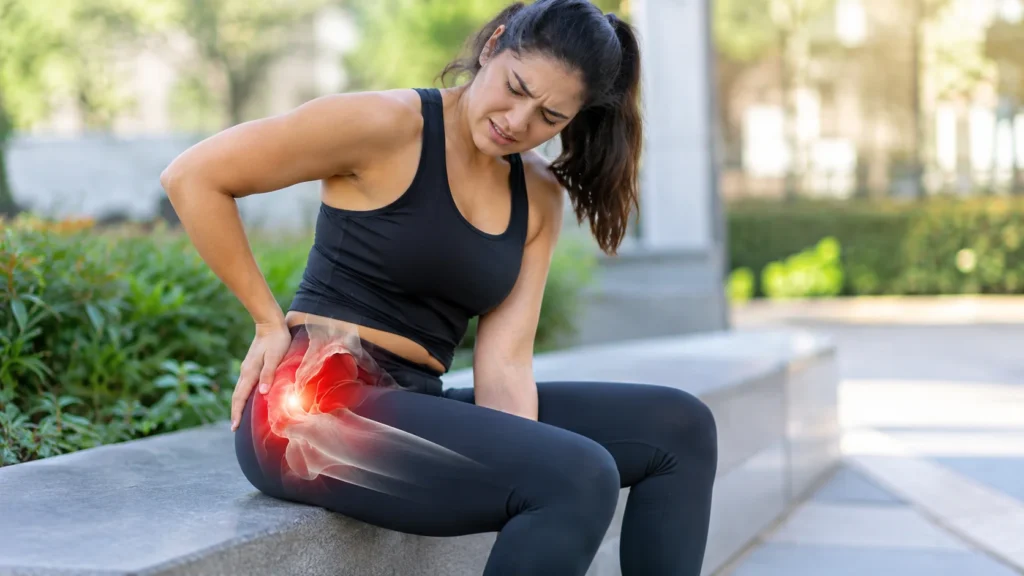
The movement that triggers the pop can provide useful clues, although it cannot confirm a diagnosis on its own.
- When lifting your knee: The iliopsoas tendon may be involved, particularly when the snap is felt at the front of the hip.
- When lowering your leg: A tendon may shift as the hip moves from a bent position towards extension.
- When doing straight-leg raises: Repeated hip flexor activity may reproduce snapping or discomfort.
- When climbing stairs: Repeated hip flexion and loading may make an existing tendon or joint problem more noticeable.
- When standing up from a chair: The transition between hip flexion and extension may trigger a snap.
- When rotating your hip: Clicking accompanied by deep pain or catching deserves assessment.
How Can You Tell Whether Hip Popping Is Concerning?
| Symptom | What it may indicate |
|---|---|
| Occasional pop without pain | Often harmless tendon movement |
| Snap at the front of the hip | Possible internal snapping |
| Snap over the outer hip | Possible external snapping |
| Deep groin pain with catching | Possible joint-related problem |
| Increasing pain or restricted movement | Needs clinical assessment |
| Sudden severe pain after an injury | Requires urgent medical evaluation |
These are general clues, not a diagnostic checklist. Several hip conditions can produce similar symptoms, and more than one problem can occur at the same time.
How Physiotherapy Can Help
Physiotherapy aims to identify what triggers the snapping, reduce unnecessary irritation, and improve strength and movement control.
Treatment should be based on the examination rather than the sound alone.
1. Movement and Strength Assessment
A physiotherapist may assess your hip movement, muscle strength, gait, pelvic control, and ability to perform activities such as squatting or climbing stairs.
They may also observe the movement that reproduces the snap, provided it is safe to do so.
This helps guide treatment and determine whether further medical investigation is appropriate.
2. Modify Aggravating Activities
Temporarily reduce movements that repeatedly produce painful snapping.
Depending on your symptoms, these may include deep squats, repeated high knee raises, straight-leg raises, or high-intensity cycling.
You do not necessarily need to stop all exercise.
Comfortable activities that do not worsen symptoms may be continued, with gradual changes based on your response.
3. Begin Suitable Strengthening Exercises
The following exercises may be useful for some people when performed comfortably.
They are examples, not a universal program for every cause of hip popping.
Glute bridges
Lie on your back with your knees bent and feet flat.
Gently tighten your buttock muscles and raise your hips without arching your lower back. Lower slowly.
Side-lying hip abduction
Lie on your side and slowly lift the upper leg while keeping your pelvis steady.
Avoid rolling your body backwards.
Gentle abdominal bracing
Lie on your back with your knees bent.
Gently tighten your abdominal muscles while breathing normally and keeping your pelvis comfortable.
Start with a small number of controlled repetitions if the movements are comfortable.
Stop if an exercise causes sharp pain, painful catching, or worsening symptoms.
If ordinary movements are painful, seek individual guidance before starting a program.
Clinical practice guidance for non-arthritic hip pain supports an individualized approach that may combine activity modification, hip and trunk strengthening, movement retraining, and other interventions selected according to the person’s assessment (American Academy of Sports Physical Therapy, 2023)
4. Improve Flexibility When Appropriate
Stretching may be useful when an assessment identifies a relevant mobility restriction. However, stretching should not be prescribed simply because a hip pops.
For some people, repeatedly forcing the hip into deep flexion or extension may aggravate symptoms.
A physiotherapist can help determine whether flexibility work, progressive strengthening, movement retraining, or another approach is most appropriate.
What Should You Avoid If Your Hip Pops?
Until you understand the cause, consider avoiding:
- Repeatedly forcing the movement to make the hip pop.
- Stretching aggressively through pain.
- Increasing exercise intensity when symptoms are worsening.
- Continuing movements that cause painful catching or locking.
- Assuming that every pop needs to be corrected with strengthening or stretching.
The aim is not necessarily to eliminate every sound.
It is to maintain comfortable movement and address any underlying symptoms or functional limitations.
Hip Popping: Myth vs Fact
MYTH: Every hip pop means joint damage.
FACT: Painless snapping can occur when a tendon moves over a bony structure. The sound alone cannot establish whether damage is present.
MYTH: Tight hip flexors are always the cause.
FACT: Hip popping has several possible causes, including tendon movement and joint-related problems. Stretching is not a universal solution.
MYTH: Everyone with a snapping hip needs treatment.
FACT: Painless snapping without functional limitations may not require treatment. Painful or persistent symptoms deserve assessment.
MYTH: More stretching will always make the hip better.
FACT: Rehabilitation should address the actual cause. Aggressive stretching can aggravate some irritated tissues.
How Is Hip Popping Diagnosed?
Diagnosis usually begins with your medical history and a physical examination.
A clinician may ask where you feel the pop, when it started, whether it hurts, and whether it followed an injury or a change in activity.
Imaging is not always required for painless snapping.
When the cause remains unclear or symptoms suggest a joint problem, a clinician may consider X-rays, MRI, or dynamic ultrasound.
Dynamic ultrasound can help show a tendon moving during the activity that reproduces the snapping.
The choice of investigation depends on your symptoms and examination findings.
A scan should be interpreted alongside your clinical presentation rather than treated as a diagnosis on its own (Sugrañes et al., 2023)
How Long Does It Take for Hip Popping to Improve?
There is no single recovery timeline.
Painless snapping may need no treatment, while painful snapping can take longer to settle depending on the underlying cause, activity demands, and response to rehabilitation.
Some people improve after modifying aggravating activities and following a tailored physiotherapy program.
If symptoms persist, worsen, or repeatedly return, reassessment is important.
Surgery is considered only in selected cases when symptoms remain troublesome despite appropriate non-surgical management.
When Should You See a Physiotherapist or Doctor?
Arrange an assessment if your hip popping:
- Becomes painful or increasingly frequent.
- Causes persistent groin or outer-hip discomfort.
- Is accompanied by catching, locking, weakness, or reduced movement.
- Interferes with walking, sleep, exercise, or daily activities.
- Does not improve after modifying aggravating activities.
Seek urgent medical care if you develop sudden severe hip pain, particularly after an injury, cannot bear weight, or have a hot or swollen hip with fever or feeling unwell.
Final Thoughts: Listen to Your Hip
A hip that pops when you lift your leg is not necessarily damaged. Tendon movement is a common explanation, particularly when the sound occurs without pain or difficulty moving.
If the popping is painful, persistent, or accompanied by catching or restricted movement, a physiotherapist or doctor can help identify the likely cause and guide the next steps.
The goal is comfortable movement, not simply eliminating every sound. Choose exercises carefully, avoid repeatedly forcing a painful pop, and seek professional advice when symptoms affect your daily life.
Conclusion
A hip that pops when you lift your leg may be caused by a tendon moving across a nearby bony structure.
In many cases, painless snapping is harmless.
However, pain, deep catching, locking, or restricted movement can signal a problem that needs assessment.
Physiotherapy can help by identifying aggravating movements, modifying activity, and improving strength and movement control where appropriate.
Rather than trying to silence every pop, focus on comfortable movement, safe exercise progression, and getting the right assessment when symptoms persist.
Frequently Asked Questions About Hip Popping
1. Why does my hip pop when I lift my leg straight up?
A tendon, often the iliopsoas at the front of the hip, may move across a nearby structure. Pain, catching, or restricted movement should be assessed.
2. Is it normal for my hip to pop without pain?
Painless popping is often harmless and may not need treatment. Seek advice if it becomes painful, limits movement, or follows an injury.
3. Can weak glutes cause hip popping?
Reduced hip strength or movement control may contribute to symptoms in some people, but weak glutes are not the cause of every hip pop.
4. Should I stretch when my hip pops?
Not automatically. Stretching may help selected mobility problems, but forcing a stretch can aggravate some irritated tissues. The appropriate approach depends on the cause.
5. Can physiotherapy stop my hip from popping?
Physiotherapy may reduce painful snapping and improve movement when treatment addresses the underlying problem. Some painless snapping may remain even when function is normal.
Stay tuned with us for more health related topics.
Follow us on LinkedIn and Instagram for more.
More Read


Medical Disclaimer
This article is intended for general educational purposes only and does not replace individual medical advice, diagnosis, or physiotherapy assessment. Hip popping can have different causes, and exercises that suit one person may not be appropriate for another. Stop any activity that causes significant pain or worsening symptoms and consult a qualified healthcare professional. Seek urgent medical care for sudden severe hip pain, inability to bear weight, or a hot, swollen hip accompanied by fever.


