


Hip labral tear vs hip impingement: although these conditions can cause similar hip or groin pain, they involve different structures of the hip joint and may require different treatment approaches.
Hip pain during squatting, walking, running, or prolonged sitting can have several causes.
Two conditions that may produce similar symptoms are a hip labral tear and femoroacetabular impingement (FAI).
Quick Answer: Hip Labral Tear vs Hip Impingement
A hip labral tear involves damage to the cartilage ring surrounding the hip socket. Femoroacetabular impingement (FAI) involves hip bone morphology that can contribute to abnormal contact during movement.
- Labral tear: May cause groin pain, clicking, catching, or discomfort during movement.
- Hip impingement: May cause pain or pinching during deep hip flexion and certain rotational movements.
- Overlap: Both conditions can occur together.
- Physiotherapy: May improve strength, movement control, and function, depending on the diagnosis.
Important: Symptoms alone cannot reliably distinguish these conditions. Clinical assessment and, when appropriate, imaging help guide diagnosis and treatment.
Both can cause groin pain, stiffness, clicking, or discomfort during movement, so distinguishing between them is not always straightforward.
The main difference is that a hip labral tear involves damage to the cartilage ring around the hip socket, while symptomatic hip impingement involves hip bone morphology contributing to abnormal contact during movement.
The conditions can also occur together.
Understanding the difference matters because treatment should address the source of symptoms, not just an abnormality seen on a scan.
Physiotherapy may help improve strength, movement control, and daily function, depending on the diagnosis and the person’s needs.
Key Takeaways for Hip Pain
A labral tear affects the cartilage ring around the socket, while impingement involves bone morphology contributing to abnormal contact.
Symptomatic hip impingement may contribute to labral damage, but not every labral tear is caused by impingement.
A labral abnormality or bone-shape variation on a scan does not automatically explain someone’s pain.
Individualized strengthening, movement retraining, and activity modification may improve symptoms and everyday function.
What Is a Hip Labral Tear?
The hip labrum is a ring of tough fibrocartilage around the rim of the acetabulum, the socket of the hip joint.
It helps deepen the socket, contributes to joint stability, and supports the seal that helps retain fluid within the joint.
A labral tear occurs when this tissue becomes damaged.
Possible contributing factors include a sudden injury, repetitive loading, associated hip impingement, or age-related changes.
Common symptoms include:
- Deep pain in the groin or front of the hip.
- Clicking, catching, or a sensation of locking.
- Discomfort during twisting, squatting, or prolonged sitting.
- Stiffness or reduced tolerance for hip movement.
- Pain that interferes with sports or everyday activities.
Not every labral tear causes symptoms.
Research has found that labral abnormalities can also appear on MRI scans of people without hip pain.
Therefore, an imaging finding should be interpreted alongside the person’s symptoms and clinical assessment. (Heerey et al., 2018)
What Is Femoroacetabular Impingement?
Femoroacetabular impingement syndrome (FAIS) occurs when the shape of the hip joint contributes to abnormal contact during movement and is associated with symptoms and clinical findings.
There are two main types of bone morphology associated with impingement:
- Cam morphology: An extra prominence or reduced roundness where the femoral head meets the femoral neck.
- Pincer morphology: Increased coverage of the femoral head by the hip socket.
- Combined morphology: Features of both cam and pincer types.
These structural variations do not automatically mean that a person has a painful condition.
A diagnosis of FAIS requires appropriate symptoms, clinical examination findings, and relevant imaging.
Symptoms commonly include groin pain during deep squats, pivoting, running, or prolonged sitting.
Bending the hip deeply while turning it inward may reproduce discomfort in some people. (Griffin et al., 2016)
Hip Labral Tear vs Hip Impingement: Key Differences
| Feature | Hip labral tear | Hip impingement |
|---|---|---|
| Main problem | Damage to the cartilage ring around the socket | Hip bone morphology contributing to abnormal contact |
| Common pain location | Often deep in the groin or front of the hip | Often in the groin or front of the hip |
| Clicking or catching | May occur | May occur, especially when associated with labral or cartilage problems |
| Possible contributing factors | Injury, repetitive loading, impingement, or age-related changes | Cam or pincer morphology combined with symptoms and clinical findings |
| Diagnosis | Clinical assessment and appropriate imaging | Clinical assessment and imaging of relevant bone morphology |
| Physiotherapy | May improve strength, function, and symptom management | May improve strength, movement control, and activity tolerance |
| Surgery | May be considered for selected persistent, symptomatic tears | May address relevant bone morphology and associated tissue damage in selected cases |
The key point: These are different conditions, but they are not mutually exclusive.
A person can have both a labral tear and symptomatic hip impingement.
Can Hip Impingement Cause a Labral Tear?
Yes, symptomatic hip impingement can contribute to labral damage in some people.
Repeated contact between the femoral head-neck junction and the hip socket may place stress on the labrum and nearby cartilage.
However, not every labral tear is caused by impingement.
Labral damage may also occur after injury or alongside other hip conditions.
Likewise, many people with cam or pincer morphology never develop symptoms.
This is why clinicians consider the full presentation rather than assuming that one imaging finding explains every symptom.
How Do Symptoms Differ?
Symptoms overlap considerably, so the following patterns can provide clues but cannot confirm a diagnosis.
Symptoms That May Occur With a Labral Tear
Some people report clicking, catching, or a sensation that the hip briefly gets stuck.
Pain may occur during twisting, pivoting, or movements that load the joint. However, these symptoms can also occur with other hip problems.
Symptoms That May Occur With Hip Impingement
Pain or pinching during deep hip flexion is common in symptomatic FAIS.
Activities such as deep squats, low seating, or certain sporting movements may aggravate discomfort.
Why Symptoms Alone Are Not Enough
Groin pain can also arise from the hip flexor muscles, adductor muscles, lower back, or other hip conditions.
Clicking does not automatically mean that the labrum is torn, and pain during a deep squat does not establish impingement.
A proper assessment is needed to identify the most likely cause and guide treatment.
How Are These Conditions Diagnosed?
Diagnosis usually combines the person’s history, a physical examination, and imaging when indicated.
Physiotherapy Assessment
A physiotherapist may ask when symptoms began, whether there was an injury, which movements aggravate pain, and how symptoms affect work, walking, exercise, or sport.
The examination may include:
- Hip range of motion and muscle strength.
- Walking pattern and single-leg control.
- Functional tasks such as squatting or stepping.
- Specific hip tests that may reproduce familiar symptoms.
- Assessment of the lower back and other potential sources of referred pain.
No single physical test can reliably confirm or exclude every labral tear or case of FAIS.
Results need to be interpreted alongside the history and other clinical findings.
Imaging Tests
A clinician may recommend one or more imaging investigations according to the suspected condition.
- X-rays: Help assess bone morphology, joint space, and other bony changes.
- MRI: Can show the labrum and other soft tissues, although abnormalities may also occur in people without symptoms.
- Magnetic resonance arthrography: May be considered in selected cases when detailed assessment of the labrum is needed.
Imaging should help answer a clinical question.
A scan result alone cannot establish which structure is responsible for pain.
How Physiotherapy Helps
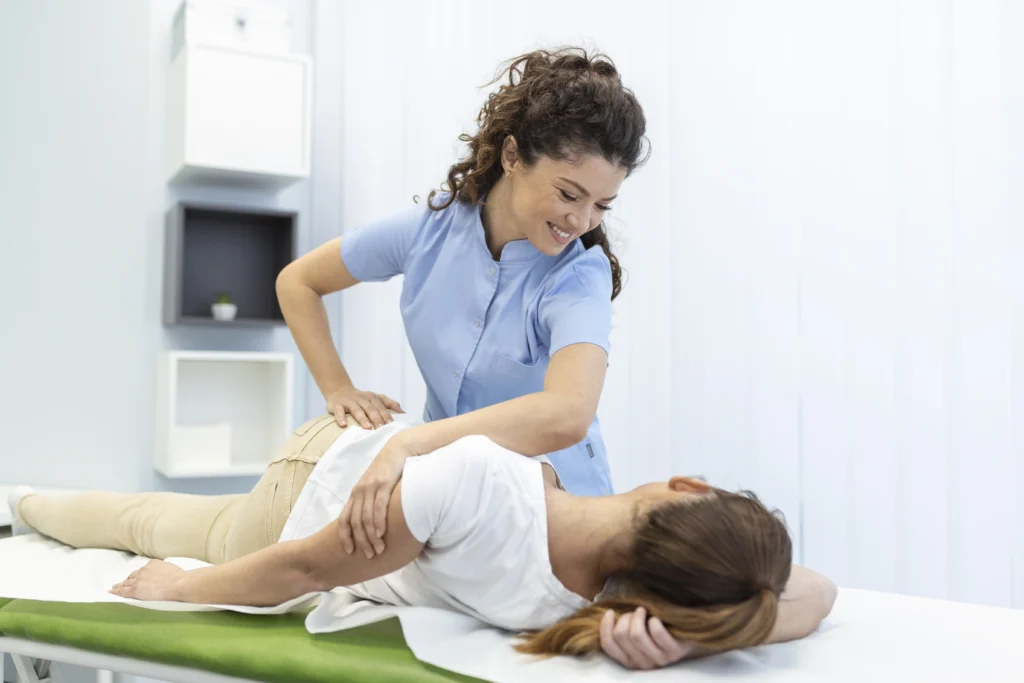
Physiotherapy may help people with either condition manage symptoms, improve strength, and return to everyday activities.
Treatment should be individualized according to the clinical assessment, symptom irritability, physical capacity, and personal goals.
1. Activity Modification
Temporarily modify movements that repeatedly provoke groin pain, pinching, or catching.
These might include deep squats, aggressive hip flexion stretches, or repetitive twisting.
The goal is to adjust the activity rather than automatically stop all exercise.
2. Progressive Hip Strengthening
Depending on the assessment, exercises may include gluteal bridges, side-lying hip abduction, controlled sit-to-stand movements, and other hip-strengthening exercises.
These movements can help develop hip and pelvic control.
They do not repair a torn labrum or reshape the hip bones, but improved strength and movement capacity may support function.
3. Trunk and Pelvic Control
The trunk and pelvis work with the hip during walking, stair climbing, squatting, and sport.
Appropriate exercises may help improve coordination and control during these tasks.
The exercise program should be adjusted if certain positions cause sharp pain or repeated catching.
4. Gradual Return to Activity
As symptoms and strength improve, activity can be progressed gradually.
A runner may need a staged return to running, while someone whose pain affects everyday walking may initially focus on comfortable walking and basic strength.
Exercise should not be forced through sharp or worsening pain.
A physiotherapist can help adjust the program when symptoms flare.
Evidence reviews support non-surgical rehabilitation for selected people with labral-related hip pain, although the quality of the evidence varies and outcomes are not guaranteed. (Theige & David, 2018)
Does a Hip Labral Tear Always Need Surgery?
No.
Some people with a labral tear can manage their symptoms without surgery, particularly when their pain and daily function improve with conservative treatment.
Physiotherapy may help improve strength, movement control, and tolerance for activity.
It does not physically reattach or repair a torn labrum.
Surgery may be considered when symptoms remain substantially limiting despite appropriate non-surgical care and clinical assessment supports an operation.
Decisions depend on the tear, associated bone or cartilage changes, overall joint health, and the person’s goals.
An MRI finding alone is not enough to determine whether surgery is necessary.
Does Hip Impingement Always Require Surgery?
No.
Some people with symptomatic FAIS improve with activity modification and structured rehabilitation.
Others may need an orthopedic consultation when pain continues to interfere with daily activities or sport.
A randomized trial comparing hip arthroscopy with physiotherapy and activity modification found improvement in both groups, although the surgery group had better average hip-related quality-of-life outcomes at eight months.
This does not mean that every person with FAIS needs surgery; the decision depends on the individual’s symptoms, joint health, goals, and response to treatment. (Palmer et al., 2019)
Hip Labral Tear vs Impingement: Myth vs Fact
MYTH: Hip clicking always means a labral tear.
FACT: Clicking can have several causes. The sound alone cannot confirm a tear or establish the source of pain.
MYTH: Hip impingement and a labral tear are the same condition.
FACT: Impingement relates to hip bone morphology and associated symptoms, while a labral tear involves damage to the cartilage ring around the socket.
MYTH: Every labral tear on MRI needs surgery.
FACT: Imaging findings must be interpreted alongside symptoms and clinical assessment. Some people improve with non-surgical treatment.
MYTH: Physiotherapy is useful only for hip impingement.
FACT: Individualized physiotherapy may also help people with labral-related hip symptoms improve strength, movement control, and function.
When Should You Seek Medical Advice?
Arrange an assessment if hip or groin pain persists, limits walking or exercise, causes repeated catching, or fails to improve with appropriate activity modification.
Seek urgent medical attention if you experience sudden severe hip pain, cannot bear weight after an injury, or develop a hot, swollen hip with fever.
These symptoms may indicate a condition requiring prompt investigation.
Final Thoughts: Understanding Your Hip Pain
A hip labral tear and femoroacetabular impingement are different conditions, although they can occur together and cause similar symptoms. Clicking, groin pain, or stiffness alone cannot reliably identify which problem is responsible.
A suitable assessment can help clarify the likely source of symptoms and guide decisions about physiotherapy, activity modification, imaging, or specialist treatment.
Remember: The goal is to improve your hip function and choose treatment based on your symptoms, joint health, and personal goals, rather than relying on a scan finding alone.
Conclusion
A hip labral tear and femoroacetabular impingement are different conditions, but they can occur together.
A labral tear affects the cartilage ring around the hip socket, while symptomatic impingement involves hip bone morphology contributing to abnormal contact during movement.
Both can cause groin pain, stiffness, or clicking, so symptoms alone cannot reliably distinguish them.
A clinical assessment helps determine whether imaging is needed and which treatment is most appropriate.
Physiotherapy may improve strength, movement control, and function, while surgery may be appropriate for selected people whose symptoms remain limiting.
The best approach depends on the actual source of symptoms, joint health, and individual goals.
Frequently Asked Questions
1. Can a hip labral tear heal without surgery?
Some people improve without surgery in terms of pain and function. However, symptom improvement does not necessarily mean the torn tissue has structurally healed.
2. Can hip impingement and a labral tear occur together?
Yes. Symptomatic impingement may contribute to labral damage, but not every labral tear is caused by impingement.
3. Does clicking mean I have a labral tear?
No. Clicking can occur for several reasons, including tendon movement and other hip-joint conditions. Clicking alone cannot confirm a labral tear.
4. Can physiotherapy help both conditions?
Physiotherapy may improve strength, movement control, and daily function in suitable cases. The program should be tailored to the diagnosis and symptom response.
5. Which condition is more serious?
Neither diagnosis is automatically more serious. Its significance depends on symptoms, joint health, associated injuries, and the impact on daily life.
Stay tuned with us for more health related topics.
Follow us on LinkedIn and Instagram for more.
More Read


Medical Disclaimer
This article is intended for general educational and informational purposes only. It does not replace individual medical advice, diagnosis, or treatment from a qualified healthcare professional.
Hip labral tears and femoroacetabular impingement can cause overlapping symptoms, and other conditions may also contribute to hip pain. Consult a qualified physiotherapist or doctor for an appropriate assessment and personalized treatment plan.
Seek urgent medical attention for sudden severe hip pain, inability to bear weight after an injury, or a hot, swollen hip accompanied by fever.


