


If you sit in a physiotherapy clinic long enough, you will start noticing a pattern.
Many people walk in complaining of neck pain, but when you ask a few more questions, they say something interesting.
The pain is not just in the neck. It travels.
Sometimes into the shoulder. Sometimes down the arm. Occasionally right into the fingers.
This pattern is what we refer to as cervicobrachial syndrome.
It is not a single diagnosis. It is more of a clinical presentation where structures in the cervical spine irritate or compress nerve roots, leading to symptoms along the arm.
In real life, it rarely appears suddenly. It builds slowly. A little stiffness at first.
Then discomfort while working. Eventually, pain that refuses to go away.
Read about our Complete Neck Pain Guide : Causes, Symptoms, Exercises and Treatment
Quick Answer
Cervicobrachial syndrome is a condition where neck problems cause pain, tingling, or weakness that travels into the arm due to nerve irritation. It is commonly linked to poor posture, muscle imbalance, or cervical spine issues. Physiotherapy, posture correction, and nerve mobilization are key to recovery.
Read about: Early Signs of Cervical Spine Damage You Should Never Ignore
Key Takeaways
- Neck pain with arm symptoms often indicates nerve involvement
- Poor posture is a major contributing factor
- Neural mobilization improves pain and function
- Strengthening is essential for long term recovery
- Daily habits influence recovery more than exercises alone
- Some cases involve multiple nerve compression sites
Read about : 15 Common Causes of Neck Pain You Should Know
What Causes Cervicobrachial Syndrome
Most people expect a single cause. In reality, it is usually a combination.
From a physiotherapy point of view, the most common contributors include:
- Prolonged forward head posture
- Weak deep neck flexor muscles
- Tight upper trapezius and levator scapulae
- Cervical disc changes
- Repetitive arm use
- Poor workstation setup
One thing I often tell patients is this. The neck rarely suffers alone. The shoulder blade plays a big role.
If the scapula is not stable, the neck compensates. Over time, this creates strain that eventually affects the nerves.
Read in detail about: How to Fix Upper Crossed Syndrome Naturally
The Anatomy Behind the Symptoms
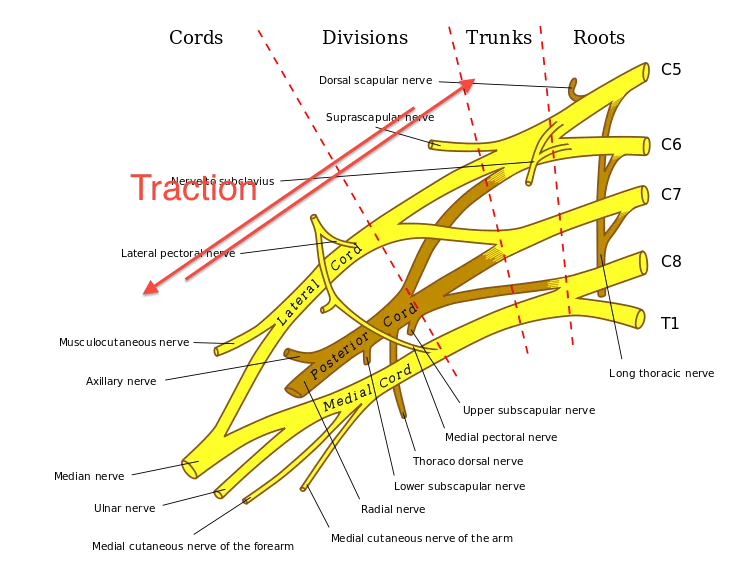
The cervical spine has seven vertebrae. Between them are discs and nerve roots that travel into the arm.
When these nerves get irritated, symptoms appear along their path.
For example:
- C5 involvement often affects the shoulder
- C6 can cause symptoms in the thumb
- C7 may affect the middle finger
- C8 often reaches the little finger
This is why patients sometimes say their fingers feel strange even though the problem is in the neck.
Read in detail about: Cervical Radiculopathy: Why Neck Nerve Pain Travels to the Arm
Symptoms Patients Commonly Describe
Not everyone explains it the same way.
Some say it is sharp pain. Others describe a dull ache. A few struggle to explain it and just say something feels off.
Common patterns include:
- Neck pain radiating into the arm
- Tingling or pins and needles
- Burning sensation
- Weak grip strength
- Reduced neck movement
One subtle symptom that often gets ignored is clumsiness in the hand. Patients may drop objects more often without realizing why.
Read: Lhermitte’s sign- An Electic Shock Sensation Down The Neck
How to Differentiate Cervicobrachial Syndrome from Similar Conditions
In clinic, one of the biggest challenges is not treating the condition, but identifying it correctly.
Many conditions feel very similar to cervicobrachial syndrome, and this is where confusion starts.
Patients often come in thinking it is just “neck pain”, but sometimes it is something else entirely.
Here is a simple way to understand the difference:
Cervicobrachial syndrome
- Pain starts in the neck and travels down the arm
- Symptoms change with neck movement
- Tingling follows a pattern into specific fingers
Shoulder problems (like rotator cuff issues)
- Pain stays more around the shoulder
- Arm movement hurts more than neck movement
- No clear tingling into fingers
Carpal tunnel syndrome
- Tingling mainly in thumb, index, and middle finger
- Worse at night
- Neck movement does not change symptoms much
- Heaviness in the arm
- Symptoms increase with overhead activity
- Often associated with poor posture
Read: The Complete Guide to Thoracic Outlet Syndrome And Its Treatment
A small clinical tip
If moving your neck changes your arm symptoms, the neck is usually involved.
If it does not, you may need to look elsewhere.
What Makes It Worse in Daily Life
This is where most problems actually come from.
Symptoms usually increase with habits rather than injuries.
- Looking down at the phone for long periods
- Laptop work without support
- Long driving hours
- Carrying weight on one side
- Sleeping with very high pillows
Some patients notice relief when they lift their arm and place it over their head. Clinically, this can indicate nerve root involvement.
Read About: How to Choose the Right and Best Pillow for Neck Pain
How Physiotherapists Actually Diagnose It
Diagnosis is not just about MRI reports.
In fact, many people with strong symptoms show minimal changes on scans.
A physiotherapist relies on:
- Posture assessment
- Movement testing
- Neurological examination
- Special tests like Spurling’s test and ULTT
Clinical reasoning plays a big role here.
Read: What Is Spurling’s Test And How To Perform
Why Some Patients Do Not Improve Easily
This is something patients rarely expect.
They follow exercises. They take treatment. Still, recovery feels slow.
Recent research has shown that recovery is not only physical. The nervous system also plays a role.
Pain can become more sensitive over time. Stress, fear of movement, and constant guarding can keep symptoms active even after tissue healing.
Physiotherapy has been shown to improve not only physical symptoms but also psychological factors like fear and anxiety. (Zhang et al., 2025)
This explains why some patients feel better one day and worse the next without a clear reason.
Read about: What Is Military Neck Or Cervical Kyphosis And How To Treat It
The Double Crush Phenomenon
This is one of the most overlooked aspects.
Sometimes the nerve is not irritated at just one place.
It can be compressed at the neck and somewhere else, like the wrist or elbow.
This is known as the double crush phenomenon.
For example, a patient may have cervical nerve irritation along with carpal tunnel syndrome.
In such cases, treating only the neck does not fully resolve symptoms.
Recent diagnostic reviews highlight how overlapping nerve issues can complicate diagnosis and delay recovery.(Kumar et al., 2025)
Read: Branchial Cleft Cyst: A Complete Guide To Neck Lump
Physiotherapy Treatment That Actually Works
Treatment is not just about pain relief. It is about restoring normal movement and reducing nerve irritation.
Read more: Is Cervical Traction For Neck Pain Really Effective
Early Phase
Focus is on calming the symptoms:
- Gentle traction
- Soft tissue release
- Heat therapy
- Postural awareness
Studies show that adding traction to physiotherapy can improve pain and function over time. (Yang et al., 2024)
Read more: Heat Or Cold Therapy for Neck Pain: What Actually Works?
Mobility Phase
Once pain reduces, movement becomes important:
- Neck mobility exercises
- Thoracic spine mobility
- Nerve gliding exercises
Neural mobilization has been shown to significantly reduce pain and disability. (Smith et al., 2024)
Read about: The Most Effective McKenzie Exercises For Neck Pain
Strengthening Phase
This is where long term recovery happens.
- Deep neck flexor strengthening
- Scapular stabilization
- Shoulder strengthening
Skipping this phase is one of the biggest reasons symptoms return.
Read about: Effective Neck Pain Exercises At Home: A Complete Guide to Relief and Improved Mobility
Nerve Gliding: Small Movement, Big Impact
Patients often underestimate these exercises.
They are gentle, controlled movements that help nerves move freely.
When done correctly, they should feel like a mild stretch, not pain.
Combining neural mobilization with joint mobilization shows better outcomes than using either alone. (Garcia et al., 2025)
Read: Simple Posture Correction Exercises for Forward Head Posture
Posture Correction: The Real Turning Point
Exercises help, but posture decides long term results.
Simple changes can make a big difference:
- Screen at eye level
- Back supported
- Feet flat
- Avoid forward head position
Many patients feel relief within days just by correcting workstation setup.
Read in detail: Best Desk Setup to Reduce Neck and Back Pain
What Patients Usually Get Wrong
This is something I see very often in clinic.
- Stopping exercises once pain reduces
- Focusing only on pain instead of movement
- Expecting quick fixes
- Ignoring posture during work
Recovery is not about doing more. It is about doing things consistently.
Read about: Which Is The Best Sitting Posture To Avoid Neck Pain And How To Achieve It
Daily Adjustments That Actually Help
Small habits matter more than most people think.
- Take breaks every 30 to 40 minutes
- Avoid holding phone between shoulder and ear
- Use both straps of a bag
- Maintain a neutral sleeping position
These are simple, but they add up.
Read About: Best Sleeping Position for Neck Pain: A Physiotherapist’s Complete Guide
When You Should Be Careful
Most cases improve with physiotherapy, but some signs need attention:
- Increasing weakness
- Loss of coordination
- Severe persistent pain
- Symptoms in both arms
These may require further medical evaluation.
Read: Spasm In Neck: What Causes It & How to Fix It Fast
Recovery Timeline
Patients always ask how long it takes.
There is no fixed answer, but generally:
- Mild cases improve in a few weeks
- Moderate cases take around 6 to 8 weeks
- Chronic cases may take a few months
Consistency matters more than intensity.
Read about: Yoga for Neck Pain: Poses That Actually Work
Lesser Known Clinical Insights
There are a few things patients usually do not realize:
- Arm symptoms can be more prominent than neck pain
- Strong muscles do not always mean good control
- Stress can increase muscle tension and worsen symptoms
- Sleep position plays a bigger role than expected
Also Read: Ultimate 6 Weeks Neck Rehabilitation Exercises For Pain Relief
A Simple Daily Routine Patients Can Follow
Most patients ask the same question at the end of a session.
“What should I actually do every day?”
Instead of complicated plans, a simple routine works better.
Morning (5 to 10 minutes)
- Gentle neck movements in all directions
- Shoulder rolls
- Light stretching for upper back
This helps reduce stiffness that builds overnight.
Learn About: The Ultimate Neck Stretch Routine for Desk Workers in 2026
During Work
- Keep screen at eye level
- Take a short break every 30 to 40 minutes
- Reset posture frequently
- Avoid leaning forward for long periods
A small reset every hour can prevent symptoms from building up.
Evening
- Do strengthening exercises
- Focus on deep neck flexors and shoulder blade control
- Add nerve gliding if prescribed
This is the most important time for recovery.
Read About: How to Choose the Right and Best Pillow for Neck Pain
Before Sleep
- Avoid using phone in bed for long
- Use a comfortable pillow, not too high
- Keep neck in neutral position
One honest observation
Patients who follow a simple routine consistently recover faster than those who try too many things at once.
Read in detail: Neck Pain from Phone Use? Here’s How to Treat Text Neck Syndrome
Prevention That Actually Works
The goal is not just recovery, but preventing recurrence.
Focus on:
- Ergonomic setup
- Regular movement
- Strength training for upper back
- Awareness of posture
Read: Neck Pain When Looking Up: What It Really Means and How to Fix It
Conclusion
Cervicobrachial syndrome is not just about the neck. It reflects how the entire upper body is functioning.
In practice, the patients who recover best are not the ones who do the most exercises.
They are the ones who stay consistent, understand their body, and make small changes every day.
That is what creates lasting improvement.
Read : Chiropractic for Neck Pain: Does It Really Work?
Frequently Asked Questions
1. What is cervicobrachial syndrome?
It is a condition where neck issues cause pain, tingling, or weakness that radiates into the arm due to nerve involvement.
2. Can it heal without surgery?
Yes, most cases improve with physiotherapy and lifestyle changes.
3. How long does recovery take?
It can take a few weeks to a few months depending on severity and consistency.
4. Are nerve gliding exercises effective?
Yes, research shows they help reduce pain and improve function.
5. Why does pain travel to the fingers?
Because cervical nerves extend from the neck into the hand.
6. Is posture really important?
Yes, poor posture is one of the main causes.
7. What is double crush syndrome?
It is when a nerve is compressed at more than one location.
8. When should I see a doctor?
If you notice weakness, severe pain, or loss of coordination.
SEO Meta Description
Cervicobrachial syndrome explained by a physiotherapist with latest research. Learn causes, symptoms, treatment, nerve gliding, and recovery tips.
10 Meta Title Ideas
- Cervicobrachial Syndrome Treatment Guide
- Neck Pain Radiating to Arm Explained
- Physiotherapy for Cervicobrachial Syndrome
- Causes of Neck to Arm Pain
- Cervical Nerve Pain Treatment
- Best Exercises for Cervicobrachial Pain
- Neck Pain That Travels to Arm
- Cervical Radiculopathy vs Cervicobrachial Syndrome
- How to Fix Nerve Pain from Neck
- Complete Cervicobrachial Syndrome Guide
Primary Keywords
cervicobrachial syndrome, neck pain radiating to arm, cervical nerve pain, cervicobrachial pain treatment, cervical radiculopathy symptoms, nerve pain in arm, physiotherapy neck pain, cervical compression, neck to arm pain, cervicobrachial exercises
Secondary Keywords
nerve gliding exercises, deep neck flexor training, scapular stabilization, posture correction neck pain, ergonomic tips, cervical physiotherapy, arm tingling causes, upper limb nerve pain, neck pain recovery, shoulder nerve pain


