


What happens to sperm after sex is often misunderstood.
Many people imagine that sperm simply remain in the vagina until they somehow travel upward toward the egg.
In reality, sperm begin a complex journey through the female reproductive tract shortly after ejaculation, and only a very small proportion ultimately reach the site where fertilization can occur.
Quick Answer
After sex, sperm begin a complex journey through the female reproductive tract. Some sperm may enter the cervix and uterus, while most are eliminated or lose their ability to move. A small number may reach the fallopian tubes, where one sperm can potentially fertilize the egg if intercourse occurs during the fertile window.
After ejaculation, semen is deposited in the vagina.
Sperm then encounter the cervix and cervical mucus, which acts as an important biological filter.
During the fertile part of the menstrual cycle, cervical mucus becomes more favorable to sperm movement, allowing some sperm to pass through the cervix and enter the uterus. (Suarez et al. 2006)
This process also explains why semen leaking out after sex does not necessarily mean that sperm have been lost or that pregnancy cannot occur.
A portion of the ejaculate may flow back out of the vagina, while sperm that have already entered cervical mucus can continue moving through the reproductive tract.
Key Takeaways
- Sperm begin moving through the reproductive tract soon after ejaculation.
- Most sperm do not survive or reach the fallopian tubes.
- The cervix and cervical mucus act as important barriers and selection points.
- Fertile cervical mucus can create a more favorable environment for sperm movement.
- Sperm can survive for several days under favorable reproductive conditions.
- Only a very small proportion of ejaculated sperm may reach the site of fertilization.
- Sperm undergo capacitation before they can successfully fertilize an egg.
- The egg’s surrounding structures help ensure that normally only one sperm fertilizes it.
- Semen leakage after sex does not mean that all sperm have been lost.
- Timing intercourse around ovulation is more important than trying to control sperm movement after sex.
What Happens to Sperm Immediately After Ejaculation?
Immediately after ejaculation, sperm are suspended in seminal fluid.
The semen initially forms a thicker coagulum, while sperm begin interacting with the vaginal and cervical environment.
The vagina itself is not an ideal long-term environment for sperm.
Its naturally acidic environment and immune defenses can damage or eliminate many sperm.
Those that successfully encounter favorable cervical mucus have a better opportunity to move beyond the vagina.
Do Sperm Immediately Enter the Cervix?
Some sperm can enter cervical mucus very quickly after ejaculation, particularly when cervical mucus is favorable around ovulation.
The cervix acts as an important selection point.
Sperm with poor movement or abnormal characteristics are less likely to successfully progress, while a smaller population of motile sperm can continue toward the uterus.
This means the journey is not simply about how many sperm are ejaculated.
Sperm quality, cervical mucus and the timing of intercourse relative to ovulation all influence which sperm can continue their journey.
Where Do Sperm Go After Leaving the Vagina?
Sperm that successfully pass through the cervix can enter the uterus and eventually travel toward the fallopian tubes.
The uterus is not simply an empty passageway.
Muscular contractions of the reproductive tract can contribute to rapid sperm transport, while the cervical mucus and other reproductive tract fluids influence which sperm are able to progress.
Research using imaging and sperm-sized particles has demonstrated that material deposited near the cervix can be transported into the uterine cavity and toward the fallopian tubes relatively rapidly. (Kunz et al. 1996)
Does Every Sperm Reach the Egg?
No.
Millions of sperm may be present in an ejaculate, but only a very small fraction make it through the reproductive tract, and normally only one sperm ultimately fertilizes the egg.
The reproductive tract therefore acts as a series of biological barriers and selection points rather than a simple open pathway.
Why Are So Many Sperm Lost?
Sperm may be eliminated because of:
- The vaginal environment
- Cervical mucus barriers
- Immune responses
- Poor sperm motility
- Abnormal sperm morphology
- Flow back toward the vagina
- Failure to pass through reproductive tract barriers
The sperm that eventually reach the fallopian tube are therefore a highly selected population.
What Happens to Sperm After They Enter the Uterus?
Once sperm successfully pass through the cervix, their journey continues into the uterus and toward the fallopian tubes.
But reaching the uterus does not mean that fertilization is guaranteed.
Only a small proportion of sperm continue far enough to potentially encounter an egg.
How Do Sperm Move Through the Uterus?
Sperm use their own flagellar movement, but they are also influenced by the environment of the female reproductive tract.
Around ovulation, changes in cervical mucus create channels that can favor the movement of progressively motile sperm.
The uterus and fallopian tubes also undergo coordinated contractions that can contribute to sperm transport.
This means sperm movement is not controlled by swimming alone.
The female reproductive tract actively participates in transporting and selecting sperm. (Suarez et al. 2015)
How Long Can Sperm Survive After Sex?
Sperm survival depends heavily on the environment.
Inside the female reproductive tract, sperm can survive for several days when conditions are favorable, particularly when intercourse occurs close to ovulation and fertile cervical mucus is present.
However, sperm do not remain equally viable throughout this entire period.
Their ability to fertilize an egg depends on factors such as sperm quality, cervical mucus and the timing of ovulation.
Can Sperm Survive for 5 Days?
Potentially, yes.
Under favorable reproductive conditions, sperm may remain capable of fertilization for up to about five days.
This is one reason pregnancy can occur from intercourse several days before ovulation.
The egg, in contrast, has a much shorter period of viability after ovulation.
This difference contributes to the concept of the fertile window, which includes the days before ovulation as well as the day of ovulation.
What Happens to Sperm That Do Not Reach the Egg?
Most sperm do not reach the egg.
Some remain in the vagina and are removed or lose viability.
Others fail to pass through the cervix or are eliminated as they travel through the reproductive tract.
The female reproductive tract also contains immune cells that can recognize and eliminate sperm.
This is a normal part of reproduction and does not mean that anything is wrong with the woman or her fertility.
Do Sperm Stay in the Fallopian Tubes?
Some sperm can reach the fallopian tubes and may interact with the tubal environment before fertilization occurs.
The fallopian tube is not merely a pipe connecting the uterus to the ovary.
It provides a specialized environment in which sperm can be maintained and interact with cells and secretions surrounding them.
What Is a Sperm Reservoir?
A particularly important concept is the sperm reservoir.
Sperm can temporarily attach to the epithelial lining of the female reproductive tract, particularly in the region of the uterotubal junction and oviduct.
This can help maintain a population of sperm that may later be released around the time an egg becomes available.
Research in mammals has demonstrated that interactions between sperm and the female reproductive tract can regulate sperm survival, movement and release. (Suarez et al. 2015)
What Happens When Ovulation Occurs?
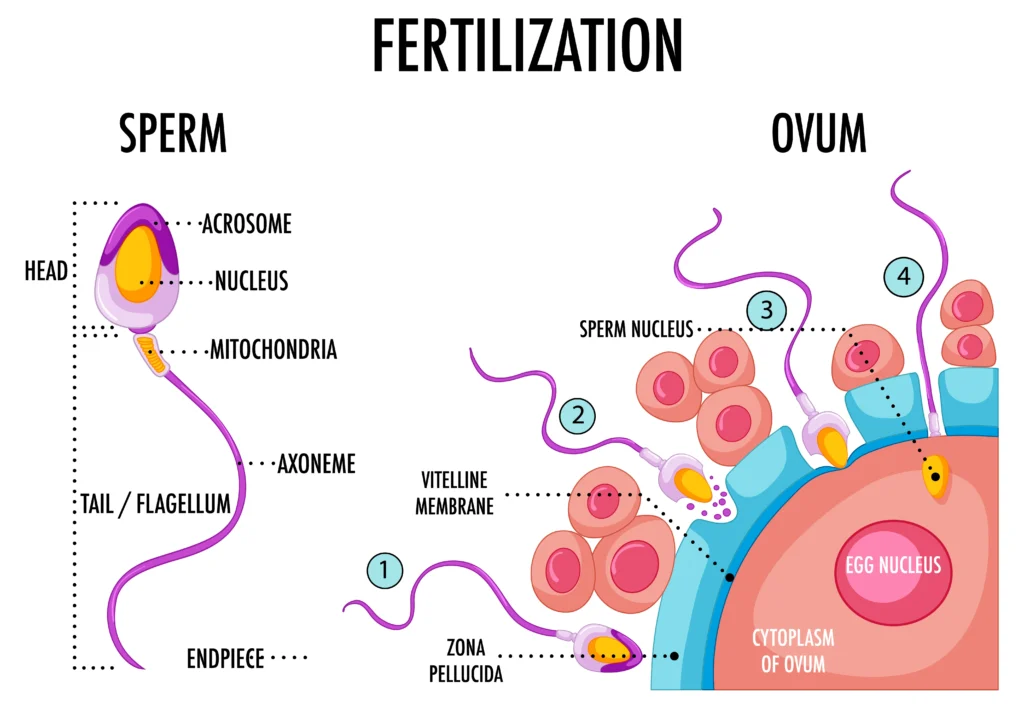
When ovulation occurs, the egg is released from the ovary and enters the fallopian tube.
If viable sperm are already present in the reproductive tract, they may encounter the egg during its limited period of viability.
This is why intercourse before ovulation can still result in pregnancy.
Sperm can survive under favorable conditions and be present when ovulation occurs.
How Do Sperm Find the Egg?
Sperm do not simply follow a straight path directly toward the egg.
Their movement is influenced by several mechanisms within the reproductive tract.
These include fluid flow, chemical signals, temperature gradients and interactions with cervical and tubal environments.
Researchers have identified chemotaxis, or movement influenced by chemical signals, as one mechanism involved in guiding sperm toward the egg-containing region of the fallopian tube.
Does the Egg Attract Sperm?
The egg and surrounding cells release chemical signals that may influence the movement of sperm.
However, fertilization is not simply a matter of one sperm detecting the egg from a long distance and swimming directly toward it.
Sperm transport involves multiple stages, and only a small number ultimately reach the appropriate location.
What Happens When a Sperm Reaches the Egg?
Reaching the egg is only the beginning of the final stage.
Before a sperm can fertilize the egg, it undergoes capacitation, a series of biochemical changes that occur within the female reproductive tract.
Capacitation changes the sperm’s membrane and prepares it for the acrosome reaction, which is required for penetration of the egg’s surrounding layers.
Can Sperm Fertilize the Egg Immediately After Ejaculation?
Usually, sperm need to undergo capacitation before they can successfully fertilize an egg.
This process occurs after sperm enter the female reproductive tract and is one reason fertilization is a biologically coordinated sequence rather than an immediate event following ejaculation.
Why Does Capacitation Matter?
Capacitation prepares sperm for the final interaction with the egg.
It allows sperm to develop the functional characteristics needed to interact with the egg’s surrounding structures and participate in fertilization.
What Happens to Sperm When They Reach the Fallopian Tube?
Only a tiny fraction of ejaculated sperm ultimately reach the fallopian tube.
The female reproductive tract acts as a series of biological barriers and selection points, so the sperm that continue toward the egg are a highly selected population.
A recent review notes that the number of sperm can fall from tens of millions in the ejaculate to only hundreds in the fallopian tube.
The oviduct also helps regulate sperm survival, movement and maturation before fertilization. (Soto-Heraset al. 2023)
Why Is the Fallopian Tube Important?
The fallopian tube is not simply a passageway connecting the ovary and uterus.
It provides a specialized environment where sperm can interact with the tubal lining and undergo further functional changes.
The tube also helps control when sperm are released toward the site where the egg is located.
This coordination helps reduce the possibility of multiple sperm fertilizing the same egg.
What Happens to Sperm Before Fertilization?
Even after reaching the appropriate region of the fallopian tube, sperm are not immediately ready to fertilize an egg.
They undergo capacitation, a series of biochemical and structural changes that occur within the female reproductive tract.
Capacitation alters the sperm membrane and prepares the sperm for the final stages of interaction with the egg.
What Is Hyperactivation?
During the later stages of capacitation, some sperm develop a more vigorous and asymmetric swimming pattern known as hyperactivated motility.
This change is thought to help sperm navigate the complex environment surrounding the egg and interact with the structures that surround it.
How Does a Sperm Recognize the Egg?
The mature egg is surrounded by several layers, including a protective extracellular matrix called the zona pellucida.
When an appropriately prepared sperm encounters the egg’s surrounding structures, molecular interactions between the sperm and zona pellucida help initiate the processes required for fertilization.
The sperm must undergo the acrosome reaction, a specialized cellular event that enables it to interact with and penetrate the egg’s surrounding layers. (Brucker et al. 1995)
Can More Than One Sperm Fertilize the Egg?
Normally, no.
Although multiple sperm may reach the vicinity of the egg, fertilization triggers changes in the egg and its surrounding zona pellucida that help prevent additional sperm from entering.
This protective mechanism is essential because the entry of multiple sperm, known as polyspermy, would generally prevent normal embryonic development.
What Happens Immediately After One Sperm Enters?
Once a sperm successfully fuses with the egg, the egg undergoes a series of activation processes.
These changes help complete the egg’s maturation and initiate the developmental program that eventually leads to formation of a zygote.
At the same time, changes around the egg help prevent additional sperm from successfully fertilizing it. (Litscher et al. 2025)
Did You Know?
Only a tiny fraction of sperm from an ejaculation ultimately reach the area where fertilization occurs. Millions of sperm may initially be present, but the female reproductive tract acts as a series of biological barriers and selection points. Only a highly selected population continues far enough to potentially encounter the egg.
Lesser-Known Fact
Only a Tiny Fraction of Sperm Reach the Fertilization Site
A fascinating lesser-known fact is that only a very small number of sperm reach the ampulla of the fallopian tube, where fertilization usually occurs.
Reviews of natural conception suggest that this number can be as low as hundreds from an ejaculate containing millions of sperm.
This means that conception is not simply a numbers game.
The female reproductive tract progressively filters and selects sperm based on factors such as motility, structure and their ability to interact with the reproductive environment. (Sakkas et al. 2015)
What Happens to Sperm That Do Not Fertilize the Egg?
Most sperm eventually lose their ability to fertilize an egg.
They may be eliminated by the reproductive tract, lose motility, remain trapped in different regions or fail to complete the biological changes required for fertilization.
This is completely normal.
Successful conception does not require large numbers of sperm to reach the egg.
It requires one appropriately functioning sperm to successfully complete the fertilization process.
Does Sperm Survival Depend on Ovulation?
Yes.
The reproductive tract changes around ovulation, creating conditions that are more favorable for sperm survival and transport.
Cervical mucus becomes more receptive to sperm, while hormonal changes influence the uterus and fallopian tubes.
This is one reason intercourse during the days leading up to ovulation can result in pregnancy even if fertilization does not happen immediately after intercourse.
What Happens After Fertilization?
Once fertilization occurs, the newly formed zygote begins dividing as it travels through the fallopian tube toward the uterus.
The sperm’s role in fertilization is therefore only the beginning of a much longer process.
Successful pregnancy requires subsequent embryo development, transport to the uterus and implantation in the uterine lining.
Can You Feel Sperm Moving After Sex?
No.
Sperm are microscopic, and their movement through the reproductive tract cannot normally be felt.
Sensations such as mild pelvic cramping, vaginal fluid leakage or changes around ovulation should not be interpreted as evidence that sperm are moving toward the egg.
What Happens to Sperm After Sex: Myth vs Fact
| Myth | Fact |
|---|---|
| All sperm immediately swim toward the egg. | Most sperm do not reach the fallopian tube. The reproductive tract acts as a series of biological barriers and selection points. |
| Sperm stay inside the vagina until the woman stands up. | Sperm can begin entering cervical mucus soon after ejaculation. |
| Semen leaking after sex means all the sperm have come out. | Semen leakage is normal and does not indicate that all sperm have been lost. |
| Every sperm can fertilize the egg immediately. | Sperm undergo capacitation in the female reproductive tract before they become capable of successful fertilization. |
| Millions of sperm reach the egg. | Only a very small fraction of ejaculated sperm reach the region where fertilization occurs. |
| The egg simply waits for the strongest sperm to swim directly toward it. | Sperm transport involves the cervix, uterus, fallopian tubes and multiple biological processes. |
| More sperm reaching the egg means multiple sperm normally fertilize it. | Normally, only one sperm fertilizes the egg, while mechanisms help prevent additional sperm from entering. |
| You can feel sperm moving toward the egg. | Sperm are microscopic and their movement through the reproductive tract cannot normally be felt. |
What Does This Mean When Trying to Conceive?
Understanding sperm transport helps explain why several common post-sex myths are misleading.
You do not need to:
- Keep your legs elevated
- Remain completely still
- Prevent normal semen leakage
- Lie down for a specific period
- Try to physically direct sperm toward the cervix
Instead, focus on regular intercourse during the fertile window, particularly in the days leading up to ovulation.
Final Thoughts
After sex, sperm begin a complex journey through the female reproductive tract. Most sperm do not reach the fallopian tube, while a small selected population may survive long enough to encounter an egg.
Understanding this process also explains why normal semen leakage, getting up after sex or changing position does not automatically prevent pregnancy. When trying to conceive, focus on regular intercourse during the fertile window rather than trying to control what happens to sperm after sex.
Conclusion
After sex, sperm face a remarkable journey through the female reproductive tract.
Most do not progress very far, while a small selected population can reach the fallopian tube and undergo the changes needed for fertilization.
Once one sperm successfully fertilizes the egg, the egg activates mechanisms that prevent additional sperm from entering.
Understanding this process also explains why conception depends on much more than simply how much semen is present after intercourse.
Frequently Asked Questions About Sperm After Sex
1. What happens to sperm immediately after sex?
After ejaculation, sperm are deposited in semen in the vagina. Some sperm can enter cervical mucus and begin moving through the reproductive tract, while many others lose viability or are eliminated.
2. How long can sperm survive after sex?
Under favorable conditions within the female reproductive tract, sperm can remain capable of fertilization for several days, particularly around ovulation.
3. Do sperm immediately reach the egg?
No. Sperm must pass through the cervix, uterus and reproductive tract before a small number may reach the fallopian tube where fertilization can occur.
4. Does semen leakage mean sperm have been lost?
No. Some semen leakage after intercourse is normal and does not mean that all sperm have left the reproductive tract.
5. Can sperm survive for five days?
Sperm can potentially survive for up to about five days under favorable reproductive conditions, although survival varies depending on the environment and sperm quality.
6. What happens when sperm reach the egg?
Sperm must undergo functional changes such as capacitation before they can successfully interact with and fertilize the egg.
7. Can you feel sperm moving after sex?
No. Sperm are microscopic, and their movement through the reproductive tract cannot normally be felt.
8. What happens if sperm fertilizes the egg?
After successful fertilization, a zygote forms and begins dividing as it travels through the fallopian tube toward the uterus.
Stay tuned with us for more health related topics.
Follow us on LinkedIn and Instagram for more.
More Read


Medical Disclaimer!
This article has been reviewed and written under the guidance of our Head Physiotherapist, Dr. Kruti Raj (PT, MUHS,CPT,CMPT). The information shared is intended for educational purposes only and should not be considered a substitute for personalized medical advice, diagnosis, or treatment.
Please consult us or any other qualified healthcare professional before beginning any exercise program, especially if you are experiencing pain, recovering from injury, or managing a medical condition.


