


Safe stretches for each trimester can help reduce stiffness, improve mobility, and support comfort throughout pregnancy.
Pregnancy stretches are everywhere online.
Most of them look calm, aesthetic, and perfectly planned.
Real pregnancy usually feels very different.
One day your lower back suddenly hurts while brushing your teeth.
Another day your ribs feel tight after sitting too long.
Then comes the strange hip pain while turning in bed that nobody really warned you about.
Quick Answer
A safe prenatal stretching routine can help reduce lower back pain, hip tightness, rib stiffness, pelvic discomfort, and muscle tension during pregnancy. The best pregnancy stretches are gentle, controlled, and adjusted according to each trimester. Physiotherapists usually recommend breathing exercises, spinal mobility stretches, pelvic tilts, calf stretches, and hip-opening movements rather than aggressive flexibility routines. Consistent movement often works better than intense workouts during pregnancy.
As a physiotherapist, I see this constantly.
Most pregnant women are not trying to become “more flexible.”
They simply want to move comfortably, sleep better, reduce pain, and feel less stiff throughout the day.
That is where prenatal stretching can genuinely help.
Not intense yoga poses.
Not internet fitness challenges.
Just safe movement that supports the body through each trimester.
Key Takeaways
- Prenatal stretching should focus on comfort, mobility, and pelvic support rather than deep flexibility.
- Pregnancy hormones increase joint laxity, which means overstretching can sometimes worsen pain.
- Breathing exercises and rib mobility stretches are often overlooked but extremely helpful during pregnancy.
- Gentle movement may help reduce lower back pain, hip tightness, rib discomfort, and muscle stiffness.
- Pelvic floor relaxation is just as important as pelvic floor strengthening during pregnancy.
- Women with pelvic girdle pain or pubic symphysis pain should avoid aggressive stretching routines.
- Short daily movement sessions usually work better than occasional intense exercise sessions.
- Always stop exercising and contact your healthcare provider if you experience dizziness, bleeding, contractions, or severe pain.
The important thing many women do not realize is that pregnancy already makes the joints more mobile because of hormonal changes.
So the goal is not stretching harder.
The goal is helping tight muscles relax while protecting joints that are becoming less stable.
This article is written from a physiotherapy perspective using current maternal health research, real clinical observations, and practical pregnancy movement advice women can actually use in everyday life.
Why Pregnant Women Often Feel Tight Even Though Their Joints Become Looser
This confuses many women during pregnancy.
Hormones like relaxin increase ligament laxity, especially around the pelvis.
Technically, the body becomes more flexible.
Yet many women feel tighter as pregnancy progresses.
That usually happens because muscles begin overworking to compensate for reduced stability.
For example:
- Hip muscles tighten to stabilize the pelvis
- The lower back works harder because posture shifts forward
- The neck and shoulders stiffen due to breast enlargement and posture changes
- Rib muscles become restricted because breathing mechanics change
So when pregnant women say, “I feel stiff all the time,” it is often muscular tension rather than true inflexibility.
This is one reason physiotherapy-based stretching works differently from generic flexibility routines online.
Research continues to show that prenatal movement and exercise may help reduce pregnancy-related back pain and pelvic discomfort. (PMC)
A Common Pregnancy Stretching Mistake Most Women Do Not Realize
A lot of women unknowingly overstretch during pregnancy.
Because connective tissues become softer, it becomes easier to push farther into stretches.
The problem is that deeper stretching is not necessarily better during pregnancy.
In fact, excessive stretching may irritate:
- SI joints
- pelvic ligaments
- pubic symphysis
- lower back structures
This becomes especially important in women already dealing with:
- pelvic girdle pain
- hypermobility
- sciatica
- pubic bone discomfort
Gentle and controlled movement usually works much better than aggressive stretching sessions.
The American College of Obstetricians and Gynecologists recommends moderate, safe exercise during pregnancy instead of extreme routines. (ACOG Committee Opinion No. 804 2020)
Safe Stretches For Each Trimester
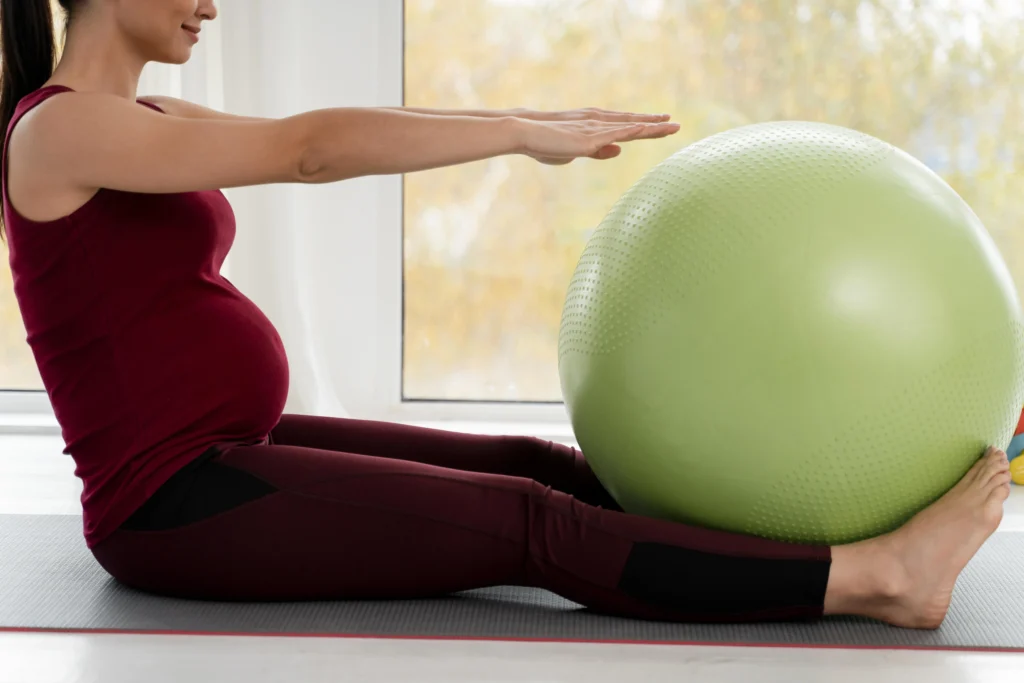
Below are the safe stretches for each trimester to ease pregnancy-related pain:
First Trimester Stretching Routine (Weeks 1 to 13)
The first trimester feels physically strange for many women.
Most do not visibly “look pregnant” yet, but the body is already adapting rapidly internally.
Fatigue is usually the biggest issue during this phase. Many women also notice:
- upper back tension
- headaches
- nausea-related stiffness
- shallow breathing
- early hip tightness
This stage is less about fitness and more about creating movement habits that feel manageable.
Rib Breathing Stretch
One of the most overlooked changes during pregnancy is breathing mechanics.
Many women begin breathing from the upper chest without realizing it, especially during stress or nausea.
That creates neck tension and rib stiffness surprisingly early.
How to do it
- Sit comfortably
- Place your hands around the sides of your ribs
- Breathe slowly into the rib cage
- Feel the ribs expand sideways
- Exhale gently
Do this for 2 minutes.
This breathing exercise sounds simple, but clinically it helps more than many women expect.
The diaphragm and pelvic floor work together mechanically.
Better breathing patterns often reduce unnecessary pelvic tension.
Cat-Camel Mobility Stretch
Cat-Camel stretch is one of the most safe stretches for each trimester during pregnancy.
It may help reduce:
- lower back stiffness
- spinal tension
- discomfort from prolonged sitting
Steps
- Start on hands and knees
- Inhale while gently arching the back
- Exhale while softly rounding the spine
- Move slowly with your breath
Do not exaggerate the movement.
8 to 10 repetitions are enough.
Neck Release Stretch
A surprising number of pregnant women develop neck pain early because posture changes begin before the belly grows significantly.
Instructions
- Sit upright
- Tilt one ear toward the shoulder
- Hold gently for 20 seconds
- Repeat on the opposite side
Avoid pulling aggressively on the neck.
Butterfly Hip Stretch
The hips often tighten early because pelvic stabilizing muscles begin compensating for hormonal laxity.
Instructions
- Sit comfortably
- Bring the soles of the feet together
- Let the knees fall outward naturally
- Stay tall through the spine
Do not push the knees downward.
Second Trimester Stretching Routine (Weeks 14 to 27)
This is usually the stage where posture changes become more noticeable.
A common thing women say around this time is:
“I suddenly cannot stand evenly anymore.”
They begin leaning onto one hip while cooking, standing, or brushing their teeth.
That shift changes how force travels through the pelvis and spine.
This trimester commonly brings:
- pelvic tightness
- lower back aching
- calf cramps
- rib stiffness
- hip fatigue
- early sciatic irritation
Why Rib Cage Mobility Matters More Than Most Women Realize
Many pregnancy articles focus only on the hips and lower back, but rib mobility becomes extremely important during the second and third trimesters.
As pregnancy progresses:
- breasts become heavier
- posture shifts forward
- the rib cage expands
- diaphragm movement changes
This is one reason many women suddenly feel short of breath or tight around the ribs even while resting.
Thoracic Rotation Stretch
This stretch is incredibly helpful and still overlooked in many prenatal routines.
Instructions
- Sit cross-legged or on a chair
- Place one hand behind you
- Slowly rotate your upper body
- Keep the movement gentle
Avoid forcing the twist.
This stretch may help reduce:
- rib tightness
- upper back stiffness
- desk posture discomfort
Standing Calf Stretch
Pregnancy changes walking mechanics more than most women expect.
The calves become overloaded because:
- body weight increases
- arches flatten slightly
- gait changes
- swelling increases pressure in the legs
Instructions
- Stand facing a wall
- Step one leg backward
- Keep the heel down
- Lean forward gently
Hold for 30 seconds.
Night calf cramps are very common during pregnancy, especially later on.
Pelvic Tilts Against the Wall
Pelvic Tilt exercise looks simple but works surprisingly well.
Why it helps
Many pregnant women stand with an exaggerated lower back arch without realizing it.
That prolonged compression may irritate:
- lumbar joints
- hip flexors
- pelvic muscles
Steps
- Stand against a wall
- Gently flatten the lower back toward the wall
- Tilt the pelvis slightly
- Relax slowly
Repeat gently.
Modified Child’s Pose
Child’s Pose stretch often feels good after standing for long periods.
Modification matters
Do not force the knees together.
Widen them comfortably to create space for the abdomen.
Place pillows under the chest if needed.
This position may help reduce:
- lower back tension
- hip tightness
- nervous system stress
Third Trimester Stretching Routine (Weeks 28 to 40)
Late pregnancy feels less like “working out” and more like body management.
This is the stage where women often say:
- “I cannot turn in bed comfortably.”
- “My hips ache while sleeping.”
- “My ribs feel sore.”
- “Walking feels heavier.”
All of this makes biomechanical sense.
By the third trimester:
- the pelvis carries greater load
- abdominal support changes
- breathing mechanics shift
- balance becomes harder
- muscles fatigue faster
This is why late pregnancy stretching should focus on comfort and mobility rather than performance.
Why Turning in Bed Hurts During Pregnancy
This is one of the most common complaints and hardly anyone explains it properly.
Turning in bed requires:
- pelvic stability
- abdominal coordination
- hip strength
During pregnancy, these systems are already under strain.
Women with pelvic girdle pain often feel sharp discomfort while rolling because the pelvis struggles to transfer load smoothly from one side to the other.
Seated Figure-4 Stretch
This stretch may help relieve deep hip tension and piriformis tightness.
Instructions
- Sit on a chair
- Cross one ankle over the opposite knee
- Lean forward slightly
You should feel the stretch in the buttock region, not the knee.
This often feels relieving for women experiencing sciatic-type tightness.
Side Body Stretch
Late pregnancy frequently creates tension around the ribs and waist.
Instructions
- Sit comfortably
- Raise one arm overhead
- Lean gently sideways
- Breathe into the stretched side
This may help improve rib mobility and reduce side-body tightness.
Supported Deep Squat
Not every pregnant woman should perform deep squats.
That is important.
Women with:
- severe pelvic pain
- pubic symphysis dysfunction
- instability
- balance concerns
may actually feel worse with unsupported squats.
But for some women, supported squats help maintain hip mobility and pelvic awareness.
Safer version
- Hold onto a stable support
- Lower only as comfortable
- Keep breathing steadily
- Use yoga blocks or cushions if needed
Pelvic Floor Relaxation Breathing
Many women constantly hear about strengthening the pelvic floor.
What they do not hear enough is that an over-tight pelvic floor can also create problems.
Some women unknowingly hold pelvic tension all day because of stress, discomfort, or fear surrounding labor.
That tension may contribute to:
- pelvic pain
- tailbone discomfort
- urinary urgency
- difficulty relaxing during labor
Try this
- Sit comfortably
- Take a slow breath in
- Imagine the pelvic floor softening downward
- Exhale gently
No squeezing required.
This is especially useful before bedtime.
The Pregnancy Stretches That Sometimes Make Pain Worse
Not every prenatal stretch is automatically safe.
Some movements may aggravate symptoms depending on the individual woman and her pelvic stability.
These commonly cause problems when overdone:
- deep lunges
- aggressive hamstring stretches
- intense yoga backbends
- forced hip openers
- wide asymmetrical poses
One of the biggest misconceptions online is:
“If it feels tight, stretch it harder.”
Pregnancy does not work that way.
Sometimes the “tight” muscle is actually trying to stabilize a loose joint.
Safe Desk Job Pregnancy Stretches That Actually Help
Women with desk jobs commonly struggle with:
- swollen feet
- stiff hips
- neck tension
- rib tightness
- tailbone discomfort
Small movement breaks often work better than one long stretching session.
Every 45 to 60 minutes:
- stand up
- walk briefly
- stretch the calves
- roll the shoulders
- change sitting position
- take 5 slow rib breaths
These small resets reduce cumulative strain surprisingly well.
A Realistic 10-Minute Prenatal Safe Stretches Routine For Each Trimester
Most pregnant women are not realistically doing hour-long routines daily.
This setup is much more practical.
Morning
- Rib breathing
- Cat-camel stretch
- Pelvic tilts
Afternoon
- Calf stretch
- Thoracic rotation
- Shoulder rolls
Evening
- Figure-4 stretch
- Side body stretch
- Pelvic floor relaxation breathing
Consistency matters more than intensity.
When to Stop Stretching and Call Your Healthcare Provider
Stop immediately and seek medical advice if stretching or exercise causes:
- vaginal bleeding
- dizziness
- contractions
- fluid leakage
- severe pelvic pain
- chest pain
- sudden shortness of breath
Final Thoughts
Pregnancy movement should feel supportive, not punishing.
Practicing safe stretches during each trimester may help improve flexibility, posture, and overall pregnancy comfort.
You do not need complicated prenatal workouts to help your body during pregnancy.
Many women actually benefit more from gentle, intelligent movement than intense routines.
The women who often feel best during pregnancy are not necessarily the fittest.
They are usually the ones who move consistently, breathe properly, change positions often, and stop forcing their body to move like it did before pregnancy.
That mindset changes everything.
Good prenatal stretching is not about becoming more flexible.
It is about helping the body adapt with less tension, less pain, and more confidence throughout each trimester.
Frequently Asked Questions
Is stretching safe during all trimesters of pregnancy?
In most healthy pregnancies, gentle stretching is considered safe throughout all trimesters when approved by a healthcare provider. Exercises should still be modified according to body changes and comfort levels.
Can prenatal stretching help reduce lower back pain?
Yes. Gentle mobility exercises and physiotherapy-based stretches may help reduce muscle tension, spinal stiffness, and lower back discomfort during pregnancy.
Why do my hips feel tighter during pregnancy?
Pregnancy hormones loosen the joints, but muscles around the pelvis often tighten to create extra stability. That muscular tension can make the hips feel stiff or sore.
Can stretching prepare the body for labor?
Gentle prenatal stretching may improve breathing control, pelvic awareness, mobility, and relaxation, which can support comfort during labor preparation.
Should I avoid deep stretching during pregnancy?
Yes. Deep or aggressive stretching may irritate already loosened joints and pelvic structures during pregnancy. Controlled movements are usually safer.
Can stretching help with pregnancy sciatica?
Some gentle stretches targeting the hips, piriformis muscle, and lower back may help reduce sciatic-type tightness during pregnancy.
How often should pregnant women stretch?
Many physiotherapists recommend short daily movement sessions instead of long intense workouts. Even 10 minutes of gentle stretching daily may help.
When should I stop stretching during pregnancy?
Stop immediately and contact your healthcare provider if you experience bleeding, contractions, fluid leakage, chest pain, dizziness, or severe pelvic pain.
Stay tuned with us for more health related topics.
Follow us on LinkedIn and Instagram for more.
More Read


Medical Disclaimer!
This article has been reviewed and written under the guidance of our Head Physiotherapist, Dr. Kruti Raj (PT, MUHS,CPT,CMPT). The information shared is intended for educational purposes only and should not be considered a substitute for personalized medical advice, diagnosis, or treatment.
Please consult us or any other qualified healthcare professional before beginning any exercise program, especially if you are experiencing pain, recovering from injury, or managing a medical condition.


