


Yoga vs physiotherapy for pregnancy is a common comparison among women looking for safe ways to improve comfort, mobility, and pain relief during pregnancy.
One thing I have noticed over the years is this.
Most pregnant women are not confused about whether they should exercise.
They are confused about what kind of exercise is actually safe and useful for their body.
Some join prenatal yoga classes because everyone around them recommends yoga during pregnancy.
Others search for physiotherapy only after the pain becomes unbearable.
A few think both are the same thing.
They are not.
And honestly, social media has made this even more confusing.
You will find one reel saying yoga solves everything during pregnancy.
Another says stretching is dangerous.
Then someone else claims pelvic floor exercises should be done throughout pregnancy without explaining how.
By the time a woman reaches the second trimester, she is already overwhelmed.
Quick Answer
Yoga and physiotherapy during pregnancy are not the same. Prenatal yoga mainly helps with relaxation, breathing, flexibility, and emotional wellness, while physiotherapy focuses on pain relief, posture correction, pelvic floor rehabilitation, movement assessment, and pregnancy-related musculoskeletal issues.
If a pregnant woman has back pain, pelvic pain, sciatica, urinary leakage, instability, or difficulty moving comfortably, physiotherapy is usually more beneficial. Yoga can still be an excellent supportive practice for stress relief and gentle movement when performed safely under supervision.
In many healthy pregnancies, combining physiotherapy, prenatal yoga, walking, and breathing exercises often provides the best overall results for both physical comfort and emotional well-being.
As a physiotherapist, I usually explain it this way:
Yoga and physiotherapy are not competitors.
They simply solve different problems.
Sometimes yoga is enough. Sometimes physiotherapy becomes necessary.
And very often, the best approach is a combination of both.
Key Takeaways
- Prenatal yoga mainly supports relaxation, breathing control, flexibility, and stress reduction.
- Physiotherapy during pregnancy focuses on pain relief, posture correction, pelvic floor rehabilitation, and movement assessment.
- Persistent back pain, pelvic pain, sciatica, or urinary leakage should not be ignored during pregnancy.
- Overstretching during pregnancy may worsen pelvic instability because pregnancy hormones naturally loosen joints and ligaments.
- Pelvic floor exercises are highly beneficial, but many women perform them incorrectly without proper guidance.
- Physiotherapy provides individualized care based on trimester, symptoms, posture, and functional limitations.
- Yoga and physiotherapy often work best together rather than competing against each other.
- Safe movement during pregnancy can improve comfort, confidence, mobility, and labor preparation.
Pregnancy Changes the Body Faster Than Most Women Expect
A lot of women are surprised by how quickly the body starts changing.
Not just the belly.
Everything.
The posture changes. Breathing changes.
Walking pattern changes. Sleep changes.
Even the way pressure moves through the pelvis changes.
Around the second trimester, many women suddenly start experiencing:
- Lower back pain
- Pelvic heaviness
- Hip tightness
- Neck stiffness
- Wrist pain
- Leg cramps
- Difficulty turning in bed
- Urinary leakage
- Tailbone pain
- Sciatica-like symptoms
And the interesting part is this.
Sometimes scans look completely normal.
But the body still hurts.
That is because pregnancy pain is often mechanical, not pathological.
(W.H. Wu, O.G. Meijer, and colleagues et al. 2004) found that pregnancy-related low back pain and pelvic pain affect a very large percentage of women globally.
What Prenatal Yoga Actually Helps With
Prenatal yoga can be genuinely helpful during pregnancy when taught correctly.
I have seen anxious mothers become calmer after just a few weeks of guided breathing and movement sessions.
Yoga usually focuses on:
- Gentle stretching
- Breathing awareness
- Relaxation
- Controlled movement
- Flexibility
- Stress reduction
- Mind-body connection
And honestly, some women need exactly that.
Not every pregnant woman requires rehabilitation.
Some simply need movement, confidence, and emotional balance.
One underrated thing about yoga is how much it improves body awareness.
Women begin noticing:
- how they stand,
- how they breathe,
- how tense their shoulders are,
- and how stress physically affects the body.
Reports suggest that prenatal yoga may help reduce stress and anxiety levels during pregnancy. (PubMed)
But this is also where an important distinction comes in.
Yoga is wellness-focused.
Physiotherapy is assessment-focused.
Physiotherapy During Pregnancy Is Much More Specific
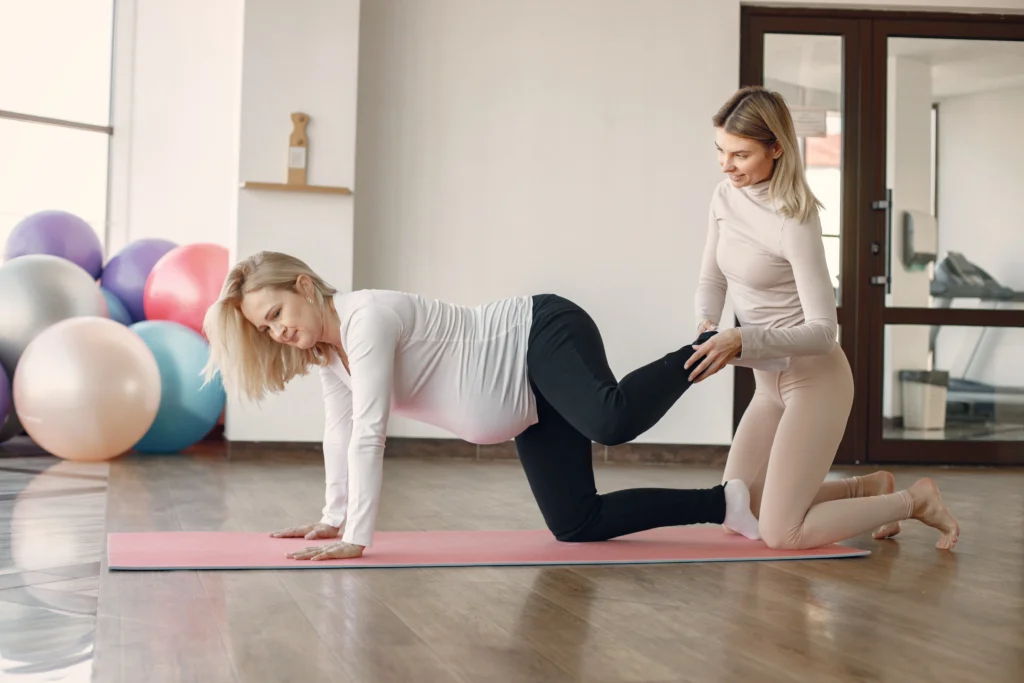
This is something many people do not realize.
Physiotherapy during pregnancy is not just “exercise sessions.”
A proper antenatal physiotherapy assessment looks at:
- posture,
- pelvic stability,
- muscle imbalance,
- breathing mechanics,
- pelvic floor function,
- movement patterns,
- joint loading,
- and pain triggers.
Two pregnant women may both complain of “back pain,” but the reason may be completely different.
One may have weak glute muscles.
Another may have sacroiliac instability.
Another may actually have rib mobility restriction causing compensation.
This is why generalized exercise videos online often fail.
Pregnancy is not one-size-fits-all.
One of the Biggest Mistakes Pregnant Women Make
Many women stretch aggressively because they feel “tight.”
But during pregnancy, tightness does not always mean the muscles need stretching.
Sometimes the body is tightening muscles because the joints are unstable.
That changes everything.
Pregnancy hormones like relaxin increase ligament laxity.
This means the pelvis and surrounding joints become naturally looser.
If someone already has pelvic instability and keeps overstretching, symptoms can worsen.
This is why some women feel worse after random online yoga sessions.
Not because yoga is bad.
Because the wrong exercise was given to the wrong body.
The Pelvic Floor Conversation Is Still Missing Everywhere
Honestly, pelvic floor health is still one of the most ignored parts of pregnancy care.
Most women hear about pelvic floor exercises only after delivery.
That is too late.
The pelvic floor supports:
- the bladder,
- uterus,
- bowel,
- and pelvic organs.
During pregnancy, these muscles undergo enormous pressure changes.
What surprises many women is this:
Doing pelvic floor exercises incorrectly is extremely common.
A recent review showed many women are unable to correctly contract pelvic floor muscles without proper instruction. (Bø et al. 2025)
This is where physiotherapy has a major advantage.
A women’s health physiotherapist can actually assess whether the muscles are:
- weak,
- overactive,
- tight,
- poorly coordinated,
- or under excessive pressure.
Yoga may improve pelvic awareness indirectly, but it does not replace pelvic floor assessment.
Yoga Helps Emotionally in Ways Physiotherapy Sometimes Cannot
This is something I say very honestly.
A calm nervous system changes pregnancy experience dramatically.
Women who are constantly anxious often breathe shallowly, tighten their shoulders, clench the pelvic floor, and move fearfully.
Prenatal yoga helps many women slow down mentally.
That matters.
I have seen women sleep better simply because they learned breathing control.
And breathing becomes very important during labor preparation too.
Good prenatal yoga instructors teach:
- diaphragmatic breathing,
- relaxation techniques,
- rib expansion,
- and pacing.
Those things are genuinely useful.
But Physiotherapy Usually Wins When Pain Becomes Functional
This is where the difference becomes obvious clinically.
If a pregnant woman says:
- “My back hurts when I stand”
- “I cannot turn in bed”
- “Walking hurts”
- “My pelvis clicks”
- “I feel pressure while climbing stairs”
then physiotherapy becomes far more important.
Because now we are dealing with biomechanics.
(B. Stuge, G. Hilde, and N. Vollestad et al. 2022) found exercise-based physiotherapy interventions helpful for pregnancy-related low back and pelvic pain.
And this is another thing rarely discussed online:
Pain during pregnancy is not always something women should simply tolerate.
Many problems improve significantly with proper management.
Walking Changes During Pregnancy Too
This is one of my favorite lesser-known facts.
Pregnancy changes gait mechanics.
Women naturally begin:
- taking shorter steps,
- widening stance,
- shifting weight differently,
- and changing hip motion.
(Marco Branco and colleagues et al. 2014) observed measurable gait changes during pregnancy due to biomechanical adaptations.
This explains why some women suddenly develop:
- knee pain,
- foot pain,
- calf fatigue,
- or hip discomfort.
Sometimes the issue is not weakness.
It is movement compensation.
Sciatica During Pregnancy Is Often Misunderstood
Many women say:
“I think I have sciatica.”
Sometimes they do.
Sometimes they do not.
Pregnancy-related nerve pain may come from:
- piriformis tightness,
- pelvic instability,
- posture changes,
- swelling,
- or nerve sensitivity.
And occasionally, stretching aggressively irritates symptoms further.
This is another reason assessment matters.
A physiotherapist looks for:
- nerve tension,
- muscle guarding,
- pelvic alignment,
- strength deficits,
- and functional movement limitations.
That clinical reasoning is difficult to get from a group class.
Can Yoga Replace Physiotherapy?
No.
And physiotherapy cannot replace everything yoga offers either.
That is the honest answer.
If a pregnant woman has:
- severe pelvic pain,
- urinary leakage,
- instability,
- mobility difficulty,
- previous orthopedic injury,
- or diastasis recti concerns,
she should absolutely see a physiotherapist.
But if someone simply wants:
- gentle movement,
- stress relief,
- flexibility,
- breathing work,
- and emotional calmness,
prenatal yoga may be enough.
Different goals.
Different tools.
Diastasis Recti Is Becoming More Common
Another thing I have been seeing more frequently is poor pressure management during pregnancy.
Women unknowingly perform exercises that excessively push pressure outward through the abdomen.
That may worsen abdominal separation.
Diastasis recti is not always preventable because abdominal stretching is a natural part of pregnancy.
But movement strategy matters.
Physiotherapists usually teach:
- breathing coordination,
- deep core activation,
- movement modification,
- and pressure control.
These small corrections often matter more than intense workouts.
The “Stretch More” Advice Needs to Stop
This may sound controversial, but not every pregnant woman needs more stretching.
Some actually need more stability.
Recent maternal rehabilitation research is increasingly emphasizing individualized biomechanics over generalized flexibility advice. (Hall et al. 2025)
I see many women who:
- are already hypermobile,
- already unstable,
- already overly flexible,
yet continue doing deep stretches daily because social media says flexibility helps labor.
Too much mobility without stability can worsen pain.
What Actually Helps Most During Labor Preparation
In real practice, the women who cope best during labor are usually the ones who:
- breathe efficiently,
- move confidently,
- understand pelvic positioning,
- conserve energy,
- and stay less fearful of movement.
Yoga helps the mental side beautifully.
Physiotherapy helps the mechanical side.
A good physiotherapist may teach:
- labor positions,
- pelvic mobility drills,
- pushing coordination,
- breathing mechanics,
- supported squatting,
- and pelvic floor relaxation strategies.
That combination is incredibly valuable.
One Thing Many Women Notice Only After Delivery
Poor pregnancy movement patterns often continue postpartum.
Women who ignored severe pelvic pain during pregnancy sometimes struggle later with:
- prolonged back pain,
- weak core recovery,
- pelvic floor dysfunction,
- or difficulty returning to exercise.
This is why antenatal care matters so much.
Pregnancy rehabilitation should not begin only after delivery.
So Which One Do I Recommend More?
Honestly?
I recommend according to the woman sitting in front of me.
Not trends.
Not reels.
Not marketing.
If someone has pain, instability, or pelvic floor symptoms, physiotherapy should come first.
If someone feels emotionally overwhelmed and physically stiff but otherwise healthy, yoga may help tremendously.
And for many women, the smartest option is combining:
- physiotherapy,
- prenatal yoga,
- walking,
- breathing work,
- and pelvic floor training.
That is usually where the best results happen.
Final Thoughts
Pregnancy is not a time to fear movement.
But it is also not a time to blindly follow generic exercise advice online.
The body is changing rapidly.
So, yoga vs physiotherapy for pregnancy: which is better for pain relief and mobility?
What works for one pregnant woman may completely fail another.
Yoga can help women feel calmer, lighter, and more connected to their body.
Physiotherapy can help women move with less pain, better stability, and more confidence.
Neither is “better” universally.
The real goal is understanding what your body currently needs.
And sometimes, the most powerful thing a pregnant woman can hear is this:
You do not have to simply suffer through pain because you are pregnant.
Proper support exists.
Frequently Asked Questions
Is yoga safe during all stages of pregnancy?
Prenatal yoga is generally safe for most healthy pregnancies when guided by a qualified instructor. However, women with high-risk pregnancies or severe pain should first consult their healthcare provider or physiotherapist.
Can physiotherapy help pregnancy back pain?
Yes. Physiotherapy is one of the most effective non-invasive approaches for pregnancy-related back pain because it focuses on posture correction, muscle support, pelvic stability, and movement retraining.
Which is better during pregnancy: yoga or physiotherapy?
Neither is universally better. Yoga supports emotional wellness and flexibility, while physiotherapy helps manage pain, instability, pelvic floor issues, and movement dysfunction.
Can prenatal yoga replace physiotherapy?
No. Yoga cannot replace physiotherapy when clinical symptoms like pelvic girdle pain, sciatica, severe back pain, or urinary leakage are present.
What are the signs a pregnant woman should see a physiotherapist?
Women should consider physiotherapy if they experience persistent pain, difficulty walking, pelvic instability, posture problems, muscle weakness, or pelvic floor symptoms during pregnancy.
Can pelvic floor exercises help during pregnancy?
Yes. Proper pelvic floor training may help reduce urinary leakage, support pelvic organs, and improve postpartum recovery. Guidance from a physiotherapist is often helpful for correct technique.
Does yoga help with labor preparation?
Prenatal yoga may improve breathing control, relaxation, flexibility, and emotional calmness, which can help women feel more prepared for labor.
Stay tuned with us for more health related topics.
Follow us on LinkedIn and Instagram for more.
More Read


Medical Disclaimer!
This article has been reviewed and written under the guidance of our Head Physiotherapist, Dr. Kruti Raj (PT, MUHS,CPT,CMPT). The information shared is intended for educational purposes only and should not be considered a substitute for personalized medical advice, diagnosis, or treatment.
Please consult us or any other qualified healthcare professional before beginning any exercise program, especially if you are experiencing pain, recovering from injury, or managing a medical condition.


