


Pain on the right side of the neck is one of the most common complaints I encounter in clinical practice. While many people assume it is due to sleeping wrong, the reality is far more complex.
From a physiotherapy point of view, one-sided neck pain is rarely random. It reflects an imbalance between load and tissue capacity, influenced by posture, movement patterns, stress, and even breathing habits.
What makes right-sided neck pain particularly interesting is that it often develops due to asymmetrical daily activities, which gradually overload one side of the cervical spine.
Read about our Complete Neck Pain Guide : Causes, Symptoms, Exercises and Treatment
Pain in the right side of the neck is most commonly caused by muscle strain, poor posture, or repetitive one-sided habits such as phone use or sleeping position. It can also result from joint dysfunction, nerve irritation, or stress-related muscle tightness. Physiotherapy treatments including exercises, posture correction, and manual therapy are highly effective in relieving pain and preventing recurrence.
Read about: Early Signs of Cervical Spine Damage You Should Never Ignore
- Right-sided neck pain is often due to asymmetrical loading from daily habits and posture.
- Trigger points, fascia tightness, and joint dysfunction are key contributors.
- Stress, breathing patterns, and jaw dysfunction can worsen symptoms.
- Pain does not always mean tissue damage due to nervous system involvement.
- Simple changes like posture correction and regular movement can significantly reduce pain.
- Physiotherapy remains one of the most effective treatments for long-term relief.
Read about: The Best Physiotherapy Exercises for Cervical Spondylosis Relief
Why Does Neck Pain Occur Only on the Right Side?
The human body is not perfectly symmetrical in function.
Even though anatomically both sides are similar, functionally one side is often dominant.
Common reasons include:
- Holding the phone on one side
- Carrying a bag on the right shoulder
- Sleeping consistently on one side
- Rotating the neck more frequently in one direction
Over time, these habits create uneven stress distribution, leading to localized pain.
A clinical study found that mechanical neck pain is strongly associated with asymmetrical muscle activation and posture-related loading patterns. (Falla et al., 2018)
Read about: Cervical Ligament Injury or Neck Ligament Tear
The Load vs Capacity Concept in Neck Pain
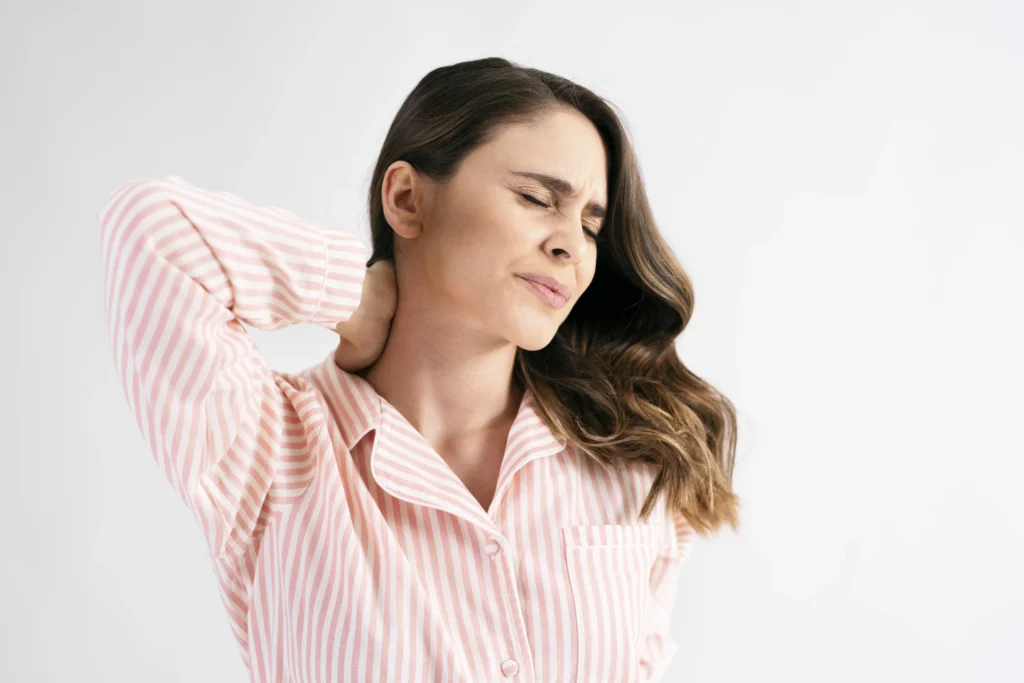
One of the most important but lesser-known concepts is this:
Pain occurs when the load placed on tissues exceeds their capacity to tolerate it.
For example:
- Long hours of desk work increase load
- Weak deep neck muscles reduce capacity
This imbalance leads to pain, especially on one side where load is higher
Read about : 15 Common Causes of Neck Pain You Should Know
Common Causes of Pain in the Right Side of the Neck
Muscle Strain and Myofascial Trigger Points
Read about: What Is Cervical Myofascial Pain Syndrome And How To Relieve Trigger Points
The most frequent cause is myofascial pain syndrome.
Muscles commonly involved:
- Upper trapezius
- Levator scapulae
- Sternocleidomastoid
These muscles develop trigger points that can cause:
- Local pain
- Referred pain to the head or shoulder
Recent research confirms that myofascial release significantly reduces pain and improves mobility in neck pain patients. (Ajimsha et al., 2024)
Read: Trigger Point Injections for Neck Pain: Do They Really Work
Fascial Tightness and Connective Tissue Dysfunction
A newer understanding in physiotherapy is the role of fascia.
Fascia is a connective tissue network that surrounds muscles. When it becomes stiff or restricted, it can:
- Limit movement
- Increase tension on one side
- Contribute to chronic pain
Recent studies highlight that fascia is an active contributor to musculoskeletal pain, not just a passive structure. (Langevin et al., 2021)
Learn how posture affects neck pain and correction exercises in our article on Simple Posture Correction Exercises for Forward Head Posture
Poor Posture and Forward Head Position
Posture remains one of the strongest contributors.
Forward head posture increases strain on the cervical spine and often affects one side more.
Research shows that poor posture alters muscle activation patterns and increases mechanical stress on the neck. (Kim et al., 2020)
Read about : What is Cervical Facet Joint Pain, how it causes cervicogenic headaches and how to correct it naturally
Cervical Joint Dysfunction
Sometimes the issue lies in the joints rather than muscles.
Facet joint dysfunction can cause:
- Pain during neck rotation
- Localized stiffness
- Restricted movement
Joint dysfunction often develops alongside muscle imbalance.
Read in detail about: Cervical Radiculopathy: Why Neck Nerve Pain Travels to the Arm
Nerve Irritation and Cervical Radiculopathy
If the pain travels beyond the neck, nerve involvement should be considered.
Symptoms include:
- Pain radiating to shoulder or arm
- Tingling or numbness
- Weakness
Disc bulge or narrowing of nerve pathways can cause these symptoms.
Read more: Cervical Disc Bulge: Causes, symptoms and treatment
Stress and Emotional Factors
Stress is a major but underestimated contributor.
When stressed, the body unconsciously tightens muscles, especially in the neck and shoulders.
This can lead to:
- Persistent tightness
- One-sided pain
- Reduced mobility
Read about: Neck And Jaw Pain Together? Here’s The Full Clinical Picture
Jaw Dysfunction and Neck Pain Connection
The jaw and neck are closely linked biomechanically.
Temporomandibular joint dysfunction can lead to:
- Neck stiffness
- One-sided pain
- Headaches
A randomized trial showed that treating jaw dysfunction improves cervical spine mobility and posture. (Olivo et al., 2024)
Also read: How to Relieve Neck Tightness Without Equipment
Breathing Dysfunction and Neck Overuse
This is one of the most overlooked causes.
When people rely on shallow chest breathing:
- Neck muscles become overactive
- One side may work harder than the other
This leads to chronic strain.
Read in detail about: Cervical Disc Degeneration: The Hidden Cause of your Neck Pain
Pain Does Not Always Mean Damage
One important concept in modern pain science:
Pain does not always equal tissue damage.
Even when pain is felt on the right side, the nervous system may amplify signals, making the pain feel more intense.
Research shows that central sensitization plays a role in chronic neck pain. (Woolf, 2011)
Read : Chiropractic for Neck Pain: Does It Really Work?
Symptoms That Help Identify the Cause
| Symptom | Likely Cause |
|---|---|
| Local stiffness | Muscle strain |
| Pain on turning head | Joint dysfunction |
| Radiating pain | Nerve involvement |
| Headache with neck pain | Trigger points |
| Morning stiffness | Posture or sleeping issues |
Read about: How to Relieve Morning Neck Stiffness Naturally
Physiotherapy Assessment Approach
A proper physiotherapy assessment includes:
- Postural analysis
- Range of motion testing
- Muscle strength evaluation
- Trigger point identification
- Neural assessment
- Ergonomic review
This helps identify the root cause rather than just treating symptoms.
Read about: Effective Neck Pain Exercises At Home: A Complete Guide to Relief and Improved Mobility
Best Physiotherapy Treatments for Right Neck Pain
Manual Therapy
Includes:
- Soft tissue release
- Joint mobilization
Evidence shows that manual therapy improves pain and function in neck disorders. Coulter et al., 2018
Read more on : Manual Therapy for Neck Pain: A Physiotherapist’s Evidence Based Guide
Cervical Stabilization Exercises
These exercises target deep neck muscles and improve control.
Examples:
- Chin tuck
- Isometric exercises
- Controlled rotations
A recent review found that stabilization exercises significantly improve pain and disability. (Blanpied et al., 2017)
Learn: How to do Chin Tucks for Neck Pain Relief and Posture Correction
Postural Correction
Includes:
- Adjusting workstation height
- Maintaining neutral spine
- Reducing forward head posture
Read in detail: Best Desk Setup to Reduce Neck and Back Pain
Stretching Tight Muscles
Important muscles to stretch:
- Upper trapezius
- Levator scapulae
- Sternocleidomastoid
Read about: Yoga for Neck Pain: Poses That Actually Work
Breathing Retraining
Focus on:
- Diaphragmatic breathing
- Reducing accessory muscle overuse
Read: 10 Proven Home Remedies for Neck Pain from Anxiety
Movement and Activity
Regular movement improves circulation and reduces stiffness.
Exercise therapy has been shown to improve pain and motor function in neck pain patients. (Gross et al., 2015)
Learn About: The Ultimate Neck Stretch Routine for Desk Workers in 2026
Home Advice from a Physiotherapist
Managing right-sided neck pain at home is not just about temporary relief.
It is about correcting the habits and movement patterns that caused the pain in the first place.
Small daily changes can make a significant difference in recovery and prevention.
Read: What is Torticollis? How to treat neck tilt condition
Avoid One-Sided Habits
One of the biggest contributors to right-sided neck pain is repetitive use of one side of the body.
Common examples include:
- Holding your phone on the right side
- Carrying a bag on one shoulder
- Sleeping consistently on one side
- Cradling the phone between neck and shoulder
These habits create asymmetrical loading, which overworks specific muscles like the upper trapezius and levator scapulae.
What to do:
- Alternate sides when carrying bags
- Use both hands for tasks when possible
- Avoid tilting your head to one side for long periods
Read about: Which Is The Best Sitting Posture To Avoid Neck Pain And How To Achieve It
Change Posture Frequently
Even a perfect posture can cause pain if maintained for too long.
Sustained positions lead to:
- Reduced blood flow
- Muscle fatigue
- Increased stiffness
What to do:
- Change your position every 30 to 40 minutes
- Alternate between sitting and standing if possible
- Reset your posture regularly by sitting upright and gently retracting your chin
A helpful tip I give patients:
“Your best posture is your next posture.”
Read About: How to Choose the Right and Best Pillow for Neck Pain
Use a Supportive Pillow
Your pillow plays a crucial role in maintaining neutral cervical alignment during sleep.
An improper pillow can:
- Tilt your neck to one side
- Overstretch muscles
- Increase morning stiffness
What to look for:
- Medium height pillow that keeps your neck aligned with your spine
- Not too high or too flat
- Memory foam or cervical contour pillows can help
Sleeping tips:
- Avoid sleeping on your stomach
- Side sleeping is fine if your neck stays neutral
- Keep shoulders relaxed, not shrugged upward
Read About: Best Sleeping Position for Neck Pain: A Physiotherapist’s Complete Guide
Take Regular Breaks from Screens
Prolonged screen use is a major cause of neck pain today.
Looking down at screens increases load on the neck significantly.
What to do:
- Follow the 30-30 rule
Every 30 minutes, take a 30-second break - Look straight ahead instead of down
- Keep screens at eye level
During breaks:
- Roll your shoulders
- Gently stretch your neck
- Take a few deep breaths
Also read: How to Relieve Neck Tightness Without Equipment
Stay Physically Active
Movement is one of the most effective ways to reduce and prevent neck pain.
Inactivity leads to:
- Muscle stiffness
- Reduced joint mobility
- Weak supporting muscles
What to include:
- Daily walking
- Gentle neck mobility exercises
- Strengthening exercises for deep neck muscles
Even 15 to 20 minutes of regular movement can improve circulation and reduce pain.
Read in detail about: How to Fix Upper Crossed Syndrome Naturally
Bonus Advice from Clinical Practice
These are small but powerful habits I often recommend:
- Keep your ears aligned over your shoulders while sitting
- Avoid holding tension in your shoulders unconsciously
- Practice diaphragmatic breathing to relax neck muscles
- Stay hydrated, as dehydration can increase muscle stiffness
Read: Sore Throat and Stiff Neck: When to Worry
The Bigger Picture
Neck pain does not usually come from a single incident. It develops from repeated micro-stress over time.
Correcting daily habits is the most effective long-term solution.
Consistency matters more than intensity. Small changes done regularly will give better results than occasional effort.
Read about: What Is Military Neck Or Cervical Kyphosis And How To Treat It
When Should You Seek Medical Help?
Consult a professional if you experience:
- Numbness or weakness
- Severe or worsening pain
- Pain after trauma
- Difficulty swallowing or speaking
- Fever with neck pain
Read more: Cervical Myelopathy: The Hidden Neck Condition Affecting Your Walking
Conclusion
Pain in the right side of the neck is not just a minor issue. It is often a sign of imbalance, overload, or dysfunction in the body.
The good news is that most cases respond well to physiotherapy.
Early intervention, proper exercise, and posture correction can not only relieve pain but also prevent recurrence.
Understanding the cause is the first step toward long-term recovery.
Read: Lhermitte’s sign- An Electic Shock Sensation Down The Neck
Frequently Asked Questions
1. Why does my neck pain only on the right side?
It usually happens due to uneven muscle use, poor posture, or daily habits that overload one side of the neck more than the other.
2. Can stress cause pain on the right side of the neck?
Yes, stress can cause muscle tightening, especially in the neck and shoulders, leading to one-sided stiffness and discomfort.
3. Is right side neck pain a sign of nerve damage?
Not always, but if the pain spreads to the arm with tingling or numbness, it may indicate nerve irritation and should be evaluated.
4. How long does right side neck pain take to heal?
Most cases improve within a few days to a few weeks with proper care, exercises, and posture correction.
5. What is the best sleeping position for neck pain?
Sleeping on your back or side with proper neck support is ideal. Avoid sleeping on your stomach as it strains the neck.
6. Can mobile phone use cause neck pain on one side?
Yes, prolonged phone use, especially looking down or holding it on one side, can lead to muscle strain and pain.
7. When should I see a physiotherapist for neck pain?
If the pain persists, worsens, or affects your daily activities, it is best to seek professional assessment and treatment.
8. Is exercise safe for right side neck pain?
Yes, gentle exercises and guided physiotherapy movements are safe and help reduce pain while improving strength and mobility.
Stay tuned with us for more health related topics.
Follow us on LinkedIn and Instagram for more.
More Read


Medical Disclaimer!
This article has been reviewed and written under the guidance of our Head Physiotherapist, Dr. Kruti Raj (PT, MUHS,CPT,CMPT). The information shared is intended for educational purposes only and should not be considered a substitute for personalized medical advice, diagnosis, or treatment.
Please consult us or any other qualified healthcare professional before beginning any exercise program, especially if you are experiencing pain, recovering from injury, or managing a medical condition.


