If you notice pain when you tilt your head back, whether you are looking at the ceiling, washing your hair, or checking something on a high shelf, your neck is not just stiff.
It is reacting to a specific movement pattern.
In physiotherapy, pain during a particular movement gives us strong clues.
Neck pain while looking up is especially important because it usually points to compression or control issues in the cervical spine.
Most people ignore it in the beginning. They stretch randomly or just wait for it to settle.
Sometimes it does. But when the root cause is not addressed, the same pain keeps coming back.
Let’s understand what is actually happening inside your neck and what you can do about it.
Read about our Complete Neck Pain Guide : Causes, Symptoms, Exercises and Treatment
Quick Answer
Neck pain when looking up is usually caused by compression of joints at the back of the neck, muscle imbalance, or poor posture developed over time.
The most common reasons include facet joint irritation, forward head posture, weak deep neck muscles, and stiffness in the upper back.
In most cases, this type of pain is mechanical and improves with physiotherapy, posture correction, and targeted exercises like chin tucks and thoracic mobility work.
Read about: Early Signs of Cervical Spine Damage You Should Never Ignore
Key Takeaways
- Neck pain when looking up is commonly linked to joint compression and poor movement control.
- Forward head posture is one of the biggest contributors to this type of pain.
- Weak deep neck flexor muscles reduce stability and increase strain during extension.
- Upper back stiffness forces the neck to take extra load during movement.
- This condition is usually mechanical and responds well to physiotherapy.
- Simple exercises like chin tucks and thoracic extensions can significantly reduce symptoms.
- Avoid repeated painful movements but do not completely stop neck movement.
- Seek medical attention if pain is constant, severe, or associated with fever or neurological symptoms.
Also read: How to Relieve Neck Tightness Without Equipment
Why Does Neck Pain Happen When You Look Up
Looking up is called cervical extension. It is a normal movement, but it places load on certain structures in your neck.
When you extend your neck:
- The joints at the back of the spine compress
- The front muscles stretch
- The back muscles contract
- The disc shifts slightly forward
If your neck is healthy and balanced, this movement is smooth and painless.
But if something is already irritated or weak, this same movement starts to feel uncomfortable or even sharp.
Read about : 15 Common Causes of Neck Pain You Should Know
The Most Common Causes You Should Know
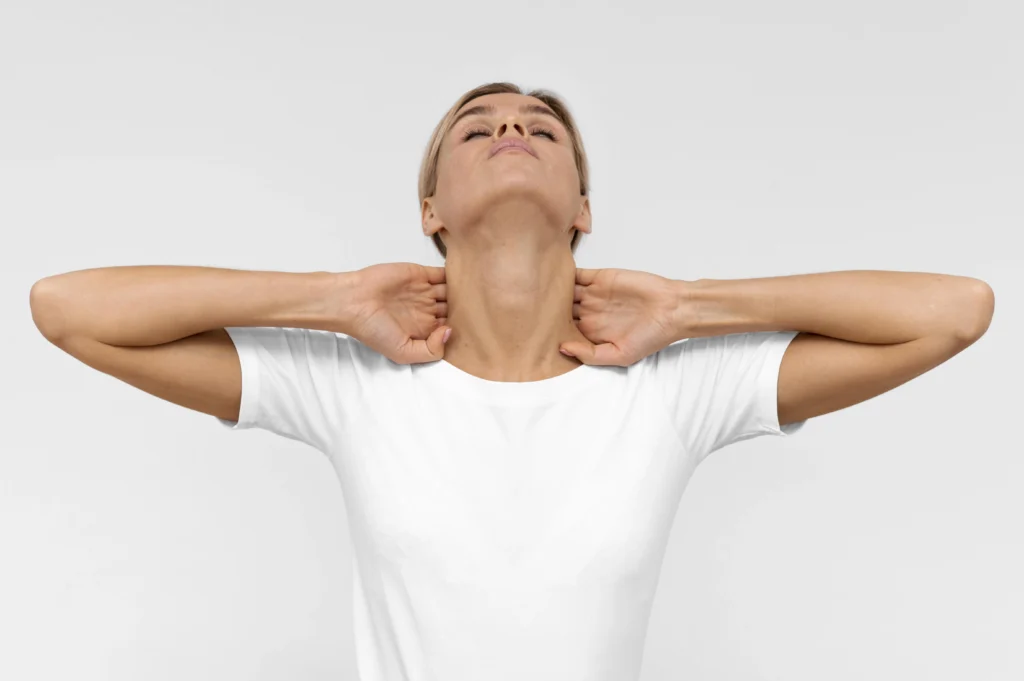
Facet Joint Irritation
This is one of the most frequent reasons I see in practice.
Facet joints are small joints at the back of your spine. When you look up, they take more load. If they are inflamed or stiff, extension becomes painful.
Typical signs include:
- Sharp pain when looking up
- Pain localized to one side
- Relief when you bring your head back to neutral (Binder, 2007)
Read about : What is Cervical Facet Joint Pain, how it causes cervicogenic headaches and how to correct it naturally
Postural Overload
If you spend hours on your phone or laptop, your neck stays in a forward position for a long time.
Over time:
- Deep stabilizing muscles become weak
- Larger muscles overwork
- Joint mechanics change
Then when you suddenly look up, your neck struggles to handle the load.
This is why many people feel pain only during that specific movement. Cagnie et al. (2014)
Learn how posture affects neck pain and correction exercises in our article on Simple Posture Correction Exercises for Forward Head Posture
Cervical Disc Stress
The disc in your neck helps absorb load. When irritated, certain movements can increase symptoms.
Looking up can:
- Increase pressure on the posterior disc
- Trigger stiffness
- Sometimes cause a deep aching sensation (Bogduk, 2011)
Read more: Cervical Disc Bulge: Causes, symptoms and treatment
Weak Deep Neck Flexors
This is something most people are never told.
Your neck has deep muscles that act like stabilizers. They are not very strong, but they are extremely important.
When they are weak:
- Movement becomes poorly controlled
- Bigger muscles compensate
- Pain appears during specific movements like extension (Jull et al. 2008)
Read in detail about: What is Cervical Spondylosis? The Truth Behind Chronic Neck Pain
Upper Back Stiffness
Your neck does not work alone.
If your upper back is stiff, your neck has to compensate for movements that should be shared.
So when you look up:
- Instead of movement spreading across spine
- It gets concentrated in the neck
That overload leads to pain.
Read in detail about: How to Fix Upper Crossed Syndrome Naturally
The Difference You Should Understand
This is honestly one of the most important parts to get right, because a lot of people treat all neck pain the same way.
And that is where mistakes happen.
In clinic, we don’t just look at where it hurts. We look at how it behaves. That tells us far more than the pain itself.
Let me explain this in a simple, practical way.
Read: Pain in the Back Side of the Neck: Causes and Treatment
Mechanical Neck Pain
This is the type of pain most people experience.
It usually develops slowly. You may not even notice when it started.
One day your neck just feels tight, and then certain movements begin to hurt, especially things like looking up, turning, or sitting for too long.
What you will typically notice:
- The pain comes and goes. Some days are better, some are worse
- It is clearly linked to posture or specific movements
- It may feel worse after long screen time or poor sleeping position
- Gentle movement or stretching actually makes it feel better
- There is no fever or general illness
- The pain feels like muscle tightness, stiffness, or a localized ache
Many patients tell me something like, “It hurts when I move it this way, but if I adjust my posture or walk around, it eases a bit.”
That is a strong sign of mechanical pain.
Another important point is this: mechanical pain often improves once you “warm up” the area.
Morning stiffness that reduces after some movement is very common here.
Read about: How to Relieve Morning Neck Stiffness Naturally
Non Mechanical or Concerning Pain
This is different, and it should not be ignored.
This type of pain does not behave like a typical muscle or joint issue. It does not follow the usual pattern of movement-related discomfort.
Instead, patients often describe it as:
- Constant, deep, and difficult to localize
- Present even when you are completely at rest
- Not clearly linked to any movement or posture
- Sometimes worse at night
- Associated with symptoms like fever, fatigue, or general unwell feeling
- Not improving with rest, stretching, or basic exercises
One thing I always ask is, “Does anything make it better?”
If the answer is “not really,” that raises concern.
Also, if someone says, “I have neck pain and I also feel feverish or unusually tired,” that is not something to brush off as a simple strain.
Why This Difference Matters
Because the approach is completely different.
With mechanical pain, movement is part of the treatment. We guide it, correct it, and strengthen the system.
With non mechanical pain, the priority is to identify the underlying cause first. Exercise is not the starting point there.
Read: Right Side Neck Pain: What Causes It and How To Treat
A Simple Way to Think About It
If your pain changes with movement, posture, or activity, it is usually mechanical.
If your pain stays the same no matter what you do, or is associated with fever or other systemic symptoms, it needs proper medical evaluation.
One Important Reminder
If fever is present, do not assume it is a simple neck issue.
It may still turn out to be nothing serious, but it is not something to self-treat or ignore. Getting it checked early is always the safer option.
What Is Actually Happening Inside Your Neck
When you look up, multiple structures work together.
- Joints compress slightly
- Muscles coordinate to control movement
- Ligaments provide support
If even one of these is not functioning properly, the load shifts.
That is when you start feeling pain.
The important thing to understand is this. Pain is not always about damage. It is often about imbalance.
Also Read : Neck Cracking: Benefits, Risks, and the Truth About Stroke
Lesser Known Factors That Can Make It Worse
Your Screen Position Matters More Than You Think
If your screen is too low, your neck stays bent forward for long periods.
Then when you look up, it becomes a sudden and stressful movement. (Szeto et al. 2002)
Read in detail: Best Desk Setup to Reduce Neck and Back Pain
Jaw Tightness Can Affect Your Neck
The jaw and neck share muscular connections.
If you clench your teeth frequently, your neck muscles remain tense. This reduces movement quality and can trigger pain during extension.
Read about: Neck And Jaw Pain Together? Here’s The Full Clinical Picture
Breathing Pattern Plays a Role
Shallow breathing activates neck muscles more than it should.
Over time, this increases baseline tension and reduces mobility.
Read About: Best Sleeping Position for Neck Pain: A Physiotherapist’s Complete Guide
Sleep Position Can Be a Hidden Cause
Using very high pillows or sleeping in awkward positions keeps your neck flexed for hours.
In the morning, extension feels restricted and painful.
Read About: How to Choose the Right and Best Pillow for Neck Pain
When Physiotherapy Helps and When It Should Not

Physiotherapy Helps When
- Pain is movement related
- No fever or systemic symptoms
- Pain changes with posture
- There is stiffness or muscle tightness
Avoid Starting Exercises Immediately If
- You have fever
- Pain is severe and unexplained
- There was recent trauma
- There is numbness or weakness
In such cases, proper medical evaluation is necessary first.
Read about: The Most Effective McKenzie Exercises For Neck Pain
Physiotherapy Approach That Actually Works
This is how we usually approach this problem clinically.
Step 1: Settle the Irritation
- Avoid repeated painful movements
- Maintain neutral posture
- Use heat if muscles feel tight
Step 2: Activate Deep Neck Muscles
Chin Tuck
- Sit upright
- Gently pull your chin backward
- Hold for 5 seconds
This improves control and reduces unnecessary strain.
Learn: How to do Chin Tucks for Neck Pain Relief and Posture Correction
Step 3: Improve Upper Back Mobility
Thoracic Extension
- Sit on a chair
- Place hands behind your head
- Gently extend your upper back
This helps distribute movement better.
Step 4: Build Stability
Isometric Neck Exercise
- Press your head gently into your hand
- Do not allow movement
- Hold for a few seconds
This strengthens support without stressing the joint.
Step 5: Correct Daily Posture
- Keep your screen at eye level
- Avoid long periods of looking down
- Take short breaks every 30 to 40 minutes
Read about: Which Is The Best Sitting Posture To Avoid Neck Pain And How To Achieve It
Simple Daily Habits That Help More Than You Expect
- Keep your phone at eye level
- Use a supportive pillow
- Stay active during the day
- Stretch lightly but regularly
- Stay hydrated
Small changes, done consistently, make a big difference.
Learn About: The Ultimate Neck Stretch Routine for Desk Workers in 2026
When You Should Not Ignore Neck Pain
Consult a doctor if you notice:
- Fever with neck pain
- Night pain that does not settle
- Unexplained weight loss
- Severe stiffness with headache
- Numbness or weakness in arms
These signs need proper medical attention.
Also Read: Ultimate 6 Weeks Neck Rehabilitation Exercises For Pain Relief
Conclusion
Neck pain when looking up is not random. It usually points to a mechanical issue involving joints, muscles, or posture.
In most cases, it is manageable and improves well with the right approach.
The key is not just doing exercises, but understanding why the pain is happening in the first place.
Once you correct movement, improve strength, and adjust your daily habits, the pain not only reduces but also becomes less likely to return.
Read about: Yoga for Neck Pain: Poses That Actually Work
Frequently Asked Question
Q1. Why does my neck hurt only when I look up?
This usually happens due to compression of joints or poor muscle control during extension movement.
Q2. Is neck pain when looking up dangerous?
Most cases are not serious, but if you have fever or constant pain, it should be evaluated.
Q3. Can posture really cause this problem?
Yes, prolonged forward head posture is one of the most common reasons behind this type of pain.
Q4. Which exercises help the most?
Chin tucks, thoracic mobility exercises, and isometric strengthening are effective when done properly.
Q5. Should I stop looking up completely?
No, but avoid repeated painful movements until your neck improves.
Q6. Can pillow height affect neck pain?
Yes, incorrect pillow height can strain your neck and contribute to stiffness.
Q7. When should I see a physiotherapist?
If pain lasts more than a few days or keeps coming back, professional guidance is helpful.
Stay tuned with us for more health related topics.
Follow us on LinkedIn and Instagram for more.
More Read


Medical Disclaimer!
This article has been reviewed and written under the guidance of our Head Physiotherapist, Dr. Kruti Raj (PT, MUHS,CPT,CMPT). The information shared is intended for educational purposes only and should not be considered a substitute for personalized medical advice, diagnosis, or treatment.
Please consult us or any other qualified healthcare professional before beginning any exercise program, especially if you are experiencing pain, recovering from injury, or managing a medical condition.