


In clinic, the sports injuries that create the most long-term problems are not always the ones that look serious.
An athlete may walk in saying,
“It was just a small hit”
or
“I only felt dizzy for a few minutes”
But when we assess them, the issue is rarely small.
Head and neck injuries affect:
- Neurological function
- Balance systems
- Muscle coordination
- Breathing patterns
Recent injury surveillance shows that although head and neck injuries make up a small proportion, they carry significant clinical impact. (Bahr et al. 2024)
Read about our Complete Neck Pain Guide : Causes, Symptoms, Exercises and Treatment
Quick Answer
Sports injuries of the head and neck include concussion, cervical strain, whiplash, and nerve injuries. These conditions affect not just pain but also balance, coordination, and neurological function. Physiotherapy focuses on restoring movement control, stability, and coordination to ensure safe recovery and reduce the risk of reinjury.
Read about: Early Signs of Cervical Spine Damage You Should Never Ignore
Key Takeaways
- Head and neck injuries can affect neurological function, balance, and coordination, not just cause pain.
- Recovery involves restoring movement patterns, proprioception, and motor control.
- Reduced proprioception and poor coordination increase the risk of reinjury.
- Pain relief alone does not indicate full recovery.
- Physiotherapy plays a key role in rebuilding control and preventing long-term complications.
Read about : 15 Common Causes of Neck Pain You Should Know
Understanding the Types of Head and Neck Sports Injuries
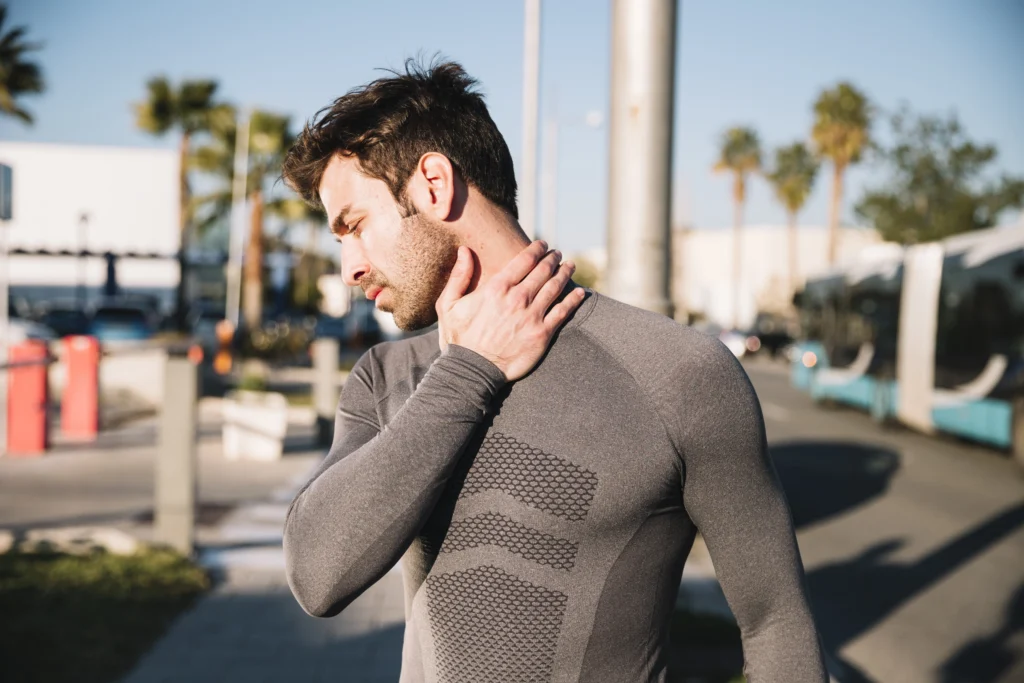
Concussion
A concussion is not always obvious.
Most athletes do not lose consciousness. Instead, they report:
- Slower thinking
- Difficulty concentrating
- Sensitivity to light
- Reduced coordination
It is a functional disturbance of brain activity.
What is often missed is the involvement of the neck.
More than 30 percent of athletes experience neck pain along with concussion, which affects recovery. Howell et al. (2024)
Read about: Cervical Ligament Injury or Neck Ligament Tear
Cervical Muscle Strain
Often dismissed as minor, but clinically more complex.
After injury:
- Deep stabilizers reduce activity
- Superficial muscles compensate
- Movement becomes inefficient
This is why symptoms tend to recur. (Jull et al. 2008)
Whiplash in Sports
Occurs during sudden acceleration or deceleration.
Common pattern:
- Minimal symptoms initially
- Increased stiffness after 24 hours
This delay is due to inflammatory response and muscle guarding. (Sterling (2011)
Read in detail: Whiplash Injury After An Accident? Here’s Treatment And Expert Rehab Guide
Nerve Injuries (Stingers or Burners)
Sudden nerve traction leads to:
- Burning sensation
- Temporary weakness
- Tingling
Repeated episodes suggest underlying instability. (Torg et al. 1997)
Read more: Cervical Disc Bulge: Causes, symptoms and treatment
Disc and Joint Injuries
Seen in repetitive stress conditions.
Symptoms:
- Radiating pain
- Numbness
- Weakness
These require careful assessment and structured rehab. (Bogduk 2011)
Read in detail about: Cervical Radiculopathy: Why Neck Nerve Pain Travels to the Arm
What Goes Wrong After Injury
Healing is not just about tissues repairing themselves.
That is only one part of the process, and often not the part that determines whether someone truly recovers.
What we see in practice is that the body adapts after injury. The problem is, these adaptations are not always helpful. In fact, many of them increase the likelihood of future issues.
Pain may reduce. Swelling may settle. But the way the body moves often changes in subtle ways that are easy to miss.
Altered Movement Patterns
After an injury, the body tries to protect itself.
This protection shows up as:
- Stiff, guarded movements
- Avoidance of certain directions
- Overuse of nearby muscle groups
For example, instead of smooth neck rotation, a person may start moving their entire upper body to compensate.
At first, this feels safer. Over time, it becomes the new normal.
The problem is that these patterns are inefficient. They increase strain on surrounding structures and reduce overall movement quality.
Reduced Proprioception
Proprioception is your body’s ability to sense position and movement.
In simple terms, it is how your brain knows where your head and neck are without looking.
After injury, this system becomes less accurate.
Patients often describe it as:
- Feeling “off” or unsteady
- Difficulty judging movement
- Lack of confidence during quick actions
This is not just psychological. It is a genuine sensory deficit.
When proprioception is reduced, the body reacts slower and less precisely. This becomes especially noticeable in sports where timing and positioning are critical.
Poor Motor Control
Motor control is about how muscles work together.
After injury, the timing between muscles changes.
What we commonly see is:
- Deep stabilizing muscles becoming less active
- Larger surface muscles taking over
- Delayed or uncoordinated activation
This creates a system where movement is possible, but not well controlled.
The person can still move their neck, but the quality of that movement is compromised.
Over time, this leads to:
- Fatigue
- Recurrent tightness
- Increased load on joints
Read in detail about: What is Cervical Spondylosis? The Truth Behind Chronic Neck Pain
Why This Matters More Than Pain
One of the biggest misconceptions is that recovery is complete when pain is gone.
In reality, pain is only one signal.
A person can be pain-free but still have:
- Poor control
- Reduced awareness
- Compensated movement patterns
This is exactly when re-injury tends to occur.
The body is back to activity, but not back to normal function.
Read in detail about: Cervical Disc Degeneration: The Hidden Cause of your Neck Pain
The Role of the Brain in Recovery
Another important piece is how the brain adapts.
After injury, the brain becomes more cautious.
It may:
- Limit movement subconsciously
- Increase muscle tension as a protective response
- Change how it processes sensory input
These changes are not always obvious, but they affect performance and recovery.
Rehabilitation, therefore, is not just physical. It is also about retraining how the brain and body communicate.
Read more: Rheumatoid Arthritis Neck: Causes, Symptoms and Treatments
Why Targeted Rehabilitation Is Essential
If these changes are not addressed, they do not simply disappear with time.
They become habits.
That is why physiotherapy focuses on:
- Restoring movement quality
- Improving proprioception
- Rebuilding coordination
Rather than just waiting for symptoms to settle.
Because true recovery is not about feeling better. It is about moving well again under real-world demands.
Read : A Complete Guide To Neck Arthritis
Recent Research That Changes Understanding
Impact Direction Matters
Rotational forces are more harmful than linear impacts. (Kieffer et al. 2024)
Neck Function Influences Injury Risk
Neck strength and control influence concussion risk, but strength alone is not enough. (Kay et al. 2024)
Neck Pain Slows Recovery
Athletes with neck pain post-concussion show prolonged symptoms. (Howell et al. 2023)
Neuromuscular Training Helps Prevention
Targeted neuromuscular programs reduce injury risk. (Schneider et al. 2023)
Read about: Effective Neck Pain Exercises At Home: A Complete Guide to Relief and Improved Mobility
Physiotherapy Recovery Guide
This is the point where treatment either works properly or fails quietly.
In many cases, pain reduces on its own over time. That does not mean recovery is complete.
From a physiotherapy perspective, we are not just looking at symptoms. We are looking at how the body is functioning after the injury.
Because what we often see is this:
The athlete feels better
But moves worse
That gap between feeling and function is where most re-injuries happen.
Recovery is not about chasing pain relief. It is about restoring control, confidence, and coordination under real-life demands.
Restoring Deep Neck Control
After head or neck injury, the deeper stabilizing muscles tend to switch off or become poorly coordinated.
These are not large, visible muscles. They do not produce big movements. But they are responsible for:
- Maintaining alignment
- Supporting the cervical spine
- Providing subtle stability during motion
When these muscles are not working properly, the body compensates by overusing larger superficial muscles.
This leads to stiffness, fatigue, and inefficient movement.
Rehabilitation here is very specific.
We do not start with heavy strengthening. Instead, we begin with:
- Low-load activation
- Gentle endurance work
- Precise positioning
The goal is to retrain timing and control, not just strength. (Jull et al. 2008)
Read: Spasm In Neck: What Causes It & How to Fix It Fast
Rebuilding Coordination
This is where many people underestimate the problem.
After injury, the issue is not just weakness. It is poor coordination between muscles.
Movements that were once automatic become awkward or guarded.
You may notice:
- Hesitation during movement
- Over-tightening of muscles
- Reduced fluidity
In physiotherapy, we gradually retrain these patterns.
This includes:
- Controlled head movements
- Integration with shoulder and upper body motion
- Functional tasks that mimic sport-specific demands
The aim is to make movement feel natural again, not forced.
Vestibular and Visual Rehabilitation
This becomes especially important after concussion.
The connection between the eyes, inner ear, and neck often becomes disrupted.
Patients may not always describe it clearly, but they experience:
- Dizziness with movement
- Difficulty focusing
- A sense of imbalance
These symptoms are not just “in the head” in a general sense. They are due to a mismatch between sensory systems.
Rehabilitation focuses on restoring that connection.
We use:
- Gaze stability exercises
- Head movement with visual tracking
- Gradual exposure to motion
Over time, this helps the brain process movement accurately again. (Alsalaheen et al. 2010)
Read more: Cervical Vertigo Explained: Why Neck Pain Make You Feel Dizzy
Breathing Re-education
This is one of the most overlooked areas, even in rehabilitation.
After neck injury, breathing patterns often change without the person realizing it.
Instead of using the diaphragm effectively, the body starts relying more on neck and upper chest muscles.
This leads to:
- Increased neck tension
- Faster fatigue
- Reduced efficiency during activity
Correcting breathing is not just about relaxation. It directly reduces load on the neck.
We guide patients through:
- Diaphragmatic breathing
- Rib cage expansion
- Controlled breathing during movement
Once breathing improves, many patients notice a reduction in both pain and stiffness. (Kapreli et al. 2009)
Gradual Return to Sport
One of the most common mistakes is returning to sport based only on how the athlete feels.
Feeling better is not the same as being ready.
Modern rehabilitation follows a step-by-step progression.
We gradually increase:
- Movement complexity
- Speed
- Load
- Sport-specific demands
At each stage, we assess how the body responds.
If symptoms return, we adjust. If not, we progress.
This structured approach reduces the risk of recurrence and builds confidence.
Complete rest is no longer recommended for extended periods. Controlled activity supports recovery. (McCrory et al. 2017)
Read : Chiropractic for Neck Pain: Does It Really Work?
Prevention
Prevention is often misunderstood.
It is not about doing a few neck exercises and assuming you are protected.
It is about how well your body responds under stress.
Control Over Strength
Strength is useful, but without control it does not translate into protection.
An athlete with good coordination can react faster, adjust position, and absorb impact more efficiently.
Training should include:
- Reaction drills
- Dynamic stability work
- Controlled movement under changing conditions
Whole Body Approach
The neck does not function in isolation.
It works together with:
- Shoulders
- Upper back
- Core
If one part is weak or stiff, the load shifts elsewhere.
That is why we include:
- Scapular stability training
- Thoracic mobility exercises
- Core control work
This creates a more balanced and resilient system.
Reducing Repetitive Impacts
Not all injuries come from one big event.
Repeated smaller impacts can build up over time.
This is particularly relevant in contact sports and training environments.
Managing exposure becomes important.
This may include:
- Monitoring training intensity
- Adjusting drills
- Allowing adequate recovery
Early Reporting
This is one of the most practical but overlooked factors.
Athletes often ignore early symptoms to continue playing.
What starts as mild discomfort can develop into a more complex issue.
Early assessment allows:
- Faster recovery
- Less time away from sport
- Reduced risk of long-term problems
From experience, the athletes who report early recover faster than those who wait.
Read more: Is Cervical Traction For Neck Pain Really Effective
Lesser-Known Clinical Insights
Rotational Forces Are Key
Not all impacts are equal in risk. (Kieffer et al. 2024)
Neck Dysfunction Affects Vision
Neck issues can alter eye movement and coordination. (Treleaven 2008)
Technology in Injury Detection
Wearable sensors are improving injury monitoring. (Wu et al. 2024)
Also Read: Ultimate 6 Weeks Neck Rehabilitation Exercises For Pain Relief
When You Should Seek Help
Do not ignore:
- Persistent headaches
- Neck stiffness
- Dizziness
- Tingling
- Difficulty concentrating
Early intervention improves outcomes significantly.
Read: Lhermitte’s sign- An Electic Shock Sensation Down The Neck
Frequently Asked Question
Q1. What happens to the body after a neck injury?
The body adapts by changing movement patterns, reducing proprioception, and altering muscle coordination.
Q2. Why does pain reduce but the problem still remain?
Pain may settle, but underlying movement and control issues often persist, increasing reinjury risk.
Q3. What is proprioception and why is it important?
Proprioception is the body’s ability to sense position and movement, which is essential for balance and coordination.
Q4. Can poor movement patterns cause reinjury?
Yes, altered movement patterns increase stress on tissues and raise the risk of repeated injury.
Q5. How does physiotherapy help after head or neck injury?
It restores movement quality, improves coordination, and retrains the body for safe activity.
Q6. Is rest enough for recovery?
No, proper rehabilitation is needed to restore function and prevent long-term problems.
Q7. When should I seek treatment?
If symptoms persist, movement feels abnormal, or daily activities are affected.
Stay tuned with us for more health related topics.
Follow us on LinkedIn and Instagram for more.
More Read


Medical Disclaimer!
This article has been reviewed and written under the guidance of our Head Physiotherapist, Dr. Kruti Raj (PT, MUHS,CPT,CMPT). The information shared is intended for educational purposes only and should not be considered a substitute for personalized medical advice, diagnosis, or treatment.
Please consult us or any other qualified healthcare professional before beginning any exercise program, especially if you are experiencing pain, recovering from injury, or managing a medical condition.


