


When someone walks into my clinic with an MRI report mentioning “facet arthropathy,” the first thing I notice is not their scan. It is how they move, sit, and describe their pain.
Facet arthropathy refers to degeneration or irritation of the small joints at the back of the spine.
These joints guide movement and provide stability. But here is something most people are not told clearly.
Degeneration does not always mean pain.
Research has shown that a significant number of people without back pain still show facet joint changes on imaging, which means the presence of arthropathy alone does not confirm it as the pain source (Acosta Julbe et al., 2024)
That changes how we approach treatment completely.
Read about our Complete Neck Pain Guide : Causes, Symptoms, Exercises and Treatment
Quick Answer
Facet arthropathy is a condition where the facet joints of the spine become irritated or degenerated, leading to localized back or neck pain. It is often caused by mechanical overload rather than just aging. Physiotherapy focusing on movement correction, posture, and core stability is the most effective long-term treatment.
Read about: Early Signs of Cervical Spine Damage You Should Never Ignore
Key Takeaways
- Facet joints are a significant source of spinal pain
- Imaging findings do not always match symptoms
- Muscle weakness and poor movement patterns contribute to pain
- Physiotherapy is the most effective long-term management
- Correct movement reduces recurrence risk
Read about : What is Cervical Facet Joint Pain, how it causes cervicogenic headaches and how to correct it naturally
Why These Joints Become Painful
From a clinical standpoint, facet arthropathy is less about aging and more about how load is distributed in the spine over time.
Load transfer from discs
When intervertebral discs lose height, more load shifts toward facet joints. This increases compression and stress on these joints, especially in the lumbar spine.
Muscle dysfunction
One of the more interesting findings in recent research is the role of paraspinal muscles.
Reduced muscle quality and fatty infiltration are associated with facet joint degeneration, which suggests that weak stabilizers may contribute to joint overload (Guven et al., 2024)
Movement habits
In practice, I often see:
- Excessive spinal extension during activities
- Poor lifting mechanics
- Standing with increased lumbar arch
These patterns create repeated compression on facet joints.
Read more: Cervical Vertigo Explained: Why Neck Pain Make You Feel Dizzy
How Common Is Facet Joint Pain Really
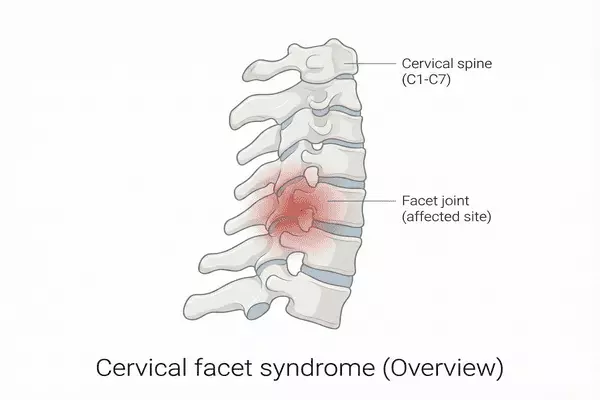
Facet joints are not a rare cause of pain.
In fact, they are responsible for a meaningful proportion of chronic spinal pain cases.
Some studies estimate that facet joints contribute to around 15 percent of chronic low back pain cases, though clinical observations often suggest higher involvement (Mahapatra et al., 2024)
This is important because many of these cases are initially labeled as disc problems.
Read: A Complete Guide To Sinuses Related Neck Pain
Recognizing the Pattern of Facet Pain
Facet pain behaves in a very specific way. Once you start noticing the pattern, it becomes easier to differentiate from other causes.
Patients usually describe:
- Pain that increases with standing
- Discomfort when leaning backward
- Morning stiffness that improves with movement
- Pain localized to the back or radiating to buttocks, but rarely below the knee
This pattern reflects mechanical irritation rather than nerve compression.
Read about: How to Relieve Morning Neck Stiffness Naturally
How to Tell If Your Pain Might Be Coming From Facet Joints
In clinic, I don’t rely on just one sign. It’s usually a pattern. But here are a few simple ways patients often recognize it themselves.
You may be dealing with facet-related pain if:
- Your pain increases when you lean backward
- Standing in one place feels worse than walking
- Sitting relieves your pain slightly
- Pain stays in the lower back or goes to the buttock, but not below the knee
- Twisting to one side feels restricted or painful
A small real-life clue
Some patients tell me, “I feel worse when brushing my teeth or looking up for a long time.”
That subtle extension movement often points toward facet involvement.
This is not a diagnosis, but it gives a useful direction before assessment.
Read in detail about: What is Cervical Spondylosis? The Truth Behind Chronic Neck Pain
Why Imaging Can Be Misleading
MRI and CT scans are useful, but they have limitations.
There is often a mismatch between imaging findings and symptoms.
Some patients have severe degeneration without pain, while others have significant pain with minimal findings.
Additionally, inflammatory changes within facet joints are sometimes underreported on imaging, which can lead to underestimation of their role in pain (Acosta Julbe et al., 2024)
This is why clinical examination remains essential.
Read in detail about: Cervical Disc Degeneration: The Hidden Cause of your Neck Pain
What Is Happening Inside the Joint
Facet arthropathy is not just cartilage wear.
There can be:
- Synovial inflammation
- Joint capsule thickening
- Bone changes
- Fluid accumulation
Recent literature suggests that inflammatory processes may play a larger role in symptom generation than previously thought, especially in early stages (Manchikanti et al., 2025)
Read : A Complete Guide To Neck Arthritis
What Happens If It Is Ignored
If left unaddressed, facet-related pain can become persistent.
The body adapts in ways that are not helpful:
- Muscles become tight
- Movement becomes guarded
- Pain sensitivity increases
Over time, this creates a cycle where even simple movements feel uncomfortable.
Read more: Cervical Myelopathy: The Hidden Neck Condition Affecting Your Walking
Physiotherapy: What Actually Works
This is where things start to change for patients.
Facet arthropathy responds well to physiotherapy, but only when the approach is specific.
Generic exercise programs usually fail because they do not address the underlying issue, which is how the spine is being loaded.
Read about: Effective Neck Pain Exercises At Home: A Complete Guide to Relief and Improved Mobility
Phase 1: Reduce Irritation
In the early stage, the goal is to calm the joint.
- Avoid repeated extension
- Use gentle mobility exercises
- Introduce breathing techniques to reduce muscle guarding
Jumping into strengthening too early can increase symptoms.
Phase 2: Restore Control
This is where meaningful improvement begins.
Focus areas:
- Deep core activation
- Pelvic alignment
- Awareness of neutral spine
A recent physiotherapy study showed that a structured, multimodal rehabilitation approach significantly improves pain and function in patients with chronic spinal conditions (Smith et al., 2024)
Phase 3: Build Strength and Function
Once control improves, strength training is introduced.
- Glute strengthening
- Hip hinge training
- Functional movement retraining
The aim is not just strength, but efficient load transfer through the body.
Read about: Neck And Jaw Pain Together? Here’s The Full Clinical Picture
Common Mistakes
Over time, I’ve noticed that many people with facet-related pain are not lacking effort.
They’re just doing the wrong things at the wrong time.
Read: Spasm In Neck: What Causes It & How to Fix It Fast
These are the most common patterns:
- Starting strengthening exercises too early when pain is still high
- Doing random YouTube exercises without understanding their condition
- Avoiding movement completely out of fear
- Pushing through pain thinking it will “loosen up”
- Ignoring posture during long sitting hours
One thing I often tell patients
“Recovery is not about doing more. It’s about doing the right things at the right stage.”
That shift alone changes outcomes.
Read about: Yoga for Neck Pain: Poses That Actually Work
A Key Insight From Clinical Practice
Facet joints are rarely the primary problem.
They are often the result of poor load management.
So recovery depends on correcting movement patterns, not just reducing pain.
Also Read: Ultimate 6 Weeks Neck Rehabilitation Exercises For Pain Relief
Exercises That Help
When performed correctly:
- Bird dog
- Side plank
- Glute bridges
- Controlled spinal mobility exercises
These improve stability without excessive compression.
Read more: Is Cervical Traction For Neck Pain Really Effective
Exercises That Can Worsen Symptoms
Certain movements increase facet joint stress:
- Repeated back extension exercises
- Poorly performed deadlifts
- Deep backbends
These should be modified or avoided initially.
Read about: Which Is The Best Sitting Posture To Avoid Neck Pain And How To Achieve It
What to Do and Avoid in Daily Life
This is where most people either improve steadily or keep irritating the joint without realizing it.
What usually helps
- Change positions frequently instead of staying still too long
- Use a small lumbar support while sitting
- Walk regularly instead of prolonged standing
- Bend from hips instead of rounding your back
What tends to aggravate symptoms
- Standing in one place for long durations
- Sudden backward bending movements
- Slouching for hours, especially on soft sofas
- Lifting objects without engaging your core
Read: Simple Posture Correction Exercises for Forward Head Posture
A simple rule I give patients
“If a movement compresses your lower back repeatedly, reduce it. If it helps you move more freely, keep it.”
It sounds simple, but it works surprisingly well.
Read About: How to Choose the Right and Best Pillow for Neck Pain
When Medical Interventions Are Needed
In some cases, pain may be too severe to begin rehabilitation comfortably.
Options include:
- Medial branch blocks
- Radiofrequency ablation
Clinical studies have shown that radiofrequency ablation can provide significant pain relief in facet-mediated pain, particularly when diagnosis is confirmed through diagnostic blocks (Shamim et al., 2024)
There is also growing interest in regenerative treatments like platelet-rich plasma, although more evidence is still emerging (Manchikanti et al., 2025)
Read : Chiropractic for Neck Pain: Does It Really Work?
Lesser Known Facts
- Facet degeneration does not always cause pain
- Muscle weakness plays a significant role
- Imaging findings alone are not reliable
- Movement patterns influence symptoms more than structure
Also Read : Neck Cracking: Benefits, Risks, and the Truth About Stroke
What Recovery Usually Feels Like
Recovery from facet arthropathy is not always linear. Patients often expect quick relief, but the body takes time to adapt.
In the first 1 to 2 weeks
- Pain may still be present
- Movement starts feeling slightly easier
- Stiffness reduces gradually
Around 3 to 4 weeks
- Pain becomes more predictable
- Flare-ups reduce
- Confidence in movement improves
By 5 to 8 weeks
- Daily activities feel easier
- Strength improves
- Pain is either minimal or manageable
A small but important point
Progress is not about pain disappearing overnight. It’s about moving better with less discomfort over time.
Read more: Heat Or Cold Therapy for Neck Pain: What Actually Works?
Can You Recover Fully
Yes, many patients improve significantly.
Recovery depends on:
- Consistent physiotherapy
- Correct exercise progression
- Awareness of posture and movement
It is not about avoiding movement, but about improving how you move.
Read: 10 Proven Home Remedies for Neck Pain from Anxiety
When You Should Seek Help
You should consult a physiotherapist if:
- Pain lasts more than two to three weeks
- Movement becomes restricted
- Pain increases with extension
Early intervention makes recovery easier and faster.
Read: How to Fix Sagging,Ozempic Neck After Rapid Weight Loss
Conclusion
Facet arthropathy is less about aging and more about how the spine is used over time. While scans may show degeneration, the real issue is often poor load management and movement patterns.
The good news is that most cases improve with the right physiotherapy approach. By correcting posture, improving muscle control, and gradually building strength, pain can be reduced significantly.
Focus less on the report and more on how you move. With consistent effort and the right guidance, recovery is very achievable.
Read more: Is Cervical Traction For Neck Pain Really Effective
Frequently Asked Questions
1. What is facet arthropathy?
It is degeneration or irritation of facet joints in the spine causing localized pain and stiffness.
2. Is facet arthropathy serious?
It is manageable and often improves with physiotherapy.
3. Can MRI confirm facet pain?
No, MRI shows structural changes but cannot confirm the pain source.
4. What movement worsens facet pain?
Spinal extension and prolonged standing usually increase symptoms.
5. Can exercise help?
Yes, targeted physiotherapy exercises are very effective.
6. Is surgery required?
Rarely. Most cases respond well to conservative care.
7. How long does recovery take?
Most patients improve within 4 to 8 weeks.
8. Can it come back?
Yes, if movement patterns and posture are not corrected.
Stay tuned with us for more health related topics.
Follow us on LinkedIn and Instagram for more.
More Read


Medical Disclaimer!
This article has been reviewed and written under the guidance of our Head Physiotherapist, Dr. Kruti Raj (PT, MUHS,CPT,CMPT). The information shared is intended for educational purposes only and should not be considered a substitute for personalized medical advice, diagnosis, or treatment.
Please consult us or any other qualified healthcare professional before beginning any exercise program, especially if you are experiencing pain, recovering from injury, or managing a medical condition.


