


What is Stingers or Burners Syndrome?
If you ask most athletes, they’ll describe it the same way
“A sudden shock running from the neck into the arm”
Clinically, burners or stingers are transient nerve injuries involving the brachial plexus or cervical nerve roots, most commonly C5 and C6.
These nerves are responsible for shoulder and arm movement, which explains why symptoms feel so dramatic even when the injury is temporary.
Recent literature describes this condition as a form of neuropraxia, meaning the nerve conduction is temporarily disrupted without structural damage. (Windmueller et al., 2025)
What makes burners unique is not just the pain, but how quickly it appears and disappears. That unpredictability is exactly why many athletes ignore it.
Read about our Complete Neck Pain Guide : Causes, Symptoms, Exercises and Treatment
Quick Answer
Burners (Stingers) Syndrome is a temporary nerve injury affecting the neck and shoulder region, usually caused by sudden impact or stretching of the brachial plexus. It leads to a sharp burning or electric shock sensation that travels down the arm. Most cases resolve quickly, but repeated episodes or prolonged symptoms require proper medical evaluation and physiotherapy management.
Read about: Early Signs of Cervical Spine Damage You Should Never Ignore
Key Takeaways
- Burners are temporary nerve injuries commonly seen in contact sports and gym activities.
- The most common symptom is a sudden burning or electric sensation radiating down one arm.
- Most cases resolve within minutes, but persistent symptoms need evaluation.
- Recurrent stingers may indicate underlying neck or nerve issues.
- Physiotherapy plays a key role in recovery through strength, posture, and nerve mobility training.
- Returning to sport too early increases the risk of repeated injury.
- Strong neck muscles and proper technique significantly reduce the risk.
Also read: How to Relieve Neck Tightness Without Equipment
What Actually Happens Inside the Body
Let me explain this in a way patients usually understand.
The nerve is not torn. It is more like a temporary electrical failure.
- The signal from the brain does not travel properly
- Muscles lose activation briefly
- Sensation becomes distorted
This leads to:
- Burning sensation
- Tingling
- Weakness
Agranovich et al., 2024 describe this as transient brachial plexopathy caused by forced neck or arm movement
Now here is something most articles skip
Repeated episodes reduce the nerve’s tolerance, making future injuries easier
Read about : 15 Common Causes of Neck Pain You Should Know
Why Burners Are More Common Than You Think

Burners are not rare. They are just underreported. (Gebeyehu et al., 2025)
- Up to 50 percent of athletes experience at least one episode
- Career incidence in football players reaches 49 to 65 percent
- Around 62 percent of neck injuries in NFL athletes are stingers
Another important observation
Many athletes do not report symptoms at all
This leads to repeated injuries and delayed recovery. (Lamplot et al., 2024)
Read about: Cervical Ligament Injury or Neck Ligament Tear
Symptoms That Go Beyond “Burning Pain”
The classic symptom is a burning or electric sensation. But clinically, the presentation is broader.
- Sudden sharp pain in the neck or shoulder
- Radiating symptoms down one arm
- Tingling or pins and needles
- Temporary arm weakness
- Reduced grip strength
- Limited neck movement
In some cases:
- Weakness appears hours later
- Symptoms last longer than expected
That delayed weakness is something I always take seriously in practice. (Gebeyehu et al., 2025)
Read more: Is Cervical Traction For Neck Pain Really Effective
Mechanism of Injury (What Actually Causes It)
There are three classic mechanisms, but let’s connect them to real situations.
Traction Injury
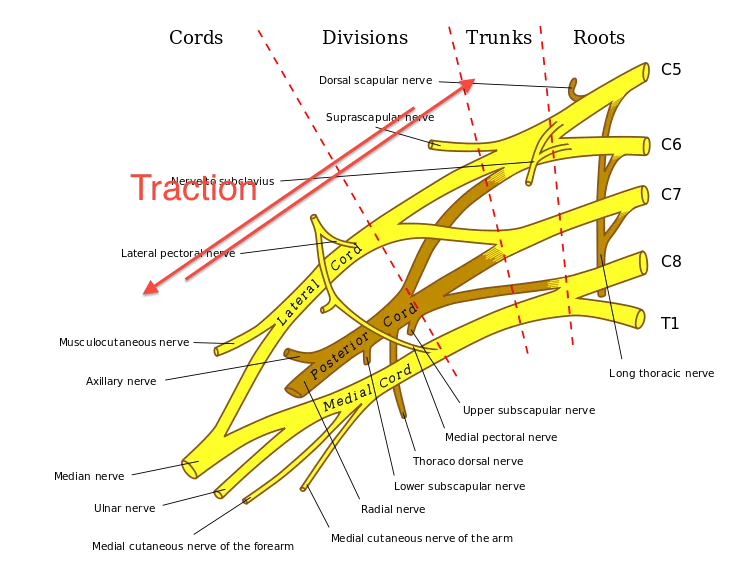
Shoulder forced downward while the neck bends the opposite way. Common in tackles or falls
Compression Injury
Direct blow to the neck or shoulder region. Seen in contact collisions
Nerve Root Compression
Neck extension combined with rotation. Often seen in gym or overhead movements (TeachMe Orthopedics, 2025)
Read in detail about: Cervical Radiculopathy: Why Neck Nerve Pain Travels to the Arm
Why Some Athletes Keep Getting Burners
This is where the real clinical reasoning begins.
Recurrent burners are rarely random. There is usually an underlying issue.
Narrow Cervical Canal
Less space for nerves increases compression risk
Weak Neck Muscles
Reduced ability to absorb impact
Poor Scapular Control
Shoulder instability increases nerve stress
Reduced Neural Mobility
Nerves do not glide properly
From experience, most recurrent cases involve at least two of these factors.
Read in detail about: Cervical Disc Degeneration: The Hidden Cause of your Neck Pain
Red Flags That Should Never Be Ignored
This part matters more than anything else.
Stop activity and seek evaluation if you notice:
- Symptoms lasting more than a few minutes
- Weakness that does not resolve
- Symptoms in both arms
- Neck pain with stiffness
- Recurrent episodes
Persistent neurological symptoms require proper assessment before returning to activity. (SportsMD, 2024)
Read more: Cervical Myelopathy: The Hidden Neck Condition Affecting Your Walking
How to Differentiate a Burner from a Serious Neck Injury
One question I hear a lot in the clinic is this
“How do I know if it’s just a stinger or something more serious?”
That’s a very valid concern. Because early symptoms can feel similar, but the implications are very different.
Here’s a simple way to think about it.
Read : How to Treat Neck Pain in Ankylosing Spondylitis
Signs It’s Likely a Simple Burner
- Pain or tingling is only on one side
- Symptoms settle within seconds to a few minutes
- No lasting weakness
- Neck movement feels mostly normal after a short time
- You regain full arm function quickly
These are typical features of a transient nerve irritation.
Signs It May Be Something More Serious
- Symptoms last more than 15 to 20 minutes
- Weakness does not fully recover
- Pain is present in both arms
- Significant neck pain or stiffness
- Repeated episodes happening close together
- Loss of coordination or grip strength
These signs suggest that the issue may involve deeper nerve structures or even the cervical spine itself.
Read: Lhermitte’s sign- An Electic Shock Sensation Down The Neck
A Simple Rule I Tell My Patients
If it disappears quickly and completely, monitor it.
If it lingers or comes back, get it assessed.
Why This Matters
Ignoring the difference can delay diagnosis of conditions like:
- Cervical disc issues
- Nerve root compression
- Early spinal canal narrowing
And in sports settings, this can directly affect safe return to play.
Read more: Cervical Disc Bulge: Causes, symptoms and treatment
Diagnosis: What a Physiotherapist Looks For
Diagnosis is not just about confirming a stinger. It is about ruling out serious conditions.
Clinical Examination
- Muscle strength testing
- Sensory mapping
- Reflex assessment
Movement Assessment
- Cervical mobility
- Symptom reproduction
Imaging (if required)
- MRI for nerve compression
- X-ray for structural issues
Persistent symptoms always require imaging before return to sport
Read in detail: Whiplash Injury After An Accident? Here’s Treatment And Expert Rehab Guide
Physiotherapy Management: What Actually Works
Most online advice stops at rest. That is incomplete.
Recovery happens in stages.
Phase 1: Acute Stage
- Relative rest
- Avoid aggressive stretching
- Gentle neck movement
Phase 2: Neural Recovery
- Nerve gliding exercises
- Pain-free movement restoration
- Light activation exercises
Phase 3: Strength and Control
This is the most important phase.
- Deep neck flexor strengthening
- Scapular stabilization
- Postural correction
Skipping this phase is the biggest reason for recurrence
Phase 4: Return to Sport
Return only when:
- Full range of motion is restored
- Strength is normal
- No neurological symptoms remain
Athletes should not return until all symptoms completely resolve and examination is normal.
(DrOracle Clinical Summary, 2025)
Read about: Effective Neck Pain Exercises At Home: A Complete Guide to Relief and Improved Mobility
Lesser-Known Rehabilitation Insight
Here is something I rarely see discussed.
Nerve recovery is not just about strength. It is about timing and coordination.
If muscles activate late:
- Nerve stress increases
- Symptoms return
This is why neuromuscular control training is essential.
Read: Spasm In Neck: What Causes It & How to Fix It Fast
Prevention: What Actually Reduces Risk
Prevention is not just about “being careful”
It is structured.
- Strengthen neck muscles regularly
- Improve posture
- Train scapular stability
- Maintain thoracic mobility
- Use proper technique in sports and gym
Read about: Yoga for Neck Pain: Poses That Actually Work
Prognosis and Recovery Timeline
The good news
- Most burners resolve quickly
- Many athletes return to sport without long-term issues
But
- Severe cases may take 2 to 6 weeks
- Recurrent cases increase long-term risk (Gebeyehu et al., 2025)
Read : Chiropractic for Neck Pain: Does It Really Work?
A Clinical Note You Won’t Read Everywhere
I’ll keep this simple.
Athletes who ignore burners usually return with more severe symptoms.
Athletes who address them early rarely have long-term problems.
It is not about how painful the first episode is
It is about how you respond to it
Also Read : Neck Cracking: Benefits, Risks, and the Truth About Stroke
Frequently Asked Questions
1. What is a burner or stinger injury?
It is a temporary nerve injury affecting the brachial plexus or cervical nerve roots, causing a sudden burning sensation in the arm.
2. Are burners serious?
Most cases are mild, but repeated injuries can lead to long-term nerve problems.
3. How long do symptoms last?
They usually last seconds to minutes, but in some cases can persist for days or weeks.
4. Can I continue playing after a stinger?
No, return only after complete recovery and normal neurological examination.
5. What causes recurrent stingers?
Weak neck muscles, poor posture, and cervical spine issues are common causes.
6. Do I need an MRI?
MRI is recommended if symptoms persist, recur, or include weakness.
7. What is the best treatment?
Physiotherapy focusing on strength, posture, and nerve mobility is most effective.


