


Understanding your endometriosis stage can help you make informed treatment decisions.
Many women believe that severe period pain is simply a part of being a woman.
However, pain that regularly disrupts work, school, exercise, sleep, or daily activities is not considered normal and should be medically evaluated.
One possible cause is endometriosis, a chronic condition that affects an estimated 1 in 10 women and girls of reproductive age worldwide (World Health Organization).
Quick Answer
Endometriosis is a chronic condition in which tissue similar to the lining of the uterus grows outside the uterus. It commonly causes severe period pain, chronic pelvic pain, pain during sex, and fertility problems. Although there is no cure, early diagnosis, medical treatment, lifestyle modifications, and pelvic health physiotherapy can help manage symptoms and improve quality of life.
Endometriosis occurs when tissue similar to the lining of the uterus grows outside the uterus.
These growths most commonly develop on the ovaries, fallopian tubes, pelvic lining, and surrounding pelvic organs.
Like the uterine lining, these tissues respond to hormonal changes during each menstrual cycle.
They can thicken, break down, and bleed, but unlike menstrual blood, they have no natural way to leave the body.
This repeated cycle can trigger inflammation, irritation, scar tissue formation, and chronic pelvic pain.
Some women may also experience fertility challenges, while others have few or no noticeable symptoms.
Although endometriosis cannot currently be cured, early diagnosis and appropriate treatment can help relieve symptoms, improve quality of life, and reduce long-term complications.
Medical treatment, lifestyle changes, and pelvic health physiotherapy often work together to manage the condition effectively.
Key Takeaways
- Endometriosis affects approximately 1 in 10 women of reproductive age.
- Severe period pain is not normal and should be medically assessed.
- Symptoms vary widely and do not always match the stage of the disease.
- Early diagnosis can help reduce pain and improve long-term outcomes.
- Treatment may include medication, hormonal therapy, surgery, lifestyle changes, and physiotherapy.
- Pelvic health physiotherapy can help reduce pain, improve movement, and enhance quality of life.
- A multidisciplinary approach often provides the best long-term management.
What Is Endometriosis?
Endometriosis is a chronic inflammatory gynecological condition in which tissue similar to the endometrium (the inner lining of the uterus) grows outside the uterine cavity
These abnormal growths, known as endometriotic lesions or implants, may develop on the ovaries, fallopian tubes, pelvic peritoneum, bladder, bowel, ligaments supporting the uterus, and, in rare cases, even outside the pelvis.
Unlike normal endometrial tissue, these lesions cannot leave the body during menstruation.
Instead, they continue to stimulate inflammation, attract immune cells, and contribute to the formation of scar tissue and adhesions.
Endometriosis affects every woman differently.
While some experience severe pelvic pain, painful periods, or pain during sexual intercourse, others may only discover the condition during investigations for infertility.
Why Does Endometriosis Cause Pain?
Pain associated with endometriosis is more complex than simply having tissue outside the uterus.
It develops because of ongoing inflammation, hormonal stimulation, nerve irritation, and scar tissue formation.
During each menstrual cycle, endometriotic tissue reacts to estrogen in much the same way as the uterine lining.
This repeated inflammatory response can irritate surrounding tissues and nearby nerves.
As the body attempts to heal, scar tissue and adhesions may develop.
These adhesions can restrict the normal movement of pelvic organs, making everyday activities such as walking, exercising, or sexual intercourse painful.
Over time, the nervous system itself may become more sensitive to pain, which explains why some women continue to experience discomfort even between menstrual periods.
Types of Endometriosis
Doctors generally classify endometriosis according to the location and depth of the lesions.
Understanding the type of endometriosis helps guide treatment planning and predict possible complications (Becker et al., 2022).
Superficial Peritoneal Endometriosis
This is the most common form of the disease.
Small lesions develop on the lining of the pelvic cavity and may still cause significant pain despite appearing minimal.
Ovarian Endometriosis (Endometrioma)
In some women, endometriosis forms cysts inside the ovaries known as endometriomas.
These cysts contain old, thick blood and are often referred to as “chocolate cysts.”
Deep Infiltrating Endometriosis (DIE)
Deep infiltrating endometriosis occurs when lesions grow more than 5 mm beneath the tissue surface.
It commonly affects the bowel, bladder, uterosacral ligaments, or pelvic nerves and is frequently associated with more severe symptoms.
Extrapelvic Endometriosis
Although uncommon, endometriosis can occasionally affect organs outside the pelvis, including the diaphragm, lungs, abdominal wall, or previous surgical scars.
What Causes Endometriosis?
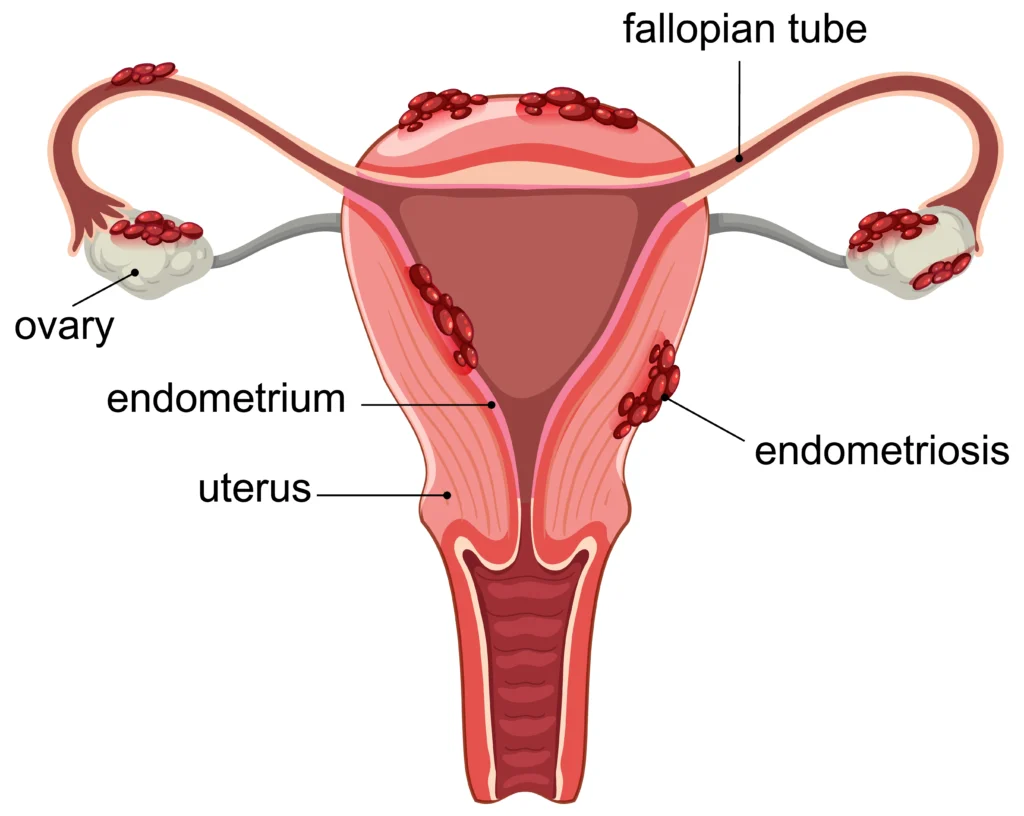
The exact cause of endometriosis remains unknown.
Most researchers believe it develops through a combination of genetic, hormonal, immune, and environmental factors rather than a single cause.
One of the most widely accepted theories is retrograde menstruation, where some menstrual blood flows backward through the fallopian tubes into the pelvic cavity instead of leaving the body.
However, because retrograde menstruation occurs in many women who never develop endometriosis, researchers believe additional factors must also contribute (Zondervan et al., 2020).
Genetics also appears to play an important role.
Women with a mother, sister, or daughter diagnosed with endometriosis have a significantly higher risk of developing the condition themselves.
Researchers have also identified changes in immune function that may prevent the body from clearing misplaced endometrial-like cells.
This allows lesions to survive, grow, and continue causing inflammation.
Because endometriosis is an estrogen-dependent condition, the hormone estrogen stimulates the growth and activity of endometriotic lesions.
This explains why symptoms often improve after menopause, when estrogen levels naturally decline.
Emerging research also suggests that stem cells and alterations in the pelvic microbiome may contribute to the development of endometriosis, although these mechanisms continue to be investigated.
Risk Factors
Certain factors are associated with a higher likelihood of developing endometriosis, although having these risk factors does not guarantee that someone will develop the condition.
Risk factors include:
- A family history of endometriosis.
- Starting menstruation at an early age.
- Short menstrual cycles.
- Heavy or prolonged menstrual bleeding.
- Never having been pregnant.
- Delayed childbirth.
- Congenital abnormalities affecting menstrual flow.
- Higher lifetime exposure to estrogen.
- Certain genetic and immune-related factors.
Many women diagnosed with endometriosis have no obvious risk factors, highlighting the complex nature of the disease.
Stages of Endometriosis
The American Society for Reproductive Medicine (ASRM) classifies endometriosis into four stages based on the number, size, depth, and location of lesions, as well as the presence of adhesions. (Lee et al. 2020)
Stage I – Minimal
Only a few superficial lesions are present, with little or no scar tissue.
Stage II – Mild
More lesions are visible, and some extend slightly deeper beneath the tissue surface.
Stage III – Moderate
Deep lesions become more common, and ovarian endometriomas or early adhesions may be present.
Stage IV – Severe
Large endometriomas, dense adhesions, and extensive disease may involve the ovaries, bowel, bladder, or other pelvic organs
It is important to remember that the stage of endometriosis does not always reflect the severity of symptoms.
Some women with Stage I disease experience debilitating pain, while others with Stage IV disease have relatively mild symptoms.
Lesser-Known Fact: Tiny endometriosis lesions located near sensitive pelvic nerves may cause more pain than larger lesions found elsewhere. This is one reason why symptom severity does not always match the stage of the disease.
Symptoms of Endometriosis
The symptoms of endometriosis vary widely.
Some women experience severe pelvic pain, while others have only mild symptoms or no symptoms at all.
Painful periods are the most common complaint.
The pain often begins before menstruation, continues during the period, and may interfere with work, school, or everyday activities.
Chronic pelvic pain can also occur between menstrual periods.
For some women, the pain becomes persistent rather than occurring only during menstruation.
Pain during or after sexual intercourse is another common symptom.
This may happen when endometriosis affects tissues deep within the pelvis.
Some women experience pain while passing urine or having a bowel movement, particularly during their menstrual period.
These symptoms are more common when the bladder or bowel is involved.
Other possible symptoms include:
- Heavy menstrual bleeding.
- Spotting between periods.
- Lower back pain.
- Fatigue.
- Abdominal bloating (“endo belly”).
- Constipation or diarrhea during menstruation.
- Difficulty conceiving.
The severity of symptoms does not always reflect the severity of the disease.
Some women with minimal endometriosis experience severe pain, while others with extensive disease have relatively mild symptoms.
How Is Endometriosis Diagnosed?
Diagnosing endometriosis can be challenging because its symptoms often overlap with conditions such as:
irritable bowel syndrome, pelvic inflammatory disease, or ovarian cysts.
Your healthcare provider will begin by discussing your symptoms, menstrual history, medical history, and any fertility concerns.
A pelvic examination may identify tender areas, nodules, or ovarian cysts. However, a normal examination does not rule out endometriosis.
Ultrasound is commonly used to detect ovarian endometriomas and may identify some forms of deep infiltrating endometriosis.
MRI may be recommended when extensive disease is suspected or before complex surgery.
When imaging is inconclusive, laparoscopy may be performed to directly visualize endometriosis lesions and confirm the diagnosis.
Early diagnosis is important because timely treatment can help control symptoms, reduce disease progression, and improve quality of life. (Consoli et al. 2026)
Possible Complications
Without appropriate management, endometriosis can lead to long-term complications.
Persistent inflammation may result in scar tissue and adhesions that cause pelvic organs to stick together.
This can reduce their normal movement and contribute to ongoing pain.
Some women develop ovarian endometriomas, which may affect ovarian function.
In more advanced cases, endometriosis can involve the bowel, bladder, ureters, or pelvic nerves, leading to additional symptoms and more complex treatment.
Living with chronic pain may also affect emotional well-being, sleep quality, work productivity, and overall quality of life.
Myth vs Fact
| Myth | Fact |
|---|---|
| Severe period pain is normal. | Pain that disrupts daily life should always be medically evaluated. |
| Only older women develop endometriosis. | It commonly affects women during their reproductive years and can even occur in teenagers. |
| Endometriosis always causes infertility. | Many women with endometriosis conceive naturally, although fertility may be affected in some cases. |
| Pregnancy cures endometriosis. | Pregnancy may temporarily reduce symptoms, but it is not a cure. |
How Endometriosis Affects Daily Life
Endometriosis affects much more than physical health.
Many women find that the condition influences their career, education, relationships, and emotional well-being.
Severe pain and fatigue may make it difficult to attend work, participate in social activities, or exercise regularly.
Pain during intimacy can place strain on relationships and affect self-confidence.
Women trying to conceive may also experience emotional stress related to fertility concerns.
Because of these wide-ranging effects, endometriosis often requires care from a multidisciplinary team rather than a single healthcare professional.
Endometriosis and Fertility
Many women with endometriosis become pregnant naturally.
However, the condition can reduce fertility by causing inflammation, altering the normal function of the ovaries and fallopian tubes, and forming adhesions that interfere with fertilization.
The likelihood of fertility problems generally increases with more advanced disease, although pregnancy is still possible for many women.
Women who have difficulty conceiving should discuss their options with a gynecologist or fertility specialist, as early intervention may improve outcomes.
Endometriosis During Pregnancy
Many women notice that their symptoms improve during pregnancy because ovulation and menstrual cycles temporarily stop.
Although pregnancy is not a treatment for endometriosis, hormonal changes may reduce pain for some women during this period.
Symptoms often return after childbirth when menstrual cycles resume.
Women with endometriosis may have a slightly higher risk of certain pregnancy complications, so regular antenatal care is important.
Physiotherapy Perspective
Physiotherapy is an important part of managing the musculoskeletal effects of endometriosis.
While it does not remove endometriosis lesions, it can help reduce pain, improve mobility, and restore everyday function.
Chronic pelvic pain often causes the pelvic floor muscles to become tight and overactive.
Treating these muscles may reduce pain during movement, sitting, bowel movements, or sexual intercourse.
A pelvic health physiotherapist may use manual therapy, myofascial release, breathing techniques, posture correction, movement retraining, stretching, and relaxation strategies based on individual needs.
Physiotherapy works best alongside medical treatment, regular exercise, healthy lifestyle habits, and ongoing follow-up with a gynecologist.
American College of Obstetricians and Gynecologists (ACOG) recommends incorporating multidisciplinary care, including pelvic floor physical therapy when appropriate, as part of comprehensive pain management for endometriosis and chronic pelvic pain. (Chronic Pelvic Pain: ACOG Practice Bulletin No. 218. Obstet Gynecol. 2020).
Treatment for Endometriosis
The treatment for endometriosis depends on several factors, including your age, symptoms, severity of the disease, and whether you plan to become pregnant.
Most women benefit from a combination of medical treatment, lifestyle changes, and supportive therapies.
The goal is to reduce pain, improve quality of life, and preserve fertility whenever possible.
There is currently no permanent cure for endometriosis.
However, early diagnosis and appropriate management can help control symptoms and slow disease progression.
Pain Relief Medications
Nonsteroidal anti-inflammatory drugs (NSAIDs), such as ibuprofen or naproxen, are often recommended to relieve menstrual pain and reduce inflammation.
These medications work best when started before the onset of menstrual pain and taken as directed by your healthcare provider.
Hormonal Therapy
Hormonal treatment aims to reduce or stop menstrual cycles, which helps slow the growth and activity of endometriosis lesions.
Depending on individual needs, your doctor may recommend:
- Combined oral contraceptive pills.
- Progestin-only medications.
- Hormonal intrauterine devices (IUDs).
- Gonadotropin-releasing hormone (GnRH) agonists or antagonists.
- Other hormone-based therapies.
The choice of treatment depends on your symptoms, age, reproductive goals, and overall health (Taylor et al., 2021).
Surgery
Surgery may be recommended when symptoms remain severe despite medication, when large endometriomas are present, or when fertility is affected.
The most common procedure is laparoscopic surgery, which allows the surgeon to remove or destroy endometriosis lesions while preserving healthy tissue whenever possible.
Women with severe disease may require more extensive surgery involving the bowel, bladder, or other pelvic organs.
These procedures are usually performed by specialized multidisciplinary teams.
Although surgery can significantly improve symptoms, endometriosis may recur over time.
Ongoing follow-up is therefore important.
Lifestyle and Self-Care
Healthy lifestyle habits cannot cure endometriosis, but they may help improve symptom control and overall well-being.
Regular low-impact exercise can improve mobility, reduce stiffness, and support mental health.
Adequate sleep and stress management are also important, as chronic pain often affects both physical and emotional health.
Some women find symptom relief by using heat therapy, such as a heating pad or warm bath, during painful periods.
Eating a balanced diet rich in fruits, vegetables, whole grains, and omega-3 fatty acids may support overall health.
While no specific diet has been proven to treat endometriosis, maintaining a healthy lifestyle can complement medical care.
Can Endometriosis Be Prevented?
At present, there is no proven way to prevent endometriosis.
Because the exact cause remains unclear, prevention strategies are limited.
Recognizing symptoms early and seeking medical evaluation without delay can help reduce diagnostic delays and allow treatment to begin sooner.
Early management may reduce pain, improve daily function, and lower the risk of long-term complications.
When Should You See a Doctor?
You should consult a healthcare professional if:
- Your menstrual pain interferes with daily activities.
- Pain persists even after your period has ended.
- You experience pain during sexual intercourse.
- You have pain while passing urine or stool during menstruation.
- You have difficulty becoming pregnant.
- Over-the-counter pain medication no longer provides relief.
- Your symptoms are becoming more frequent or severe.
Seeking medical advice early can improve treatment outcomes and help prevent unnecessary delays in diagnosis.
Final Thoughts
Living with endometriosis can be physically and emotionally challenging, but you do not have to face it alone. Recognizing the symptoms early and seeking timely medical care can help prevent years of unnecessary pain and improve your quality of life.
With the right combination of medical treatment, healthy lifestyle habits, and pelvic health physiotherapy, many women are able to manage their symptoms effectively and continue leading active, fulfilling lives.
Conclusion
Endometriosis is a long-term condition that affects millions of women worldwide, yet many continue to live with symptoms for years before receiving a diagnosis.
Although there is no permanent cure, modern treatment options can effectively reduce pain, improve daily functioning, and support fertility when needed.
Managing endometriosis often requires a multidisciplinary approach involving gynecologists, physiotherapists, pain specialists, and, when appropriate, fertility experts.
If you experience persistent pelvic pain or severe menstrual symptoms, don’t ignore them.
Early diagnosis and individualized treatment can make a meaningful difference to your long-term health and quality of life (Chapron et al. 2019).
Frequently Asked Questions
Can endometriosis be cured?
There is currently no permanent cure, but treatments can effectively manage symptoms and improve quality of life.
Can endometriosis cause infertility?
Yes. Endometriosis may reduce fertility in some women, although many still conceive naturally.
Can teenagers develop endometriosis?
Yes. Endometriosis can begin during adolescence, especially in girls with severe menstrual pain.
Is surgery always necessary?
No. Many women successfully manage endometriosis with medication, hormonal therapy, physiotherapy, and lifestyle modifications.
Does physiotherapy help?
Yes. Pelvic health physiotherapy can reduce pain, improve pelvic floor function, and support overall recovery when combined with medical care.
Stay tuned with us for more health related topics.
Follow us on LinkedIn and Instagram for more.More Read


Medical Disclaimer!
This article has been reviewed and written under the guidance of our Head Physiotherapist, Dr. Kruti Raj (PT, MUHS,CPT,CMPT). The information shared is intended for educational purposes only and should not be considered a substitute for personalized medical advice, diagnosis, or treatment.
Please consult us or any other qualified healthcare professional before beginning any exercise program, especially if you are experiencing pain, recovering from injury, or managing a medical condition.


