


The terms sexually transmitted infection (STI) and sexually transmitted disease (STD) are often used interchangeably in everyday conversations, news reports, and even some healthcare settings.
Although they are closely related, they do not mean exactly the same thing.
Understanding the difference can help you better interpret medical information, know when testing is recommended, and understand why many healthcare professionals now prefer the term STI.
Quick Answer
An STI (sexually transmitted infection) is an infection caused by bacteria, viruses, or parasites that spreads mainly through sexual contact. An STD (sexually transmitted disease) develops when that infection causes symptoms or health complications. Because many infections do not produce symptoms, healthcare professionals now commonly use the term STI.
A sexually transmitted infection occurs when bacteria, viruses, or parasites enter the body through sexual contact.
In many cases, these infections cause no symptoms, meaning a person may not know they are infected.
A sexually transmitted disease develops when an infection progresses and begins causing recognizable signs, symptoms, or health complications.
Because many sexually transmitted infections remain silent for months or even years, public health organizations such as the World Health Organization (WHO) and the Centers for Disease Control and Prevention (CDC) increasingly use the term STI.
This terminology emphasizes the importance of early testing and treatment before complications develop.
This article explains the difference between STIs and STDs, why the terminology has changed, whether one is more serious than the other, and why the distinction matters for your sexual health.
Key Takeaways
- An STI is an infection, while an STD refers to disease caused by that infection.
- Many STIs cause no symptoms, making routine screening important.
- Healthcare organizations now prefer the term STI because it better reflects asymptomatic infections.
- Early diagnosis and treatment help prevent complications and reduce transmission.
- Both terms describe related conditions, but understanding the difference encourages earlier testing and better sexual health decisions.
- Practicing safer sex and following recommended screening guidelines remain the best ways to protect yourself and your partners.
What Is an STI?
A sexually transmitted infection (STI) is an infection that spreads mainly through vaginal, anal, or oral sexual contact.
It occurs when harmful microorganisms enter the body and begin to multiply.
The organisms responsible for STIs include:
- Bacteria
- Viruses
- Parasites
An STI may affect:
- The reproductive organs
- The urinary tract
- The mouth and throat
- The rectum
- The skin
- Other organs in some cases
One of the most important characteristics of many STIs is that they often do not cause noticeable symptoms, especially during the early stages.
Someone with an STI may:
- Feel completely healthy.
- Have no pain or discomfort.
- Continue normal daily activities.
- Unknowingly transmit the infection to sexual partners.
This is one of the main reasons why routine STI testing is recommended for people with ongoing risk factors. (Centers for Disease Control and Prevention)
What Is an STD?
A sexually transmitted disease (STD) develops when a sexually transmitted infection begins causing symptoms, tissue damage, or other health problems.
In other words:
- Infection means the organism is present in the body.
- Disease means the infection has resulted in illness or medical complications.
Examples of disease-related symptoms include:
- Genital sores
- Pain during urination
- Abnormal discharge
- Pelvic pain
- Fever
- Skin rashes
- Infertility caused by untreated infection
Not every STI progresses to an STD, and some infections may resolve naturally or remain without symptoms for long periods.
Understanding the Difference Between Infection and Disease
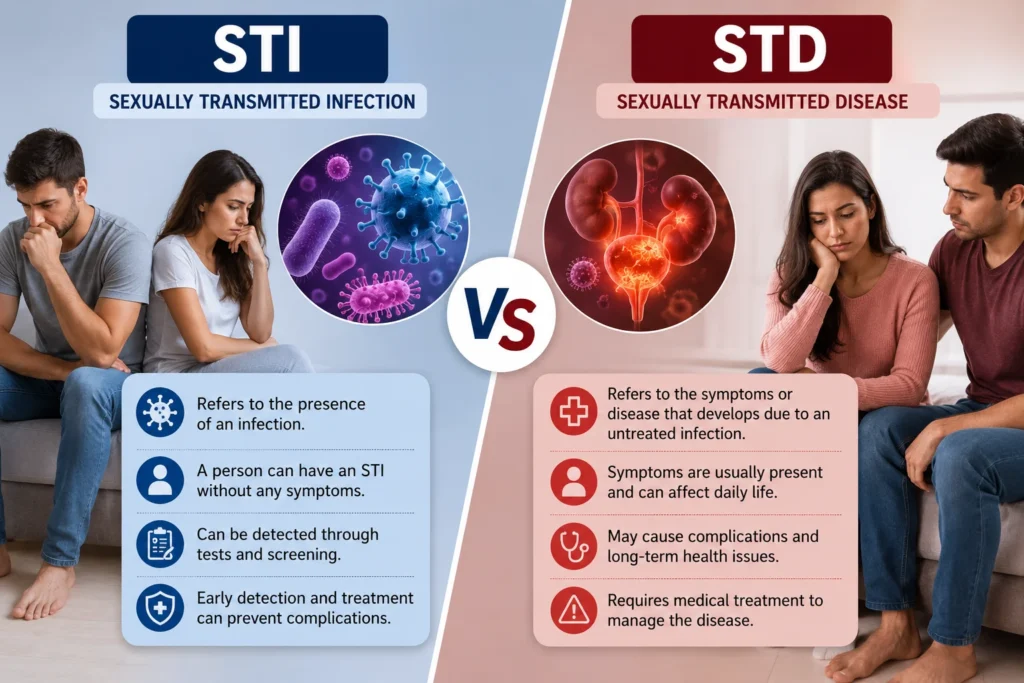
Although the words “infection” and “disease” are often used interchangeably, they describe different stages of a medical condition.
What Is an Infection?
An infection occurs when bacteria, viruses, or parasites enter the body and begin multiplying.
During this stage:
- Symptoms may be absent.
- The immune system may control or eliminate the infection.
- The person may still transmit the infection to others.
Many STIs remain at this stage for extended periods.
What Is a Disease?
Disease develops when the infection begins affecting normal body function.
This may lead to:
- Symptoms
- Organ damage
- Inflammation
- Long-term health complications
Not everyone with an infection will develop disease, but the risk increases if certain infections remain untreated.
Why Did Healthcare Professionals Change From “STD” to “STI”?
Over the past two decades, healthcare organizations have gradually shifted toward using the term STI rather than STD.
There are several important reasons for this change.
Many Infections Do Not Cause Symptoms
One of the biggest reasons is that many sexually transmitted infections remain asymptomatic.
Examples include:
- Chlamydia
- Human papillomavirus (HPV)
- Gonorrhea
- HIV during its early stages
A person may carry these infections for months or years without knowing it.
Using the word infection better reflects this reality.
Early Testing Saves Lives
If people believe they only need testing after developing symptoms, many infections will go undiagnosed.
Using the term STI reminds people that:
- Testing may be necessary even when they feel healthy.
- Early diagnosis reduces complications.
- Treatment can prevent transmission to others.
Public Health Messaging
Organizations such as WHO and CDC now use STI because it encourages prevention rather than waiting for disease to develop.
This terminology helps improve:
- Public awareness
- Routine screening
- Early treatment
- Sexual health education
Is One More Serious Than the Other?
Neither term indicates that one condition is inherently more serious than the other.
Instead, they describe different stages of the same process.
An STI May Never Become an STD
Some infections:
- Clear naturally.
- Remain without symptoms.
- Are treated before complications develop.
In these situations, disease may never occur.
An Untreated STI Can Progress to Disease
If certain infections remain untreated, they may eventually lead to health problems.
For example:
- Untreated chlamydia may cause pelvic inflammatory disease (PID).
- Persistent HPV infection may increase the risk of certain cancers.
- Untreated syphilis may affect the brain, heart, and nervous system.
- Untreated HIV can progress to advanced immune system damage if not managed with appropriate treatment.
This is why early diagnosis and treatment are so important. (National Academies of Sciences, Engineering, and Medicine et al. 2021)
Why Does the Difference Matter?
Understanding the difference between an STI and an STD helps people make informed decisions about their sexual health.
It reinforces several important messages:
You Can Be Infected Without Knowing It
Feeling healthy does not always mean you are free of infection.
Many sexually transmitted infections remain silent.
Testing Should Not Depend on Symptoms
Routine screening based on risk factors is often more effective than waiting for symptoms to appear.
Early Treatment Prevents Complications
Identifying infections early allows healthcare professionals to begin treatment before long-term damage develops.
Prevention Protects Everyone
Understanding the difference encourages:
- Safer sex practices.
- Regular testing.
- Vaccination where appropriate.
- Open communication with sexual partners.
These measures help reduce the spread of sexually transmitted infections within the community.
Key Differences Between STIs and STDs
Although the terms STI and STD are closely related, they describe different stages of the same medical process.
Understanding these differences can help you interpret medical advice more accurately and appreciate why early testing is so important.
| Feature | STI (Sexually Transmitted Infection) | STD (Sexually Transmitted Disease) |
|---|---|---|
| Meaning | Presence of an infection caused by bacteria, viruses, or parasites | Illness or disease that develops because of the infection |
| Symptoms | May have no symptoms | Usually causes symptoms or health complications |
| Detection | Often identified through screening tests | May be diagnosed through symptoms, examination, and laboratory tests |
| Treatment | Early treatment may prevent disease from developing | Treatment focuses on managing infection and its complications |
| Transmission | Infection can spread even without symptoms | Disease may also spread if the infection is still active |
The distinction emphasizes that infection can exist long before disease develops, making routine screening an important part of sexual healthcare.
Examples of STIs That May Never Become Diseases
Many sexually transmitted infections do not always progress to symptomatic disease.
Human Papillomavirus (HPV)
HPV is one of the most common sexually transmitted infections worldwide.
In many people:
- The immune system clears the infection naturally.
- No symptoms ever develop.
- The individual may never know they were infected.
However, persistent HPV infection can sometimes lead to genital warts or certain cancers, highlighting the importance of vaccination and regular screening where recommended.
Chlamydia
Chlamydia frequently causes no symptoms, especially in women.
Without testing:
- The infection may remain undetected.
- A person may unknowingly transmit it to partners.
If left untreated, it can eventually lead to complications such as pelvic inflammatory disease (PID) or fertility problems.
Gonorrhea
Gonorrhea may also remain asymptomatic, particularly in the throat, rectum, or female reproductive tract.
Routine testing allows treatment before complications develop.
Human Immunodeficiency Virus (HIV)
After initial infection, HIV may enter a prolonged stage with few or no symptoms.
Modern treatment can suppress the virus effectively, helping people live long, healthy lives while greatly reducing the risk of transmission.
These examples illustrate why healthcare professionals prefer the term STI, as many infections exist before disease becomes apparent. (World Health Organization)
Can You Have an STI Without Symptoms?

Yes. In fact, many people with sexually transmitted infections have no symptoms at all.
This is known as an asymptomatic infection.
An individual may:
- Feel completely healthy.
- Continue daily activities without noticing any changes.
- Unknowingly pass the infection to sexual partners.
Examples of infections that are commonly asymptomatic include:
- Chlamydia
- Gonorrhea
- HPV
- HIV (early stages)
- Trichomoniasis
Because symptoms are not a reliable indicator of infection, healthcare professionals recommend testing based on individual risk factors rather than waiting for symptoms to appear.
Regular screening helps identify infections early, reducing the risk of complications and further transmission.
When Does an STI Become an STD?
An STI becomes an STD when the infection begins causing illness, symptoms, or measurable damage to the body.
This transition varies depending on the specific infection and the individual’s immune response.
Development of Symptoms
Many infections become diseases once symptoms appear, such as:
- Pain during urination.
- Unusual genital discharge.
- Genital sores or ulcers.
- Pelvic pain.
- Testicular swelling.
- Skin rashes.
Development of Complications
Some infections may progress without obvious symptoms but still cause internal damage over time.
Examples include:
- Pelvic inflammatory disease resulting from untreated chlamydia or gonorrhea.
- Infertility due to untreated reproductive tract infections.
- Cervical cell changes caused by persistent HPV infection.
- Liver damage associated with chronic hepatitis B.
In these situations, the infection has progressed to disease even if symptoms remain mild or unnoticed.
How Are STIs and STDs Diagnosed?
Healthcare professionals use the same diagnostic methods whether someone has an asymptomatic STI or a symptomatic STD.
Diagnosis may include:
Medical History
Your healthcare professional may ask about:
- Current symptoms.
- Sexual history.
- Recent sexual partners.
- Previous STIs.
- Use of barrier protection.
These questions help determine which tests may be appropriate.
Physical Examination
Some infections produce visible signs that may be identified during a physical examination, including:
- Genital sores.
- Warts.
- Skin rashes.
- Swollen lymph nodes.
Laboratory testing is often performed to confirm the diagnosis.
Laboratory Testing
Testing methods may include:
- Urine tests.
- Blood tests.
- Swabs from the cervix, vagina, urethra, throat, rectum, or sores.
- Molecular tests that detect the genetic material of bacteria or viruses.
The choice of test depends on the suspected infection and the person’s symptoms or risk factors. (Wi et al. 2019)
Are STIs and STDs Treated Differently?
Treatment depends on the cause of the infection, not whether it is called an STI or an STD.
Bacterial Infections
Bacterial infections are generally treated with antibiotics.
Examples include:
- Chlamydia
- Gonorrhea
- Syphilis
Early treatment often cures the infection and prevents complications.
Viral Infections
Viral infections may not always be curable, but many can be managed effectively.
Examples include:
- HIV
- Genital herpes
- Hepatitis B
Treatment may:
- Reduce symptoms.
- Suppress viral activity.
- Lower the risk of transmission.
- Improve long-term health outcomes.
Parasitic Infections
Parasitic infections are treated with medications that eliminate the parasite.
Examples include:
- Trichomoniasis
- Pubic lice
- Scabies
Most people recover completely after appropriate treatment.
Common Misconceptions About STIs and STDs
Misunderstanding these terms can lead to delayed testing or unnecessary anxiety. (Crosby et al. 2000)
“If I Feel Fine, I Don’t Have an STI”
This is false.
Many sexually transmitted infections remain asymptomatic for long periods.
“Only People With Many Sexual Partners Get STIs”
Anyone who is sexually active can acquire an STI, even after a single sexual encounter with an infected partner.
“STD Is the Correct Medical Term”
While both terms are still used, most healthcare organizations now prefer STI because it more accurately reflects infections that exist before symptoms develop.
“An STI Always Becomes an STD”
Not necessarily.
Some infections:
- Clear naturally.
- Are treated before disease develops.
- Never cause symptoms.
“Testing Is Only Needed When Symptoms Appear”
Routine STI screening is often recommended based on risk factors, even in people who feel completely healthy.
Early testing protects both individual and public health.
Why This Difference Matters for Public Health
Using the term STI encourages people to think about prevention rather than waiting for illness.
It supports important public health goals by:
- Promoting regular screening.
- Encouraging earlier treatment.
- Reducing stigma around testing.
- Helping prevent complications.
- Reducing the spread of infections within the community.
This change in terminology reflects a broader focus on maintaining sexual health rather than simply treating disease after it develops.
Which Term Should You Use?
Both STI and STD are medically understandable, but most healthcare professionals, researchers, and public health organizations now prefer the term STI.
This preference exists because:
- It includes infections that do not cause symptoms.
- It encourages people to seek testing even when they feel healthy.
- It reflects the earliest stage of infection, allowing treatment before complications develop.
- It supports public health efforts focused on prevention and early diagnosis.
Organizations such as the World Health Organization (WHO) and the Centers for Disease Control and Prevention (CDC) primarily use the term STI in their educational materials.
That said, the term STD is still commonly used by the public and in some healthcare settings.
Regardless of the terminology, both refer to infections acquired primarily through sexual contact, and the most important step is recognizing the need for prevention, testing, and timely medical care.
When Should You See a Healthcare Professional?
You should seek medical advice if you think you may have been exposed to a sexually transmitted infection, even if you do not have symptoms.
Seek Medical Care If You Have Symptoms
Consult a healthcare professional if you notice:
- Unusual vaginal, penile, or rectal discharge.
- Pain or burning during urination.
- Genital sores, ulcers, or blisters.
- Genital warts.
- Persistent itching around the genital area.
- Pelvic pain or testicular pain.
- Abnormal vaginal bleeding.
- Skin rashes associated with possible STI exposure.
Prompt diagnosis allows treatment to begin before complications develop.
Get Tested After Possible Exposure
Testing may be appropriate if you:
- Have had unprotected vaginal, anal, or oral sex.
- Have a new sexual partner.
- Have multiple sexual partners.
- Learn that a partner has been diagnosed with an STI.
- Share needles or other equipment that may expose you to blood-borne infections.
Testing recommendations vary depending on the type of exposure and the specific infection.
Routine Screening Is Important
Some individuals benefit from routine STI screening even without symptoms.
This may include:
- Sexually active individuals with ongoing risk factors.
- Pregnant women, according to prenatal care recommendations.
- People advised by their healthcare professional to undergo periodic testing.
Regular screening helps identify infections early and protects both individual and public health.
Why Early Testing Matters
Early testing offers several important benefits.
Prevents Serious Health Complications
Treating infections before they progress can reduce the risk of:
- Pelvic inflammatory disease (PID)
- Infertility
- Chronic pelvic pain
- Pregnancy complications
- Long-term organ damage from untreated infections
Reduces Transmission
Knowing your STI status allows you to:
- Begin treatment if necessary.
- Take steps to reduce transmission.
- Inform sexual partners when appropriate.
- Make informed decisions about safer sex.
Improves Treatment Outcomes
Many bacterial and parasitic STIs respond well to treatment when diagnosed early.
Even viral infections that cannot currently be cured are often easier to manage when treatment begins promptly.
Myth vs Fact
| Myth | Fact |
|---|---|
| STI and STD mean exactly the same thing. | An STI refers to an infection, while an STD refers to disease that develops because of that infection. |
| If I don’t have symptoms, I don’t have an STI. | Many STIs are completely asymptomatic and can only be detected through testing. |
| Every STI eventually becomes an STD. | Some infections are treated early or never cause disease, so not every STI progresses to an STD. |
| Only people with symptoms need STI testing. | Routine screening may be recommended even without symptoms based on individual risk factors. |
Lesser-Known Fact
Did you know that the medical community began replacing the term “STD” with “STI” because many infections never become diseases?
For example, a person may carry human papillomavirus (HPV) or chlamydia for months without any symptoms.
During this time, the infection can still be transmitted to others and, in some cases, lead to complications if left untreated.
Using the term STI highlights the importance of testing and early treatment rather than waiting for symptoms to appear.
Final Thoughts
Understanding the difference between an STI and an STD is more than just learning medical terminology. It highlights the importance of recognizing that infections can exist without symptoms and that early testing plays a vital role in preventing complications and protecting sexual health.
Whether you use the term STI or STD, the most important step is staying informed, practicing safer sex, and seeking medical advice when needed. Early diagnosis and treatment benefit both you and your partners.
Knowledge, regular screening, and open communication are key to maintaining healthy relationships and reducing the spread of sexually transmitted infections.
Conclusion
Although the terms sexually transmitted infection (STI) and sexually transmitted disease (STD) are often used interchangeably, they describe different stages of the same process.
An STI refers to the presence of an infection, while an STD develops when that infection causes symptoms or disease.
Understanding this distinction helps explain why healthcare professionals now commonly use the term STI.
Many sexually transmitted infections do not cause noticeable symptoms, making routine testing an essential part of sexual healthcare.
Early diagnosis allows prompt treatment, reduces the risk of long-term complications, and helps prevent transmission to others.
Whether you hear the term STI or STD, the key message remains the same:
practicing safer sex, staying up to date with recommended vaccinations, getting tested when appropriate, and seeking medical advice if you have concerns are all important steps toward protecting your sexual and reproductive health.
Learning the difference between these terms is more than a matter of language, it encourages earlier action, reduces stigma, and supports healthier relationships through informed decision-making. (Centers for Disease Control and Prevention)
Frequently Asked Questions
1. What is the difference between an STI and an STD?
An STI is an infection that may not cause symptoms, while an STD develops when the infection causes illness, symptoms, or complications.
2. Why do doctors prefer the term STI?
Healthcare professionals prefer the term STI because many infections remain symptom-free and may never develop into disease.
3. Can you have an STI without symptoms?
Yes. Many sexually transmitted infections are asymptomatic, making regular testing important for early detection.
4. Does every STI become an STD?
No. Some STIs are treated early, remain symptom-free, or resolve without progressing to disease.
5. Should I get tested even if I feel healthy?
Yes. Many STIs do not cause symptoms, so testing may be recommended based on your risk factors and sexual history.
Stay tuned with us for more health related topics.
Follow us on LinkedIn and Instagram for more.
More Read


Medical Disclaimer!
This article has been reviewed and written under the guidance of our Head Physiotherapist, Dr. Kruti Raj (PT, MUHS,CPT,CMPT). The information shared is intended for educational purposes only and should not be considered a substitute for personalized medical advice, diagnosis, or treatment.
Please consult us or any other qualified healthcare professional before beginning any exercise program, especially if you are experiencing pain, recovering from injury, or managing a medical condition.


