


If you have ever treated or experienced neck pain that keeps coming back despite stretches, posture correction, or even strengthening, there is usually a missing link.
In clinic, I have seen patients who have done everything right on paper. They improved their posture, used ergonomic chairs, even followed exercise routines. Still, the pain sits there in the background.
What often gets ignored is something very basic and very constant. The way we breathe.
Breathing is not just about oxygen. It is closely linked to how the body stabilizes itself, how muscles coordinate, and how tension builds over time.
Read about our Complete Neck Pain Guide : Causes, Symptoms, Exercises and Treatment
Quick Answer
Yes, poor breathing patterns can contribute to neck pain. When breathing shifts from the diaphragm to the chest, the neck muscles begin to work continuously, leading to tightness and fatigue over time.
In many people, especially those with stress or prolonged sitting, this happens without awareness. Correcting breathing patterns can reduce unnecessary strain on the neck, but it works best when combined with proper exercises and posture awareness.
Read about: Early Signs of Cervical Spine Damage You Should Never Ignore
Key Takeaways
- Breathing is closely linked to neck muscle activity and overall posture control.
- Upper chest breathing increases strain on the neck and shoulder muscles.
- Rib cage stiffness can limit proper breathing and shift workload to the neck.
- Breathing alone is not a cure, but it is an important part of recovery.
- Simple awareness and small daily corrections can make a noticeable difference.
- Long-standing patterns take time to change, so consistency matters more than intensity.
Read: Spasm In Neck: What Causes It & How to Fix It Fast
Understanding what normal breathing should feel like
At rest, breathing should be quiet and efficient.
- Air comes in through the nose
- The diaphragm moves downward
- The lower ribs expand slightly
- The neck and shoulders remain relaxed
This pattern allows the diaphragm to do most of the work.
But this is not what I see in most people with chronic neck pain.
Read about : 15 Common Causes of Neck Pain You Should Know
What actually happens in people with neck pain
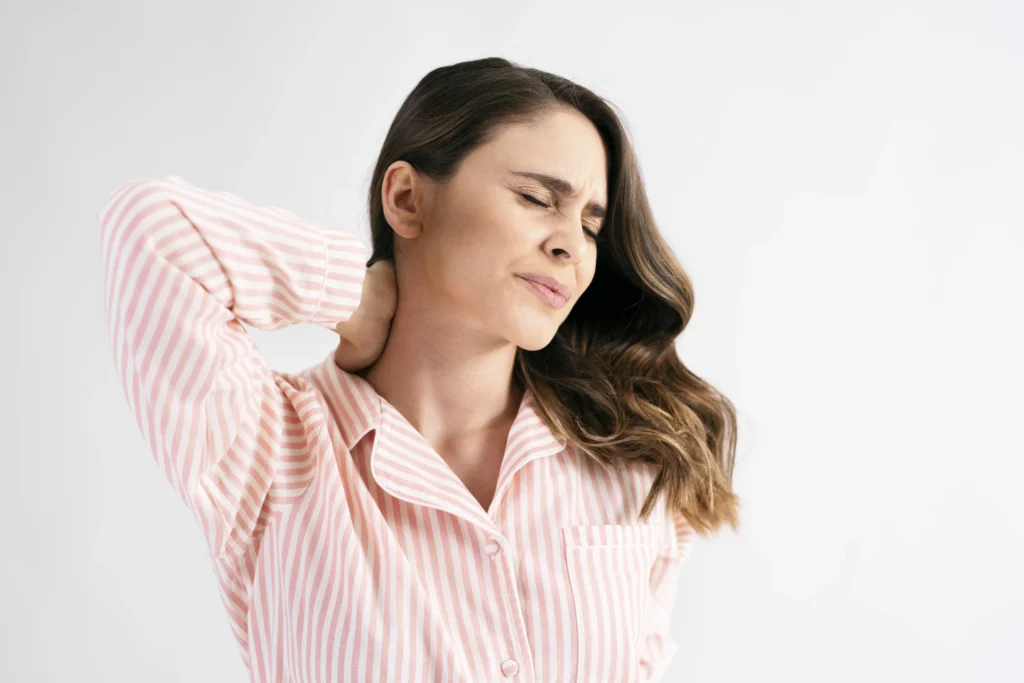
Many people shift to what we call upper chest breathing.
You can usually spot it within seconds:
- The chest lifts excessively
- The neck muscles visibly contract
- Breathing looks effortful even at rest
Over time, this becomes the default pattern.
A study by Kapreli et al. (2009) showed that individuals with chronic neck pain demonstrate altered respiratory muscle activity and increased use of accessory muscles.
Read: What is Sternocleidomastoid Syndrome, Trigger Points and Its Treatment
The role of accessory breathing muscles in neck pain
The body has backup muscles for breathing. These include:
- Sternocleidomastoid
- Scalenes
- Upper trapezius
These muscles are meant to assist during high demand situations like exercise or breathlessness.
But when they are used all day:
- They remain in a semi-contracted state
- Blood flow reduces
- Trigger points develop
- Pain spreads to the neck and head
This is why many patients describe a dull, persistent tightness rather than sharp pain.
Read about: What Is Cervical Myofascial Pain Syndrome And How To Relieve Trigger Points
A clinical pattern I see repeatedly
Let me describe a common case.
A desk-based professional walks in with:
- Neck stiffness
- Headaches by evening
- Feeling of heaviness in shoulders
They have already tried posture correction.
But when I observe their breathing:
- The neck muscles are active with every breath
- The lower ribs barely move
- Breathing is shallow and frequent
Once we start addressing breathing, their symptoms begin to shift. Not overnight, but steadily.
Read about : What is Cervical Facet Joint Pain, how it causes cervicogenic headaches and how to correct it naturally
A situation you might relate to
You sit down to work in the morning feeling fine.
By afternoon, your neck feels tight. By evening, it feels heavy, sometimes even slightly painful. You try adjusting your posture, maybe stretch a bit, but the relief does not last.
If this sounds familiar, there is a good chance your breathing pattern is quietly contributing throughout the day without you noticing it.
Also read: How to Relieve Neck Tightness Without Equipment
New research is strengthening this connection
Recent studies are moving beyond theory and showing measurable changes.
A 2023 study found that patients with cervical issues had reduced diaphragm movement and altered rib cage mechanics. (Yousefiyan et al. 2023)
Another study showed that adding breathing exercises improved chest expansion and reduced pain levels. (Chand and Vaish 2023)
These findings support what we see clinically. The problem is not just in the neck.
Read about: How to Relieve Morning Neck Stiffness Naturally
The rib cage is often the missing piece
Most people focus only on the neck.
But in many cases, the issue starts lower.
If the rib cage is stiff or not moving well:
- The diaphragm cannot function efficiently
- Breathing shifts upward
- Neck muscles compensate
This is why some patients do neck exercises perfectly but still do not improve.
Read in detail about: How to Fix Upper Crossed Syndrome Naturally
Another factor most people are unaware of
Breathing affects more than muscles. It also affects your nervous system and pain perception.
When breathing becomes shallow and fast:
- Carbon dioxide levels drop
- The body becomes more sensitive to pain
- Muscles stay in a heightened state of tension
Busch et al. (2012) showed that breathing patterns can influence pain modulation and sensitivity.
This explains why neck pain often feels worse during stressful periods.
Read more: Cervical Myelopathy: The Hidden Neck Condition Affecting Your Walking
The posture and breathing relationship
We are often told that bad posture causes neck pain.
But sometimes the sequence is reversed.
In some individuals:
- Poor breathing leads to changes in posture
- Forward head posture helps open the airway
Koseki et al. (2019) found that forward head posture affects respiratory function and reduces lung capacity.
So correcting posture without addressing breathing may not solve the problem.
Learn how posture affects neck pain and correction exercises in our article on Simple Posture Correction Exercises for Forward Head Posture
Important clarification from recent evidence
Breathing is important, but it is not a magic fix.
A 2025 trial showed that breathing exercises improved breathing patterns, but pain reduction was similar to conventional neck exercises. (Tatsios et al. 2025)
So the takeaway is simple:
Breathing should be part of treatment, not the only treatment.
Read about: What Is Military Neck Or Cervical Kyphosis And How To Treat It
Common mistakes
Many people try to fix this but unknowingly make it worse.
- Trying to take very deep or forceful breaths
- Lifting the chest instead of expanding the ribs
- Holding the breath too long
- Overcorrecting posture and becoming stiff
- Expecting quick results within a few days
Breathing should feel natural and effortless. If it feels forced, something is off.
Read about: Yoga for Neck Pain: Poses That Actually Work
Physiotherapy approach

Treatment is not just about giving exercises. It is about changing how the body functions.
Step 1: Identify if breathing is actually a problem
Not everyone with neck pain has breathing dysfunction.
I look for:
- Visible neck muscle activity during breathing
- Minimal lower rib movement
- Mouth breathing at rest
Step 2: Restore rib cage mobility
Before teaching breathing, the rib cage must move.
We work on:
- Thoracic extension
- Rib expansion drills
- Gentle manual techniques if required
Step 3: Teach efficient breathing, not forced deep breathing
Many people try to take exaggerated deep breaths.
Instead, we focus on:
- Slow nasal breathing
- Low effort breathing
- Subtle lower rib expansion
Step 4: Combine breathing with neck control
This is where real change happens.
We integrate:
- Breathing with deep neck flexor activation
- Breathing during sitting and working
- Breathing under mild load or movement
Also Read: Ultimate 6 Weeks Neck Rehabilitation Exercises For Pain Relief
A simple daily routine you can start
You do not need complicated exercises. Start small and stay consistent.
1. Breathing awareness (2-3 minutes)
Sit quietly and observe your breathing without changing it.
2. Gentle nasal breathing (5 minutes)
Breathe slowly through your nose, allowing the lower ribs to expand slightly.
3. Rib mobility (1-2 minutes)
Take slow breaths and focus on expanding the sides of your rib cage.
4. Neck relaxation check (throughout the day)
Pause and notice if your neck is tense while breathing. If yes, consciously relax it.
Do this once or twice daily. Consistency matters more than intensity.
Read: 10 Proven Home Remedies for Neck Pain from Anxiety
Signs your breathing may be contributing to neck pain
You might notice:
- Tightness even at rest
- Frequent tension headaches
- Fatigue while sitting
- Difficulty taking a relaxed breath
- Neck muscles visibly working during breathing
Read about: Effective Neck Pain Exercises At Home: A Complete Guide to Relief and Improved Mobility
Simple self-check you can do right now
Try this for a minute.
- Sit comfortably
- Place one hand on your chest and one on your lower ribs
- Breathe normally
Now observe:
- If your upper chest moves more than your ribs, you are likely overusing neck muscles
- If your shoulders lift slightly with each breath, it is another sign
- If breathing feels effortful instead of relaxed, that also matters
This is not a diagnosis, but it gives you a starting point.
Read About: Best Sleeping Position for Neck Pain: A Physiotherapist’s Complete Guide
Who is more likely to have this issue
This pattern is more common in:
- People with desk-based jobs
- Individuals under long-term stress
- Those who sit for prolonged hours
- People with poor sleep habits
- Individuals who frequently feel fatigued without clear reason
If you fall into one or more of these categories, it is worth paying attention to your breathing.
Read about: Which Is The Best Sitting Posture To Avoid Neck Pain And How To Achieve It
When breathing is likely not the main cause
It is important to stay realistic.
Breathing is less likely to be the main factor in:
- Acute injuries
- Severe nerve compression
- Structural spinal conditions
In such cases, it plays a supportive role, not a primary one.
Read in detail: Best Desk Setup to Reduce Neck and Back Pain
How long does it take to improve
This is one of the most common questions.
- Some people notice awareness within a few days
- Reduction in tightness may take 2 to 3 weeks
- Long-standing patterns may take longer to fully change
Progress is usually gradual, not immediate.
Read About: How to Choose the Right and Best Pillow for Neck Pain
Final thoughts
If neck pain keeps returning, it is usually not because you are not trying hard enough. It is often because one important factor is being overlooked.
Breathing is one of those factors.
You do not need to obsess over it, but you do need to become aware of it. Once that awareness builds, small corrections start to make a noticeable difference.
Sometimes, the solution is not doing more exercises, but doing simple things a little differently.
Read: Lhermitte’s sign- An Electic Shock Sensation Down The Neck
Frequently Asked Questions
1. Can poor breathing really cause neck pain?
Yes, inefficient breathing patterns can overload neck muscles, leading to chronic tightness and discomfort over time.
2. What is the best breathing technique for neck pain?
Gentle diaphragmatic breathing with minimal neck involvement is considered most effective.
3. How do I know if my breathing is incorrect?
If your chest rises more than your lower ribs or your shoulders lift while breathing, your pattern may need correction.
4. Can breathing exercises alone fix neck pain?
They help, but should be combined with strengthening, posture awareness, and mobility work.
5. Why does stress worsen neck pain?
Stress leads to shallow breathing, which increases muscle tension and sensitivity to pain.
6. How long does it take to improve breathing-related neck pain?
Most people notice improvement within a few weeks with consistent practice.
7. Is physiotherapy necessary for this condition?
It is helpful, especially if symptoms are persistent or not improving with basic changes.
8. Can posture correction alone solve the problem?
Not always. If breathing dysfunction is present, it must be addressed along with posture.
Stay tuned with us for more health related topics.
Follow us on LinkedIn and Instagram for more.
More Read


Medical Disclaimer!
This article has been reviewed and written under the guidance of our Head Physiotherapist, Dr. Kruti Raj (PT, MUHS,CPT,CMPT). The information shared is intended for educational purposes only and should not be considered a substitute for personalized medical advice, diagnosis, or treatment.
Please consult us or any other qualified healthcare professional before beginning any exercise program, especially if you are experiencing pain, recovering from injury, or managing a medical condition.


