


Understanding Neck Pain in Students
Neck pain is no longer a problem seen only in office workers or aging populations. In recent years, physiotherapists across the world have noticed a sharp rise in neck pain among school and college students.
Modern academic life exposes students to prolonged sitting, digital learning, smartphone use, laptop studying, and poor ergonomic habits.
These factors create excessive stress on the cervical spine.
Recent research shows that neck pain among university students has become a widespread musculoskeletal issue.
In one cross-sectional study involving university students, 95.6% reported experiencing neck pain associated with smartphone use, demonstrating how common this condition has become in young populations. (Health and Rehab Journal)
Another study assessing physiotherapy students found that 63.5% showed symptoms of text neck syndrome, and over 60% had smartphone addiction patterns linked with neck disability. (bryanhousepub.com)
From a physiotherapy perspective, neck pain in students is typically postural and mechanical, meaning it develops due to repeated strain on muscles, ligaments, joints, and discs rather than structural disease.
Understanding why this occurs is the first step toward preventing long-term cervical spine problems.
Read about our Complete Neck Pain Guide : Causes, Symptoms, Exercises and Treatment
Quick Answer
Neck pain in students is commonly caused by prolonged studying posture, excessive smartphone use, laptop work, and poor ergonomics. These habits lead to forward head posture, muscle imbalance, and cervical spine strain.
Common symptoms include neck stiffness, headaches, shoulder tightness, and difficulty turning the head. Physiotherapy treatment focuses on posture correction, strengthening deep neck muscles, stretching tight structures, and improving study ergonomics to prevent recurring pain.
Read about : 15 Common Causes of Neck Pain You Should Know
Why Neck Pain Is Increasing Among Students

Several lifestyle changes in modern education have significantly increased neck strain among students.
1. Prolonged Smartphone Use
Students spend several hours daily on smartphones for studying, social media, and entertainment.
Research shows that smartphone addiction is significantly associated with neck pain and disability among undergraduate students. (IIUM Journals)
When the head bends forward while using a phone, the load on the cervical spine increases dramatically.
For example:
- Neutral head position → ~5 kg load
- 30° flexion → ~18 kg load
- 60° flexion → ~27 kg load
This repetitive stress leads to muscular fatigue and joint strain.
Read in detail: Neck Pain from Phone Use? Here’s How to Treat Text Neck Syndrome
2. Long Study Hours Without Breaks
Students preparing for competitive exams or studying for long hours often remain seated in one posture for extended periods.
Recent large-scale research suggests that sitting for more than six hours daily significantly increases the risk of neck pain due to prolonged muscle tension and postural stress. (The Washington Post)
3. Laptop and Tablet Studying
Laptop screens are usually positioned below eye level, forcing students to bend their neck forward.
This creates forward head posture, which:
- Weakens deep neck flexor muscles
- Tightens upper trapezius and levator scapulae
- Increases stress on cervical discs
4. Heavy Backpacks
School students often carry heavy backpacks.
Excess load alters spinal alignment and causes compensatory forward head posture.
5. Poor Sleep and Late Night Studying
Many students:
- Study in bed
- Use phones late at night
- Sleep with poor pillow support
This combination leads to muscle stiffness and morning neck pain.
Learn how posture affects neck pain and correction exercises in our article on Simple Posture Correction Exercises for Forward Head Posture
Mechanism of Neck Pain in Students
What Actually Happens in the Body
From a physiotherapy standpoint, student neck pain is usually postural overload syndrome.
The process occurs in stages:
Stage 1: Muscle Fatigue
Prolonged neck flexion overworks muscles like:
- Upper trapezius
- Levator scapulae
- Sternocleidomastoid
These muscles remain in constant contraction.
Stage 2: Deep Neck Flexor Weakness
The deep stabilizing muscles of the neck become weak, including:
- Longus colli
- Longus capitis
These muscles are responsible for cervical stability.
Weakness leads to poor spinal alignment.
Stage 3: Joint and Disc Stress
Sustained poor posture increases compressive forces on:
- Cervical facet joints
- Intervertebral discs
- Ligaments
Over time this may lead to:
- Cervicogenic headaches
- Disc irritation
- Nerve irritation
Stage 4: Movement Dysfunction
Students begin experiencing:
- Reduced neck mobility
- Pain during rotation
- Shoulder tightness
- Headaches during study
This is when most students seek physiotherapy.
Read in detail about: What is Cervical Spondylosis? The Truth Behind Chronic Neck Pain
Common Symptoms of Neck Pain in Students
Students often ignore early warning signs.
Typical symptoms include:
Musculoskeletal Symptoms
- Neck stiffness
- Pain at the base of the skull
- Shoulder tightness
- Upper back discomfort
- Muscle knots
Neurological Symptoms
- Headaches
- Tingling in arms
- Numbness in fingers (rare but possible)
Functional Symptoms
Students may notice:
- Pain after studying for long hours
- Difficulty concentrating due to discomfort
- Pain while looking down at books
- Neck stiffness in the morning
Read about: How to Relieve Morning Neck Stiffness Naturally
Lesser Known Causes of Neck Pain in Students
Most people blame phones alone, but physiotherapists often identify other hidden causes.
Exam Stress and Muscle Guarding
Stress activates the body’s protective muscle response.
Students unconsciously tighten neck and shoulder muscles during intense studying.
Eye Strain
Poor vision or incorrect screen brightness causes students to lean forward while reading.
This gradually worsens posture.
Dehydration
Dehydration reduces disc hydration, increasing spinal stiffness.
Students often forget to drink water during long study sessions.
Lack of Physical Activity
Sedentary lifestyles reduce muscular endurance and postural control.
Weak muscles fatigue faster during studying.
Advanced Physiotherapy Assessment for Students
When students visit physiotherapy clinics, assessment typically includes:
Postural Analysis
Physiotherapists assess:
- Forward head posture
- Rounded shoulders
- Thoracic kyphosis
Neck Range of Motion Testing
Movement is evaluated in:
- Flexion
- Extension
- Rotation
- Side bending
Deep Neck Flexor Endurance Test
This test measures stability of the cervical spine.
Reduced endurance is strongly associated with neck pain.
Read about: Which Is The Best Sitting Posture To Avoid Neck Pain And How To Achieve It
Evidence-Based Physiotherapy Treatment for Students
Physiotherapy remains the most effective non-surgical treatment for student neck pain.
Treatment focuses on posture correction, muscle strengthening, and mobility restoration.
1. Deep Neck Flexor Activation (Chin Tuck)

Purpose:
- Strengthens cervical stabilizers
- Corrects forward head posture
How to perform:
- Sit upright.
- Gently tuck the chin inward.
- Hold for 5 seconds.
Repetitions:
10 reps × 3 sets
Research shows that chin tuck exercises significantly improve cervical muscle activation and reduce pain in individuals with forward head posture.
Learn: How to do Chin Tucks for Neck Pain Relief and Posture Correction
2. Scapular Retraction Exercise

Purpose:
Improves shoulder posture and reduces neck strain.
Steps:
- Sit upright.
- Pull shoulder blades together.
- Hold for 5 seconds.
Repeat 10-15 times.
3. Upper Trapezius Stretch

Purpose:
Relieves tight neck muscles.
Steps:
- Tilt head sideways.
- Use opposite hand for gentle stretch.
- Hold for 20 seconds.
Repeat on both sides.
4. Levator Scapulae Stretch

Purpose:
Targets a muscle commonly tight in students.
Steps:
- Rotate head 45° downward.
- Gently pull head forward.
- Hold 20 seconds.
5. Thoracic Extension Exercise

Purpose:
Counteracts prolonged sitting posture.
Steps:
- Sit upright.
- Place hands behind head.
- Extend upper back over chair.
Repeat 10 times.
6. Resistance Band Row

Purpose:
Strengthens postural muscles.
Steps:
- Hold resistance band.
- Pull elbows backward.
- Squeeze shoulder blades.
Read About: Best Sleeping Position for Neck Pain: A Physiotherapist’s Complete Guide
Advanced Physiotherapy Techniques Used Today
Modern physiotherapy also includes advanced treatment approaches.
Read About : Manual Therapy for Neck Pain: A Physiotherapist’s Evidence Based Guide
Manual Therapy
Techniques include:
- Cervical joint mobilization
- Soft tissue release
- Myofascial trigger point therapy
These methods help reduce muscle tension and restore joint movement.
Read about: What Is Cervical Myofascial Pain Syndrome And How To Relieve Trigger Points
Dry Needling
Used for treating trigger points in:
- Upper trapezius
- Levator scapulae
Studies show dry needling may significantly reduce myofascial pain.
Postural Re-Education Programs
These programs train students to maintain proper posture during studying.
Technology-Based Rehabilitation
Emerging research shows virtual reality-based rehabilitation programs can improve adherence and posture correction exercises in individuals with neck pain. (arXiv)
Gamified exercises encourage students to perform rehabilitation regularly.
Read in detail: Best Desk Setup to Reduce Neck and Back Pain
Study Ergonomics for Students
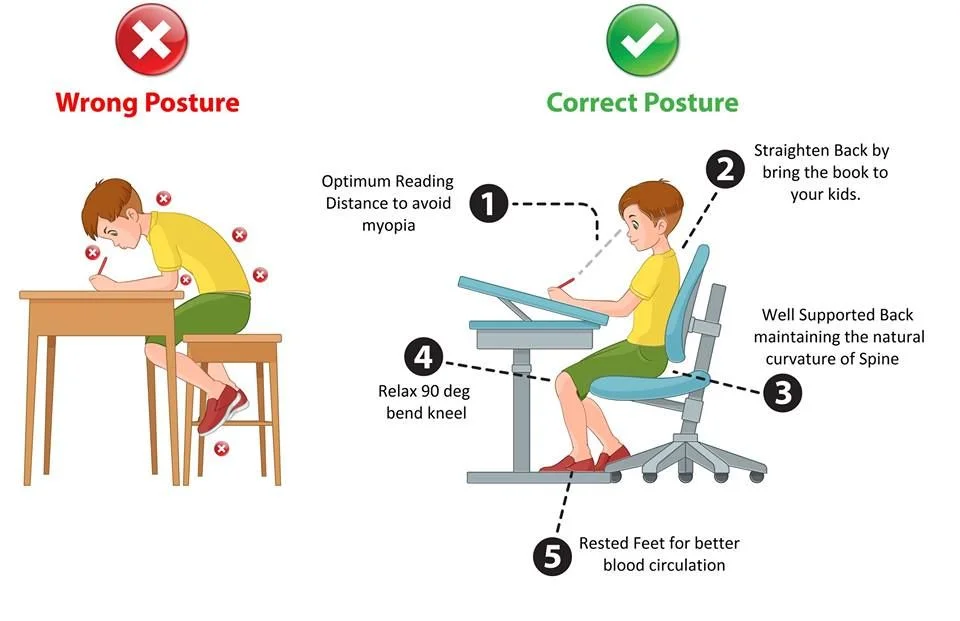
Physiotherapists strongly emphasize ergonomic changes.
Ideal Study Setup
- Screen at eye level
- Back supported
- Feet flat on the floor
- Book stand for reading
The 30-30 Rule
Every 30 minutes:
- Stand up
- Stretch
- Walk for 30 seconds
Proper Smartphone Use
Students should:
- Hold phones at eye level
- Avoid studying while lying in bed
- Use voice notes instead of long typing sessions
Read About: How to Choose the Right and Best Pillow for Neck Pain
When Students Should Seek Physiotherapy
Students should consult a physiotherapist if:
- Pain lasts more than 1–2 weeks
- Pain radiates to arms
- Headaches occur frequently
- Neck movement becomes restricted
Early treatment prevents chronic cervical problems.
Read about: Effective Neck Pain Exercises At Home: A Complete Guide to Relief and Improved Mobility
My Clinical Insight
In my clinical practice, many students assume neck pain is a normal part of studying.
However, persistent neck pain is often a sign of postural overload and muscle imbalance.
If these issues are ignored, they can progress into chronic cervical dysfunction in adulthood.
Early physiotherapy intervention combined with simple ergonomic corrections can completely reverse most student-related neck pain.
Read about: The Most Effective McKenzie Exercises For Neck Pain
Physio Prescription
Students should follow this routine:
Daily:
- Chin tucks- 10 reps
- Scapular squeezes- 15 reps
- Neck stretches- 2 times daily
Study habit:
- Break every 30 minutes
- Maintain upright posture
Also Read: Ultimate 6 Weeks Neck Rehabilitation Exercises For Pain Relief
Red Flags
Seek medical evaluation if neck pain includes:
- Arm weakness
- Severe numbness
- Loss of coordination
- Persistent night pain
Learn About: The Ultimate Neck Stretch Routine for Desk Workers in 2026
Myth vs Fact
Myth: Neck pain in students is harmless and temporary.
Fact: Persistent postural stress can lead to chronic cervical spine problems if not corrected early.
Read about: 10 Minutes Best Neck and Shoulder Warm Up for Swimmers
Key Takeaways
- Neck pain among students is rising due to smartphone use, long study hours, and poor posture.
- Forward head posture places excessive stress on cervical muscles and discs.
- Common symptoms include stiffness, headaches, shoulder tightness, and reduced neck mobility.
- Physiotherapy treatment focuses on strengthening deep neck muscles and correcting posture.
- Regular stretching, study breaks, and ergonomic setups can prevent recurring neck pain.
Also read: How to Relieve Neck Tightness Without Equipment
Final Word
Neck pain in students is a growing modern health issue driven by digital lifestyles and prolonged studying habits.
Fortunately, it is also one of the most preventable musculoskeletal conditions.
Through posture awareness, ergonomic study setups, and targeted physiotherapy exercises, students can protect their cervical spine and maintain long-term spinal health.
Read more: Cervical Vertigo Explained: Why Neck Pain Make You Feel Dizzy
Frequently Asked Questions
1. Why do students experience neck pain while studying?
Students often experience neck pain due to prolonged sitting, smartphone use, poor posture, and improper study ergonomics that strain the cervical spine.
2. Can studying for long hours cause neck pain?
Yes. Studying for long hours without breaks leads to muscle fatigue and cervical joint stress, which commonly causes neck pain and stiffness.
3. Which exercises help students relieve neck pain?
Exercises such as chin tucks, scapular retractions, upper trapezius stretching, and thoracic extension exercises help reduce neck pain and improve posture.
4. How can students prevent neck pain while studying?
Students should maintain proper posture, position screens at eye level, take regular study breaks, and perform daily neck strengthening exercises.
Stay tuned with us for more health related topics.
Follow us on LinkedIn and Instagram for more.
More Read


Medical Disclaimer!
This article has been reviewed and written under the guidance of our Head Physiotherapist, Dr. Kruti Raj (PT, MUHS,CPT,CMPT). The information shared is intended for educational purposes only and should not be considered a substitute for personalized medical advice, diagnosis, or treatment.
Please consult us or any other qualified healthcare professional before beginning any exercise program, especially if you are experiencing pain, recovering from injury, or managing a medical condition.


