Pregnancy back pain relief exercises can help reduce muscle tension, improve posture, and support more comfortable movement during pregnancy.
Pregnancy back pain can feel strangely isolating.
One day you are walking normally, and a few weeks later even turning in bed feels like work.
Many women are told this discomfort is “normal,” so they quietly tolerate it for months.
But in physiotherapy clinics, we see something different.
We see that most pregnancy-related back pain improves when the body gets the right kind of movement, support, and muscle activation.
What surprises many pregnant women is that the pain is not always caused by the baby’s weight alone.
Sometimes the issue starts higher up in the rib cage.
Sometimes it comes from weak glute muscles.
Sometimes it is the way you stand while brushing your teeth every morning.
Pregnancy changes movement patterns slowly, so many women do not notice the strain building until the pain becomes constant.
Quick Answer
Pregnancy back pain is extremely common, but it should not be ignored or simply tolerated. Gentle physiotherapy-based exercises such as pelvic tilts, cat-camel movements, breathing exercises, glute strengthening, and posture correction can help reduce pressure on the spine and pelvis safely during pregnancy.
Many women notice significant relief when they avoid prolonged standing, improve sleep posture, strengthen hip muscles, and practice breathing-focused core activation instead of aggressive stretching.
If pain becomes severe, causes numbness, affects walking, or worsens suddenly, a physiotherapist or healthcare provider should evaluate it promptly.
Research suggests that almost 50 to 70% of pregnant women experience low back pain or pelvic girdle pain during pregnancy. (ScienceDirect)
The good news is that the body responds surprisingly well to gentle movement when exercises are chosen carefully.
This article is written from a physiotherapy perspective. Not textbook-style advice. Not generic “just stretch more” tips. These are practical, research-supported exercises and movement strategies that actually help pregnant women feel more comfortable in real life.
Key Takeaways
- Pregnancy back pain is often linked to posture changes, muscle fatigue, pelvic instability, and altered breathing mechanics.
- Gentle stability exercises usually help more than aggressive stretching during pregnancy.
- Weak glute muscles are a hidden contributor to lower back and pelvic pain in many pregnant women.
- Pelvic tilts, cat-camel movements, breathing exercises, and supported strengthening exercises are physiotherapy favorites for pregnancy pain relief.
- Walking can help, but very long walks may worsen pelvic girdle pain in some women.
- Sleeping posture, lifting habits, and standing positions affect back pain more than many women realize.
- Breathing mechanics influence deep core muscle activation and spinal support during pregnancy.
- Persistent pain, numbness, or difficulty walking should always be professionally evaluated.
Why Pregnancy Back Pain Feels Different From Normal Back Pain
Pregnancy back pain has its own personality.
Sometimes it feels sharp near the tailbone.
Sometimes it spreads into the hips.
Some women only feel it while walking.
Others feel fine all day but cannot sleep because the pain worsens at night.
One major reason is hormonal change.
During pregnancy, the body produces relaxin, a hormone that loosens ligaments and joints to prepare for childbirth.
While this is necessary, it also reduces stability around the pelvis and lower spine. (Vleeming et al. 2008)
At the same time, the growing abdomen shifts the center of gravity forward.
The lower back muscles start working overtime to stop the body from falling forward.
This is why many pregnant women unconsciously lean backward while standing.
It feels supportive temporarily, but over time it compresses the lumbar spine.
Another lesser-known factor is breathing mechanics.
As the baby grows, the rib cage expands and the diaphragm changes position.
Many women begin taking shallow chest breaths without realizing it.
This reduces deep core muscle support and can increase tension in the back and pelvis.
The Weird Thing About Pregnancy Back Pain
A lot of pregnant women notice pain while doing surprisingly small activities.
Not lifting weights.
Not exercising.
Just standing in the kitchen.
Or folding laundry.
Or walking through a grocery store.
This happens because pregnancy pain is often related to endurance rather than strength.
Muscles fatigue faster during pregnancy because they are already working harder to stabilize changing posture all day.
In clinic settings, many women can tolerate exercise for 20 minutes but struggle with standing still for 10 minutes.
That difference matters.
What I Notice Most in Pregnant Patients
One common pattern appears again and again.
Most women try stretching first.
They stretch the lower back repeatedly because it feels tight.
But sometimes the muscles are not truly “tight.”
They are overworking because the hips and deep core are not supporting the body properly.
That is why aggressive stretching alone does not always help.
In fact, overstretching during pregnancy can occasionally increase discomfort because ligaments are already more flexible than usual.
What tends to help more is:
- gentle stability work
- breathing exercises
- glute strengthening
- posture correction
- movement variation throughout the day
Best Pregnancy Back Pain Relief Exercises
Pelvic Tilts Against a Wall
This is one of the safest and most underrated exercises during pregnancy.
Most women expect dramatic movements to create relief, but pelvic tilts are tiny.
The movement is subtle. Yet many patients say it immediately reduces pressure in the lower back.
How to Do It
- Stand with your back against a wall.
- Keep knees soft, not locked.
- Gently flatten your lower back toward the wall.
- Tighten the lower abdominal area slightly.
- Hold for 5 seconds.
- Relax slowly.
Repeat 10 to 15 times.
This exercise helps the deep abdominal muscles reconnect with the pelvis without straining the body.
Cat-Camel Movement
Many pregnant women love Cat-Camel exercise because it relieves stiffness without feeling exhausting.
How to Do It
- Position yourself on hands and knees.
- Slowly round the back upward.
- Then gently let the belly relax downward while lifting the chest slightly.
- Move slowly with your breathing.
Do not force the movement.
The goal is comfort, not maximum stretch.
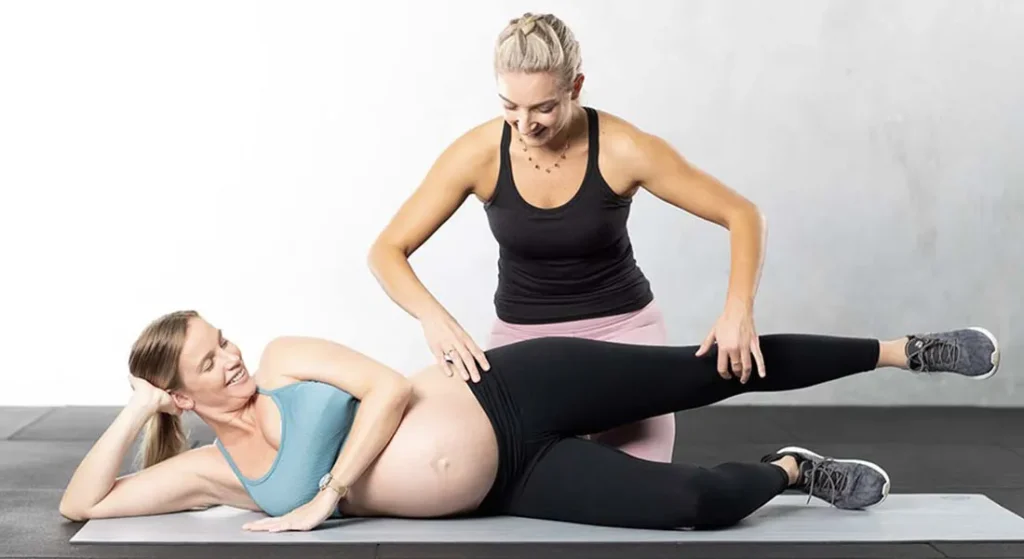
Side-Lying Glute Exercise
Weak glute muscles are one of the biggest hidden causes of pregnancy back pain.
When the glutes stop stabilizing the pelvis properly, the lower back compensates.
How to Do It
- Lie on one side.
- Bend the knees comfortably.
- Keep feet together.
- Lift the top knee slowly.
- Lower with control.
Repeat 12 repetitions on each side.
Many women feel this exercise more in the hip than the back, which is exactly the point.
The Exercise That Helps Women Turning in Bed
Turning in bed becomes surprisingly painful during pregnancy for many women.
Usually this happens because the pelvis is becoming unstable.
A simple trick that physiotherapists often teach is this:
Before turning in bed:
- tighten the lower abdomen gently
- keep knees together
- roll the shoulders and hips together as one unit
Small movement adjustments can dramatically reduce night pain.
Breathing Exercises That Actually Help Back Pain
This part is often ignored online.
Pregnancy changes breathing patterns more than most women realize.
When breathing becomes shallow, neck and back muscles become overactive.
The body loses some of its natural core stability.
Simple Rib Cage Breathing
- Sit comfortably.
- Place hands around the lower ribs.
- Inhale slowly through the nose.
- Feel the ribs expand sideways.
- Exhale gently.
This sounds simple, but many pregnant women immediately notice reduced tension in the upper and lower back.
Recent rehabilitation research also supports breathing-focused core retraining for lumbopelvic pain management. (Falla et al. 2018)
Why Walking Sometimes Helps and Sometimes Hurts
Walking is usually recommended during pregnancy, and in most cases it helps circulation, mobility, and stiffness.
But there is an important detail many articles ignore.
Too much walking without pelvic stability can aggravate pain.
Women with pelvic girdle pain often notice:
- pain while climbing stairs
- discomfort during long walks
- clicking sensations in the pelvis
- pain when standing on one leg
In those situations, reducing stride length and slowing walking speed may help temporarily.
Shorter, frequent walks are often better than one long walk.
The Grocery Bag Mistake That Flares Pregnancy Pain
Carrying uneven weight is a common trigger.
One heavy grocery bag on one side creates rotational stress through the pelvis and spine.
During pregnancy, the body tolerates this poorly because ligament support is already reduced.
Whenever possible:
- split weight evenly
- avoid twisting while carrying
- hold objects close to the body
These tiny habits matter more than people think.
Why Back Pain Gets Worse at Night
Many pregnant women say:
“I’m okay during the day but terrible at night.”
This usually happens because muscles fatigue after stabilizing the body all day.
The pelvis also becomes more sensitive after prolonged standing and walking.
Sleep posture matters a lot here.
Better Sleeping Position
- Sleep on the side instead of flat on the back
- Keep a pillow between the knees
- Support the abdomen with a pillow if needed
- Avoid twisting the pelvis while sleeping
ACOG also recommends side sleeping later in pregnancy to improve comfort and circulation. (American College of Obstetricians and Gynecologists 2020)
Exercises That Usually Feel Better in the Third Trimester
By the third trimester, many women dislike exercises requiring too much effort getting up and down from the floor.
Exercises that tend to feel more comfortable include:
- wall-supported pelvic tilts
- seated breathing exercises
- gentle standing hip movements
- supported squats
- short walks
- seated mobility exercises
Comfort matters.
Pregnancy exercise should not feel like punishment.
Why Stretching Alone Sometimes Makes Pain Worse
This surprises many women.
Pregnancy already increases flexibility because of hormonal changes.
So if the body is unstable, aggressive stretching may increase irritation instead of reducing it.
This is especially true for:
- deep hamstring stretches
- forceful back bending
- aggressive hip opening stretches
The body often needs support and control more than extra flexibility.
A Lesser-Known Cause of Tailbone Pain During Pregnancy
Tailbone pain during pregnancy is more common than many realize.
It can happen because:
- pelvic floor muscles become tense
- sitting posture changes
- prolonged leaning backward compresses the coccyx
- glute muscles weaken
Women who sit for long hours often notice worsening pain.
Changing sitting positions frequently helps more than staying perfectly upright all day.
Can Exercise Really Reduce Pregnancy Pain?
Yes, and newer evidence strongly supports it.
Recent studies show that exercise-based interventions can reduce pregnancy-related lumbopelvic pain and improve function.
A systematic review published in recent years also highlighted that combining education with exercise appears more effective than exercise alone. (Malmqvist et al. 2023)
That education component matters because fear changes movement.
Some pregnant women become so cautious that they stop moving normally altogether, which can increase stiffness and muscle deconditioning.
Signs You Should See a Physiotherapist
Please do not ignore severe symptoms.
Seek professional evaluation if you have:
- pain shooting down the legs
- numbness
- severe pelvic instability
- difficulty walking
- sudden intense pain
- bladder or bowel changes
- persistent night pain
Pregnancy pain should not automatically be dismissed as “normal.”
Recent literature also highlights that many pregnant women remain under-treated because symptoms are minimized during pregnancy care. (Gianola et al. 2024)
Final Thoughts
Pregnancy changes nearly everything about how the body moves.
The frustrating part is that many women blame themselves for struggling with pain when the real issue is simply that the body needs a different kind of support during this phase.
Safe pregnancy back pain relief exercises and posture support can help reduce back strain and improve comfort throughout pregnancy.
The goal is not perfect posture.
The goal is reducing unnecessary strain.
Some days your body will feel strong.
Other days even getting out of bed may feel awkward and heavy.
That fluctuation is common.
Gentle strengthening, smarter movement habits, breathing work, and consistent low-pressure exercise usually help far more than complete rest.
And perhaps the most important reminder of all:
Pain during pregnancy may be common, but suffering through it silently should never be considered normal.
Frequently Asked Questions About Pregnancy Back Pain Relief Exercises
1. Which exercise helps pregnancy back pain the fastest?
Pelvic tilts and gentle cat-camel movements often provide quick relief because they reduce pressure on the lower back and improve pelvic mobility.
2. Is walking good for pregnancy back pain?
Yes, short and comfortable walks usually help reduce stiffness and improve circulation. However, long walks may worsen pelvic pain in some pregnant women.
3. Why does my back pain feel worse at night during pregnancy?
Muscles become tired after supporting changing posture all day. Poor sleeping position and pelvic strain may also increase nighttime discomfort.
4. Can pregnancy back pain start in the first trimester?
Yes, hormonal changes and early postural adaptations can trigger lower back discomfort even during early pregnancy.
5. Should I avoid exercise if my back hurts during pregnancy?
Usually no. Gentle physiotherapy-guided movement is often more helpful than complete rest unless your doctor advises otherwise.
6. Can breathing exercises really help pregnancy back pain?
Yes. Proper breathing improves deep core muscle support and may reduce unnecessary tension around the spine and pelvis.
7. When should I see a physiotherapist for pregnancy back pain?
You should seek professional help if the pain becomes severe, affects walking, causes numbness, or continues getting worse.
8. Can weak hips cause pregnancy back pain?
Yes. Weak glute and hip muscles often increase strain on the pelvis and lower back during pregnancy.
Stay tuned with us for more health related topics.
Follow us on LinkedIn and Instagram for more.
More Read


Medical Disclaimer!
This article has been reviewed and written under the guidance of our Head Physiotherapist, Dr. Kruti Raj (PT, MUHS,CPT,CMPT). The information shared is intended for educational purposes only and should not be considered a substitute for personalized medical advice, diagnosis, or treatment.
Please consult us or any other qualified healthcare professional before beginning any exercise program, especially if you are experiencing pain, recovering from injury, or managing a medical condition.