


As rehabilitation increasingly embraces artificial intelligence and digital health technologies, researchers are now turning their attention to an unlikely innovation: LiDAR (Light Detection and Ranging) technology.
A growing body of research suggests that LiDAR, best known for its role in autonomous vehicles and 3D mapping, could soon become a valuable tool in physiotherapy and rehabilitation.
Recent studies indicate that LiDAR can accurately measure patient environments, analyze movement patterns, support remote rehabilitation,
and potentially improve clinical decision-making while offering greater privacy than conventional camera-based systems. (ResearchGate)
The findings highlight an exciting future where physiotherapists can combine clinical expertise with advanced sensing technologies to deliver more personalized and accessible rehabilitation.
What Is LiDAR Technology?
LiDAR (Light Detection and Ranging) uses laser pulses to calculate precise distances between the sensor and surrounding objects.
By measuring how long it takes each laser pulse to return, the technology generates detailed three-dimensional maps of rooms, objects, and human movement.
Unlike standard video cameras, LiDAR primarily captures depth information rather than identifiable facial features, making it particularly attractive for healthcare settings where patient privacy is essential. (arXiv)
New Research Shows Promise for Rehabilitation
One of the newest proof-of-concept studies investigated whether consumer-grade LiDAR technology could assist therapists during in-home rehabilitation planning.
Researchers evaluated whether LiDAR could accurately measure environmental features that therapists normally assess during home visits.
The study reported that:
- Consumer LiDAR devices accurately measured home dimensions.
- Many environmental barriers relevant to rehabilitation could be identified automatically.
- Certain complex assessments still required professional clinical judgment.
- A hybrid model combining LiDAR measurements with therapist expertise may reduce assessment time without compromising quality. (ResearchGate)
Rather than replacing physiotherapists, the technology appears most useful as a clinical support tool.
Comprehensive Review Expands the Evidence
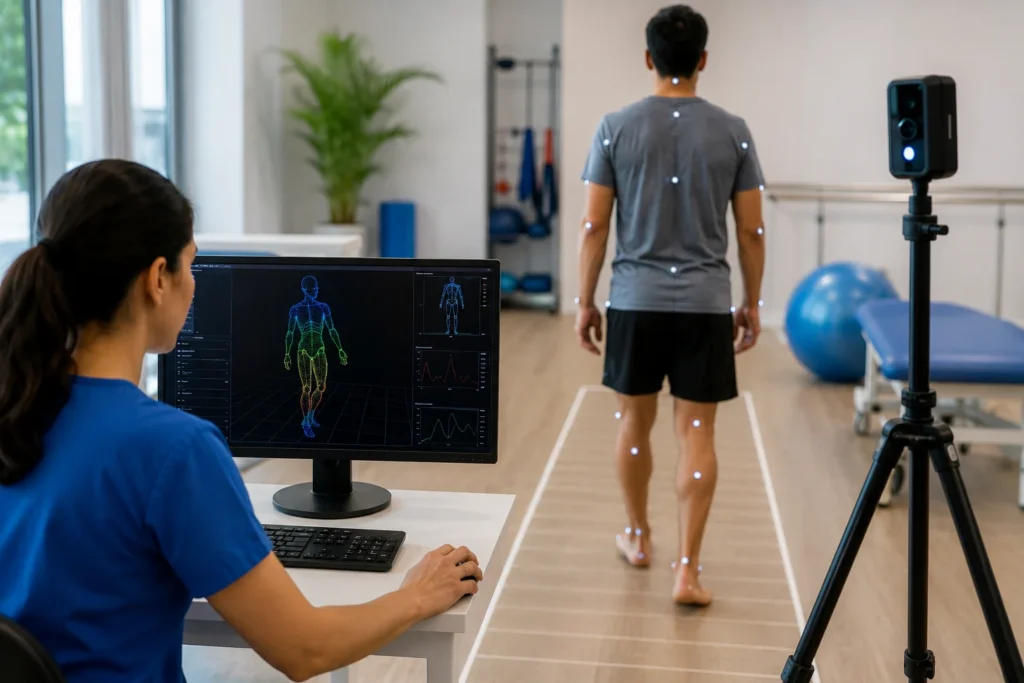
A recently published comprehensive survey reviewed rehabilitation studies conducted between 2019 and 2025 involving LiDAR technology.
Researchers concluded that LiDAR offers several important advantages over traditional monitoring methods.
Key observations included:
- Better privacy protection than standard RGB cameras.
- No need for patients to wear multiple sensors.
- Ability to perform continuous movement monitoring.
- Potential applications in hospitals, clinics, and home rehabilitation.
- Strong compatibility with artificial intelligence for automated movement analysis. (IEEE Xplore)
The review also emphasized that LiDAR should complement, not replace, clinical assessment by rehabilitation professionals.
Why This Matters for Physiotherapy
Physiotherapists often rely on visual observation, goniometers, wearable sensors, and patient-reported outcomes.
Each method has limitations.
Wearable sensors can be uncomfortable.
Camera systems raise privacy concerns.
Manual assessments require significant clinician time.
LiDAR addresses several of these challenges by creating accurate three-dimensional representations of body movement without requiring patients to wear special equipment. (IEEE Xplore)
Potential Clinical Applications
Emerging evidence suggests LiDAR may benefit multiple rehabilitation settings.
1. Home Safety Assessments
Therapists could remotely evaluate:
- Door widths
- Stair dimensions
- Bathroom accessibility
- Furniture placement
- Fall hazards
before recommending home modifications.
The recent proof-of-concept study demonstrated encouraging accuracy for this application.
2. Remote Physiotherapy
Patients performing home exercise programs may eventually receive automated movement tracking using LiDAR-enabled devices.
This could allow therapists to monitor exercise quality between appointments while reducing the need for frequent in-person visits. (IEEE Xplore)
3. Gait Analysis
LiDAR can generate highly detailed spatial information, making it useful for analyzing:
- Walking speed
- Step symmetry
- Balance
- Turning performance
- Mobility progression
Researchers believe this may improve long-term monitoring of neurological and orthopedic rehabilitation.
4. Fall Risk Assessment
Depth sensing technology could help detect changes in movement quality associated with increasing fall risk, particularly among older adults.
Although further clinical validation is needed, researchers consider this one of the most promising future applications.
Advantages Over Traditional Camera Systems
LiDAR offers several unique benefits.
| Traditional Camera | LiDAR |
|---|---|
| Records detailed facial images | Captures mainly depth information |
| Higher privacy concerns | Improved privacy protection |
| Sensitive to lighting | More robust in variable lighting |
| May require markers | Marker-free movement capture |
| Large video files | Efficient 3D spatial data |
These characteristics make LiDAR particularly attractive for telehealth and home rehabilitation. (arXiv)
Current Limitations
Despite the excitement, researchers caution that LiDAR is not yet ready to replace physiotherapists.
Current limitations include:
- Difficulty assessing pain.
- Cannot evaluate patient motivation or fear.
- Limited understanding of movement quality without AI interpretation.
- Some environmental barriers still require therapist judgment.
- Need for larger clinical trials.
The home assessment study found that several high-priority rehabilitation factors still required professional evaluation beyond automated measurements.
Could Smartphones Play a Role?
Many newer smartphones and tablets already include built-in LiDAR sensors.
Researchers suggest these devices could eventually become affordable rehabilitation tools by enabling:
- Remote exercise monitoring
- Home environment scanning
- Functional mobility assessment
- Progress tracking
However, clinical software specifically designed for physiotherapy remains under development.
Artificial Intelligence Will Likely Drive Future Progress
LiDAR becomes significantly more powerful when paired with artificial intelligence.
Future systems may automatically:
- Detect incorrect exercise techniques.
- Measure joint movement.
- Track recovery over time.
- Predict fall risk.
- Generate clinician-friendly reports.
Researchers believe this combination could improve rehabilitation efficiency while allowing therapists to focus more on individualized patient care.
Expert Perspective
The current evidence suggests LiDAR is evolving from a technology primarily associated with autonomous vehicles into a promising clinical tool for rehabilitation.
Importantly, recent research consistently supports a hybrid approach, where LiDAR enhances therapist decision-making rather than replacing clinical expertise.
Human assessment remains essential for interpreting pain, psychosocial factors, patient goals, and complex functional limitations.
What This Means for Patients
While LiDAR-based rehabilitation systems are still emerging, patients may eventually benefit from:
- More convenient home rehabilitation.
- Better access to physiotherapy in rural areas.
- Improved monitoring between clinic visits.
- Faster home modification planning.
- More personalized rehabilitation programs.
As larger clinical studies are completed, LiDAR could become an important component of future digital physiotherapy.
Stay tuned with us for more health related topics.
Follow us on LinkedIn and Instagram for more.
More Read


Medical Disclaimer!
This article has been reviewed and written under the guidance of our Head Physiotherapist, Dr. Kruti Raj (PT, MUHS,CPT,CMPT). The information shared is intended for educational purposes only and should not be considered a substitute for personalized medical advice, diagnosis, or treatment.
Please consult us or any other qualified healthcare professional before beginning any exercise program, especially if you are experiencing pain, recovering from injury, or managing a medical condition.


