


A cough or sneeze lasts only a second, yet if you have ever felt a sudden stabbing pain in your lower back during one, you know how surprisingly intense it can be.
Sometimes the pain feels like a quick muscular spasm.
In other people, it is a sharp pain that shoots from the lower back into the buttock or leg.
You may even feel as though something inside your spine has suddenly “shifted.”
But does pain when coughing or sneezing automatically mean you have a slipped disc?
No.
Quick Answer
Coughing and sneezing rapidly increase pressure and muscle activity around your trunk. If your lower back is already irritated, this sudden load can reproduce pain. Possible causes include muscle strain, disc irritation, nerve-root irritation or sciatica.
Important: If pain travels down your leg or you develop numbness, tingling, weakness, bladder/bowel changes or saddle numbness, seek medical assessment promptly.
Coughing and sneezing temporarily change pressure inside the abdomen and trunk and rapidly recruit the muscles around your spine.
If your back is already sensitive, irritated, stiff, or affected by nerve-root compression, that brief mechanical event can expose the problem.
In particular, pain that travels from your lower back into the buttock or leg, especially when accompanied by tingling, numbness or weakness, deserves more attention than isolated back pain.
Sciatica, for example, can become worse with coughing and sneezing because these actions can aggravate an already irritated nerve root.
The NHS notes that sciatica symptoms can worsen with coughing or sneezing and typically involve pain, tingling, numbness or weakness along the buttock and leg. (NHS)
As a physiotherapist, I would therefore look at the pattern of your pain, not simply whether coughing hurts.
Key Takeaways
- Lower back pain when coughing or sneezing does not automatically mean you have a slipped disc.
- Coughing and sneezing temporarily change trunk pressure and activate the abdominal and spinal muscles.
- Pain that remains in the lower back is different from pain that shoots into the buttock or leg.
- Leg pain accompanied by numbness, tingling or weakness may indicate nerve-root irritation.
- Do not assume that an MRI finding such as a disc bulge is automatically the cause of your pain.
- Prolonged bed rest and fear of movement are generally not the goal of rehabilitation for uncomplicated low back pain.
- Progressive exercise and appropriate physical activity can improve back function and resilience.
- Most lumbar disc herniations do not automatically require surgery.
- Bladder or bowel changes, saddle numbness or rapidly worsening weakness require urgent medical assessment.
Quick answer: Why does your lower back hurt when you cough or sneeze?
The most common explanation is that coughing or sneezing creates a rapid increase in trunk pressure and muscle activation.
If the tissues of your lower back are already irritated, that sudden load can reproduce your pain.
Possible causes include:
- Irritated lumbar muscles
- Lumbar disc irritation or herniation
- Nerve-root irritation or sciatica
- Facet joint irritation
- Sacroiliac-region pain
- Recent back strain or injury
- Less commonly, a more serious spinal or non-spinal condition
The important distinction is whether the pain stays in your lower back or travels into your buttock, thigh, calf or foot.
A herniated lumbar disc can irritate a nearby nerve root and produce pain that radiates into the leg. Numbness, tingling and weakness can also occur. [Mayo Clinic]
So, if coughing produces a brief ache directly over your lower back, the explanation may be very different from a cough that produces an electric-shock sensation down your leg.
What actually happens to your back when you cough or sneeze?
This is one of the lesser-known pieces of the puzzle.
A cough or sneeze is not simply an action of your lungs. Your respiratory system and musculoskeletal system work together.
Before a powerful cough or sneeze, your abdominal and trunk muscles rapidly contract.
Your diaphragm, abdominal muscles, pelvic floor and spinal muscles participate in creating and controlling pressure within the trunk.
That pressure helps generate the force required to expel air.
Your spine consequently experiences a brief change in mechanical loading.
This does not mean that every cough is damaging your discs.
In fact, intradiscal pressure is influenced by many factors, including spinal position, movement direction, disc condition, age and the specific spinal level being examined.
A 2025 experimental study involving 107 human spinal motion segments found that intradiscal pressure varies substantially according to:
degeneration, age, spinal level and movement direction, challenging the idea that one simple “disc pressure” explanation can account for back pain. (Elsevier)
That is an important clinical point.
Pressure is not the same thing as damage.
If coughing hurts, it does not automatically mean your spine is being injured each time you cough.
Why can coughing trigger pain from a disc or nerve?
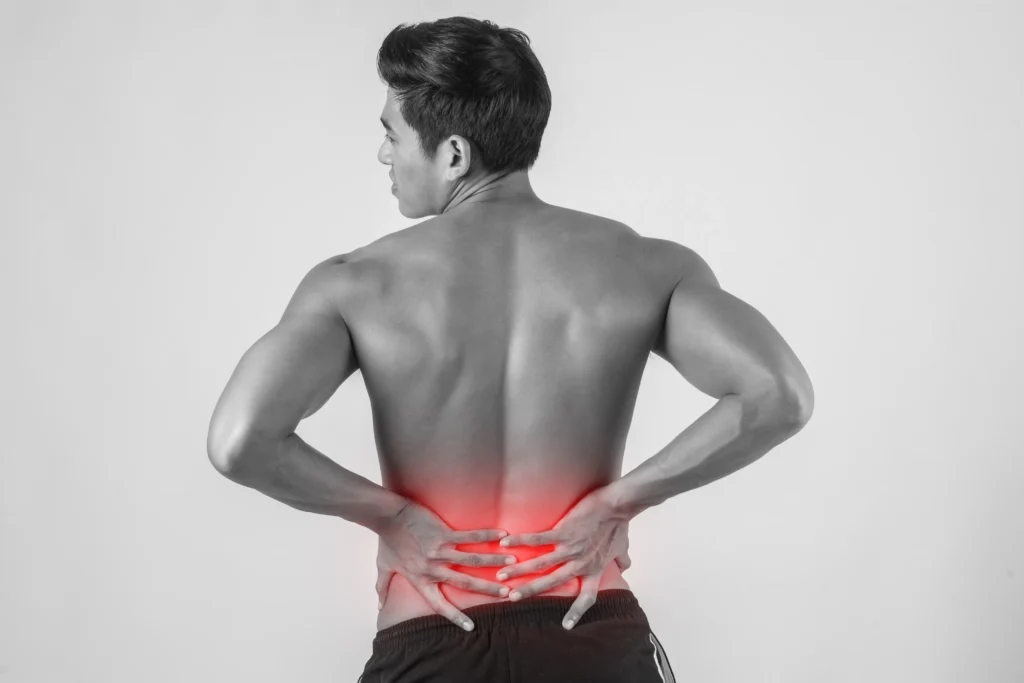
Imagine a nerve root that is already irritated.
The nerve does not necessarily need a dramatic new injury to become painful.
It may already be sensitive because of mechanical compression, inflammation or chemical irritation around the nerve root.
A sudden cough or sneeze can reproduce symptoms because it temporarily changes the mechanical environment around the spine.
This is why someone with lumbar radiculopathy may say:
“Every time I sneeze, I get an electric shock down my leg.”
That description is much more clinically meaningful than simply saying “my back hurts when I sneeze.”
Lumbar disc herniation is one possible cause of sciatica because disc material can irritate or compress a nearby nerve root.
Symptoms can extend from the lower back into the buttock, thigh, calf or foot. [Mayo Clinic]
A useful clue: where does the pain go?
Think about your pain pathway.
Pattern 1: Lower back only
Pain remains around the lumbar region and does not travel down the leg.
This is less suggestive of classic sciatica.
Pattern 2: Lower back to buttock
This can occur with several musculoskeletal conditions and does not automatically mean nerve compression.
Pattern 3: Lower back to leg
Pain extending below the buttock, particularly toward the calf or foot, raises more suspicion of nerve-root involvement.
Pattern 4: Leg pain with tingling, numbness or weakness
This is more concerning for neurological involvement and deserves a proper assessment.
The NHS specifically notes that isolated back pain is not usually considered sciatica, whereas sciatica commonly involves symptoms in the buttock and back of the leg. [NHS: Sciatica]
Does pain when sneezing mean you have a slipped disc?
This is probably the biggest misconception I see.
Not necessarily.
People often hear “pain when coughing or sneezing” and immediately assume “disc prolapse.”
But low back pain has many possible causes, and the World Health Organization estimates that approximately 90% of low back pain is nonspecific,
meaning no single specific underlying pathology can confidently explain the symptoms.
A disc problem becomes more plausible when coughing or sneezing is accompanied by a characteristic pattern of radiating leg pain, neurological symptoms or symptoms that change with spinal positions.
And even if imaging shows a disc bulge, that does not automatically prove that the disc is responsible for your pain.
Disc changes can exist without symptoms.
Mayo Clinic similarly notes that some people have herniated discs without symptoms and may discover them only on imaging. [Mayo Clinic]
This is why physiotherapy assessment is not simply about looking at an MRI report.
The surprising role of your sitting posture
Here is another less obvious factor.
If you spend hours sitting, especially in a flexed posture, your back may become sensitive to sudden movements when you finally stand, bend, cough or sneeze.
This does not mean that sitting has “damaged your disc.”
Research into lumbar intradiscal pressure has shown that spinal loading is considerably more complicated than the old idea that one posture simply equals “bad pressure.”
A systematic review and meta-analysis found inconsistent evidence regarding differences in intradiscal pressure between sitting and standing. [MDPI]
Instead of obsessing over perfect posture, I prefer to ask patients:
How long are you staying in one position, and how well can your body tolerate movement?
A back that becomes uncomfortable after several hours of immobility may benefit more from regular movement breaks and progressive strengthening than from trying to maintain a rigid “perfect posture” all day.
Could a back muscle strain cause pain when coughing?
Absolutely.
A strained lumbar or abdominal muscle may hurt when you cough or sneeze because these actions rapidly contract the muscles surrounding your trunk.
This can be particularly noticeable after:
- Heavy lifting
- Sudden twisting
- A new gym program
- Repeated bending
- Intense abdominal exercises
- Sports activity
- A prolonged coughing illness
If the pain is localized, tender to touch and aggravated by particular movements without neurological symptoms, muscular involvement becomes more plausible.
However, I would avoid diagnosing yourself solely from the location of tenderness.
The body often produces overlapping pain patterns.
Could your sacroiliac joint be responsible?
Possibly, although this diagnosis should not be made simply because pain is near one side of the lower back.
The sacroiliac joints connect the pelvis with the sacrum.
Pain around this region can be influenced by loading, movement and surrounding muscle function.
A cough or sneeze may temporarily increase trunk and pelvic forces and reproduce pain in a sensitive region.
But because sacroiliac pain, lumbar pain and hip-region pain can overlap, a physiotherapist should assess the whole lumbopelvic region rather than relying on one painful spot.
The “pressure equals damage” myth you should stop believing
This is one of the most important messages I want you to take away.
A painful cough does not mean:
“Every cough is worsening my disc.”
Pain is an output of the nervous system influenced by tissue sensitivity, mechanical loading, inflammation, previous injury, sleep, stress, movement and many other factors.
Even intradiscal pressure itself is not a simple measurement of whether a disc is healthy or unhealthy.
A 2025 study found that degeneration and age were associated with lower, rather than higher, intradiscal pressure in its experimental specimens, illustrating just how oversimplified the “more pressure = more damage” model can be. [PubMed]
This is why I don’t advise patients to become frightened of every cough, bend or sneeze.
Instead, we need to understand the symptom pattern.
What should you do when your lower back hurts during coughing or sneezing?
1. Do not deliberately suppress every cough or sneeze
If you need to cough or sneeze, do it.
The goal is not to become afraid of normal bodily functions.
Instead, try to avoid unnecessary twisting or extreme bending at the same time.
2. Try supporting your trunk
If coughing causes a sharp back spasm, place your hands gently over your abdomen or use a pillow for light support.
The purpose is comfort, not immobilization.
3. Avoid sudden lifting immediately after prolonged sitting
This is particularly relevant if your pain began after long desk hours.
Stand up gradually, walk for a minute and then perform your normal activity.
4. Keep moving within your tolerance
Complete bed rest is rarely the answer to uncomplicated low back pain.
WHO recommends physical activity and rehabilitation approaches such as exercise and physical therapy for many people with low back pain.
The key is appropriate movement, not forcing painful exercises.
5. Do not repeatedly test your back
This is a surprisingly common mistake.
Some people repeatedly cough, bend forward or perform a particular movement just to see whether the pain is still there.
That can irritate an already sensitive area.
Instead, monitor your symptoms during normal daily activities.
What exercises can help?
There is no universal “cough back pain exercise.”
Your exercise selection should depend on whether your symptoms are primarily muscular, mechanical, disc-related or neurological.
For uncomplicated low back pain, progressive exercise can be useful.
A 2024 systematic review and meta-analysis found evidence supporting exercise and education for prevention of nonspecific back pain. [Sage Journals]
For some patients, this may include:
- Walking
- Pelvic control exercises
- Hip strengthening
- Trunk endurance exercises
- Glute strengthening
- Gradual resistance training
- Mobility work
- Movement-specific rehabilitation
For persistent nonspecific low back pain, a 2024 network meta-analysis also examined different exercise types and doses,
finding meaningful pain improvements across exercise approaches, although certainty varied between outcomes. [JOSPT]
The important word is progressive.
Your back does not necessarily need more stretching. It may need better capacity.
What if you have a suspected disc herniation?
Do not panic.
A disc herniation can sound frightening, but many people improve without surgery.
A 2020 systematic review and meta-analysis involving 2,219 patients found a pooled regression rate of approximately 63% among nonsurgically treated symptomatic lumbar disc herniations. [BMC]
Another systematic review found that regression varies considerably according to the type of herniation, with extruded and sequestrated discs showing greater probabilities of spontaneous regression than simple bulges or protrusions. [NCBI]
That does not mean every disc problem should be treated without medical supervision.
It means that “disc problem = inevitable surgery” is outdated thinking.
When should you see a physiotherapist?
I recommend an assessment if:
- Your pain keeps returning whenever you cough or sneeze
- Pain lasts more than a few days and is not improving
- Pain interferes with walking or sleeping
- Pain travels into the buttock or leg
- You experience tingling or numbness
- You feel weakness in the leg
- You are avoiding normal activities because you are afraid of damaging your back
- Your symptoms started after lifting or trauma
A physiotherapist can examine your lumbar movement, hip function, neurological signs, strength, movement patterns and symptom behavior.
Importantly, the assessment should help determine what you can safely do, not simply tell you what you cannot do.
Do you need an MRI?
Not automatically.
This is another area where fear can lead people toward unnecessary investigations.
Clinical guidelines recommend against routine imaging for uncomplicated nonspecific low back pain.
Imaging becomes more appropriate when serious pathology is suspected, neurological deficits are significant or persistent symptoms suggest that imaging could change management.
The World Federation of Neurosurgical Societies also emphasizes combining clinical findings with appropriate imaging rather than relying on radiological abnormalities alone when evaluating lumbar disc herniation. [WFNS]
An MRI can show anatomy.
It cannot, by itself, tell you exactly how much pain you should feel.
When is coughing-related back pain an emergency?
Most episodes are not emergencies.
But certain symptoms require urgent medical assessment.
Seek urgent care if back pain associated with coughing or sneezing occurs together with:
- New loss of bladder control
- Difficulty passing urine
- Loss of bowel control
- Numbness around the genitals, inner thighs or saddle region
- Severe or rapidly worsening leg weakness
- Significant difficulty walking
- Major trauma
- Severe pain accompanied by concerning systemic symptoms
These can indicate serious neurological or other medical conditions.
Cauda equina syndrome, for example, is uncommon but potentially serious and requires urgent assessment when symptoms such as:
saddle numbness, bladder dysfunction or significant neurological deficits develop.
Do not wait for a physiotherapy appointment if these symptoms occur.
A lesser-known reason coughing can expose an existing problem
Sometimes the cough is not the cause.
It is simply the trigger that reveals a problem that was already there.
Imagine your lower back has been mildly irritated for several weeks. You may have noticed stiffness but continued with your routine.
Then you develop a respiratory infection and start coughing repeatedly.
Suddenly your back hurts.
It is tempting to conclude:
“The cough damaged my spine.”
But another interpretation may be more accurate:
The repeated mechanical stress exposed an already sensitive system.
This distinction matters because the treatment strategy changes.
Instead of protecting your back indefinitely, rehabilitation can focus on gradually restoring its ability to tolerate normal loads.
Things to avoid if coughing hurts your lower back
Avoid prolonged bed rest
Unless a medical professional specifically recommends otherwise, remaining in bed for extended periods is generally not the strategy I would choose for uncomplicated back pain.
Avoid aggressive stretching into pain
If your symptoms are nerve-related, repeatedly forcing a stretch may make the leg symptoms worse.
Avoid heavy lifting during a severe flare
Give your symptoms some room to settle before returning to maximal loads.
Avoid fear-based movement
Your spine is not a fragile structure that needs to be protected from every cough, bend or rotation.
Avoid diagnosing yourself from an MRI
A disc bulge on a scan is not automatically the explanation for your symptoms.
Avoid repeatedly checking whether coughing still hurts
Your body does not need an examination every five minutes.
How I would approach this as a physiotherapist
If you came to my clinic and said, “My lower back hurts every time I sneeze,” I would not immediately tell you that you have a slipped disc.
I would ask:
Where exactly is the pain?
Does it remain in your back or travel into your leg?
What does the pain feel like?
Do you have tingling or numbness?
Have you noticed weakness?
When did it start?
Was there lifting, twisting or trauma beforehand?
Does sitting aggravate it?
Does walking help?
Can you bend, stand and walk normally?
Have your bladder or bowel symptoms changed?
Those questions can provide much more useful information than simply asking whether your MRI says “disc bulge.”
The reassuring part: your back can become more resilient
One of my biggest concerns as a physiotherapist is when patients become afraid of their own spine.
They stop bending.
They stop exercising.
They avoid lifting.
They brace their abdomen constantly.
They become hyper-aware of every sensation.
Ironically, this can gradually reduce their confidence and physical capacity.
The goal of physiotherapy is usually not to make you protect your spine forever.
It is to help you restore capacity.
Exercise, education and appropriate physical activity are central components of modern low back pain rehabilitation.
WHO specifically recommends physical activity, exercise-based rehabilitation and self-management strategies for many people with low back pain.
And if a disc herniation is involved, the outlook may still be favorable.
Current evidence demonstrates that spontaneous disc regression or resorption occurs in a substantial proportion of patients managed conservatively.
Final word
If your lower back hurts when you cough or sneeze, do not immediately assume that you have damaged your spine or developed a slipped disc.
The cough or sneeze may simply be temporarily increasing trunk loading and reproducing pain from an already sensitive area.
The more important clues are what happen around the cough or sneeze.
Back pain alone is generally less concerning than back pain accompanied by pain traveling down the leg, numbness, tingling or weakness.
And symptoms involving bladder or bowel function, saddle numbness or rapidly progressive weakness require urgent medical assessment.
If the problem keeps happening, a physiotherapy assessment can help identify whether your symptoms are primarily related to muscular sensitivity, movement dysfunction, disc-related irritation, nerve-root involvement or another source.
Most importantly, don’t let one painful sneeze convince you that your spine is fragile.
Your back is designed to move, adapt and become stronger.
The right rehabilitation approach is about rebuilding that capacity safely and progressively.
Frequently Asked Questions
Why does my lower back hurt when I cough or sneeze?
Coughing and sneezing rapidly increase trunk pressure and activate the muscles around the spine. If your lower back is already irritated, this sudden mechanical load can reproduce pain.
Does back pain when sneezing mean I have a slipped disc?
No. Pain when sneezing can occur with muscle irritation, mechanical low back pain, disc-related problems or nerve irritation. A slipped disc becomes more concerning when pain travels into the leg or is accompanied by numbness, tingling or weakness.
Can sciatica get worse when coughing?
Yes. Sciatica symptoms can become worse with coughing or sneezing, particularly when a lumbar nerve root is irritated. Sciatica commonly causes pain, tingling, numbness or weakness extending from the lower back or buttock into the leg.
Should I get an MRI if my back hurts when I sneeze?
Not necessarily. Routine imaging is generally not recommended for uncomplicated low back pain. An MRI may be considered when there are significant neurological symptoms, persistent radicular symptoms or suspicion of a serious underlying condition.
Should I rest if coughing makes my back hurt?
Short-term modification of aggravating activities can be sensible, but prolonged bed rest is usually not necessary for uncomplicated low back pain. Gradual movement and appropriately selected exercise are generally more useful for recovery.
When should I worry about back pain when coughing?
Seek urgent medical attention if you develop new bladder or bowel dysfunction, numbness around the saddle area, rapidly worsening leg weakness, severe difficulty walking or significant neurological changes.
Can a physiotherapist treat back pain that happens when I sneeze?
Yes. A physiotherapist can assess your lumbar spine, hips, movement patterns, muscle strength and neurological signs and develop an individualized rehabilitation program based on the likely source of your symptoms.
Can a herniated disc heal without surgery?
Many lumbar disc herniations improve without surgery. Research has demonstrated that herniated disc material can spontaneously regress or resorb, particularly in certain types of herniation. Treatment decisions should nevertheless be based on symptoms, neurological findings and clinical assessment.
Can coughing actually damage my spine?
A normal cough or sneeze does not automatically mean that your spine is being damaged. It can temporarily increase trunk loading and reproduce pain from an already sensitive area. Persistent or neurological symptoms should be assessed rather than assuming that each cough is causing structural damage.
What is the best exercise for lower back pain when coughing?
There is no single exercise that works for everyone. Depending on the cause, rehabilitation may include walking, trunk strengthening, hip strengthening, mobility exercises and progressive resistance training. Exercise should be selected according to your symptoms and physical assessment.
Stay tuned with us for more health related topics.
Follow us on LinkedIn and Instagram for more.
More Read


Medical Disclaimer!
This article has been reviewed and written under the guidance of our Head Physiotherapist, Dr. Kruti Raj (PT, MUHS,CPT,CMPT). The information shared is intended for educational purposes only and should not be considered a substitute for personalized medical advice, diagnosis, or treatment.
Please consult us or any other qualified healthcare professional before beginning any exercise program, especially if you are experiencing pain, recovering from injury, or managing a medical condition.


