


If you regularly lift weights, getting an IUD does not necessarily mean putting your workouts on hold for a long time.
Getting an intrauterine device (IUD) does not mean you have to give up your gym routine.
For women who enjoy strength training, one of the first questions after an IUD insertion is often whether they can safely return to squats, deadlifts, resistance machines, core exercises or heavier weights.
Quick Answer
Yes. Most women can return to weightlifting after getting an IUD once the initial discomfort from insertion has settled.
Routine physical activity is not generally recognized as a typical cause of IUD expulsion. However, direct research on very heavy resistance training is limited.
If lifting causes severe pelvic pain, unusual bleeding, significant pelvic pressure or other concerning symptoms, stop exercising and seek appropriate medical advice.
The reassuring part is that routine physical activity is not generally recognized as a cause of IUD expulsion.
However, there is limited research specifically examining whether heavy resistance exercise can trigger an IUD to move or be expelled.
That means the safest approach is to focus on recovery after insertion, your symptoms and a gradual return to training rather than assuming that every type of lifting has been directly studied.
An IUD sits inside the uterus, while weightlifting primarily loads the muscles of the legs, hips, abdomen and back.
These structures work together during lifting, but that does not mean a heavy workout mechanically pulls on the IUD.
Key Takeaways
- An IUD does not automatically mean you need to stop strength training.
- Routine exercise is not established as a typical cause of IUD expulsion.
- Research specifically examining very heavy weightlifting and IUD displacement is limited.
- After insertion, return to heavier training gradually and let your symptoms guide your progression.
- Squats, deadlifts, machines and core exercises do not need to be automatically avoided.
- Pelvic pain, unusual pressure, heavy bleeding or other concerning symptoms should not be ignored.
- Physiotherapy can help with pelvic-floor coordination, breathing, movement and return to exercise after medical concerns have been ruled out.
Can You Lift Weights After Getting an IUD?
For most women, having an IUD does not require permanent restrictions on strength training.
Once the immediate discomfort following insertion has settled, you can generally work toward returning to your usual activities.
The first few days can be different, though.
Cramping, spotting and pelvic discomfort can occur after insertion.
If lifting makes these symptoms noticeably worse, reducing the intensity or taking additional recovery time may be sensible.
Your return to exercise should also take into account how the insertion went and whether you experienced any complications.
When Can You Start Weight Training?
There is no universal number of days that every woman must wait before lifting weights.
Some women feel ready for normal activity relatively quickly, while others experience cramping or discomfort for longer.
Instead of using a rigid timeline, pay attention to how your body responds.
If you normally perform heavy resistance training, start with a lighter load and gradually work back toward your normal intensity.
This gives you an opportunity to notice how your body responds without immediately placing it under the same demands as a full training session.
Can Heavy Lifting Dislodge an IUD?
There is no good evidence showing that lifting heavy weights by itself causes an IUD to be expelled.
At the same time, it would be too strong to say that every form of heavy lifting has been proven incapable of affecting IUD position.
Direct research on specific exercises such as deadlifts, squats or maximal lifts is limited.
IUD expulsion is a recognized complication of IUD use, and several factors unrelated to exercise can influence expulsion risk.
Therefore, if an IUD is expelled around the same time that someone increases their training, the timing alone does not establish that the workout caused it.
Can You Do Squats With an IUD?
Squats place considerable demands on the hips, thighs and trunk.
During heavier squats, the abdominal muscles and diaphragm contribute to trunk stability, while the pelvic floor works as part of the broader pressure-management system.
None of this means that squatting automatically pushes an IUD out of position.
If you are returning to squats soon after insertion, start with a comfortable load and avoid immediately testing your maximum strength.
A gradual increase gives you more control over how your body responds.
What About Deadlifts?
Deadlifts can create substantial abdominal and trunk pressure, particularly when lifting heavy loads.
An IUD does not need to be removed from your exercise programme simply because you perform deadlifts.
However, technique becomes especially important when you are returning after insertion.
Use a weight that allows you to maintain good control.
Coordinate your breathing and bracing rather than repeatedly forcing through pain or unusual pelvic pressure.
If a particular load consistently produces pelvic symptoms, reduce the weight and reassess rather than trying to push through them.
Can You Do Leg Presses and Machine Exercises?
Resistance machines can also be part of a workout with an IUD.
A leg press, for example, places a large demand on the lower body, but the machine does not directly interact with the IUD.
After insertion, you may find it useful to begin below your usual training load.
If the movement feels comfortable and does not produce unusual pelvic symptoms, resistance can gradually be increased.
Can You Do Abdominal Exercises With an IUD?
An IUD does not automatically mean that you need to avoid abdominal exercises.
Planks, dead bugs, controlled abdominal strengthening and other core exercises can be included if they feel comfortable.
The abdominal muscles and pelvic floor coordinate during changes in pressure and movement.
This is a normal part of human movement and does not mean that core exercises are pushing the IUD around inside the uterus.
However, sharp pelvic pain or unusual pressure during an exercise is a reason to stop and reassess.
Can Weightlifting Affect the Pelvic Floor?
This is where the physiotherapy perspective becomes particularly useful.
The pelvic floor is involved in supporting the pelvic organs and coordinating with the abdominal muscles and diaphragm during movement.
During resistance exercise, the pelvic floor does not simply switch on and stay contracted. It needs to coordinate with breathing, trunk movement and the demands of the task.
Some women may experience pelvic heaviness, pressure, urinary leakage or difficulty relaxing during high-load exercise.
These symptoms do not automatically mean that an IUD has moved.
They may instead reflect how the pelvic floor, abdominal muscles and breathing system are responding to the physical demands of the exercise.
Evidence from pelvic-health research suggests that pelvic-floor physical therapy can be useful for certain pelvic pain and pelvic-floor overactivity conditions, although this evidence is not specifically about women with IUDs (van Reijn-Baggen et al., 2022).
Does Heavy Bracing Matter?
Experienced lifters often use abdominal bracing during heavy resistance exercise.
Bracing increases trunk stiffness and helps the body manage the demands of lifting.
It also changes pressure within the abdomen.
Having an IUD does not automatically mean you need to avoid bracing.
However, if you repeatedly experience pelvic pain, pressure or urinary leakage when bracing, it may be useful to have your breathing and lifting strategy assessed.
A physiotherapist can look at how your rib cage, diaphragm, abdominal wall and pelvic floor coordinate during movement.
The goal is not to eliminate normal abdominal pressure.
It is to help you manage movement and pressure appropriately for the task.
What If Weightlifting Causes Cramping?
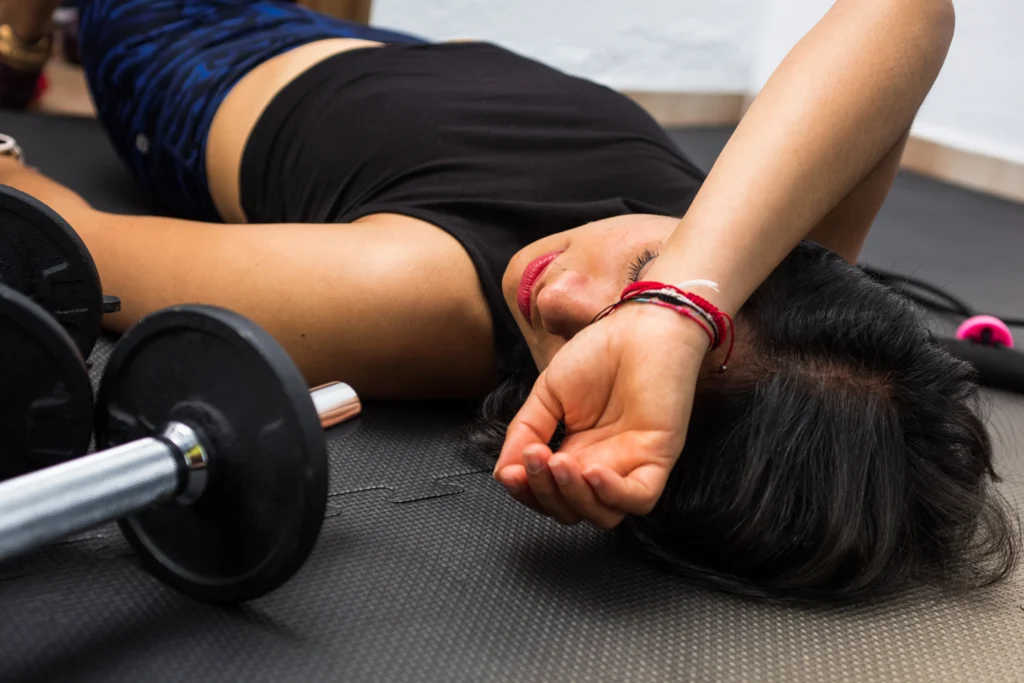
Mild cramping can occur after an IUD insertion.
You may notice it more during exercise because movement increases awareness of the pelvic area.
If the discomfort is mild and settles when you stop or reduce the intensity, taking a break and returning more gradually may help.
Severe or worsening pain is different.
Do not assume significant pelvic pain is simply a normal response to exercise.
Seek medical assessment if you develop severe pelvic pain, heavy bleeding, fever, unusual vaginal discharge, dizziness or other concerning symptoms.
How Do You Know If an IUD Has Moved?
IUD expulsion or displacement can sometimes produce noticeable changes.
Possible warning signs include:
- A significant change in the length of the IUD strings
- Being unable to feel the strings when you previously could
- Feeling a hard part of the device
- New or significant pelvic pain
- Unusual or heavy bleeding
- Pain during intercourse
- The device partially or completely coming out
- A positive pregnancy test
Not every change in string position means that an IUD has moved.
Strings can change position naturally.
If you are concerned about the position of the device, however, medical assessment is more appropriate than trying to determine the answer from your workout symptoms.
Should You Stop Lifting If You Cannot Feel the Strings?
A change in your ability to feel the strings is worth discussing with a healthcare professional, particularly if it is new.
Sometimes the strings curl upward and become difficult to feel.
However, missing strings can also occur with expulsion or, less commonly, perforation.
Do not attempt to push an IUD back into position yourself.
If you suspect that the device has moved or been expelled, use appropriate backup contraception as advised by your healthcare professional until the IUD’s position has been confirmed.
How Should You Return to Heavy Training?
A gradual return is often more practical than immediately attempting your previous maximum weights.
Start With Familiar Exercises
Begin with movements you already know well.
This makes it easier to distinguish normal post-insertion discomfort from symptoms associated with a particular exercise.
Reduce Your Training Load
If you normally lift heavily, start below your usual working weight.
You can gradually increase resistance as long as you remain comfortable.
Increase One Variable at a Time
Rather than increasing weight, volume and training intensity simultaneously, progress gradually.
This gives your body time to adapt and makes it easier to identify what is causing a problem if symptoms appear.
Do Not Train Through Concerning Symptoms
Muscle fatigue is one thing.
Sharp pelvic pain, unusual pelvic pressure, heavy bleeding or significant new symptoms are different and should not simply be pushed through.
Can a Hormonal IUD Affect Exercise?
An interesting area of research is whether hormonal IUDs influence the body’s response to exercise in hot conditions.
A 2024 study compared women using hormonal IUDs with women who were not using them during moderate- and high-intensity exercise in a warm, dry environment.
The researchers found statistically similar whole-body heat loss, body heat storage and core temperature responses between the groups.
The findings suggest that hormonal IUD use did not substantially compromise thermoregulation during the exercise conditions studied (Kirby et al., 2024).
This study does not answer whether heavy lifting can affect IUD position, but it provides useful information about exercise physiology in hormonal IUD users.
Where Does Physiotherapy Fit In?
Physiotherapy should not be used to determine whether an IUD has been expelled, displaced or perforated.
Those concerns require medical assessment.
The role of pelvic-health physiotherapy is different.
Once a medical issue has been ruled out, physiotherapy may help women who are struggling to return to exercise because of pelvic pain, pelvic-floor symptoms, movement-related discomfort or reduced confidence.
A pelvic-health physiotherapist may assess:
- Pelvic-floor coordination
- Pelvic-floor relaxation
- Breathing patterns
- Abdominal pressure management
- Hip and pelvic movement
- Trunk control
- Strength and mobility
- Exercise technique
- Movement patterns associated with pain
A 2024 systematic review and meta-analysis found that multimodal physical therapy reduced pain in women with chronic pelvic pain, although those studies were not specifically conducted in IUD users.
This distinction is important when applying the evidence to someone with an IUD. (Starzec-Proserpio et al., 2024).
Do You Need Kegels If You Lift Weights With an IUD?
No.
Having an IUD does not automatically mean that you need Kegel exercises.
The pelvic floor needs to contract when appropriate, but it also needs to relax.
For some women experiencing pelvic pain or pelvic-floor overactivity, repeatedly performing strengthening exercises without assessment may not address the underlying problem.
A pelvic-health physiotherapist can determine whether strengthening, relaxation, coordination, breathing work or another approach is appropriate.
Can an IUD Affect Your Strength or Gym Performance?
An IUD itself is not expected to reduce your strength or prevent you from participating in resistance training.
Your experience may nevertheless change temporarily after insertion because of cramping, bleeding, discomfort or anxiety about exercising.
These factors can affect how confident you feel under a heavy barbell even when the device itself is not affecting muscle performance.
Returning gradually can help rebuild confidence as well as physical tolerance.
Myth vs Fact
Myth
“Heavy lifting will pull my IUD out of place.”
Fact
There is no good evidence that ordinary weightlifting by itself causes IUD expulsion. However, research specifically studying very heavy resistance training is limited, so unusual symptoms should be assessed rather than automatically attributed to exercise.
Myth
“If I have an IUD, I need to avoid abdominal exercises.”
Fact
An IUD does not automatically require you to avoid planks, core strengthening or other abdominal exercises. Comfort and symptoms should guide exercise progression.
Myth
“Pelvic pressure during lifting always means the IUD has moved.”
Fact
Pelvic pressure can have several causes, including pelvic-floor coordination and pressure management. It does not by itself prove IUD displacement.
Lesser-Known Fact
An IUD does not normally travel around the body.
It is designed to sit inside the uterus.
A rare uterine perforation can occur during insertion, but this is different from an IUD being pushed through the uterus because someone lifted weights.
That distinction is important because women sometimes interpret pelvic sensations during exercise as evidence that the device has moved.
Exercise-related pelvic pressure alone does not establish IUD displacement.
When Should You See a Physiotherapist?
Pelvic-health physiotherapy may be worth considering if a medical assessment has ruled out IUD-related complications but you continue to experience:
- Pelvic discomfort during lifting
- Pelvic heaviness or pressure during exercise
- Urinary leakage during workouts
- Difficulty relaxing the pelvic floor
- Pain during certain movements
- Difficulty coordinating breathing and lifting
- Reduced confidence returning to strength training
Physiotherapy can help identify whether movement, muscle coordination, breathing or exercise technique is contributing to your symptoms.
However, severe pelvic pain, heavy bleeding, fever, unusual discharge, suspected IUD expulsion or pregnancy symptoms require medical assessment first.
Final Thoughts
Getting an IUD does not mean you have to give up weightlifting. Most women can work toward returning to strength training after the initial recovery period.
Squats, deadlifts, leg presses and core exercises do not need to be automatically removed from your programme. Start gradually, pay attention to your symptoms and avoid pushing through concerning pelvic pain or unusual bleeding.
If medical concerns have been ruled out but pelvic symptoms continue to interfere with exercise, pelvic-health physiotherapy can help assess movement, breathing, pelvic-floor coordination and your return to strength training.
Final Thoughts
Getting an IUD does not mean you have to give up weightlifting.
For most women, the main consideration is allowing the body to settle after insertion and then returning to resistance training progressively.
Squats, deadlifts, leg presses, core exercises and other strength movements do not need to be automatically removed from your programme simply because you have an IUD.
At the same time, there is limited direct research specifically examining heavy weightlifting as a trigger for IUD expulsion.
It is therefore better to avoid absolute claims and focus on what is known: IUD expulsion can occur, but routine exercise is not established as a typical cause.
If you develop unusual pelvic pain, pressure, heavy bleeding or other concerning symptoms, reduce or stop the activity and seek appropriate medical advice.
If medical concerns have been ruled out but pelvic symptoms continue to interfere with exercise, pelvic-health physiotherapy may help you understand your movement and pelvic-floor response and build a more comfortable return to strength training.
Frequently Asked Questions
1. Can you lift weights after getting an IUD?
Most women can return to weightlifting after the initial discomfort from insertion has settled. A gradual return can make the transition more comfortable.
2. Can heavy lifting dislodge an IUD?
There is no good evidence that ordinary weightlifting by itself causes IUD expulsion. However, direct research on very heavy resistance training is limited.
3. Can I do squats with an IUD?
Squats do not need to be automatically avoided because you have an IUD. If you are returning after insertion, start with a comfortable load and increase gradually.
4. Can I do deadlifts with an IUD?
Deadlifts can generally be part of strength training with an IUD. Use appropriate technique and reduce the load if lifting causes pelvic pain or unusual pressure.
5. Can I do abdominal exercises with an IUD?
Yes. An IUD does not automatically require avoiding planks, dead bugs or other core exercises. Stop and seek advice if an exercise causes concerning symptoms.
6. What if weightlifting causes pelvic pressure?
Pelvic pressure does not automatically mean that an IUD has moved. It may relate to pelvic-floor or abdominal pressure management, but persistent or concerning symptoms should be assessed.
7. Can physiotherapy help me return to weightlifting after getting an IUD?
After medical concerns have been ruled out, pelvic-health physiotherapy can help assess pelvic-floor coordination, breathing, movement, strength and exercise technique.
Stay tuned with us for more health related topics.
Follow us on LinkedIn and Instagram for more.
More Read


Medical Disclaimer
This article is intended for general educational purposes only and does not replace individual medical advice, diagnosis or treatment. If you experience severe pelvic pain, heavy bleeding, fever, unusual vaginal discharge, suspected IUD displacement or pregnancy symptoms, contact a qualified healthcare professional promptly. A physiotherapist should not be used to diagnose or reposition a displaced IUD.


