


Pain on the outside of your hip can make walking, climbing stairs, and sleeping on your side uncomfortable.
Quick Answer: What Is Gluteus Minimus Tendinopathy?
Gluteus minimus tendinopathy is a condition affecting a tendon of a small hip muscle that helps stabilize the pelvis and control leg movement. It can cause pain on the outside of the hip, particularly during walking, stair climbing, standing on one leg, or lying on the affected side.
What can help? Physiotherapy may involve modifying painful activities, reducing excessive tendon compression, and gradually strengthening the hip muscles. Because other hip and back conditions can cause similar symptoms, an assessment is important before starting a targeted rehabilitation program.
One possible cause is gluteus minimus tendinopathy, a condition affecting a tendon that helps control hip movement and stabilize the pelvis.
This condition can be difficult to distinguish from gluteus medius tendinopathy, hip bursitis, and other causes of lateral hip pain.
Physiotherapy can help manage many cases through targeted assessment, activity modification, and progressive strengthening.
Key Takeaways
- Gluteus minimus tendinopathy is one possible cause of pain on the outside of the hip.
- Symptoms may increase during walking, stair climbing, single-leg activities, or sleeping on the painful side.
- Gluteus minimus and gluteus medius tendinopathy can occur together and may be difficult to distinguish from symptoms alone.
- Greater trochanteric pain syndrome includes several possible causes of outer hip pain, not just bursitis.
- Physiotherapy may include activity modification, progressive strengthening, and gradual return to daily activities.
- Sudden severe pain, inability to bear weight, or a hot, swollen hip with fever requires urgent medical assessment.
What Is Gluteus Minimus Tendinopathy?
The gluteus minimus is a small muscle located deep beneath the gluteus medius on the outer side of the hip.
Its tendon attaches to the upper thigh bone, close to the greater trochanter, the bony prominence you can feel on the outside of your hip.
The muscle helps move the leg away from the body, assists with hip rotation, and contributes to pelvic stability when you stand on one leg or walk.
Gluteus minimus tendinopathy refers to pain and impaired load tolerance involving this tendon.
It may develop gradually when repeated physical demands exceed the tendon’s current capacity.
The condition belongs to a broader group of problems called greater trochanteric pain syndrome (GTPS).
This term describes pain around the outer hip that may involve the gluteus minimus tendon, gluteus medius tendon, nearby bursa, or several structures together.
Symptoms alone cannot reliably identify which tendon is affected.
Gluteus minimus and gluteus medius tendinopathy may occur together, so an accurate clinical assessment is important. (Grimaldi et al., 2015)
What Causes Gluteus Minimus Tendinopathy?
Gluteus minimus tendinopathy does not always begin with a specific injury.
It can develop when the tendon repeatedly experiences loads or positions it struggles to tolerate.
Sudden increases in activity
Increasing walking distance, running mileage, hill training, or gym workload too quickly can place additional demands on the tendon.
Symptoms may appear after an otherwise ordinary activity if the total workload has increased substantially.
Repeated compression around the hip
Lying directly on the painful side, crossing your legs tightly, or repeatedly allowing the upper leg to move across your body can increase compression around the gluteal tendons.
These positions are not harmful to everyone, but they may aggravate symptoms in a sensitive tendon.
Changes in strength and load tolerance
The hip muscles and tendons must manage repeated forces during walking, climbing stairs, and standing on one leg.
Reduced capacity to tolerate these demands may contribute to symptoms, although weakness is not necessarily the original cause.
Age and previous hip problems
Gluteal tendinopathy is frequently reported in middle-aged and older adults, particularly women.
Previous hip pain, changes in activity, and other musculoskeletal problems may also influence symptoms.
However, age, posture, and muscle strength alone cannot establish the diagnosis.
What Are the Symptoms of Gluteus Minimus Tendinopathy?
The most characteristic symptom is pain around the outer hip, often near the greater trochanter.
Discomfort may remain localised or extend down the outer thigh.
Common symptoms include:
- Pain when lying on the affected side.
- Discomfort during longer walks or uphill walking.
- Pain while climbing stairs or standing on one leg.
- Tenderness around the outer hip.
- Pain during certain hip movements or exercises.
- Discomfort after prolonged standing.
- Sleep disturbance when pressure is placed on the painful side.
Symptoms may fluctuate.
You might feel comfortable while sitting but notice pain after walking, climbing stairs, or sleeping on the affected hip.
These symptoms are not specific to gluteus minimus tendinopathy.
Hip osteoarthritis, gluteus medius tendinopathy, and referred pain from the lower back can produce similar complaints.
Significant weakness, a new limp, or a sudden decline in your ability to walk warrants assessment rather than an assumption that the problem is a mild tendon condition.
Why Is Gluteus Minimus Tendinopathy Often Overlooked?
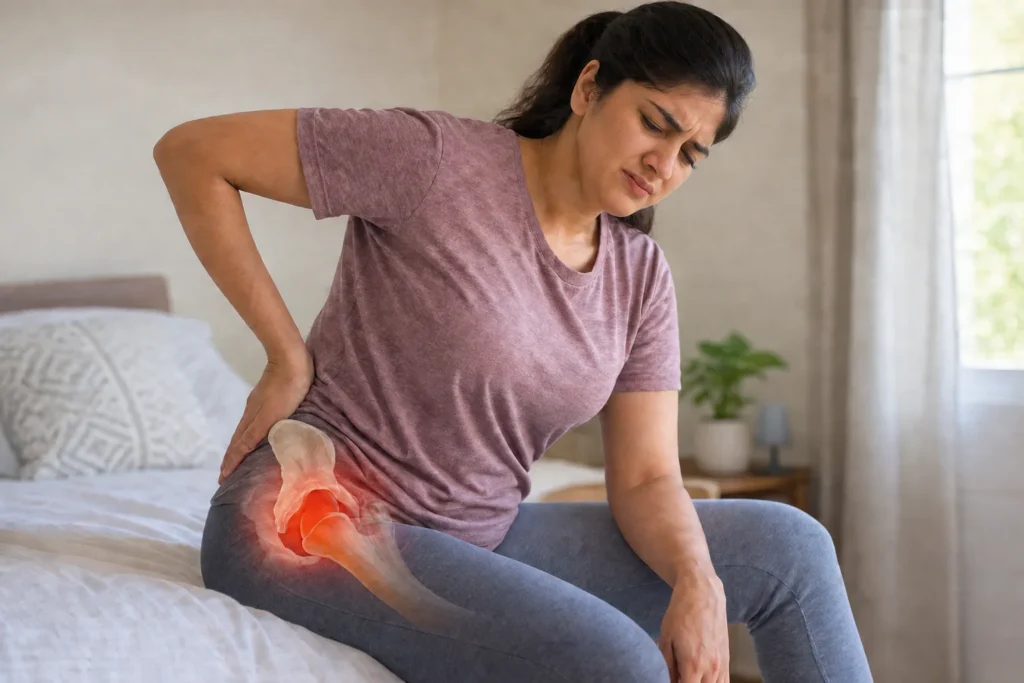
The gluteus minimus tendon lies beneath the gluteus medius, and both muscles contribute to hip stability.
Their tendons attach close together, so symptoms can overlap.
Another source of confusion is hip bursitis.
The nearby bursa helps reduce friction between tissues around the greater trochanter, but the bursa is not necessarily the main source of pain in someone with lateral hip symptoms.
Pain originating from the lower back or hip joint can also be felt around the outer hip.
This overlap matters because treatment should match the likely cause.
A person with tendon-related pain may benefit from progressive strengthening and reducing excessive tendon compression, while another person may need assessment and treatment for a different condition.
Gluteus Minimus vs Gluteus Medius Tendinopathy
Both conditions can cause pain around the outer hip, and they frequently overlap.
| Feature | Gluteus minimus tendinopathy | Gluteus medius tendinopathy |
|---|---|---|
| Location | Deep outer hip region | Outer hip and buttock region |
| Main role of muscle | Hip movement and pelvic stability | Hip movement and pelvic stability |
| Common aggravating activities | Walking, stairs, single-leg loading | Walking, stairs, single-leg loading |
| Can symptoms overlap? | Yes | Yes |
| Can symptoms alone identify the tendon? | No | No |
A physiotherapist cannot reliably distinguish these conditions simply by asking where it hurts.
The assessment may include strength testing, palpation, functional movements, and screening for other causes.
Imaging may be appropriate in selected cases, particularly when symptoms persist or a significant tendon tear is suspected. (Kinsella et al., 2024)
How Is Gluteus Minimus Tendinopathy Diagnosed?
Diagnosis usually begins with a clinical history and physical examination.
A physiotherapist or other healthcare professional may ask when symptoms began, which activities aggravate the pain, and whether walking, sleeping, or exercise has become more difficult.
The assessment may include:
- Palpation: Checking whether pressure around the greater trochanter reproduces your familiar pain.
- Resisted hip abduction: Assessing the muscles that move the leg outwards against resistance.
- Single-leg tasks: Observing whether standing on one leg or stepping up reproduces symptoms.
- Movement assessment: Examining walking, hip movement, balance, and relevant daily activities.
- Screening for other conditions: Assessing the lower back and hip joint when symptoms suggest they may contribute.
No single test can confirm isolated gluteus minimus tendinopathy in every person.
Clinical findings need to be interpreted together.
Do you need an MRI or ultrasound?
Not everyone needs imaging.
Many cases of suspected gluteal tendinopathy can initially be assessed through symptoms and physical examination.
An ultrasound or MRI may be considered if the diagnosis remains uncertain, symptoms persist despite appropriate management, or a significant tendon tear or another condition is suspected.
Imaging results should always be considered alongside clinical findings.
A tendon abnormality on a scan does not automatically mean that it is responsible for the pain.
How Can Physiotherapy Help Gluteus Minimus Tendinopathy?
Physiotherapy aims to reduce unnecessary irritation while gradually improving the hip’s ability to tolerate everyday movement.
The program should reflect your symptoms, physical capacity, and assessment findings.
1. Modify aggravating activities
During a painful phase, temporarily reduce activities that consistently increase symptoms.
These may include prolonged hill walking, repeated stair climbing, or lying directly on the affected hip.
Complete rest is not automatically necessary.
The aim is to maintain comfortable activity while reducing repeated flare-ups.
2. Start with appropriate strengthening
Depending on your symptoms, a physiotherapist may introduce gentle muscle contractions before progressing to more demanding exercises.
Examples may include:
- Gentle gluteal isometric contractions: Tightening the buttock muscles without moving the hip.
- Supported standing hip abduction: Moving the leg gently outwards while holding a stable surface, if comfortable.
- Controlled sit-to-stand: Practicing standing up from a chair with comfortable movement and control.
These are examples rather than a universal exercise prescription.
An exercise that aggravates your symptoms should be modified, and significant or unexplained pain should be assessed before you begin a new program.
3. Progress to functional exercises
As your symptoms and strength improve, rehabilitation may progress to controlled step-ups, resistance-band exercises, and other weight-bearing movements.
The purpose is to improve the hip’s ability to manage daily demands, such as walking, climbing stairs, and standing on one leg.
Progression should depend on your response to exercise rather than a fixed timetable. Increasing resistance or repetitions too quickly may cause symptoms to flare.
4. Manage tendon loading
Tendons need an appropriate amount of loading to build capacity.
Too much too soon can aggravate symptoms, while avoiding all movement for long periods may make returning to activity more difficult.
A physiotherapist can help balance exercise, rest, and daily activity.
They may also recommend changes to positions that repeatedly compress the gluteal tendons.
Research supports education and exercise as a core approach to managing gluteal tendinopathy, although individual outcomes vary and the evidence does not establish one exercise program as best for every patient. (Bremer et al., 2025)
What Should You Avoid During a Painful Flare?
There is no universal list of exercises that everyone with gluteus minimus tendinopathy must avoid.
However, certain movements may need temporary modification if they repeatedly reproduce pain.
Depending on your symptoms, these may include:
- Lying directly on the painful hip.
- Deep stretches that pull the leg across the body.
- Side-lying leg raises that cause increasing discomfort.
- Long walks or steep hills that repeatedly trigger symptoms.
- Standing for long periods with most of your weight resting on one hip.
These movements are not necessarily harmful forever.
Some can be gradually reintroduced as your tolerance improves.
Do not use pain as a challenge to push through.
If an exercise produces significant discomfort or leaves the hip noticeably worse afterwards, reduce the load and seek professional guidance if needed.
Myth vs Fact: Gluteus Minimus Tendinopathy
MYTH: All outer hip pain is gluteus minimus tendinopathy.
FACT: Outer hip pain can arise from several conditions, including gluteal tendinopathy, hip joint problems, and referred pain from the lower back. An assessment helps identify the likely cause.
MYTH: Gluteus minimus and gluteus medius tendinopathy are always easy to distinguish.
FACT: These tendons work together and their symptoms can overlap. Clinical findings, rather than pain location alone, help guide assessment.
MYTH: Complete rest is the best treatment.
FACT: Many cases benefit from adjusting aggravating activities while gradually rebuilding strength and load tolerance. The appropriate approach depends on the diagnosis and severity.
MYTH: Painful exercises should always be pushed through.
FACT: Exercises should be adapted to your symptoms and physical capacity. Significant or persistent worsening pain warrants reassessment rather than forcing progression.
What Can You Do at Home?
Simple adjustments may help you manage symptoms while arranging an assessment or following your physiotherapy programme.
Adjust your sleeping position
Avoid lying directly on the painful side if it aggravates your symptoms.
If sleeping on the opposite side is comfortable, place a pillow between your knees to prevent the upper leg from falling across your body.
Modify your walking routine
If long walks or hills trigger discomfort, temporarily reduce the distance, pace, or incline.
Continue comfortable movement if appropriate rather than automatically stopping all activity.
Avoid prolonged single-leg standing
Try to distribute your weight evenly instead of resting for long periods with your pelvis shifted over one hip.
Monitor your symptoms
Record which activities trigger pain, how long symptoms last, and whether discomfort is worse later that day or the following morning.
This information can help guide your rehabilitation.
Avoid repeatedly testing the tendon
Repeatedly pressing the painful area or performing painful movements to see whether it still hurts may aggravate symptoms without providing a reliable measure of recovery.
If symptoms persist or worsen despite these changes, arrange a clinical assessment.
How Long Does Gluteus Minimus Tendinopathy Take to Improve?
Recovery depends on symptom severity, how long the problem has been present, your activity demands, and whether there is significant tendon damage.
Some people notice gradual improvement over several weeks, while others need several months of consistent rehabilitation.
Symptoms can fluctuate during recovery, especially after unusually demanding days.
Rather than focusing only on whether the pain has disappeared, look for functional improvements, such as:
- Sleeping more comfortably.
- Walking further without increasing pain.
- Climbing stairs with less discomfort.
- Standing on one leg more comfortably.
- Returning gradually to usual exercise and daily activities.
If symptoms are not improving despite appropriate management, or if weakness and walking difficulty are increasing, seek reassessment.
When Should You Seek Medical Attention?
Outer hip pain is not always caused by tendinopathy. Some symptoms require prompt medical assessment.
Seek urgent medical care if:
- You develop sudden, severe hip pain, particularly after a fall or injury.
- You cannot walk or bear weight on the affected leg.
- Your hip becomes hot or swollen and you have a fever or feel generally unwell.
- You develop significant new weakness or rapidly worsening symptoms.
Arrange a clinical assessment if:
- Pain keeps returning despite appropriate activity modification.
- You develop a noticeable limp or increasing difficulty climbing stairs.
- Hip weakness is becoming more pronounced.
- Pain regularly disrupts sleep or limits daily activities.
- You are unsure whether the pain originates from the hip tendon, joint, or lower back.
A healthcare professional can assess whether gluteal tendinopathy is likely and whether further investigation is needed.
A Lesser-Known Fact About Gluteus Minimus Tendinopathy
A tendon can become painful during ordinary activities, even when there has been no obvious injury.
Walking, standing, and sleeping are generally normal activities.
However, repeated loading combined with certain hip positions can exceed a tendon’s current capacity or increase compression around it.
This helps explain why someone might develop outer hip pain after an ordinary walk or wake up uncomfortable after sleeping on their side.
The answer is not necessarily to stop moving.
Instead, the aim is to identify the activities and positions that aggravate symptoms, adjust the load where necessary, and progressively rebuild the tendon’s ability to manage everyday demands.
Final Thoughts: Understanding Outer Hip Pain
Gluteus minimus tendinopathy is one possible explanation for pain on the outside of the hip, but similar symptoms can arise from other tendons, the hip joint, or the lower back. Identifying the likely cause is an important first step towards appropriate treatment.
Physiotherapy can help many people manage tendon-related pain through individualized exercise, sensible activity modification, and gradual strengthening. Recovery should be guided by symptoms, function, and clinical assessment rather than a fixed timetable.
If outer hip pain keeps returning or limits your sleep, walking, or daily activities, seek a professional assessment instead of relying on rest or stretching alone.
Conclusion
Gluteus minimus tendinopathy is one possible cause of lateral hip pain, particularly when discomfort increases during walking, climbing stairs, standing on one leg, or lying on the affected side.
Because its symptoms overlap with gluteus medius tendinopathy, greater trochanteric pain syndrome, hip joint conditions, and referred back pain, an appropriate assessment is important.
Physiotherapy can help through activity modification, progressive strengthening, and a gradual return to everyday movement.
Recovery depends on the underlying problem, symptom severity, and how well the rehabilitation programme matches your needs.
If outer hip pain keeps returning, affects your sleep, or limits daily activities, seek an appropriate clinical assessment rather than relying on rest or stretching alone.
Sudden severe pain, inability to bear weight, or a hot, swollen hip with fever requires urgent medical attention.
Frequently Asked Questions
1. What does gluteus minimus tendinopathy feel like?
It may cause pain around the outside of the hip, particularly during walking, stair climbing, standing on one leg, or lying on the affected side. These symptoms can overlap with other hip conditions.
2. What is the difference between gluteus minimus and gluteus medius tendinopathy?
Both affect tendons that help stabilize the hip and can cause similar outer hip pain. They may occur together, so symptoms alone cannot reliably identify which tendon is involved.
3. Can gluteus minimus tendinopathy cause pain at night?
Yes. Lying directly on the painful side may compress the tissues around the outer hip. A pillow between the knees when sleeping on the opposite side may help reduce discomfort.
4. Can physiotherapy help gluteus minimus tendinopathy?
Physiotherapy may help through activity modification, progressive strengthening, and gradual return to everyday activities. The program should be tailored to the diagnosis, symptoms, and physical capacity.
5. How long does gluteus minimus tendinopathy take to heal?
Recovery varies. Some people improve over several weeks, while others need several months of consistent rehabilitation. Symptom severity, activity demands, and the presence of tendon damage can affect recovery.
6. When should I seek medical attention for outer hip pain?
Seek urgent medical care for sudden severe pain, inability to bear weight, or a hot or swollen hip accompanied by fever or feeling unwell. Persistent, worsening, or unexplained pain also needs assessment.
Stay tuned with us for more health related topics.
Follow us on LinkedIn and Instagram for more.
More Read


Medical Disclaimer
This article is intended for general educational and informational purposes only. It does not replace professional medical advice, diagnosis, or treatment. Outer hip pain can have several causes, and the information provided cannot determine the cause of an individual’s symptoms. Consult a qualified healthcare professional for an appropriate assessment and personalized treatment recommendations. Seek urgent medical care for sudden severe hip pain, inability to bear weight, or a hot or swollen hip accompanied by fever or feeling seriously unwell. Do not delay seeking medical advice because of information in this article.


